
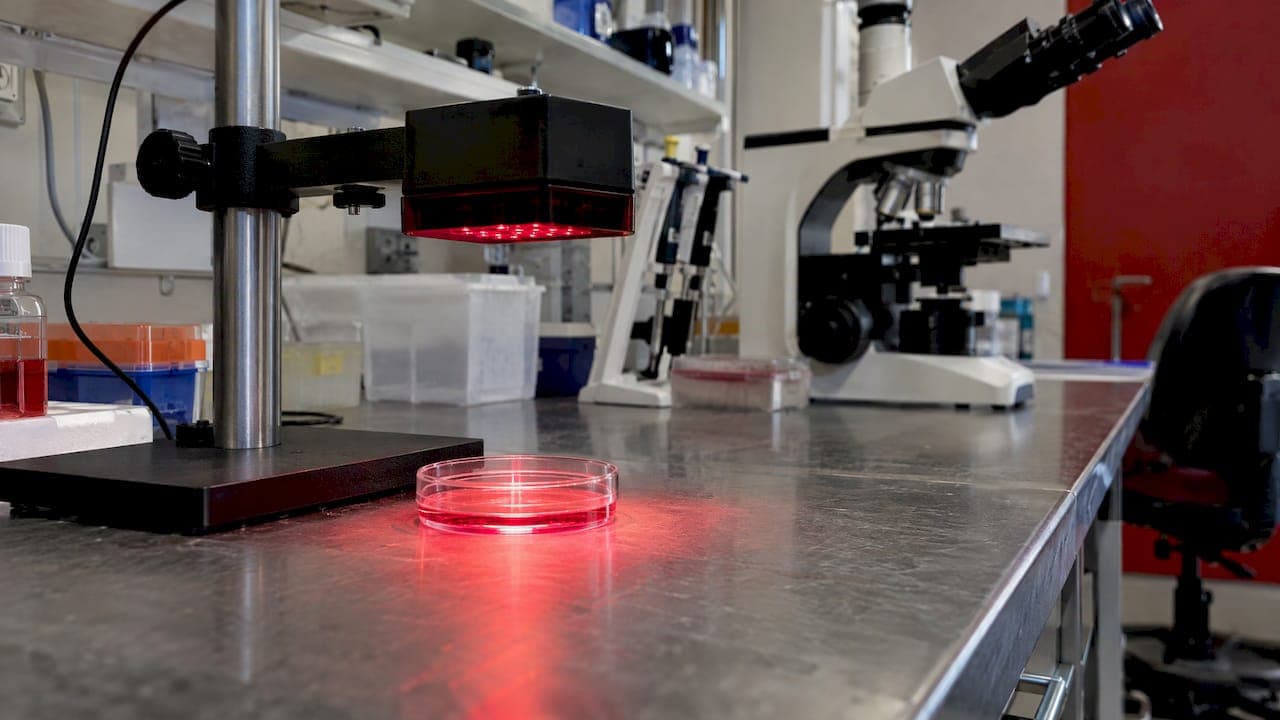
Red light reaches your mitochondria through a process called photobiomodulation. Certain wavelengths of red and near-infrared light are absorbed inside your cells. Researchers think that absorption nudges the mitochondrial respiratory chain, the machinery that makes ATP, your cells' usable energy. The leading candidate for the light-catcher is an enzyme called cytochrome c oxidase. The newest research says the full picture is more layered than that. Here is what is known, what is still being worked out, and what it means if you are a man over 30 who wants to understand the signal before you build a routine around it.
TL;DR
- Mitochondria make most of your cell energy. Red and near-infrared light is thought to act on the last enzyme in that chain, cytochrome c oxidase (complex IV), which may lift ATP output.
- A 2026 review says that enzyme is probably not the only target. The effect likely depends on wavelength, tissue, and dose.
- Dose matters in both directions. Too little does nothing, a moderate dose helps, and far too much can backfire in cells.
- Red light (about 630 to 670 nm) suits surface tissue. Near-infrared (about 800 to 850 nm) travels deeper.
- Consistency and sensible dosing beat blasting yourself for hours.
Table of Contents
- What mitochondria do, and why you feel it when they slow down
- How red light interacts with mitochondria
- Wavelength: why red and near-infrared are not the same
- Dose: the sweet spot is real
- Does it change metabolism?
- What the wider evidence says
- Using red light safely
- Our perspective
- Where RedRockit fits
- FAQ
- Sources
What mitochondria do, and why you feel it when they slow down
Every cell in your body runs on small structures called mitochondria. They take fuel and oxygen and turn them into ATP. Think of ATP as the current your muscles, brain, and hormone-producing tissues draw on all day.
You don't notice them at 22. Recovery just happens. Energy just shows up. Somewhere after 30, for a lot of men, that stops feeling automatic. The tank takes longer to fill. You sleep and still wake up flat.
To be clear, a tired afternoon is not a diagnosis, and we are not here to tell you that you are broken. Low energy has many causes: sleep, stress, food, training, medications, and medical conditions your doctor can check. But mitochondrial function is one piece of the puzzle that men rarely hear about, and light is one of the few non-drug inputs that researchers have studied directly at that level.
How red light interacts with mitochondria
The process is called photobiomodulation, or PBM. Light of the right wavelength is absorbed by a molecule in the cell, and that sets off a chain of changes.
The classic model: cytochrome c oxidase as the antenna
The best-known explanation centers on cytochrome c oxidase (Cox, also called CCO or complex IV), the final enzyme of the electron transport chain. According to Freitas and Hamblin's 2016 review of proposed mechanisms, PBM increases the activity of complexes I, II, III, and IV, and Cox appears to be the primary photoacceptor. Two things support that: oxygen consumption rises during low-level light, and sodium azide, a Cox inhibitor, blocks the beneficial effect.
The same review describes the proposed sequence. A photon is absorbed by Cox. Mitochondrial membrane potential goes up, ATP synthesis rises, and levels of reactive oxygen species, calcium, and nitric oxide shift. Signals then travel between the mitochondria and the nucleus.

A 2022 paper in Photochemistry and Photobiology puts it in similar terms: light acts on Cox, electron transport speeds up, the proton gradient across the membrane increases, and that drives ATP production. It adds that red or infrared absorption can cause a short, transient burst of reactive oxygen species, which is associated with reduced oxidative stress afterward.
Cell studies that point the same way
Work on specific cell types fits the model. In a 2022 study on heart muscle cells, 630 nm LED light promoted ATP synthesis, improved succinate dehydrogenase activity and mitochondrial membrane potential, and increased transcript levels of TFAM, a gene involved in maintaining mitochondrial DNA.
A 2024 systematic review of PBM in the aging brain notes that red and near-infrared light at 8 J/cm² enhanced active mitochondria, membrane potential, Cox activity, and ATP levels in the studies it covered.
Can mitochondria actually capture light?
People often ask whether mitochondria "capture light energy" the way plants do. Not on their own. A 2014 study showed that mammalian mitochondria could capture light and make ATP when mixed with a chlorophyll-derived pigment, and that with that pigment, 670 nm red light produced more ATP than darkness. That is a lab demonstration of the principle, not a claim that your cells photosynthesize. In your body, the mechanism is a nudge to existing machinery, not a new power source.
The newer, more nuanced picture
Science keeps moving. A 2026 review in Lasers in Medical Science states that the evidence does not establish Cox as a universal or exclusive photoacceptor. Its contribution likely varies with wavelength, cell type, metabolic state, tissue context, and irradiation settings. The authors favor a multi-target, context-dependent model.
The review points to experiments in which light had no clear effect on isolated Cox, and to work showing 660 nm light could boost cell proliferation in cells lacking functional Cox. So other targets are probably involved too.
What that means for you: the mitochondria are clearly part of the story, but "one enzyme, one switch" is a simplification. The good news is that it points toward light acting on several cellular signals at once, which is how a body actually works.
Wavelength: why red and near-infrared are not the same
Not every color does the same job, and depth matters.
| Light | Typical range | Where it tends to act |
|---|---|---|
| Red | 630 to 670 nm | Superficial or moderately deep targets |
| Near-infrared | 810 to 850 nm | Deeper tissue, greater transmission |
| Near 980 nm | About 970 to 980 nm | Treated separately: water absorption rises, so local absorption and heat contributions may increase |
Those ranges come from the 2026 review, which also cites a human cadaver model where 830 nm light passed through the skull far better than 633 nm light.
The Brain Photobiomodulation narrative review adds that bands around 650 to 680 nm and 800 to 870 nm match the absorption of relatively oxidized Cox, while 750 to 770 nm matches reduced Cox. It also says the most effective brain results have come from near-infrared. Choosing a wavelength means balancing absorption peaks, penetration depth, and how concentrated the target molecules are in the tissue.
The simple takeaway: shallow targets and deep targets want different light. Know which one your device is built for.
Dose: the sweet spot is real
This is the part most marketing skips. PBM follows what researchers call a biphasic, inverted U-shaped dose response, known as the Arndt-Schulz law. According to the brain PBM review, very low doses do little, small doses above a threshold help, and much higher doses can inhibit or even harm.
In cultured cortical neurons at a constant 25 mW/cm², ATP production peaked at 3 J/cm². Doses of 0.03 and 0.3 J/cm², and 10 J/cm², gave only minor effects, and 30 J/cm² caused inhibition linked to mitochondrial damage. That is a cell-culture result, not a rule for your skin, but it shows why "more" is not the plan.
A few practical consequences:
- Use a device with a clear, repeatable protocol instead of guessing.
- Keep sessions consistent rather than extreme.
- Treat a much longer session as a risk, not a bonus. Our guide on red light overexposure walks through the upper ranges.
Does it change metabolism?
A frequent question is whether red light therapy speeds up metabolism. The evidence is early. In a 2022 randomized crossover trial of 13 people with type 2 diabetes, 850 nm LED PBM lowered plasma glucose 15 minutes after the 75 and 450 J protocols. The dose windows reported were 75 to 300 J for hemodynamic variables and 450 to 600 J for glucose and lactate. It is a small study in a specific group, so read it as a signal worth following, not a promise.
What the wider evidence says
A 2025 umbrella review in Systematic Reviews pooled 15 meta-analyses covering 204 randomized trials and more than 9,000 participants. PBM showed significant effects on 12 outcomes. Moderate-certainty evidence supported improvements in burning mouth syndrome, knee osteoarthritis, fibromyalgia, androgenetic alopecia, and cognitive function. Most other outcomes were low or very low certainty, and the authors call for standardized protocols and higher-quality trials.
On the aging brain, the 2024 systematic review reports that most studies used 800, 810, or 1064 nm and describes cognitive improvements in healthy older adults, alongside neuroprotective, anti-inflammatory, and hemodynamic effects.
We will say it plainly, because we respect you: the research on mitochondria is strong at the cell level and still maturing in people. Protocols vary. That is exactly why a repeatable, guided routine matters more than hype.

Using red light safely
Safety is part of doing this well. A few facts worth knowing:
- Regulation. The FDA's January 2023 draft guidance treats PBM devices as class II medical devices for premarket submissions and lays out expectations for testing, clinical studies, and labeling. Our breakdown of what the FDA says about red light for men 30+ goes deeper.
- Drug interactions. A 2025 systematic review notes that PBM bypasses liver metabolism through cytochrome P450, so it is recognized as not interacting with drugs. The same review says long-term studies are still limited.
- Your eyes. The American Academy of Ophthalmology advises caution with red light devices aimed at the eye and notes a US study suggesting some instruments could cause retinal damage. Follow your device's eye guidance every time.
- Medical conditions. If you have a health condition, take photosensitizing medication, or have concerns about a body area, talk to your physician or a dermatologist first. For musculoskeletal conditions, this overview of red light therapy for arthritis shows how it is used alongside other care.
For home use, start with our home red light safety rules, the contraindications Q&A, and the side effects guide.
Our perspective
We built Primal Red Co. for men who feel the shift coming and refuse to wait for the crash. We are not a clinic, and we are not TRT. We don't diagnose, and we don't prescribe.
Here is how we think about the mitochondria story. Your cells run on a signal. Over time, for a lot of men, that signal gets quieter. Energy, drive, and recovery stop arriving on their own. The research on photobiomodulation tells us light is one way cells respond at the energy-production level, and that dose and wavelength shape the response.
That is why RedRockit is designed as a private-use, at-home restoration routine, not a one-off blast. It is built to be simple enough to stick with, with the Rockit IQ companion app guiding session protocols so you aren't guessing. No subscriptions. No appointments. No ongoing dependence.
YOU HAVEN'T LOST IT. You may just need to give your body a better signal, consistently.
Nurse Rachel
Where RedRockit fits
If you want to act on this, RedRockit is our private-use red light wellness device, designed to support a daily restoration routine for men over 30 focused on energy, drive, recovery, and vitality. The Rockit IQ app walks you through guided session protocols, and the device carries a lifetime craftsmanship guarantee.

See how it works on the RedRockit Primal Restoration page. Still weighing options? Read what to try before TRT or our honest look at alternatives to TRT. For the bigger picture, our red light therapy science guide for men over 30 and what works for men are good next reads.
FAQ
Does red light therapy really boost mitochondria?
Lab and cell studies show red and near-infrared light can raise mitochondrial membrane potential, Cox activity, and ATP in several cell types. Human results depend on wavelength, dose, and tissue, and researchers are still standardizing protocols. Think of it as a well-studied cellular signal with evidence still growing in people.
Is red light or near-infrared better for mitochondria?
Neither wins outright. Red light around 630 to 670 nm suits surface and moderately deep targets, while near-infrared around 810 to 850 nm travels deeper. The right choice depends on where you want the light to land.
Can too much light damage mitochondria?
In cell studies, yes. PBM follows an inverted U-shaped dose response, so moderate doses stimulate and much higher doses can inhibit or harm. That is why a consistent, defined protocol beats longer sessions.
Does red light therapy increase metabolism?
Early evidence is limited. One small 2022 crossover trial in people with type 2 diabetes saw lower plasma glucose after 850 nm light at certain doses. It is promising but narrow, so it does not prove a general metabolic boost.
Sources
- Proposed Mechanisms of Photobiomodulation or Low-Level Light Therapy (Freitas and Hamblin, 2016)
- Does photobiomodulation alter mitochondrial dynamics? (Photochemistry and Photobiology)
- Mitochondria are an important target of photobiomodulation (BIOCELL, 2022)
- Photobiomodulation in the aging brain: a systematic review (2024)
- Light-harvesting chlorophyll pigments enable mammalian mitochondria to capture photonic energy (2014)
- Red and near-infrared photobiomodulation in precision medicine (Lasers in Medical Science, 2026)
- Brain Photobiomodulation Therapy: A Narrative Review
- Dose response effect of photobiomodulation on hemodynamic variables (Photonics, 2022)
- Effects of photobiomodulation on multiple health outcomes: umbrella review (Systematic Reviews, 2025)
- FDA: Photobiomodulation (PBM) Devices, Premarket Notification 510(k) Submissions
- Near-Infrared Stimulation in Psychiatry Disorders: A Systematic Review (2025)
- American Academy of Ophthalmology: Can Red Light Therapy Slow Nearsightedness in Children?
- Red Light Therapy for Arthritis and Bone Health