
An FDA-cleared red light device tells you the device is low-risk for its labeled use. It does NOT tell you it will raise your testosterone or fix your energy. That distinction is the whole game.
If you've been searching "FDA red light therapy" hoping to find a device that will flip your vitality back on, here's the honest answer: clearance from the FDA, the American Academy of Dermatology (AAD) and guidance from the American Medical Association (AMA) all point to the same thing. Red light therapy has a solid safety profile for specific uses. The evidence for systemic energy or testosterone benefits is thin. Primal Red Co builds its entire approach around that truth.
Before you buy anything, check the box for these three things:
- "FDA cleared" label with a specific intended indication (e.g., wrinkles, acne, hair regrowth)
- Wavelength range listed in nanometers (nm)
- Irradiance or power density listed in mW/cm²
If any of those are missing, the marketing is doing more work than the science.
Pro Tip: Treat FDA clearance as a safety floor, not a performance guarantee. Evaluate irradiance, wavelength specs, and published clinical support before trusting any claim about energy or testosterone.
Table of Contents
- What does FDA clearance actually mean for a red light device?
- What does the clinical evidence actually support?
- What are the real side effects and who should see a dermatologist first?
- How do you read device specs before you buy?
- How do you build a safe at-home routine that actually tells you something?
- Is red light therapy actually worth it for men over 30?
- What are your next steps before you buy or start?
- Key Takeaways
- What men 30+ actually need to hear about red light therapy
- RedRockit: built for men who want a vetted at-home option
- Useful sources and further reading
What does FDA clearance actually mean for a red light device?
FDA clearance, granted through the 510(k) pathway, means a device has been shown to be substantially equivalent in safety and intended use to a device already legally marketed. It is not the same as FDA approval, which requires clinical trials proving a drug or device is superior and effective for a specific condition.
When a red light device says "FDA cleared," it means:
- The device poses a low safety risk for its labeled indication
- It is not associated with UV-type DNA damage or skin cancer risk when used as directed
- The manufacturer has demonstrated equivalence to a predicate device, not clinical superiority
What it does NOT mean:
- The device is proven to raise testosterone
- The device is proven to boost systemic energy
- Any off-label marketing claim has been validated
UCLA Health confirms that FDA-cleared devices pose low public risk but that evidence for long-term photobiomodulation effects needs further study. Watch for marketing terms like "FDA approved" or "FDA certified" on device packaging. Neither is accurate for cleared devices. "FDA cleared" is the only term that carries regulatory weight.
What does the clinical evidence actually support?
The honest answer is: some things, not others. And the gap between "some things" and "everything marketing promises" is wide.
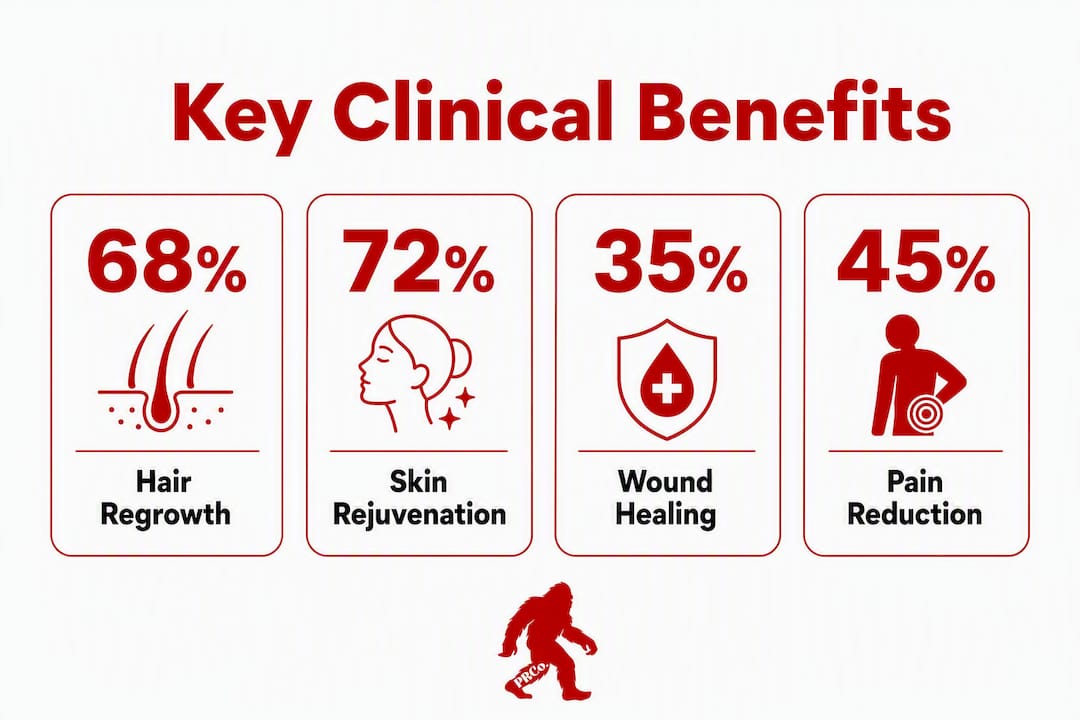
Well-supported uses (moderate to strong evidence):
- Skin rejuvenation and wrinkle reduction (collagen stimulation)
- Hair regrowth in androgenetic alopecia
- Wound healing and oral mucositis in oncology settings
Limited or inconsistent evidence:
- Systemic energy increases
- Testosterone elevation
- Athletic performance gains
- Deep-joint inflammation and general nervous system effects
A Stanford Medicine review found evidence reasonably strong for hair regrowth and skin rejuvenation, while calling data for systemic energy benefits insufficient. Sports physicians and sleep experts echo that: expect modest, localized benefits, not a hormonal overhaul.
| Use | Evidence Level | Notes |
|---|---|---|
| Skin rejuvenation / wrinkles | Moderate | Clinical trials exist; collagen stimulation documented |
| Hair regrowth (androgenetic alopecia) | Moderate | Stanford review supports; FDA-cleared devices available |
| Wound healing | Moderate | Used in clinical settings |
| Oral mucositis (oncology) | Moderate | Established clinical use |
| Systemic energy increase | Weak | No robust randomized trial data |
| Testosterone elevation | Weak | Not supported by current evidence |
| Athletic performance | Inconsistent | Mixed results across studies |
Pro Tip: Clinical-grade devices deliver higher irradiance than most at-home units. Clinic results often exceed what you'll get at home. That's not a reason to skip home use. It's a reason to set realistic expectations.
What are the real side effects and who should see a dermatologist first?
Red light therapy is genuinely low-risk for most people. Short-term side effects are mild: temporary redness, mild skin irritation, and occasional warmth at the treatment site. These typically resolve within hours.
The risks that matter more:
- Blistering at high fluence levels, particularly in skin-of-color patients
- Pigment changes (hyperpigmentation or hypopigmentation) in darker skin tones
- Prolonged erythema when dosing is too aggressive
The STARS 1 and 2 randomized trials found that maximum tolerated doses differ significantly by skin pigmentation, with lighter skin tolerating higher fluences and skin of color requiring lower doses before dose-limiting adverse events occurred. The AMA specifically lists skin of color as a higher-risk group and advises conservative dosing.
See a board-certified dermatologist before starting if you:
- Have a photoreactive autoimmune condition (lupus, porphyria)
- Take photosensitizing medications (certain antibiotics, retinoids, NSAIDs)
- Have a history of skin cancer
- Have Fitzpatrick skin type IV–VI
Pro Tip: If you have darker skin (Fitzpatrick IV–VI), start with half the recommended session time. Watch for delayed redness or pigmentation changes in the 24–48 hours after your first few sessions, not just immediately after.
How do you read device specs before you buy?
Most men buy on LED count or total watts. Both are nearly useless for judging biological effect. The number that actually matters is irradiance, measured in mW/cm².
Core specs to verify before purchasing:
- Wavelength (nm): Red light typically 630–670 nm; near-infrared 800–850 nm
- Irradiance (mW/cm²): Measured at a specified distance from the device
- Treatment area: Size of the panel or mask relative to your target area
- Recommended distance: Usually 6–12 inches for panels
- Session dose (J/cm²): Irradiance × time, if the manufacturer provides it
| Spec | At-Home Typical | Clinic-Grade |
|---|---|---|
| Irradiance | Low to moderate | High |
| Wavelength accuracy | Varies by brand | Verified by protocol |
| Treatment area | Small to medium panel | Full-body or targeted |
| Session dose reporting | Rarely published | Often documented |
The most reliable way to verify a device's actual output is to check its 510(k) summary in the FDA's records. That document discloses measured irradiance and intended indications, the specs the manufacturer had to prove to get cleared.
Buying checklist:
- Device is FDA-cleared for your specific intended use
- Irradiance is published in mW/cm² at a stated distance
- Session protocol is clearly documented
- Manufacturer provides or cites clinical support
- Trial or return policy exists
How do you build a safe at-home routine that actually tells you something?
A modest, consistent protocol is the only honest way to test whether red light helps your energy or recovery. Sporadic use over two weeks tells you nothing.
- Start at 3 sessions per week. Build to 5 once you confirm no skin irritation.
- Session length: 10–20 minutes per area, following manufacturer guidance.
- Distance: Position the device 6–12 inches from skin unless specs say otherwise.
- Eye protection: Always. Red and near-infrared light can stress the eyes at close range.
- Avoid use on broken or irritated skin. Wait until the skin is intact.
- Trial length: Commit to 8–12 weeks before judging benefit.
- Stop immediately if you experience persistent redness, blistering, or pigmentation changes, and consult a dermatologist.
Track these metrics weekly: sleep quality, morning energy (1–10 scale), workout recovery time, mood, and libido. Pair with a sleep tracker or HRV monitor if you have one. Subjective logs are more useful than you think when you review them at week 8.
For a full step-by-step protocol, the at-home red light therapy guide from Primal Red Co walks through session setup, distance, and tracking in detail.
Pro Tip: Keep a simple daily log: date, session length, device setting, and a 1–10 energy score. At week 8, you'll have real data instead of a feeling.
Is red light therapy actually worth it for men over 30?
Here's the straight answer: red light therapy is a low-risk adjunct. Not a cure. Not a testosterone protocol. An adjunct.
What you can reasonably expect after a consistent 8–12 week trial:
- Modest improvement in skin appearance and texture
- Possible reduction in hair thinning if you have androgenetic alopecia
- Faster superficial recovery from training
- Better local tissue response at treated areas
What to be skeptical about: large systemic testosterone increases. The science simply does not support that claim at the irradiance levels available in at-home devices.
Where red light fits best is inside a broader restoration routine. Pair it with consistent sleep (7–9 hours), resistance training 3–4 days per week, and a diet that supports hormonal health. If you want to understand what else to try before considering TRT, the non-TRT restoration guide lays out the full picture.
Pro Tip: Prioritize consistent use over intensity. Eight weeks of three sessions per week beats two weeks of daily sessions followed by nothing.
What are your next steps before you buy or start?
You don't need to overthink this. You need a short checklist and a plan.
Immediate actions:
- If you have a skin condition or take photosensitizing medication, book a consult with a board-certified dermatologist before starting. A skincare consultation for men can help you understand what to ask and what to expect.
- If you're clear to proceed, pick an FDA-cleared device whose specs you can verify.
Device buying checklist:
- FDA-cleared for your specific goal (wrinkles, hair, acne)
- Irradiance published in mW/cm² at a stated distance
- Session protocol clearly documented
- 510(k) summary accessible or manufacturer provides clinical citations
- Trial or return policy in writing
- Skin-of-color safety guidance included if relevant to you
Trial plan:
- 8–12 weeks, 3–5 sessions per week
- Weekly log of sleep, energy, recovery, mood
- Stop criteria: persistent redness, blistering, or pigmentation changes
- Reassess at week 8 with your log in hand
Key Takeaways
FDA-cleared red light devices are low-risk for labeled uses like skin rejuvenation and hair regrowth, but the evidence for systemic energy or testosterone benefits remains insufficient.
| Point | Details |
|---|---|
| Clearance vs. approval | FDA clearance means safety equivalence, not proven efficacy for energy or testosterone claims. |
| Strongest evidence | Skin rejuvenation, androgenetic alopecia, and wound healing have the most clinical support. |
| Irradiance is the key spec | Check mW/cm² at a stated distance, not LED count or total watts, before buying. |
| Trial length | Commit to 8–12 weeks with consistent use before judging whether red light helps your goals. |
| Primal Red Co's RedRockit | Designed for men 30+ with guided protocols via the Rockit IQ app; check the product page to verify specs and session guidance. |
What men 30+ actually need to hear about red light therapy
Most of the hype around red light therapy is aimed at selling devices, not setting expectations. The men who get real value from it are the ones who go in with clear eyes: they know what the evidence supports, they check the specs, they run a proper trial, and they treat it as one piece of a bigger restoration routine.
The thing that frustrates me about this space is how often "FDA cleared" gets used as a shortcut for "this will fix your testosterone." It won't. What it will do, if you use a properly spec'd device consistently, is support your skin, possibly your hair, and your recovery. That's not nothing. For a man over 30 who's already sleeping well and training consistently, those gains are real and worth having.
What I'd tell any man reading this: don't buy on marketing. Buy on specs. Run the trial. Track the outcomes. And if you're on any medication that affects light sensitivity, see a dermatologist first. That's not overcaution. That's how you actually know whether this works for you.
RedRockit: built for men who want a vetted at-home option
Male vitality after 40 doesn't come from one device. But having the right device, used consistently, as part of a real routine? That's where RedRockit fits.

RedRockit is Primal Red Co's private-use red light wellness device, built specifically for men over 30 who want to support energy, recovery, and daily restoration without a clinic visit or a prescription. The companion app, Rockit IQ, delivers guided session protocols so you're not guessing at distance, duration, or frequency. You follow the protocol. You track the results.
The device is designed with the checklist from this article in mind: published specs, clear session guidance, and a restoration-focused protocol built around realistic outcomes. Visit the RedRockit product page to review the full spec sheet, session protocol, and what the Activation Method includes.
Pro Tip: Pair RedRockit sessions with 7–9 hours of sleep and 3–4 resistance training sessions per week. That combination gives the device the best possible environment to support your recovery and energy goals.
Useful sources and further reading
These are the primary sources cited throughout this article. Use them to verify claims, read deeper, or check a device's regulatory status.
| Source | What it covers |
|---|---|
| AAD: Is red light therapy right for your skin? | Safety vs. efficacy guidance; dermatologist-consult recommendation |
| AMA: 6 things patients should know about red light therapy | Skin-of-color risks; conservative dosing guidance |
| Stanford Medicine: Red light therapy science review | Evidence summary for dermatologic uses vs. systemic claims |
| STARS trials (PMC) | Randomized safety data; maximum tolerated doses by skin type |
| UCLA Health: 5 health benefits of red light therapy | Clearance context; cautious expectations for long-term effects |
| FDA 510(k) records via Innolitics | Verify device irradiance, intended indications, and technical specs |
| Primal Red Co. RedRockit | Product specs, session protocols, and Activation Method details |