
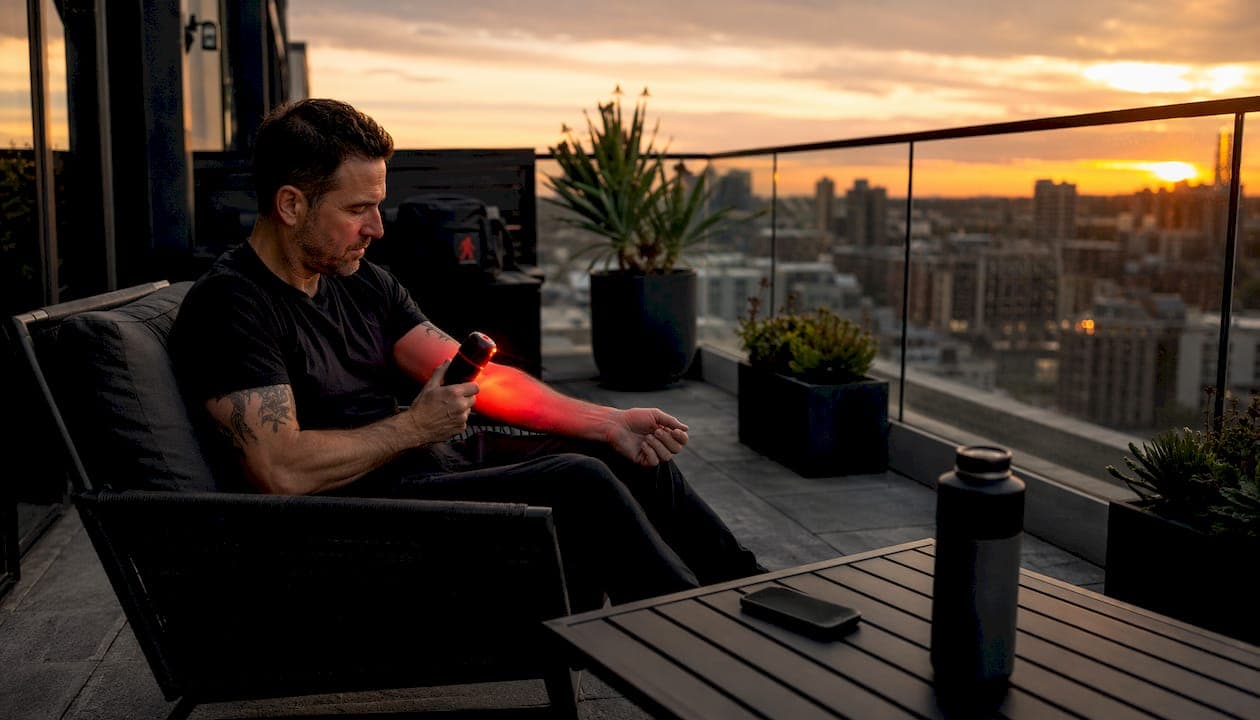
Red light therapy, clinically known as photobiomodulation (PBM), can meaningfully support tissue recovery, circulation, hair stimulation, and slow restoration of vitality for men over 30, but only with consistent use and correct dosing. This is not a magic fix. It is a signal your cells can actually respond to, if you give them the right frequency, the right dose, and enough time.
Here is what the evidence actually supports:
- Moderate evidence: skin rejuvenation, hair regrowth (androgenetic alopecia), wound healing, and oral mucositis treatment
- Mixed or low-certainty evidence: athletic performance, sleep quality, systemic energy, and cognitive function
- The practical takeaway: routine and dose matter more than the device brand. A cheap device used consistently at the right fluence beats an expensive one used randomly
Harvard Health recommends structured sessions multiple times per week regular sessions spanning several months to see skin and hair results. The U.S. Food and Drug Administration has cleared specific PBM devices for narrow indications, which tells you the mechanism is real, even if the consumer market has gotten ahead of the science.
Table of Contents
- How does red light therapy actually work at the cellular level?
- What do clinical studies actually show?
- What wavelengths and doses actually matter for home use?
- Is red light therapy safe, and who should be cautious?
- How long before you actually feel or see a difference?
- How do home devices compare to clinical setups?
- Nurse Rachel's evidence-aligned routine for men over 30
- Key Takeaways
- Why routine and education come first
- RedRockit: the guided protocol built for this
- Useful sources for further reading
How does red light therapy actually work at the cellular level?
The primary mechanism is mitochondrial photostimulation. When red or near-infrared (NIR) light hits your tissue, it is absorbed by cytochrome c oxidase, a key enzyme in the mitochondrial respiratory chain. That absorption increases ATP production, reduces oxidative stress, and alters nitric oxide (NO) signaling. More ATP means cells have more energy to repair, replicate, and function. That is the core signal.
Downstream from that, you get vasodilation. Improved blood flow delivers more oxygen and nutrients to hair follicles, skin, and muscle tissue. This is why the dermatologic benefits are among the most consistently documented. Better circulation to the scalp feeds follicles. Better circulation to muscle tissue speeds recovery.
"Beyond mitochondrial activation, an emerging hypothesis is that red and near-infrared light reduces the viscosity of intracellular water, improving the motion of molecular machines — an idea attributed to researchers such as Robert Fosbury. It remains an active area of investigation, not yet confirmed by large-scale trials." — Scientific American
Effective wavelength windows:
- 600–700 nm (red): primarily skin-deep, targets fibroblasts, collagen synthesis, surface healing
- 760–940 nm (near-infrared): penetrates deeper into muscle, joint, and nerve tissue
Different targets need different wavelengths. A device that only emits one range is not wrong, it is just limited.

What do clinical studies actually show?
The honest answer: the evidence base is real, but uneven. An umbrella review of meta-analyses pooled results across approximately 9,000 patients and 35 unique endpoints. The finding: PBM showed beneficial effects across multiple outcomes, including androgenetic alopecia, wound healing, and some pain conditions. But no outcome reached high-certainty evidence. Most ranged from very low to moderate certainty.
Statistic: That umbrella review covered 35 distinct endpoints across roughly 9,000 patients, making it the broadest synthesis of PBM evidence to date, yet even at that scale, no outcome cleared the high-certainty bar.
Where the evidence is strongest:
- Skin rejuvenation and wrinkle reduction (doses up to 15–20 J/cm² in dermatologic studies)
- Androgenetic alopecia (hair loss in men)
- Wound healing, particularly in advanced repair phases
- Oral mucositis, now included in clinical treatment guidelines
Where it is mixed or weak:
- Athletic performance and strength gains
- Sleep quality and systemic energy
- Cognitive function and mood
The main barrier to consistent results is protocol heterogeneity. Studies vary in wavelength, irradiance, pulse pattern, and session count. Without standardized dosimetry, comparing trials is difficult. That is not a reason to dismiss PBM. It is a reason to be precise about how you use it.
What wavelengths and doses actually matter for home use?
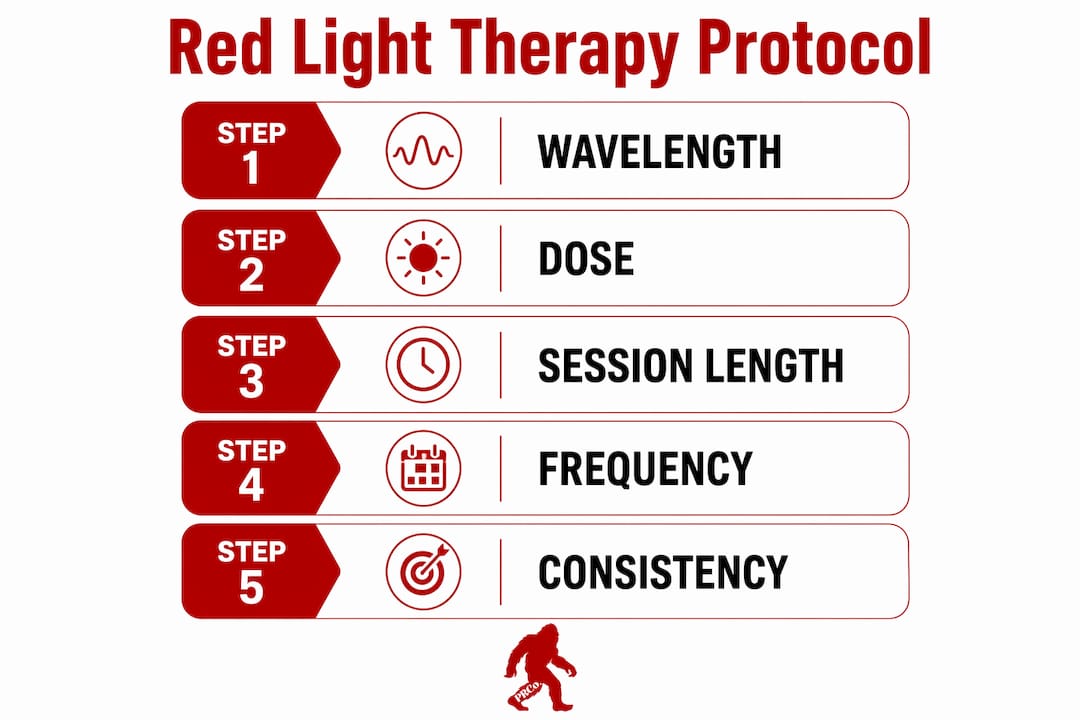
Start here: if a device does not tell you its wavelength in nanometers and its irradiance in mW/cm², do not buy it. The biological effect depends entirely on those numbers.
Practical numeric guidance:
- Wavelength: target 630–680 nm for red light (skin, hair, surface tissue) and 760–940 nm for NIR (muscle, joint, deeper recovery)
- Irradiance: typical safe home-use ranges fall between 20–100 mW/cm² depending on the device and target tissue
- Fluence (energy dose): multiply irradiance (mW/cm²) by time in seconds, then divide by 1,000 to get J/cm². A device at 50 mW/cm² run for 600 seconds delivers 30 J/cm²
- Session frequency: most clinical protocols use 3–5 sessions per week, not daily saturation
Pro Tip: More is not better. PBM follows the Arndt-Schulz biphasic dose response: too little has no effect, the right dose stimulates, and too much can suppress the very response you are trying to trigger. Start conservative and build.
- Skin and hair targets: 10–20 J/cm² per session is a common clinical reference range
- Muscle recovery targets: 20–50 J/cm² for deeper NIR penetration
- Always follow the device's validated protocol if one exists, rather than guessing from vendor time recommendations
Is red light therapy safe, and who should be cautious?
Red and NIR photobiomodulation is generally safe when used within established fluence and irradiance limits. Serious adverse events are rare in the published literature. That said, a few things genuinely matter.
Use caution or stop if:
- You take photosensitizing medications (certain antibiotics, retinoids, or chemotherapy agents)
- You have a light-sensitive condition such as lupus or porphyria
- You notice persistent pigment changes or irritation at the treatment site
- You are undergoing active cancer treatment (consult your oncologist before starting)
Eye protection: direct exposure to high-irradiance devices can damage retinal tissue. Use the protective eyewear that comes with your device, or close your eyes during facial sessions.
Skin tone and fluence: clinical safety guidance indicates that darker skin types have different photosensitivity thresholds and may be at higher risk for pigmentation changes at higher fluences. Start at the lower end of any recommended range and increase gradually.
Pro Tip: If you are tracking low testosterone symptoms alongside your PBM routine, note any skin or energy changes in a journal. Patterns matter more than single data points.
This article is general information, not medical advice. Confirm current guidance with a qualified clinician for your specific situation.
How long before you actually feel or see a difference?
Slow and steady. That is the honest answer, and it is the one most consumer marketing skips.
- Acute soreness and muscle recovery: some men notice reduced post-workout soreness within days to weeks of consistent use
- Skin texture and tone: visible improvement typically requires months of regular sessions
- Hair stimulation: Harvard Health and dermatology experts cite several months of structured use as the benchmark for hair and skin outcomes
- Maintenance: benefits from vasodilation and tissue stimulation tend to subside once use stops, so ongoing sessions are part of the plan, not a sign the therapy is not working
Statistic: Harvard recommends regular sessions multiple times per week spanning several months for skin and hair results, not 4–6 sessions total.
Track what matters to you: post-workout soreness scores, sleep quality, energy levels, and monthly photos for skin or hair. Combine PBM with sleep, nutrition, and strength training. The light amplifies what you are already doing. It does not replace it.
How do home devices compare to clinical setups?
Clinical rigs deliver higher, calibrated doses with validated protocols and trained operators. Many consumer devices vary widely in actual output, and researchers warn that the market is saturated with products that fail to deliver a therapeutic dose.
What to look for when buying:
- Clearly stated wavelength (nm) and irradiance (mW/cm²)
- Adequate coverage area for your target body region
- Thermal management (LEDs that overheat lose output)
- A published protocol or app-guided session structure
- FDA clearance for a specific indication, or at minimum, FDA registration for safety (not the same thing, but registration means basic safety review)
Red flags:
- No irradiance or wavelength specs listed anywhere
- Claims of curing disease or reversing aging in weeks
- No independent testing or third-party validation
- Vendor-recommended session times with no fluence math behind them
For neck and shoulder coverage specifically, treating those regions together improves results compared to isolated spot treatment, a detail many buyers overlook when choosing device size.
Pro Tip: Ask the vendor for the irradiance spec at the recommended treatment distance. If they cannot provide it, that is your answer.
Nurse Rachel's evidence-aligned routine for men over 30
A simple protocol, repeated consistently, beats a complex one you abandon after two weeks. Here is a starting point built around the clinical evidence:
- Frequency: 3–5 sessions per week, not daily
- Duration: 10–20 minutes per target area, calibrated to your device's irradiance output
- Target areas: start with one or two regions (scalp for hair, lower back or quads for recovery) before expanding
- Timing: morning or post-workout sessions align well with natural cortisol rhythms and recovery windows
- Checkpoint: reassess at 8 weeks (soreness, energy) and again at 4–6 months (skin, hair, photos)
- Pair with: 7–8 hours of sleep, adequate protein, and consistent strength work
Readers who want a ready-made version of this protocol can follow the Signal routine built around RedRockit and the Rockit IQ app, which provides guided session timing and progression.
Pro Tip: Schedule your sessions like a standing appointment, not a when-I-feel-like-it habit. Adherence is the variable that separates men who see results from men who give up at week three.
Key Takeaways
Red light therapy science supports real, measurable benefits for men over 30, but only when dosing, wavelength, and consistency are all in place.
| Point | Details |
|---|---|
| Dose and wavelength are non-negotiable | Choose devices that specify irradiance (mW/cm²) and wavelength (nm); without those numbers, you cannot know what you are delivering. |
| Evidence is strongest for skin and hair | Moderate evidence supports hair regrowth and skin rejuvenation; mixed evidence exists for athletic performance and systemic energy. |
| Results take months, not days | Harvard Health cites 4–6 months of consistent, multi-weekly sessions for skin and hair outcomes; muscle recovery signals may appear sooner. |
| Safety requires awareness | Start at lower fluences, use eye protection, and consult a clinician if you take photosensitizing medications or have a light-sensitive condition. |
| Primal Red Co's RedRockit | Provides guided dosing protocols via the Rockit IQ app, addressing the most common consumer-device pitfall: using a device without a validated session structure. |
Why routine and education come first
Most men over 30 are not broken. They are running on a signal that has gotten quieter. The frustrating part is that most of what gets marketed to them skips the education entirely and jumps straight to the prescription pad or the hype reel.
At Primal Red Co, the approach is different. Nurse Rachel built the RedRockit routine around what the clinical literature actually supports, not what sells fastest. The goal is to give men the information to make a real decision, understand what they are doing and why, and build a habit that holds. That is what male vitality after 40 actually looks like in practice. Not a shortcut. A signal, restored.
RedRockit: the guided protocol built for this

RedRockit is Primal Red Co's private-use red light wellness device, paired with the Rockit IQ app for guided session protocols. It addresses the two biggest consumer pitfalls directly: unclear dosing and no structured progression. The device specifies wavelength and irradiance, the app guides session timing and tracks your routine, and the protocol is built around the same clinical evidence covered in this article.
If you want the turnkey version of the nurse-authored routine above, the RedRockit Activation Method is where to start. No guesswork, no vendor time recommendations pulled from thin air. Just a protocol that maps to the science.
Useful sources for further reading
- From light to healing: photobiomodulation therapy in medical disciplines — Journal of Translational Medicine. The primary mechanistic reference covering cytochrome c oxidase activation, ATP production, and the urgent need for standardized dosimetry across indications.
- Effects of photobiomodulation on multiple health outcomes: an umbrella review — Springer. The broadest synthesis of PBM meta-analyses to date, covering approximately 9,000 patients and 35 endpoints; essential for understanding evidence certainty levels.
- Red light therapy for skin care — Harvard Health. Practical clinical perspective on timelines, device variability, and safety considerations for home users.
- Red light therapy for skin and hair — Stanford Medicine. Explains vasodilation as a primary driver of dermatologic and hair benefits and addresses benefit durability.
- Does red light therapy work? — Scientific American. Covers clinical guideline adoption for oral mucositis, the emerging cellular-water hypothesis, and the consumer-market hype problem.
- Photobiomodulation safety and skin-type considerations — PMC/NIH. Clinical safety guidance on photosensitivity thresholds across skin types and recommended fluence ceilings.
Recommended
- How to Increase Testosterone After 40: What Men Search Before TRT | RedRockit
- Low Testosterone Symptoms in Men: What Changes After 40 Can Feel Like | RedRockit
- Is TRT for Life? What Men Should Understand Before Starting Testosterone | RedRockit
- TRT Side Effects: What Men Search Before Starting Testosterone | RedRockit