
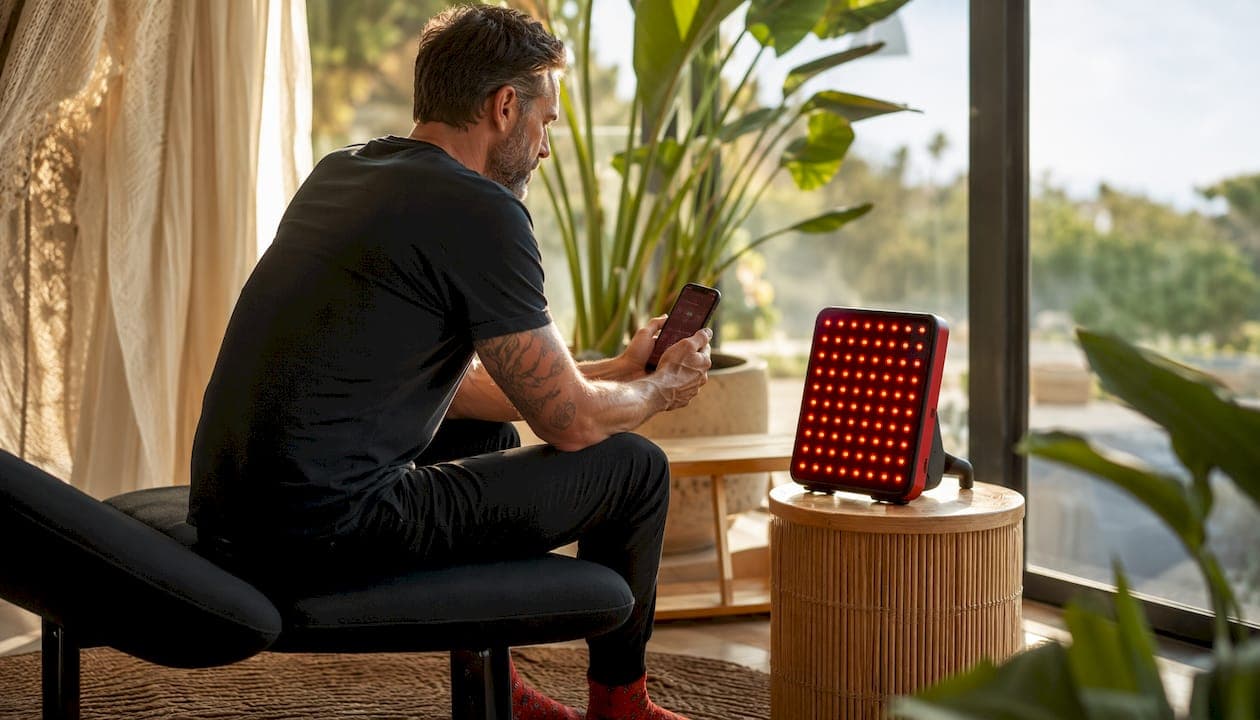
A red light therapy app guides, schedules, and documents your photobiomodulation sessions so the habit actually sticks. For men over 30 who want to restore energy, drive, and vitality without a clinic visit, the practical starting point is RedRockit paired with the Rockit IQ app from Primal Red Co. This guide is for you if you feel the shift coming and want a private, evidence-aligned routine before bigger decisions land on the table. If you're treating a diagnosed condition, the American Academy of Dermatology (AAD) and Cleveland Clinic both recommend consulting a healthcare provider first. Dr. Rachel Reynolds of Beth Israel Deaconess Medical Center reinforces that realistic expectations and consistent protocols are what separate results from wishful thinking.
Table of Contents
- What should a good red light therapy app include?
- How do red light therapy apps and devices actually work?
- Safety rules and when you should see a clinician
- How do you choose the right app and device setup for energy and drive?
- Your 4-week app-guided restoration starter routine
- RedRockit and Rockit IQ: a private option built for men over 30
- Key Takeaways
- What I actually think about red light therapy apps for men
What should a good red light therapy app include?
Not all apps are built the same. Most are timers dressed up as wellness tools. Here's what actually matters.
Core features to look for:
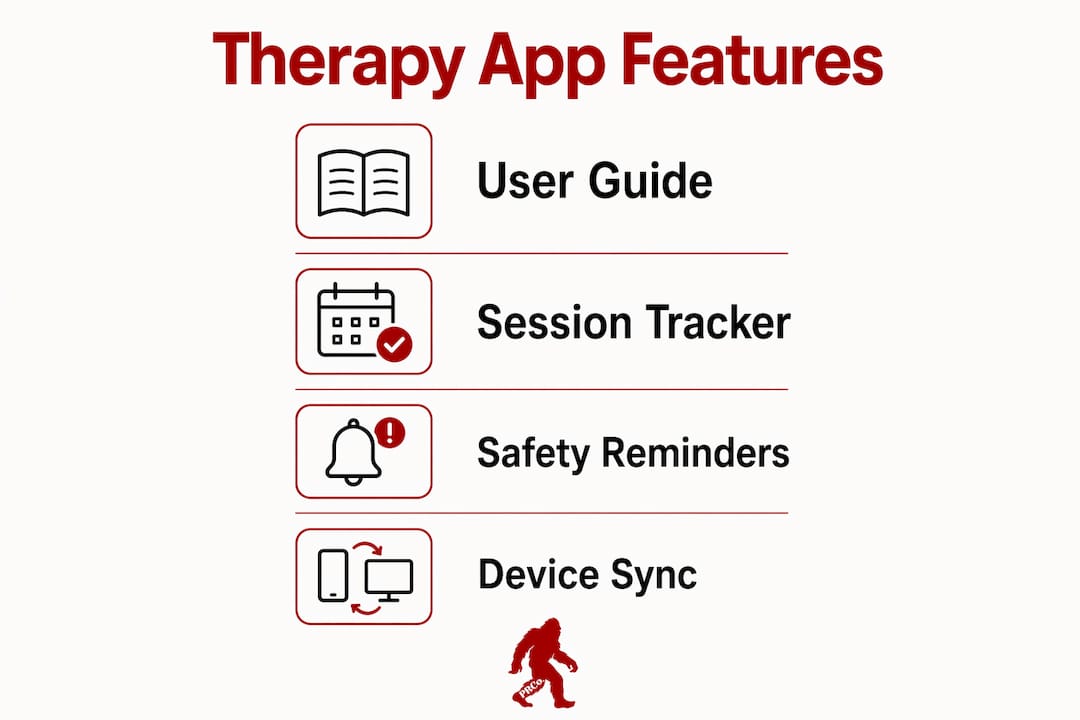
- Guided session protocols with templates for common goals (energy, recovery, skin)
- Session timer with audible or haptic cues
- Session logging, streaks, and progress history
- Customizable scheduling and daily reminders
Device control features:
- Bluetooth or Wi-Fi pairing with your specific device
- Local device control (not cloud-dependent)
- Firmware update support
Specification fields:
- Fields to record device wavelength(s), irradiance (mW/cm²), session distance, and dose
- Ability to log subjective outcomes like energy, sleep quality, and libido
Privacy and data features:
- Local data storage option
- Clear, readable privacy policy
- Opt-out of analytics; no sale of health data
Pricing model: Prefer a one-time purchase or a transparent subscription. Avoid any app that locks safety settings or core protocols behind a paywall.
Pro Tip: Pick an app built around habit formation, not miracle claims. Streaks, simple rituals, and consistent reminders drive results far more than any "advanced AI protocol" badge on the app store page.
How do red light therapy apps and devices actually work?
The app guides and documents. The biological effect comes entirely from your device's wavelength and irradiance. Get that distinction right and you'll stop wasting time on tools that can't deliver.
The mechanism is called photobiomodulation (PBM). When red or near-infrared light hits your tissue, it activates cytochrome c oxidase in the mitochondrial electron transport chain. That activation increases ATP production, which drives tissue repair, reduces inflammation, and improves blood flow. The therapeutic window sits broadly between 600–1100 nm, with 660 nm (red) and 850 nm (near-infrared) being the most studied wavelengths for skin and deeper tissue work.
| Wavelength | Primary Use | Tissue Penetration |
|---|---|---|
| 630–660 nm | Skin rejuvenation, acne, scalp | Superficial (1–3 mm) |
| 810–850 nm | Muscle recovery, joint tissue | Deeper (5–10 mm) |
| 600–1100 nm | Experimental, neurological research | Variable |
One thing worth saying plainly: your smartphone screen cannot do this. Stanford Medicine confirms that screens lack both the irradiance and the targeted therapeutic wavelengths needed for clinical PBM. An app on your phone is a control and tracking layer, not a light source.
Harvard Health notes that results typically require multiple sessions per week over 4–6 months. The app's job is to keep you showing up.
Safety rules and when you should see a clinician
Red light is low-risk. That doesn't mean zero risk. Know the limits before you start.
Do this:
- Wear appropriate eye protection during every session
- Keep skin clean and unobstructed before exposure
- Log any skin changes or reactions in your app immediately
- Follow your device's recommended distance and session length
- Consult a board-certified dermatologist if you're treating a diagnosed condition
Don't do this:
- Aim the device directly at your eyes
- Use RLT if you take photosensitizing medications without medical clearance
- Assume FDA clearance means a device is clinically superior — it signals safety for a stated use, not proven efficacy for every claim
- Skip the consultation if you have lupus or another light-sensitive condition
Darker skin types may need lower starting doses. Harvard Health and the AAD both recommend monitoring for pigment changes and adjusting dose with clinician guidance. If you notice unexpected discoloration or persistent irritation, stop and see a provider.
How do you choose the right app and device setup for energy and drive?
Prioritize device specs first, then find an app that enforces consistent protocols aligned with what the science actually supports.
For men targeting energy and drive, near-infrared wavelengths (810–850 nm) penetrate deeper into muscle and tissue. Red wavelengths (630–660 nm) work closer to the surface for skin and scalp. A solid setup covers both. Stanford Medicine is clear that device quality and documented specs are the primary trust signal — not marketing copy.
| Dimension | Entry-Level | Mid-Range | Clinical-Grade |
|---|---|---|---|
| Device compatibility | Manual only | Bluetooth pairing | Wi-Fi + Bluetooth |
| Guided protocols | Basic timer | Pre-set templates | Customizable + clinician protocols |
| Wavelengths & irradiance | Single wavelength, low irradiance | Dual wavelength, moderate irradiance | Multi-wavelength, high irradiance |
| Scheduling & tracking | None | Reminders + streak log | Full session history + export |
| Privacy | Varies | Local storage option | Documented data policy |
| Price model | One-time, low cost | One-time or low subscription | Higher upfront, no subscription |
What to avoid:
- Apps with no documented wavelength or irradiance specs
- Missing or vague privacy policy
- Safety settings or core protocols locked behind a paywall
- Devices with no independent validation of their output claims
If you're still weighing whether a device-based routine fits before considering clinical options, what to try before TRT is a useful starting point.
Your 4-week app-guided restoration starter routine
Follow this plan for 4 weeks to build the habit and give yourself a real baseline to evaluate.
Before you start each session:
- Hydrate. Drink water before and after.
- Clean the target area. Remove clothing, hair ties, or anything blocking the light path.
- Open your app and confirm your session settings (wavelength, distance, duration).
- Put on eye protection.
Session protocol:
- Position the device at the manufacturer's recommended distance (typically 6–12 inches).
- Start the session timer in your app.
- Hold still. Movement reduces effective dose.
- When the timer ends, log your session immediately: duration, distance, and a 1–10 subjective rating for energy and recovery.
Weekly structure:
- Weeks 1–2: 3 sessions per week, 10 minutes per session, single target area
- Weeks 3–4: 4–5 sessions per week, 10–15 minutes, expand to secondary areas if desired
After each session:
- Note sleep quality and energy level in the app that evening
- Use the streak feature to maintain momentum
- Export your session log at the end of week 4 for review, or share with a clinician if you're tracking a specific condition
Troubleshooting connectivity issues:
- If Bluetooth drops, restart both the app and the device before re-pairing
- Log incomplete sessions separately with a note so your data stays clean
- Check for firmware updates if pairing fails repeatedly
The Signal walks through how RedRockit fits this kind of structured daily routine.
RedRockit and Rockit IQ: a private option built for men over 30
RedRockit, paired with the Rockit IQ app from Primal Red Co, is designed specifically for men who want a private, routine-driven restoration plan without a clinic.

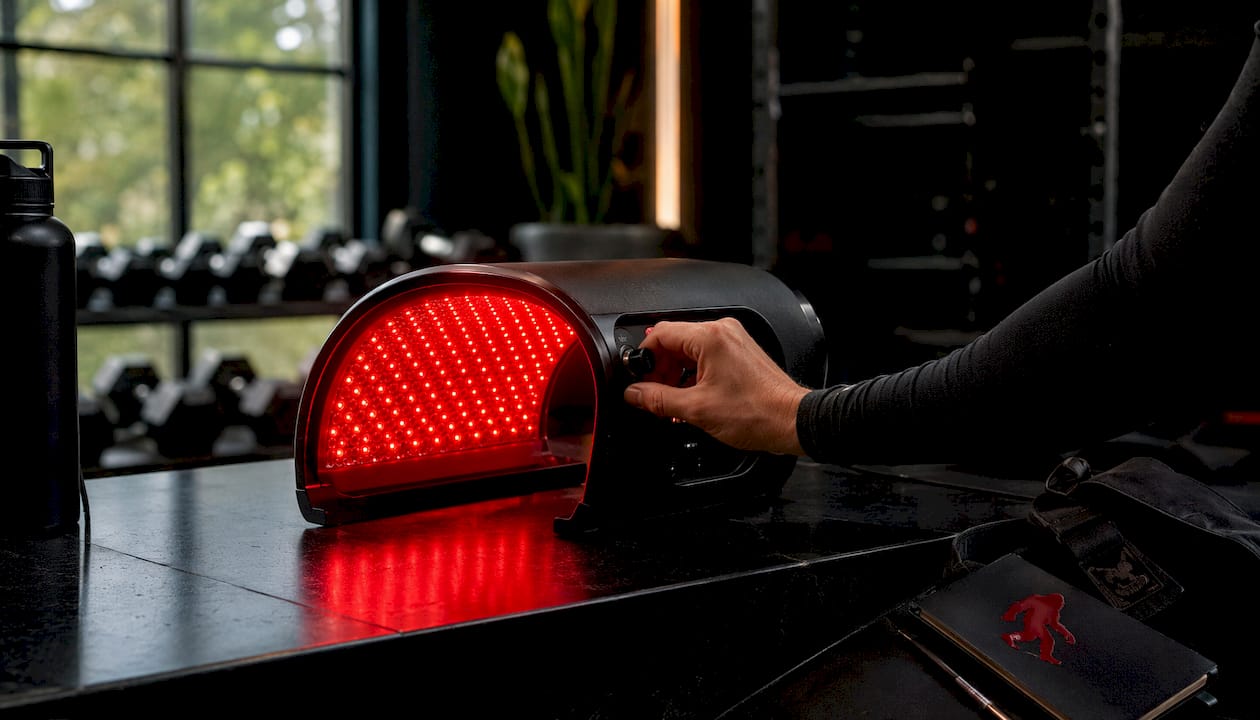
The device covers both red and near-infrared wavelengths with documented irradiance specs, so you're not guessing whether your sessions are doing anything. Rockit IQ maps directly to the checklist above: pre-configured protocols for energy and recovery, session scheduling, streak tracking, and local data options that keep your health information off third-party servers. Safety guidance from Nurse Rachel is built into the content layer, so you're not navigating this alone.
This isn't TRT. It isn't a diagnosis. It's a consistent, evidence-aligned signal you give your body every day. The Cleveland Clinic notes that at-home devices are generally less powerful than clinical systems, so realistic expectations matter. RedRockit is positioned as a restoration support tool, not a medical treatment.
Ready to start? Visit the RedRockit Activation Method page to see the full device specs and get started with Rockit IQ.
Key Takeaways
A red light therapy app is only as effective as the device behind it: documented wavelengths, consistent irradiance, and a habit-forming app are the three things that actually move the needle.
| Point | Details |
|---|---|
| App role | Apps guide, schedule, and track sessions — the biological effect comes from device wavelength and irradiance. |
| Wavelengths matter | 660 nm targets skin and scalp; 850 nm penetrates deeper for muscle and tissue recovery. |
| Consistency is the mechanism | Harvard Health notes results require multiple sessions per week over 4–6 months — streaks and reminders close that gap. |
| Safety first | Follow AAD guidance: eye protection always, consult a provider for diagnosed conditions or photosensitizing medications. |
| Primal Red Co option | RedRockit + Rockit IQ offers documented specs, pre-configured protocols, and private local data for men over 30. |
What I actually think about red light therapy apps for men
Most men over 30 who come to red light therapy are not looking for a miracle. They're looking for something they can do consistently, privately, and without a waiting room. That's exactly where a well-built app earns its keep.
Here's what gets underestimated: the app is not the therapy. The habit is. I've seen men spend real money on devices and then use them twice because there was no structure holding the routine together. An app with reminders, streaks, and a simple log changes that. Not because it's magic, but because it removes the friction between intention and action.
The other thing worth saying directly: red light is one input. Sleep, movement, and nutrition are doing more heavy lifting than any device. RedRockit fits into a broader restoration plan alongside those fundamentals, not instead of them. If you're noticing symptoms that feel deeper than fatigue, low testosterone symptoms is worth reading before you decide your next step.
Start the 4-week routine. Track your energy and sleep honestly. Give it a real run before you judge it.
Authoritative sources and further reading
- Harvard Health: Red light therapy for skin care — realistic timelines, adherence, and skin outcomes
- Stanford Medicine: What the science says — device specs, limits, and hair follicle viability
- American Academy of Dermatology: Is red light therapy right for your skin? — safety guidance, FDA clearance context, eye protection
- Cleveland Clinic: Red Light Therapy benefits, side effects, and uses — evidence overview and clinician consultation guidance
- Systematic Reviews: Umbrella review of photobiomodulation RCTs — PBM mechanism, therapeutic wavelengths, evidence certainty
Recommended
- How to Increase Testosterone After 40: What Men Search Before TRT | RedRockit
- Low Testosterone Symptoms in Men: What Changes After 40 Can Feel Like | RedRockit
- Male Vitality After 40: Energy, Drive, Recovery, and Restoration | RedRockit
- Supplements for Men Over 40: Vitality, Energy, and Restoration | RedRockit