
Testicular red light therapy is not proven to increase testosterone in humans. Full stop. No published, peer-reviewed randomized controlled trial has demonstrated that shining red or near-infrared (NIR) light on the testes produces a meaningful, sustained rise in circulating testosterone. Fertility data are similarly early, drawn mostly from in-vitro sperm samples and animal models rather than clinical endpoints. That does not mean the practice is worthless or dangerous when done correctly. It means you deserve an honest read of the evidence before you point a panel at your groin and expect hormonal miracles.
TL;DR
- Verdict: Unproven for testosterone increases in humans; preliminary lab and animal signals for sperm motility exist.
- Evidence strength: In-vitro and animal studies only for hormonal claims; one human randomized trial exists for chronic testicular pain (not hormones).
- Biggest safety flag: Heat. Scrotal temperature above roughly 34–35°C can impair sperm production, and poorly cooled devices are the most common way home users accidentally cause harm.
- Next steps: (1) Consult a clinician if you have pain, lumps, or fertility concerns. (2) If you experiment, use a vetted device with published wavelength and irradiance specs. (3) Follow a conservative protocol: short sessions, safe distance, no perceivable heat.
Table of Contents
- How does testicular red light therapy work at the cellular level?
- What does the research actually show?
- Testosterone, sperm quality, sexual function, and pain: what does PBM actually affect?
- Is testicular red light therapy safe? Risks, myths, and what to watch for
- How to vet a device and what protocol parameters actually matter
- What to do if you decide to try testicular RLT at home
- When should you see a clinician, and what research gaps still exist?
- Key Takeaways
- The honest case for curiosity with caution
- RedRockit: built for men who want to do this right
- Useful sources and further reading
How does testicular red light therapy work at the cellular level?
The formal term is photobiomodulation (PBM). It describes the use of red (roughly 630–670 nm) or near-infrared (roughly 800–880 nm) light to trigger biological responses in tissue without generating clinically significant heat. The mechanism is photochemical, not thermal. That distinction matters a lot when you are talking about scrotal tissue.
The primary cellular target is cytochrome c oxidase, a protein in the mitochondrial respiratory chain. When red or NIR photons hit this chromophore, they appear to temporarily boost ATP production, release nitric oxide (NO), and modulate reactive oxygen species (ROS) signaling. In theory, those downstream effects could influence Leydig cells (the testosterone-producing cells in the testes), support spermatogenesis, and improve local circulation.
Here is where the story gets complicated. Scrotal skin is thin, which means red and NIR wavelengths can penetrate to testicular tissue more readily than they would through, say, your chest wall. That is the biological plausibility argument. But penetration depth, irradiance at the target tissue, and the geometry of a home device are all very different from the controlled conditions of a laboratory study. Pelvic-floor PBM research describes circulation and oxygenation benefits, but those findings do not automatically translate to endocrine changes.
Key cellular mechanisms proposed for testicular PBM:
- Mitochondrial stimulation: Cytochrome c oxidase absorbs red/NIR photons, temporarily increasing ATP output in Leydig and Sertoli cells.
- Nitric oxide release: Transient NO release may improve local blood flow and reduce oxidative stress.
- ROS modulation: Low-dose ROS signaling can be protective; high-dose or thermal ROS is damaging.
- Steroidogenic enzyme expression: In-vitro Leydig cell studies show upregulation of enzymes involved in testosterone synthesis, though this has not been replicated in human clinical trials.
Pro Tip: The mechanism is non-thermal. If your device makes the skin feel warm or hot, that is not the therapy working harder. That is a safety problem. Heat is the enemy of sperm production, not a sign of efficacy.
What does the research actually show?
Let's be clear about the hierarchy here. Not all evidence is equal, and the marketing world for red light devices has a habit of treating a cell-culture study like a clinical trial. It is not.
Human evidence
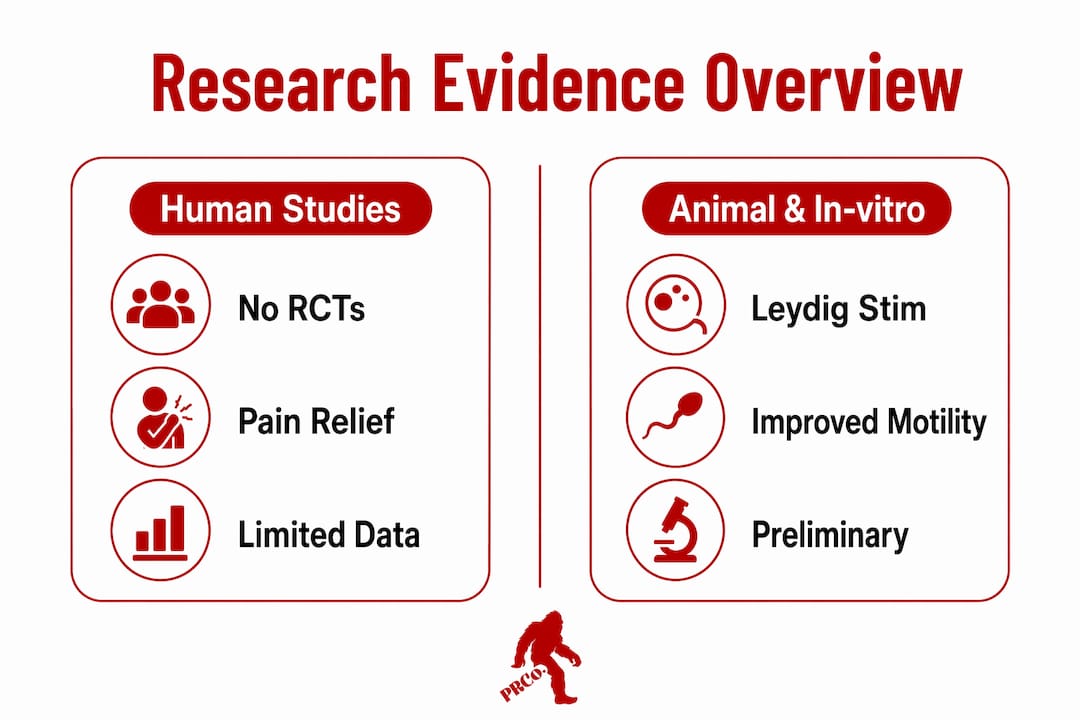
No published human randomized controlled trials have demonstrated that testicular or scrotal red light exposure increases circulating testosterone. That is not a gap waiting to be filled by one more study. It is a fundamental absence of clinical proof for the most commonly marketed claim.
The one area where human trial data does exist is chronic testicular pain. A randomized clinical trial published in PMC found that low-level laser therapy (LLLT) can be a safe, noninvasive option for managing chronic testicular pain in select patient groups. That is a meaningful finding. It is also completely separate from any hormonal or fertility claim.
Animal and in-vitro evidence
Animal models and cell-culture studies are where most of the excitement comes from. In-vitro Leydig cell studies using 670 nm light show increased expression of steroidogenic enzymes and modest hormone changes. Sperm motility improvements have been observed in treated samples. These are real signals. They are just not proof that pointing a home panel at your testes will raise your testosterone by any clinically meaningful amount.
Some fertility clinics use red light on sperm samples before assisted reproduction procedures like ICSI to improve motility. That is an in-vitro application, controlled and precise. It does not prove that whole-testis PBM in a living person produces the same result.
Evidence summary table
| Study Type | Outcome Measured | Key Finding | Evidence Strength |
|---|---|---|---|
| Human RCT | Testosterone levels | No published trials | Absent |
| Human RCT | Chronic testicular pain | LLLT reduced pain in select groups | Moderate |
| Human observational | Sperm parameters (in vivo) | Limited data, no large trials | Weak |
| Animal model | Testosterone / steroidogenesis | Modest increases in some models | Weak (not translatable) |
| In-vitro (Leydig cells) | Steroidogenic enzyme expression | Upregulation at 670 nm | Weak (mechanism only) |
| In-vitro (sperm samples) | Motility | Improvements in treated samples | Moderate (lab context only) |
One more myth worth naming directly: many popular articles cite a 1939 study by Myerson as proof that light therapy raises testosterone. That study used ultraviolet light, not red or NIR wavelengths. UV and PBM have entirely different mechanisms and safety profiles. Citing Myerson as evidence for red light therapy is like citing aspirin studies to argue that ibuprofen cures headaches.
Testosterone, sperm quality, sexual function, and pain: what does PBM actually affect?
Breaking this down by outcome makes the picture clearer and more honest.
Testosterone
The human data are absent. Animal and in-vitro studies suggest plausible mechanisms through Leydig cell stimulation, but those findings have not been replicated in controlled human trials. Marketing claims of dramatic testosterone increases, sometimes framed as percentage gains, are not supported by clinical evidence. If you are experiencing low testosterone symptoms, PBM is not a replacement for medical evaluation.
Sperm and fertility metrics
This is where the most credible preliminary signals exist, and they are still limited. In-vitro sperm motility improvements are real in laboratory conditions. Clinics do sometimes use red light on sperm samples before assisted reproduction, and that practice has some supporting data. What does not exist yet is a large, well-designed clinical trial showing that testicular PBM improves live birth rates, pregnancy rates, or semen parameters measured at a fertility clinic. If fertility is a concern, that distinction matters enormously in practical terms.
Sexual function and libido
The evidence here is thin and largely indirect. Improved circulation and reduced oxidative stress could theoretically support sexual function, but no human trial has tested this as a primary endpoint for testicular PBM. Low libido after 40 has multiple drivers, most of which require more than a light device to address.
Chronic testicular pain
This is the strongest area of human evidence. LLLT has demonstrated real benefit for chronic testicular pain in randomized trial data. The mechanism likely involves anti-inflammatory effects and nerve modulation rather than hormonal changes. If you are dealing with persistent scrotal discomfort, this is worth discussing with a urologist, with the understanding that LLLT for pain is a clinical application, not a home-device DIY project.
Key takeaways by outcome:
- Testosterone: No human RCT evidence. Animal/in-vitro signals only.
- Sperm motility: Positive in-vitro signals; no large in-vivo fertility endpoint trials.
- Sexual function/libido: No direct human evidence; plausible indirect pathways only.
- Chronic testicular pain: Moderate human trial evidence for LLLT as a noninvasive option.
Is testicular red light therapy safe? Risks, myths, and what to watch for
Safety is where you need to pay the most attention, because the risks are real and some of them are the opposite of what marketing suggests.
Heat is the primary threat
Scrotal temperature is tightly regulated by the body for a reason. Spermatogenesis requires a temperature slightly below core body temperature, roughly 34–35°C. Small increases above that threshold can impair sperm production and reduce sperm quality. Many home consumer panels, when used at close range, generate enough surface warmth to push scrotal temperature into that danger zone. The photochemical mechanism of PBM is non-thermal by design, but a poorly cooled or improperly used device can still heat tissue.
UV is not red light
This cannot be overstated. UV light is a known carcinogen and causes direct DNA damage. Genital UV exposure is dangerous. Red and NIR wavelengths (630–880 nm) are not UV. They do not share the same mechanism, the same risk profile, or the same evidence base. Any source conflating UV studies with PBM research is either confused or misleading you.
Cancer risk
There is no established evidence that red or NIR light at PBM doses causes cancer. The photon energy at these wavelengths is too low for direct DNA damage. That said, if you have an undiagnosed lump, unexplained swelling, or any testicular abnormality, you should not be applying any device to that area until you have had a clinical evaluation. The NCI's guidance on testicular cancer treatment makes clear that early diagnosis and standard treatment are the cornerstones of care. PBM is not a diagnostic tool and is not a cancer treatment.
Safety checklist before you try testicular PBM at home
- No undiagnosed lumps, swelling, or unexplained pain in the area.
- No active infection, recent scrotal surgery, or known testicular abnormality.
- Device has published wavelength and irradiance specifications.
- Device does not produce perceivable warmth at your intended distance.
- You are not using UV-emitting equipment (tanning beds, UV panels).
- Eye protection is available if the device emits NIR (invisible to the eye but still potentially harmful).
- You have discussed this with a clinician if you have any underlying condition.
How to vet a device and what protocol parameters actually matter
Home consumer devices often cannot reproduce clinical irradiance levels, and FDA recognition of a device category does not validate specific therapeutic claims. That gap between marketing and reality is where most men get burned, sometimes literally.
Device specifications to look for
- Wavelength: Red range 630–670 nm; NIR range 800–880 nm. Both should be clearly stated, not implied.
- Irradiance: Expressed in mW/cm². Clinical studies use controlled irradiance; a device that does not publish this figure cannot be compared to any study.
- Thermal management: Active cooling or a design that prevents surface heating at the intended use distance. This is non-negotiable for scrotal applications.
- Independent testing: Third-party verification of wavelength and output, not just manufacturer claims.
- FDA status: Understand the difference between FDA-cleared (specific clinical indication tested) and FDA-registered (manufacturing compliance only). Most home wellness devices are the latter.
Protocol parameters from published research
Clinical PBM studies typically use sessions of roughly 5–10 minutes, at distances that maintain irradiance without generating heat, with frequencies ranging from every other day to 3–5 times per week. These are not universal prescriptions. They reflect the parameters researchers controlled for in specific studies. Cumulative exposure matters too. More is not better with PBM; there is a dose-response curve, and exceeding it can reverse the benefit.
Pro Tip: Test your device before using it on sensitive tissue. Hold it at your intended distance and place the back of your hand under it for a full session. If you feel warmth within 3–5 minutes, the device is running too hot or too close for scrotal use. Adjust the distance or reconsider the device entirely.
Device vetting checklist:
- Published wavelength (nm) with specific values, not just "red light."
- Published irradiance (mW/cm²) at stated distances.
- Thermal performance data or active cooling confirmation.
- Manufacturer transparency about what the device is and is not cleared for.
- No claims of 200–300% testosterone increases or similar marketing language. Those claims are not supported by evidence and signal a brand you should not trust.
What to do if you decide to try testicular RLT at home
You have read the evidence. You understand the limits. You want to experiment responsibly. Here is a conservative routine built around minimizing risk while giving the practice a fair trial.
Step-by-step safe routine
- Get a baseline first. Before starting, get a semen analysis if fertility is your concern, or a testosterone blood panel if hormones are your focus. You cannot track change without a starting point.
- Set up the device at a safe distance. Start at 30–50 cm from the target area. Closer is not better if it generates heat.
- Start with short sessions. Begin at 3–5 minutes per session. Work up to a maximum of 10 minutes only if no warmth is perceived and your device specs support it.
- Frequency: 2–3 times per week initially. Do not use daily in the first month. Give tissue time to respond and monitor for any adverse signs.
- Remove clothing for direct skin exposure. Fabric blocks light transmission. Direct skin contact is necessary for any photochemical effect.
- Use a timer. Do not guess. Consistent dosing is the only way to evaluate whether anything is changing.
- Monitor scrotal warmth actively. If you feel warmth during a session, stop immediately. That is the signal to increase distance or discontinue.
Red flags that require immediate cessation and medical review
- Any new lump or hardness in the testicle.
- Persistent or worsening pain during or after sessions.
- Sudden swelling or change in scrotal appearance.
- Unexplained bleeding or discharge.
- Significant warmth during treatment that does not resolve with increased distance.
Pro Tip: Sperm takes roughly 90 days to mature (one full spermatogenic cycle). If you are tracking fertility outcomes, run a home semen analysis at baseline and again at 90 days. For testosterone, a morning blood draw at baseline and at 60–90 days gives you the cleanest comparison. Without objective measures, you are just guessing.
Stress is one of the most underrated suppressors of testosterone and sperm quality. If you are running on empty mentally, no light device will compensate. Managing stress effectively is not optional when you are trying to optimize any aspect of male physiology.
When should you see a clinician, and what research gaps still exist?
PBM is an adjunctive tool at best. There are situations where it is simply the wrong starting point, and a doctor's evaluation is not optional.
Clinical situations requiring medical evaluation first
- Testicular pain lasting more than a few weeks, especially if new or worsening.
- Any palpable lump, firmness, or change in testicular size or shape.
- Fertility concerns that have persisted for 12 months or longer without explanation.
- Known varicocele, prior testicular surgery, or a history of testicular torsion.
- Suspected infection (epididymitis, orchitis) or recent trauma.
Conditions like varicocele, infection, or structural issues need clinical diagnosis and treatment. PBM does not replace that. If you are experiencing symptoms that suggest low testosterone, a blood panel and a conversation with your doctor come before any device.
What the research still needs
The field is genuinely early. Here is what would be required to settle the major questions:
- Human RCTs for testosterone: Randomized, placebo-controlled trials with prespecified testosterone endpoints, adequate sample sizes, and standardized device parameters. None currently exist.
- Human RCTs for fertility: Trials measuring semen parameters, pregnancy rates, or live birth rates as primary endpoints after whole-testis PBM. The in-vitro sperm motility data is promising but not a substitute.
- Standardized protocols: Irradiance, geometry, session duration, and frequency need to be locked down before results from one study can be compared to another.
- Long-term scrotal temperature safety data: Trials specifically designed to measure scrotal temperature during and after home-device use, across different device types and distances.
Until those trials exist, anyone telling you that testicular PBM is proven to raise testosterone is selling something. That includes the marketing copy on most device websites.
Key Takeaways
Testicular red light therapy has real biological plausibility at the cellular level, but no human randomized controlled trial has proven it raises testosterone or improves fertility outcomes in vivo.
| Point | Details |
|---|---|
| No human RCT for testosterone | Current evidence for hormonal benefit is limited to in-vitro and animal studies; no published human trial confirms testosterone increases. |
| Heat is the real danger | Scrotal temperature above roughly 34–35°C impairs sperm production; a device that warms the skin is a risk, not a benefit. |
| Pain relief has the best human data | A randomized clinical trial supports LLLT for chronic testicular pain; this is separate from any hormonal or fertility claim. |
| Vet your device before use | Only use devices that publish wavelength (nm) and irradiance (mW/cm²); avoid any brand claiming dramatic testosterone percentage gains. |
| Primal Red Co's RedRockit | Designed for conservative, private restoration routines with validated wavelengths and companion app protocols for men over 30 who want to experiment responsibly. |
The honest case for curiosity with caution
Men over 30 are not wrong to look for tools that support their physiology without jumping straight to exogenous testosterone. That instinct is healthy. The problem is that the red light therapy market has filled the space between "biologically plausible" and "clinically proven" with a lot of noise, and most men do not have the time or the background to sort through it.
Here is what I keep coming back to: the cellular mechanisms are real. Cytochrome c oxidase responds to red and NIR photons. Mitochondrial ATP production can be influenced. Leydig cells in a dish do show responses to 670 nm light. None of that is fiction. What is fiction is the leap from those findings to "this device will raise your testosterone by X percent." That leap requires human clinical trials, and those trials do not exist yet for hormonal endpoints.
What I tell men who are curious about PBM is this: if you want to experiment, do it with the same discipline you would bring to any other health decision. Get a baseline. Use a device with real specs. Keep sessions short and cool. Track objective measures. And do not let a marketing claim substitute for a conversation with your doctor, especially if something feels off physically.
The men who get the most out of adjunctive tools like PBM are the ones who are already doing the fundamentals: sleep, stress management, movement, and honest medical monitoring. Red light therapy as part of a consistent restoration routine makes more sense than red light therapy as a Hail Mary. One is a habit. The other is hope without a plan.
RedRockit: built for men who want to do this right
Most men who find their way to testicular red light therapy are not looking for a clinical procedure. They are looking for something private, consistent, and grounded in real parameters. That is exactly what Primal Red Co built RedRockit for.

RedRockit is a private-use red light wellness device designed for men over 30 who want a daily restoration routine they can actually stick with. It is not a clinic. It does not promise hormonal cures. What it does offer is validated wavelengths, a companion app (Rockit IQ) with guided session protocols, and a design built around the conservative parameters described in this article. No guesswork about distance or timing. No device that runs hot against sensitive tissue.
If you have read this far, you already know more about testicular PBM than most men who buy a random panel off the internet. You know what to look for in a device, what a conservative protocol looks like, and what the evidence actually supports. RedRockit is built for that kind of man. Check out the RedRockit Activation Method to see how the device and app work together as a guided restoration routine.
Useful sources and further reading
These are the primary sources referenced throughout this article. If you are discussing testicular PBM with a clinician, these are worth bringing to the conversation.
- Influence of Low-Level Laser Irradiation for Treating Chronic Testicular Pain: A Randomized Clinical Trial (PMC) — The strongest human trial data available for testicular LLLT; covers pain outcomes, not hormonal endpoints.
- Red Light Therapy for Men: Testosterone and Performance (RedLightTherapy.expert) — Comprehensive review of the evidence landscape, including the absence of human RCTs for testosterone, the UV/PBM distinction, and device transparency standards.
- Red Light Therapy for Fertility: Does It Boost Sperm Health? (ExSeed Health) — Covers in-vitro sperm motility findings and the clinical context for assisted reproduction applications; includes the important caveat that PBM does not replace medical care for structural fertility issues.
- Does Red Light Therapy Actually Work? (MensHealthSITREP) — Independent analysis of home-device limitations, irradiance gaps between clinical and consumer equipment, and what FDA registration actually means.
- Male Pelvis Center: Red Light Therapy Commentary — Clinical perspective on PBM as adjunctive to physical therapy and stress management; useful framing for non-hormonal benefits.
- Testicular Cancer Treatment (NCI) — Authoritative guidance on standard testicular cancer treatments; relevant context for understanding why undiagnosed lumps require immediate clinical evaluation, not home device use.
This article is general educational information, not medical advice. If you have testicular pain, a lump, fertility concerns, or any symptoms that worry you, consult a qualified clinician and review current guidance from primary sources before making any health decisions.
Recommended
- Low Testosterone Symptoms in Men: What Changes After 40 Can Feel Like | RedRockit
- TRT Side Effects: What Men Search Before Starting Testosterone | RedRockit
- What to Try Before TRT: Male Vitality, Energy, and Restoration | RedRockit
- How to Increase Testosterone After 40: What Men Search Before TRT | RedRockit