
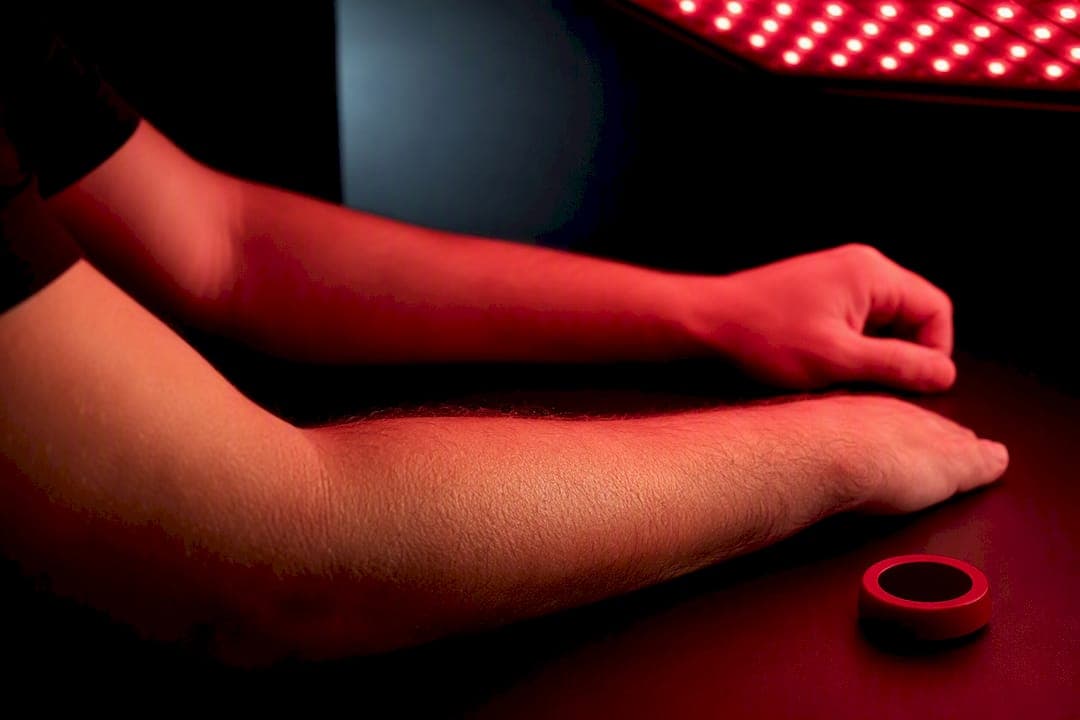
Yes, red light overexposure is real, though most home sessions stay well within safe limits when you follow device instructions. If you notice blistering, burn-like pain, or vision changes, stop treatment immediately, move away from the device, cool the skin with room-temperature water, and get medical attention. For anything milder, back off the dose before it becomes a problem.
TL;DR:
- Red light overexposure risks increase with closer proximity, longer sessions, and darker skin tones, which are more prone to prolonged redness and hyperpigmentation.
- Clinical safety thresholds exist, but they are upper bounds established in supervised settings, meaning home use should stay well below these fluence levels to prevent adverse effects.
- Using eye protection rated for high-intensity LEDs is essential, as high-energy wavelengths can cause retinal stress or vision changes over time.
- Starting with brief sessions of 5 to 10 minutes at recommended distances, recording session details, and rotating treatment zones help prevent cumulative overexposure.
- Symptoms such as blistering, persistent redness, vision changes, or severe skin pain require immediate cessation of treatment and medical consultation.
Table of Contents
- What Are the Symptoms of Red Light Overexposure?
- Why Does Red Light Overexposure Happen?
- What Increases Your Risk of Overexposure?
- Do You Need Eye Protection for Red Light Therapy?
- How Do You Set Up a Safe Red Light Session?
- When Should You Stop and Seek Medical Help?
- What Does the Clinical Evidence Actually Say?
- Nurse Rachel's Take: Simple Rules I Recommend for Men Using Red Light at Home
- Why RedRockit Is Built for Safe, Consistent Use
- Sources
- FAQ
What Are the Symptoms of Red Light Overexposure?
Your skin talks before it screams. The trick is knowing which signals mean "ease up" and which mean "stop and get help." Overexposure symptoms fall on a spectrum, and most men who use red light at home never get past the mild end, provided they respect the timer.
Mild signs show up during or right after a session and usually fade fast:
- Transient redness that clears within an hour
- A warm, tingling sensation on treated skin
- Temporary dryness or tightness
- Short-lived light sensitivity
Moderate signs mean the dose outpaced your skin's ability to recover:
- Redness that lingers past 24 hours
- Skin that stays sensitive to touch for a day or more
- Headaches or mild nausea after a session
Serious signs are your body demanding you stop:
- Blistering or burn-like pain
- Persistent vision changes, halos, or afterimages
- Redness that spreads, warms further, or shows signs of infection
A common list of overexposure symptoms includes redness, dryness, headaches, eye strain, and mild fatigue. That matches what most dose-response research shows: the body reacts to too much light the way it reacts to too much sun. Redness and irritation come first. Real damage takes sustained misuse, not one slightly long session.
Why Does Red Light Overexposure Happen?
Every red light session delivers a dose, and dose is a math problem before it's anything else. Irradiance measures how much light power hits your skin at a given moment, in milliwatts per square centimeter. Fluence is the total dose delivered over time, calculated as irradiance multiplied by minutes of exposure. Stand closer to the panel, and irradiance climbs. Stay under it longer, and fluence climbs too. Both push you toward the upper edge of what your skin can tolerate.
Red light therapy follows what researchers call a biphasic dose response: benefits rise with dose, peak, then reverse. Past a certain point, more light doesn't mean more recovery. It means more inflammation, more irritation, and less benefit than a shorter session would have delivered. This is the mechanism behind the biphasic dose response researchers describe in red light therapy, and it's why "more is better" is the wrong instinct here.
Clinical trials have actually mapped where that tipping point sits. The STARS randomized controlled trials found LED red light safe up to 320 J/cm² for skin of color and 480 J/cm² for non-Hispanic Caucasian participants. Push past those fluences, into the 480 to 640 J/cm² range, and dose-limiting adverse events start showing up, including blistering and prolonged redness.
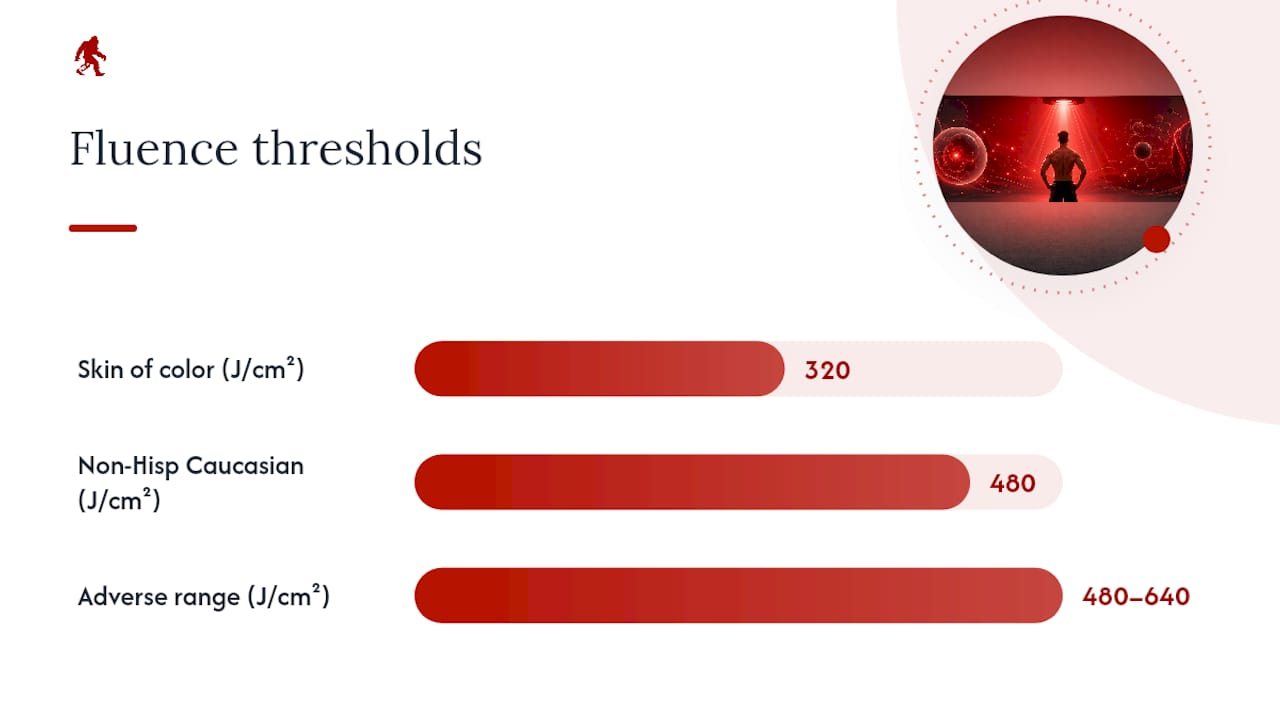
Those numbers came from supervised clinical settings, not a bathroom mirror at 11 p.m. Treat them as upper bounds you never want to approach at home, not as targets.
What Increases Your Risk of Overexposure?
Not every man faces the same odds. A few factors stack the deck, and knowing yours changes how you should dose.
Skin phototype matters more than most marketing admits. The same STARS trials that established safe fluence thresholds also found that skin of color tolerated lower maximum doses before showing adverse effects than lighter skin did. Dermatologists interviewed by the AMA point to a real risk of prolonged redness and hyperpigmentation in darker skin tones, which means starting conservative isn't optional. It's the baseline.
Photosensitizing medications and conditions can lower your tolerance without you realizing it. Certain antibiotics, acne medications, and some supplements increase how your skin reacts to light. If you're on a new prescription, ask your doctor before adding a light-based routine on top of it.
Device problems cause more harm than clinical fluence ever does. Hotspots from uneven LED arrays, ventilation failures that let a panel overheat, or a unit running past its rated output can deliver far more energy than the timer suggests.
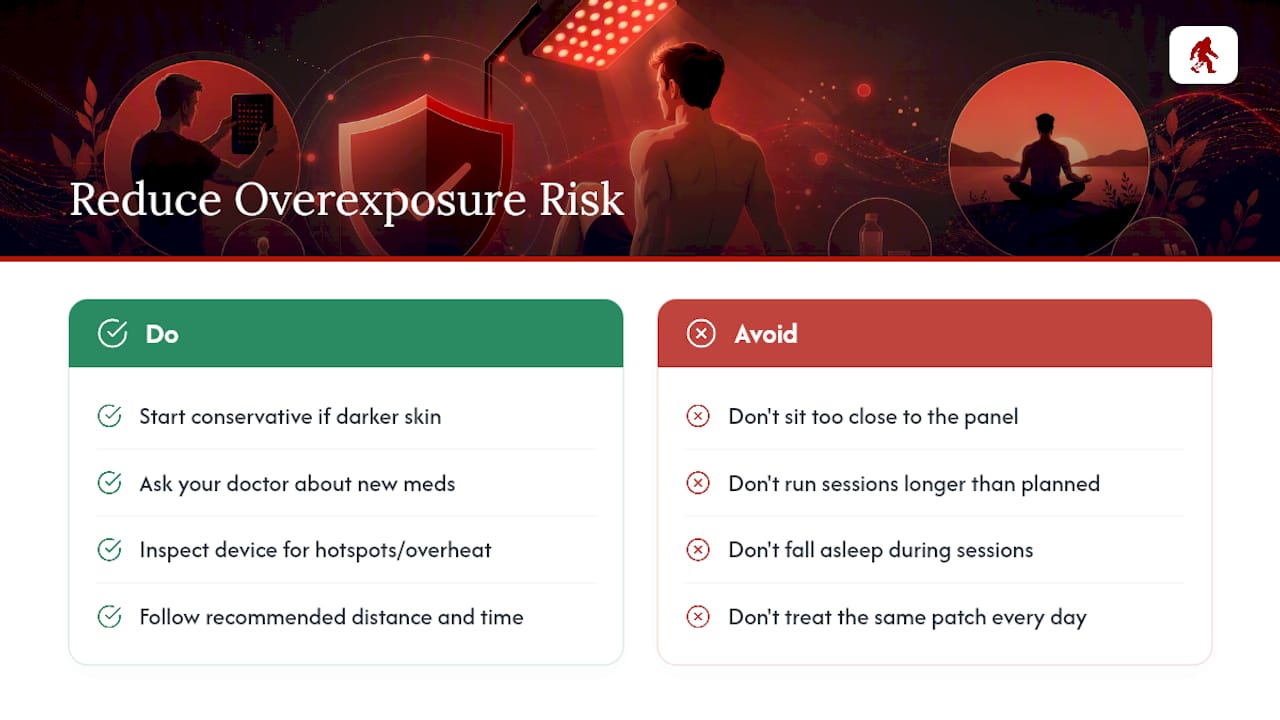
Behavioral risk is the most common cause of real-world overexposure. Sitting too close, running sessions longer than planned, or falling asleep in front of an active panel turns a controlled dose into an uncontrolled one. Reports on home red light therapy risk consistently point to misuse, not the light itself, as the source of most injuries.
Cumulative dosing rounds out the list. Treating the same patch of skin every day, at full intensity, doesn't give tissue time to recover between sessions. That's how a series of "fine" sessions adds up to irritation nobody saw coming.
Pro Tip: Keep a simple log: date, session length, distance from the device, and how your skin looked the next morning. Patterns show up in that log long before they show up as a real problem.
Do You Need Eye Protection for Red Light Therapy?
Yes, and this is the piece most men skip. Near-infrared and red wavelengths penetrate deeper into ocular tissue than visible light, which means closing your eyes during a facial session isn't the safeguard it feels like. Eyelids block glare. They don't fully block the wavelengths that matter here.
Prolonged, unprotected exposure to high-intensity red or NIR light can create photochemical or thermal stress on the retina over time. Ophthalmology experts cited by the National Eye Institute warn that staring into high-intensity LEDs at close range can exceed safe ocular thresholds, especially during extended sessions.
A quick, accidental glance at a panel isn't cause for alarm. Persistent afterimages, halos, or vision changes after a session are.
- Wear OD4+ rated or manufacturer-certified goggles for any facial or near-eye session
- Never stare directly at an active panel, even briefly
- Treat eye protection as standard equipment, not an optional accessory
Our own guide to red light eye safety breaks down exactly why closed eyes aren't enough protection on their own.
How Do You Set Up a Safe Red Light Session?
Getting this right isn't complicated, but it does take discipline the first few weeks. Here's the sequence that keeps a routine safe instead of turning it into a gamble.
- Start short. Begin with 5 to 10 minutes per session, even if the device manual allows more. Track how your skin looks the next day before adding time.
- Respect distance. Move closer, and irradiance rises fast, which means the same time at 6 inches can deliver a much higher dose than at 18 inches. Follow the manufacturer's stated distance, don't eyeball it.
- Set a timer every time. Never rely on "I'll know when it's been ten minutes." Use a phone alarm or the device's built-in cutoff.
- Never treat while drowsy. Falling asleep in front of an active panel is the single most common way a safe dose becomes an unsafe one.
- Rotate treatment zones. Don't hit the same patch of skin daily at full intensity. Alternate areas or give each zone a rest day to recover.
- Inspect the device regularly. Check for hotspots, unusual heat, or ventilation blockage. If a unit runs hotter than usual or the light output looks uneven, stop using it until it's checked.
- Adjust down for risk factors. If you're on a photosensitizing medication or have darker skin, cut your starting time and build up more slowly than the general guidance suggests.
Most guidance lands around 3 to 5 sessions per week at 5 to 20 minutes, depending on the device and target area. That range gives skin real recovery time between sessions instead of stacking dose on dose.
Pro Tip: Log the model, distance, and time for every session. Devices vary widely in actual delivered irradiance versus advertised specs, so what worked with one panel might overshoot with another.
For the full breakdown of setup rules, our home red light therapy safety guide walks through distance and timing in more detail, and our at-home protocol guide covers photosensitivity considerations too. Since darker skin also carries higher sun-sensitivity considerations generally, this overview of photosensitivity and pigmentation is worth a look if you're adjusting your routine for skin tone.
When Should You Stop and Seek Medical Help?
Some signs mean pause and reassess. Others mean stop now and call someone. Know the difference before you're standing in front of a mirror trying to decide.
Stop immediately if you notice:
- Severe pain or blistering
- Any vision change, however brief it seems
- Fever or spreading redness
- Signs of infection around treated skin
First aid is simple: remove yourself from the light source, cool the area with room-temperature water, and skip the urge to apply irritant creams or home remedies. Write down when symptoms started and how they've changed. That timeline helps a clinician a lot.
Blistering, vision changes, high fever, or rapidly spreading redness call for urgent care, not a wait-and-see approach. Milder but persistent symptoms, like redness that hasn't budged after 48 hours, warrant a same-day call to your regular doctor.
What Does the Clinical Evidence Actually Say?
The strongest data on red light safety comes from the STARS randomized controlled trials, which established maximum tolerated doses and confirmed that skin tone changes where that ceiling sits. That's a real number, but it comes with a real caveat: it was measured in a supervised clinical setting over a limited trial period, not years of unsupervised home use.
That's the position Cleveland Clinic takes, and it's a fair summary of where the evidence actually stands. Ophthalmology guidance from the National Eye Institute adds the eye-safety layer most consumer guides skip entirely.
- Clinical fluence thresholds exist, but they're upper bounds, not targets
- Long-term safety data on daily home use remains limited
- When symptoms feel off, a same-day conversation with a clinician beats guessing
Nurse Rachel's Take: Simple Rules I Recommend for Men Using Red Light at Home
Men come to red light because they want to feel like themselves again, not because they want to run an experiment on their own skin. So keep it simple. Start low. Use goggles every single session, no exceptions. Set a timer and actually respect it. Rotate the zones you treat so no single patch takes the full load every day.
Consistency beats intensity here. A conservative routine you actually stick with for months will do more for you than an aggressive one you abandon after a bad week. Build the habit first. Push the dose later, if ever.
— Nurse Rachel
Why RedRockit Is Built for Safe, Consistent Use
Most red light devices hand you a panel and a manual and call it a protocol. RedRockit is built around the opposite idea: safety and consistency should be automatic, not something you have to remember at 11 p.m. after a long day.

The RedRockit device pairs with the Rockit IQ companion app, which walks you through guided session protocols, recommended distances, and built-in timers, so you're never guessing how long is too long. That structure matters more than most men realize until they've tried to eyeball a session themselves. The device is designed as a private-use restoration tool without the need for prescriptions, subscriptions, or clinic visits. If you're ready to build a routine you can actually trust, start with the RedRockit Primal Restoration overview, or head straight to the RedRockit Activation Method product page to see the setup and guided protocols for yourself.
This article is general information, not a substitute for advice from a qualified doctor. Consult a qualified healthcare professional about your own circumstances before acting on anything here.
Sources
- Safety of light emitting diode-red light on human skin: two randomized controlled trials
- NEI coverage: expert warns red light therapy can injure retina
- Red light therapy (Cleveland Clinic)
FAQ
What Happens If You Do Too Much Red Light Therapy?
Overuse typically causes prolonged redness, dryness, headaches, or eye strain, and in more severe cases, blistering or burn-like skin damage from cumulative dose exceeding your skin's tolerance.
Is 20 Minutes of Red Light Therapy Too Long?
It depends on the device's actual irradiance and your distance from it, but most guidance recommends starting at 5 to 10 minutes and building up gradually rather than defaulting to 20 minutes on day one.
Can You Overdo It With Red Light Therapy?
Yes. Red light follows a biphasic dose response, meaning benefits rise with dose up to a point, then decline or reverse if you push past your skin's tolerance.
How Long Can You Safely Be Exposed to Red Light?
Clinical trials found LED red light safe up to fluences of 320 J/cm² for skin of color and 480 J/cm² for non-Hispanic Caucasian skin, but those figures reflect supervised research settings, not a recommended home target. Most home protocols stay far more conservative, using 5 to 20 minute sessions, 3 to 5 times per week, with a timer running every time.
Does RedRockit Include Safety Guidance for At-Home Use?
RedRockit pairs with the Rockit IQ app for guided session protocols and recommended distances, built to help you stay within a conservative, consistent routine rather than guessing at dose.