

Photobiomodulation for men shows real, repeatable results in sperm samples and animal models. It does not yet have solid human trial evidence for boosting testosterone or fixing erectile dysfunction. Treat it as a supportive tool, not a cure. The mechanism is credible, the preclinical data is encouraging, and the caution around heat and inconsistent protocols is non-negotiable if you're experimenting at home.
TL;DR:
- Human evidence for photobiomodulation's effects on testosterone and erectile function is limited, with most data coming from animal studies or lab experiments.
- For sperm health, research shows consistent improvements in motility and mitochondrial activity in vitro, but clinical trials with men are scarce and often small.
- Proper dosing, wavelength, and avoiding heat build-up are critical, as excessive light or improper protocols can negate potential benefits or cause harm.
- PBM remains a supportive tool rather than a proven treatment, best used alongside established health habits like sleep, exercise, and weight management.
- Men with existing health conditions, on certain medications, or with active fertility issues should consult a healthcare professional before trying PBM at home.
Table of Contents
- What Photobiomodulation For Men Actually Means
- What The Studies Actually Say About Sperm, Testosterone, And Erectile Function
- Safety Checklist And The Biggest Uncertainties You Should Know
- A Conservative, Evidence-Aligned Way To Try Photobiomodulation
- Why Trust This Guide
- Beyond Sperm Counts: What PBM Might Mean For Sexual Health
- How PBM Stacks Up Against Other Options For ED And Low T
- Who Should Be Careful: Medications And Health Conditions
- Choosing A Device: What Actually Matters
- A Nurse's Take On Where PBM Actually Fits
- Where RedRockit Fits Into A Safety-First Routine
- Sources
What Photobiomodulation For Men Actually Means
Photobiomodulation, or PBM, is the clinical term for what most guys call red light therapy or low-level laser therapy. It uses specific wavelengths of red and near-infrared light to change how your cells produce energy. That's the whole idea in one sentence, but the mechanism behind it is where things get interesting for men thinking about their own biology.
Your cells run on mitochondria, and mitochondria have a light-sensitive enzyme called cytochrome c oxidase sitting in their membrane. When red light in the roughly 600 to 700 nanometer range, or near-infrared light between about 760 and 1,100 nanometers, hits that enzyme, it can boost ATP production, which is the energy currency your cells spend to do everything from repairing tissue to powering sperm cells down the reproductive tract.
Three things happen at the cellular level that matter for men's health specifically:
- ATP production increases, giving cells more usable energy for repair and function.
- Nitric oxide gets modulated, which affects blood flow, a detail that matters directly for erectile tissue.
- Reactive oxygen species drop, reducing oxidative stress that damages sperm DNA and mitochondrial function over time.
Here's the catch most marketing skips: this is a biphasic response. Too little light does nothing. Too much light past a certain threshold can actually suppress the same cellular activity you're trying to stimulate. Power output, irradiance (how much light energy hits a given area), and exposure time all have to land in a specific range. A lab study using 810 nm laser irradiation found that one watt and two watts applied for 60 seconds significantly increased progressive sperm motility in low motility samples compared to controls. Change the dose, and the outcome changes with it.
There's also a translation problem worth understanding before you get excited. Almost all of the strongest mitochondrial and ATP data comes from isolated sperm samples in a lab dish or from animal models, not from light passing through skin, fat, and tissue in a living man. Red and near-infrared light does penetrate tissue, but depth and intensity drop off fast the further it travels. What works beautifully on a sperm sample under a microscope does not automatically work the same way once you add several layers of human anatomy between the light source and the target cells. That gap is exactly why red light therapy science for men has to separate lab findings from real-world expectations.
What The Studies Actually Say About Sperm, Testosterone, And Erectile Function
Split the evidence by outcome and the picture gets a lot clearer, and a lot more honest.
Sperm health has the strongest data. A systematic review covering 15 studies, spanning 477 semen samples and 70 human trial participants, found that in-vitro work consistently reported increased progressive sperm motility after PBM exposure. That same 810 nm study mentioned earlier showed wavelength- and dose-dependent improvements in mitochondrial energetics tied to nitric oxide regulation. This is where PBM has earned its credibility. Multiple independent labs, using different sample sets, keep landing on the same direction of effect.
But look closer at that same review, and the limitation shows up fast:
Only one double-blind randomized controlled trial existed among the 15 studies reviewed, meaning almost everything we know about PBM and sperm comes from petri dishes and animal models, not from tracking real men over time.
That's not a knock on the science. It's a flag that clinical conclusions for actual fertility outcomes in living men remain premature.
Testosterone data is thinner and more mixed. Some animal studies report recovery in serum testosterone after light exposure at specific wavelengths, but such effects have not been demonstrated in robust human trials. That's a real signal at the animal level. It has not been replicated in well-designed human trials showing sustained testosterone increases in men. If you've read claims online promising a testosterone jump from a home device, that claim is riding on rodent data, not on men. Primal Red Co has covered this gap directly in red light therapy and testosterone, because the distance between animal recovery and human hormone change is exactly where hype tends to fill in the blanks.
Erectile function evidence is preclinical only, but the mechanism is genuinely promising. A study using a cavernous nerve injury model found that PBM improved angiogenesis, supported nerve regeneration, and improved erectile function metrics in animals. Erectile function depends heavily on blood vessel health and nerve signaling, both of which PBM appears to influence at the tissue level. That makes the mechanism plausible. It does not make it proven in men, and no human randomized trial has yet tested PBM specifically for erectile dysfunction outcomes.
Here's the contrast that puts everything in perspective. A 2025 umbrella review of PBM randomized controlled trials found the strongest, most consistent clinical support sits in muscle recovery, pain reduction, and inflammation control. Those are areas with dozens of well-powered human trials behind them. Reproductive and hormonal applications did not show the same level of consistent RCT support. PBM isn't unproven science across the board. It's a technology with a strong track record in one category (recovery and pain) and a promising but still early track record in another (male reproductive health).
What's driving the gap? A few consistent issues show up across the research:
- Small sample sizes in the handful of human trials that do exist, often fewer than 100 participants.
- Device heterogeneity, meaning one study's laser and another study's LED panel aren't delivering comparable doses.
- Inconsistent wavelength and irradiance reporting, which makes it hard to compare results across studies at all.
- Short follow-up periods that can't capture whether sperm or hormone changes persist over months.
None of that means the underlying biology is fake. It means the human research hasn't caught up to the cellular story yet. A broader review on PBM and sperm motility mechanisms reaches the same conclusion: the cellular case is coherent, the human clinical case is still being built.
Safety Checklist And The Biggest Uncertainties You Should Know
Your body regulates testicular temperature for a reason. Sperm production runs best a few degrees below core body temperature, which is why the scrotum sits outside the body cavity in the first place. Heat, whether from a hot bath, a laptop resting on your lap, or a poorly designed light device running too hot for too long, is a documented risk factor for reduced spermatogenesis. Any PBM protocol targeting reproductive tissue has to actively avoid adding thermal load, not just deliver light.
Most of the safety data on PBM at studied parameters, in sperm samples and animal models, looks reassuring. Whole-body human safety data at consumer-use intensities and durations is thinner, and that gap matters more than most marketing admits.
Three things determine whether a session helps, does nothing, or causes a problem:
- Wavelength — outside the roughly 600 to 1,100 nm window studied in the research, effects are unpredictable.
- Irradiance and total dose — the biphasic response means overshooting the dose can suppress the exact cellular activity you want to stimulate.
- Session length and frequency — longer isn't automatically better, and running sessions too often without recovery time can work against you.
There is currently no FDA-sanctioned photobiomodulation therapy specifically approved for treating low testosterone or erectile dysfunction. If you're dealing with a suspected fertility issue or ongoing erectile difficulty, that's a conversation for a doctor, not a home device protocol. PBM may be used as a supportive approach alongside clinical care but should not replace medical evaluation or treatment for hormone imbalances, vascular issues, or medication side effects.
Pro Tip: Keep a device at least the manufacturer-recommended distance from skin, and never extend a session past the stated protocol just because "more light should mean more benefit." That instinct is exactly what the biphasic dose curve punishes.
For a full breakdown of what can go wrong with poorly designed protocols, red light therapy side effects walks through the most common mistakes men make with home devices.
A Conservative, Evidence-Aligned Way To Try Photobiomodulation
If you're going to experiment with PBM, set expectations that match the evidence rather than the marketing copy. Sperm-sample research suggests measurable changes in motility markers can show up within weeks of consistent exposure. Testosterone and erectile function outcomes have no established timeline in men, because no human trial has mapped one out yet. Anyone promising a specific number of days to a testosterone spike is guessing.
A few guardrails, drawn straight from what the published research actually used, keep a home routine reasonable:
- Favor wavelengths in the studied ranges, roughly 600 to 700 nm for red and 760 to 1,100 nm for near-infrared, rather than unverified or unlisted wavelengths.
- Start with shorter, less frequent sessions and build up gradually instead of maxing out duration on day one.
- Keep distance and ventilation in mind so the device doesn't add heat load to groin tissue, which works directly against sperm health.
- Avoid stacking heat sources on the same day, like a sauna session followed immediately by a light session targeting the same area.
Home devices also come with a practical limitation worth knowing before you buy one. Lab studies often use flat-top handpieces that deliver uniform, evenly distributed light across the treatment area. Many consumer devices use a different beam profile, which means the exact lab parameters don't always translate directly to what a home unit delivers. That's not a reason to dismiss home devices. It's a reason to look closely at irradiance specs and session guidance rather than assuming any red light panel matches the studies.
What should you actually track? Keep it simple:
- Baseline semen analysis if fertility is a concern, before starting any routine, so you have a real comparison point.
- Morning serum testosterone, tested by a clinician, if hormone levels are part of your concern.
- Sleep quality and duration, since poor sleep independently tanks testosterone and libido regardless of light exposure.
- Libido and mood, tracked weekly in a simple note, not because it's clinical data, but because patterns over eight to twelve weeks tell you more than any single day.
Before PBM enters the picture at all, the foundational habits deserve first priority. Sleep debt, excess body fat, sedentary days, smoking, and regular hot baths or jacuzzis all move the needle on testosterone and fertility more reliably than any light device currently has evidence to support. Critical commentary from McGill University's Office for Science and Society calls out exactly this pattern: marketing claims about dramatic testosterone gains routinely outrun what the evidence supports, while the boring fundamentals keep getting sidelined. PBM works best as an adjunct sitting on top of those fundamentals, never as a replacement for them. If you've already got sleep, training, and weight under control and still have real concerns about fertility or persistent erectile issues, that's the point to bring in a specialist rather than adjust your light protocol further.
Why Trust This Guide
This article was written by Nurse Rachel, who authors men's health and restoration content for Primal Red Co. Her focus is translating hormone and wellness research into practical guidance men can actually use, without the exaggeration that dominates a lot of red light marketing.
A few things shape how this guide was built:
- Evidence-first stance: every claim about mechanism or outcome is tied to a specific study type (preclinical, in-vitro, or human trial), never presented as settled science when it isn't.
- Safety-first stance: heat risk, dose sensitivity, and the lack of FDA-sanctioned PBM therapy for testosterone or ED get flagged clearly rather than glossed over.
- Transparent commercial interest: Primal Red Co sells the RedRockit device, and this article still steers readers toward clinical consultation whenever a concern (fertility, persistent ED, suspected hormone imbalance) falls outside what a home light device can responsibly address.
- Publisher resources: Primal Red Co's blog covers related territory in depth, including testicular red light therapy and red light therapy for men, for readers who want the fuller picture before deciding anything.
Beyond Sperm Counts: What PBM Might Mean For Sexual Health
Most of the rigorous research on PBM and male biology centers on sperm samples in a lab, but the mechanisms involved reach further into male sexual health than fertility alone. Nitric oxide modulation, the same pathway involved in erectile blood flow, and reduced oxidative stress both play a role in tissue health beyond the testes.
The preclinical cavernous nerve injury research mentioned earlier points toward broader vascular and nerve benefits, not just localized erectile tissue repair. Improved angiogenesis, the formation of new blood vessels, matters for circulation generally, and nerve regeneration matters for sensation and signaling throughout the pelvic region. These are systemic-adjacent benefits riding on the same biological mechanism that helps sperm motility.
Energy and recovery are the other underexplored angle. Men using PBM as part of a broader recovery routine, covered in red light recovery routines, often report subjective improvements in energy and mood that could plausibly support libido indirectly, even without a direct hormonal mechanism. Better sleep, less inflammation, and improved circulation all feed into how a man feels day to day, and feeling better tends to show up in the bedroom regardless of whether testosterone numbers moved at all.
The honest summary: PBM's sexual health benefits beyond sperm data are mechanistically plausible and worth watching, but they remain inferred from adjacent research rather than directly tested and confirmed in men.
How PBM Stacks Up Against Other Options For ED And Low T
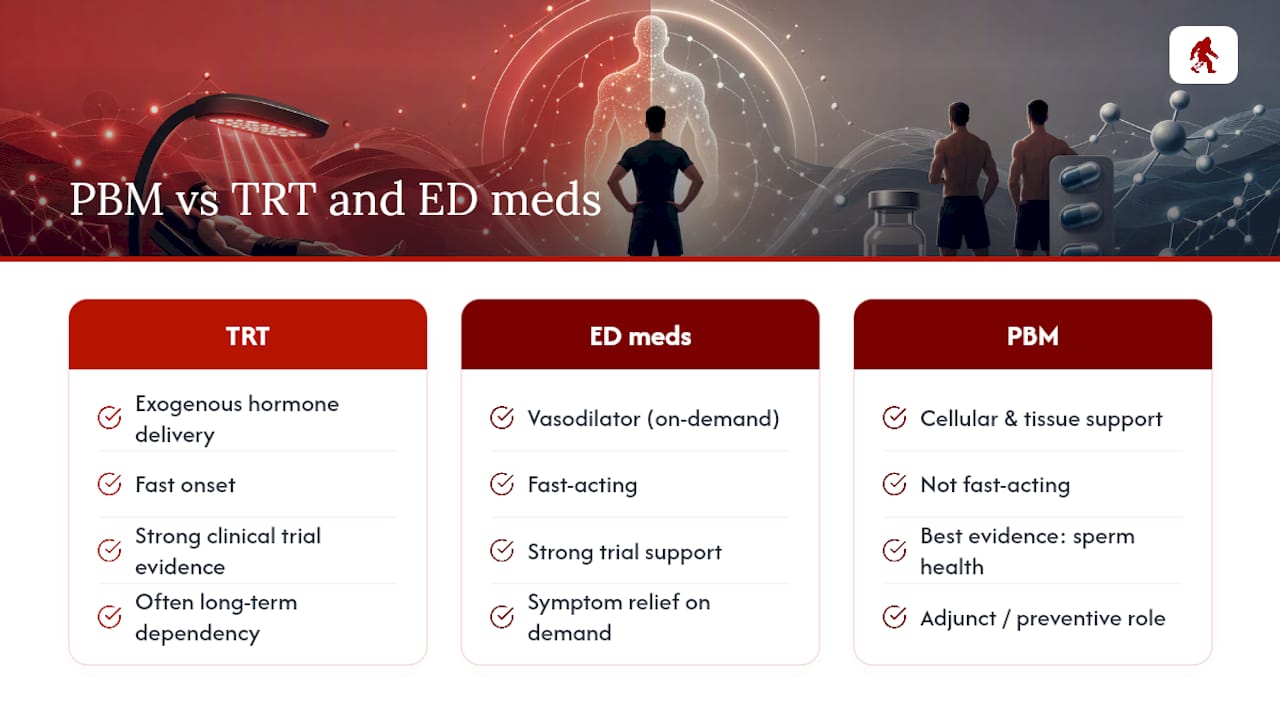
Testosterone replacement therapy delivers exogenous hormone directly into your bloodstream, and it works fast for men with clinically diagnosed low testosterone. It also comes with a real commitment: ongoing injections or applications, monitoring, and for many men, a long-term dependency on the treatment once started. Prescription ED medications work through a different, well-established pathway, increasing blood flow on demand with strong clinical trial support behind them.
PBM sits in a different category entirely. It's not a hormone replacement and it's not a fast-acting vasodilator. It's a supportive input aimed at cellular and tissue-level function, with evidence that's strongest in isolated sperm health and weakest in whole-person hormone or erectile outcomes. That's a meaningful trade-off to understand before comparing it head-to-head with medical treatments that have decades of human trial data behind them.
Where PBM earns a real place is as a low-risk, non-invasive addition alongside foundational health work, not as a substitute for a diagnosed medical condition that needs treatment. A man with normal testosterone who wants to support recovery and general vitality is in a different situation than a man with clinically low testosterone who needs a documented treatment plan. If you're exploring what a testosterone path actually involves before committing to one, what men should know before choosing a testosterone path covers that decision in more depth. PBM doesn't compete with TRT or ED medication. It occupies the space before those decisions become necessary, or alongside them as a supportive habit once they do.
Who Should Be Careful: Medications And Health Conditions
Photobiomodulation is generally considered low-risk at studied parameters, but "low-risk" doesn't mean risk-free for every man in every situation. A few groups deserve extra caution before starting any home protocol.
Men on photosensitizing medications, including certain antibiotics, acne treatments, and some blood pressure medications, should check with a prescribing doctor first, since these drugs can change how skin and tissue respond to light exposure. Men with diagnosed fertility issues under active treatment should loop in their fertility specialist before adding PBM to the mix, since timing and protocol could interact with treatment cycles already in progress. Men with a history of testicular cancer, active malignancy, or unexplained testicular pain or swelling need a medical evaluation before considering any light-based therapy targeting that area, full stop.
Existing cardiovascular conditions also deserve a mention, since nitric oxide modulation affects blood vessel behavior, and men managing blood pressure medication or vascular disease should discuss any new intervention affecting circulation with their physician. A partner resource on red light therapy contraindications breaks down additional conditions worth reviewing before starting, including skin conditions and certain autoimmune concerns.
None of this is meant to scare you off the technology. It's meant to make sure the men who genuinely shouldn't experiment without medical input know it before they start, not after.
Choosing A Device: What Actually Matters
Not all red light devices are built the same, and the differences matter more for men targeting reproductive or sexual health tissue than for general skin use.
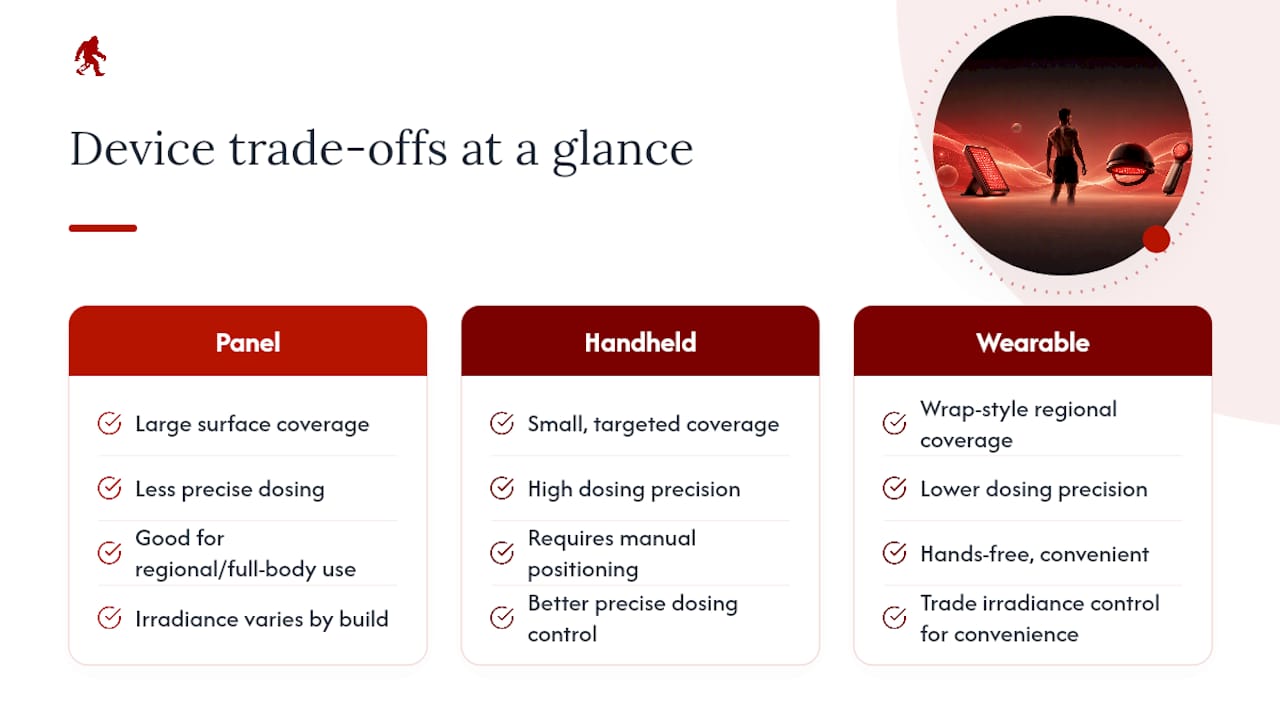
Panel devices cover a larger surface area and work well for full-body or targeted regional use, but irradiance can vary across the panel depending on build quality. Handheld or targeted devices offer more precise dosing to a specific area, which suits men focused on a particular concern rather than broad exposure. Wearable or wrap-style devices trade some irradiance control for convenience and hands-free sessions, useful for consistency but worth checking irradiance specs on closely.
Look for three things regardless of device type: wavelengths that fall within the researched ranges rather than vague marketing terms like "advanced spectrum," clear published irradiance numbers rather than just wattage claims, and cooling or thermal management so sessions don't add heat load to sensitive tissue. Guided session protocols, ideally through a companion app, help take the guesswork out of dosing rather than leaving duration and frequency to trial and error. Primal Red Co's guide to the best red light devices for men covers feature comparisons in more depth if you're weighing specific options before buying.
A Nurse's Take On Where PBM Actually Fits
PBM belongs in a restoration toolkit, not on a pedestal. It's a supportive habit, not a cure for low testosterone or erectile dysfunction, and any routine built around it should reflect that.
If you're going to try it, keep it simple: three to five sessions a week, consistent timing, paired with the habits that actually move hormone and energy markers, quality sleep, resistance training, and keeping body fat in a healthy range. PBM works better as a supporting layer on top of those habits than as a stand-alone fix.
Track something real, whether that's a mood log, a sleep app, or actual bloodwork, and give it eight to twelve weeks before judging results. And if fertility or a persistent erectile issue is the real concern driving your interest here, see a clinician. PBM can sit alongside that care. It should never replace it.
— Nurse Rachel
Where RedRockit Fits Into A Safety-First Routine
Everything in this guide points to the same conclusion: dose consistency and heat control matter more than any single wavelength claim. That's exactly the gap RedRockit is built to close. Instead of guessing at session length or wondering if your panel is running hot, A well-designed red light device can pair research-aligned wavelengths with built-in cooling and a companion app to guide session timing, so you don't have to estimate duration manually.

Such a device isn't a fertility treatment or testosterone therapy. It is intended as a private-use tool for men who are not pursuing a medical diagnosis but want to address changes they are experiencing. If erectile dysfunction or a suspected fertility issue is your primary concern, see a clinician first, full stop. If you're looking to build a consistent, safety-conscious light routine as part of a broader restoration habit, explore RedRockit's product details and see how a controlled, private-use device fits into a routine designed around energy, drive, and recovery, not overblown promises.
This article is general information, not a substitute for advice from a qualified doctor. Consult a qualified healthcare professional about your own circumstances before acting on anything here.
Sources
- Efficacy and Safety of Visible and Near-Infrared Photobiomodulation Therapy on Astenospermic Human Sperm: Wavelength-Dependent Regulation of Nitric Oxide Levels and Mitochondrial Energetics
- Systematic review on PBM and male infertility (Journal of Lasers in Medical Sciences, 2023)
- Umbrella review of RCTs on PBM therapeutic effects (2025)