
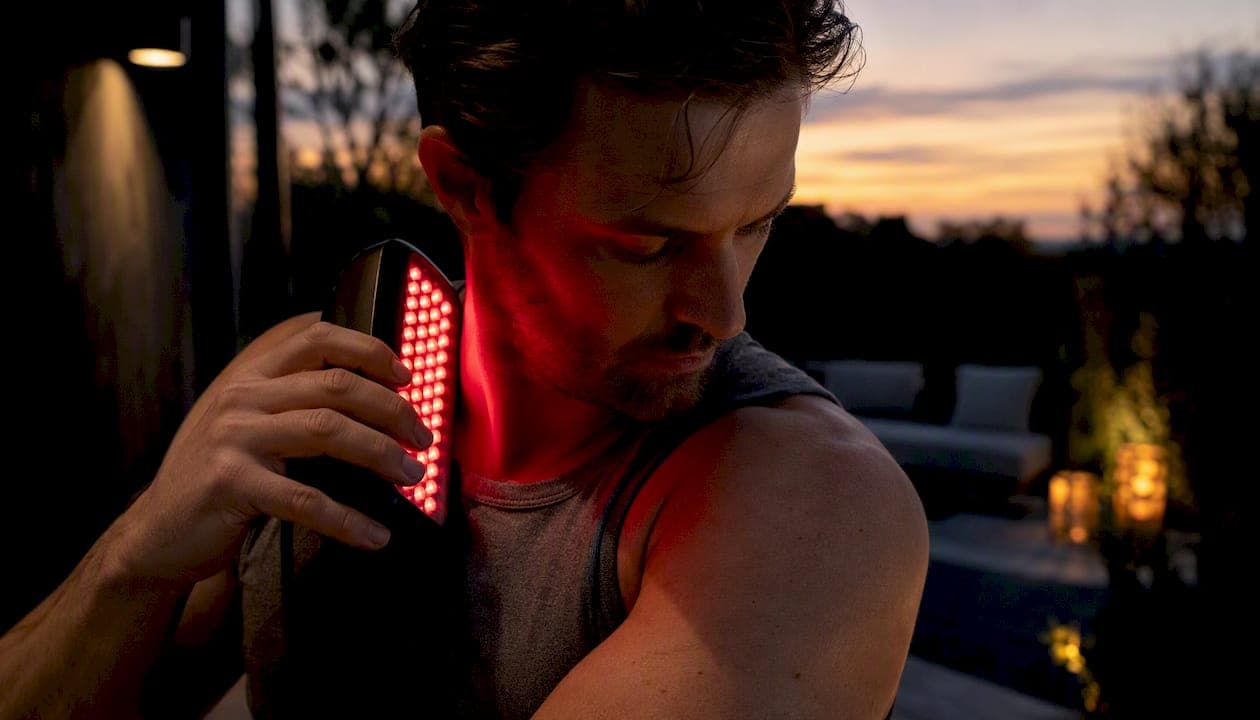
Red light therapy can help men grow back thinning hair, support skin repair, and speed recovery after training, and it's safe for most people when used correctly. It cannot reliably raise testosterone or fix erectile dysfunction. That's the honest verdict, backed by clinical evidence rather than the marketing copy stapled to every panel on Amazon.
Here's what the research actually supports:
- Hair density and thickness improve with several months of consistent red light sessions on areas with active follicles, according to research summarized by Stanford Medicine.
- Skin repair and collagen support show up in dermatologic studies, with stronger evidence for wound healing than for cosmetic wrinkle reduction.
- Muscle recovery benefits from reduced markers of exercise damage and less soreness when light is applied around training sessions.
- Testosterone and erectile function claims remain unsupported by controlled human trials. If a seller promises a hormone spike from a light panel, that's a sales pitch, not science.
Your move: pick one goal, run a monitored six to eight week protocol using a device with real specs (not just a flashy LED array), and track results before you decide whether to keep going or see a clinician. Restoration isn't magic. It's a signal you send your body on repeat until it listens.
Table of Contents
- What Is Red Light Therapy and How Does It Work for Men?
- What Benefits Can Men Realistically Expect From Red Light Therapy?
- How Strong Is the Clinical Evidence for Red Light Therapy?
- Is Red Light Therapy Safe, and Who Should Avoid It?
- At-Home Devices vs. Clinic Treatment: Which Is Right for You?
- What Red Light Therapy Protocol Should Men Actually Follow?
- What Does Red Light Therapy Cost, and Where Can You Get It?
- What Would a Clinician and a Device Maker Each Tell You to Try First?
- If You Want a Simple, Male-Focused At-Home Option: RedRockit
- Quick Recap: What Men Should Remember About Red Light Therapy
- Sources
What Is Red Light Therapy and How Does It Work for Men?
Red light therapy, known clinically as photobiomodulation, uses specific wavelengths of light to trigger a response inside your cells rather than just warming your skin. The light gets absorbed by mitochondria, the energy factories inside your cells, and that absorption appears to boost ATP production and improve local blood flow. Think of it as sending your cells a signal they've been missing, not injecting them with something foreign.
The wavelength determines how deep that signal travels. Visible red light in the 600 to 700 nanometer range mostly affects the skin surface: think acne, fine lines, and superficial tissue repair. Near-infrared light, typically in the 810 to 850 nanometer range, penetrates deeper into muscle and joint tissue, which is why serious recovery-focused panels usually pair both bands rather than relying on red alone, per Men's Health.
This isn't some fringe idea invented by a supplement company. Early research connecting light exposure to cellular repair traces back to NASA-funded work studying how astronauts' wounds healed in space. That history matters because it shows the biological plausibility long predates the current wellness boom.
Here's what actually separates an effective session from a waste of your time:
- Wavelength coverage. Devices need real red and NIR output, not a marketing sticker with big numbers.
- Irradiance and dose. Power output (measured in mW/cm²) combined with session time determines your actual dose in J/cm². Too little does nothing; too much can irritate skin.
- Distance from the device. Move six inches farther away and your dose can drop by more than half.
- Consistency. A single session feels good. Results come from repetition over weeks.
Effective devices generally deliver moderate irradiance at visible red wavelengths held a moderate distance from the skin for several minutes per session, consistent with published protocols for skin and hair applications — a useful benchmark before you compare specs on any panel you're considering.
What Benefits Can Men Realistically Expect From Red Light Therapy?
Hair, skin, and recovery are where the evidence holds up. Everything else deserves a skeptical eyebrow.
Hair regrowth works specifically on follicles that are thinning but still alive, not on scalp that's already gone bald and smooth. Stanford's clinical review notes that consistent treatment over multiple months can improve density and thickness in men with androgenetic alopecia, and pairing red light with topical minoxidil often outperforms either approach alone. The catch: results fade once you stop treating. This is maintenance, not a cure.
Skin benefits center on collagen support and inflammation reduction. Acne-prone skin tends to calm down, and some men notice smoother texture after a few months. Don't expect a face-lift in a box. The magnitude here is real but modest, closer to "skin looks less tired" than "skin looks ten years younger."
Recovery has some of the most consistent data of the bunch. Research summarized by The Art of Manliness points to lower creatine kinase levels and reduced delayed-onset muscle soreness (DOMS) when light therapy is applied before or after training. If you lift, run, or play a sport that leaves you stiff for two days afterward, this is where red light earns its keep fastest.
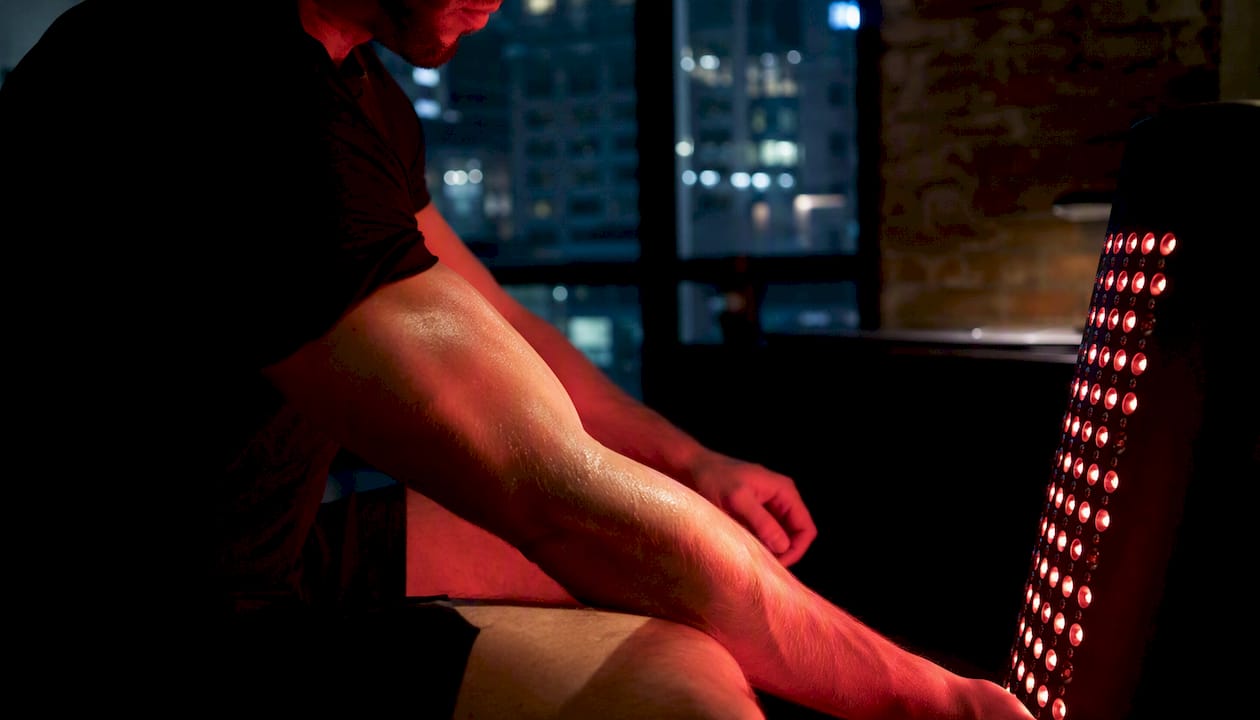
Pro Tip: Track one specific metric, not a vague feeling. If you're testing recovery, log your soreness on a 1 to 10 scale after hard training days before and after starting. If you're testing hair, take a photo under the same lighting every two weeks. Vague impressions lie to you. Numbers and photos don't.
Now the part nobody selling you a device wants to lead with: testosterone and erectile function. There is no strong human trial evidence showing red or near-infrared light reliably raises circulating testosterone, according to a review focused specifically on men's health claims. If a product page shows you a chart of "testosterone increase" without linking to a real randomized trial, that chart is decoration. You can read more on the libido and sexual health evidence gap if that's the outcome you're chasing.
How Strong Is the Clinical Evidence for Red Light Therapy?
The evidence is real but uneven, and that unevenness is worth understanding before you spend money.
Hair and certain dermatologic outcomes have the most support. A systematic review of photobiomodulation found solid evidence for specific skin and wound-healing endpoints, though the strength of that evidence varies significantly depending on the exact condition being treated. Radiation dermatitis and certain wound types show clearer benefit than, say, general anti-aging claims.
Recovery research shows a consistent pattern across multiple studies: less muscle damage, less soreness, when light is timed around exercise. That consistency across independent trials is more convincing than a single flashy study.
Where things get murky is study design. A review examining photobiomodulation research points out that trials use wildly different devices, wavelengths, power levels, and exposure times. That heterogeneity makes it hard to say "red light therapy does X" as a blanket statement, because the "red light therapy" used in one study might barely resemble the device used in another.
The core problem isn't whether photobiomodulation works. It's that "photobiomodulation" covers such a wide range of devices and doses that comparing studies is like comparing different sports and calling them all "athletics." Standardized protocols would move this field forward faster than more small studies.
Small sample sizes and short follow-up periods compound the problem. Many trials run a few weeks to a few months, which tells you little about what happens after a year of consistent use, or what happens when you stop. When you're weighing a claim, ask three questions: How many participants? What wavelength and power? How long was the follow-up? If a source can't answer those, treat the claim as unproven rather than disproven.
Is Red Light Therapy Safe, and Who Should Avoid It?
For most men, red light therapy carries a low risk profile. The real safety issues are specific and preventable, not mysterious.
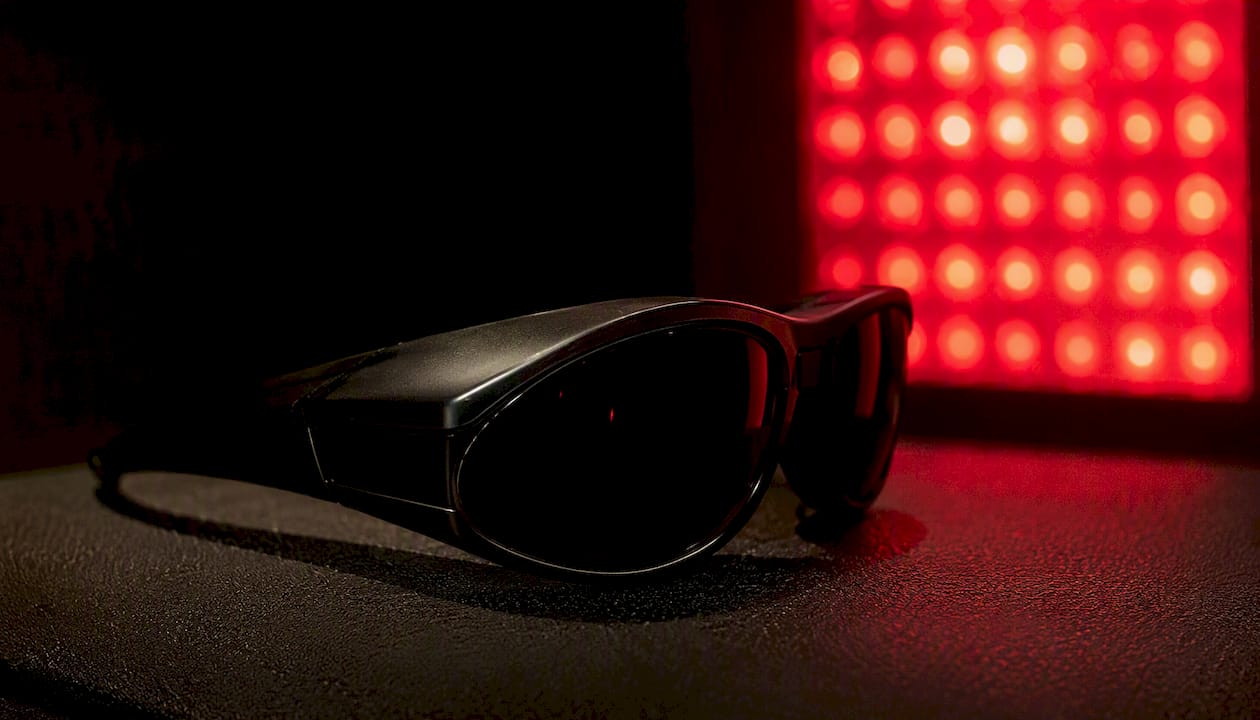
Eye exposure tops the list. Staring directly into a high-power panel isn't like glancing at a lamp. Clinical guidance from Stanford recommends eye protection during sessions, especially with higher-irradiance devices. Burns are rare but happen when people misuse high-power devices at close range for extended periods, essentially cooking the skin instead of treating it.
Medications that increase photosensitivity deserve real caution. Certain antibiotics, acne medications like isotretinoin, and some blood pressure drugs can make skin more reactive to light exposure. If you're on a prescription and unsure whether it affects photosensitivity, that's a five-minute question for your pharmacist before your first session.
Men considering experimental testicular use should apply the same caution other risky applications get. Heat buildup near the scrotum from a close-range, high-power device is a real thermal concern, not a theoretical one. Short sessions, real distance from the panel, and devices with proper cooling reduce that risk. Read the full breakdown on testicular red light therapy before you experiment here, because the evidence for benefit is thin and the margin for misuse is not.
Active cancer lesions are a hard stop. Light stimulation on tissue that might be malignant is not a decision to make without a dermatologist or oncologist involved.
Run through this checklist before your first session:
- Protect your eyes with the goggles that came with your device or equivalent-rated protection.
- Test a small area first for 24 to 48 hours if you have sensitive skin or a history of reactions.
- Monitor skin temperature during sessions. Warmth is normal; heat that feels uncomfortable is not.
- Stop and reassess if you notice redness that doesn't fade, irritation, or unusual sensitivity.
This is general information, not a substitute for a conversation with your doctor. If you're managing a chronic condition, taking photosensitizing medication, or have an active skin lesion, check with a clinician before starting.
At-Home Devices vs. Clinic Treatment: Which Is Right for You?
Clinics generally run higher-powered devices under supervision, which means faster results per session but a real time and cost commitment. At-home panels trade some power for convenience: lower irradiance, but sessions you can run in your bedroom every night without booking anything.
Dermatologists tend to agree that at-home outcomes hinge less on brand prestige and more on whether you actually follow the protocol consistently, according to insight from Stanford's clinical overview. A mediocre panel used every day for three months will usually outperform a premium panel used twice and forgotten in a closet.
Here's the buyer's checklist that actually matters, stripped of marketing fluff:
- Wavelength coverage. Look for both red (630 to 660 nm) and near-infrared (810 to 850 nm) output if you want skin and deeper tissue benefits in one device.
- Irradiance and stated power output. A manufacturer that publishes real mW/cm² numbers at a specific distance is telling you something. A manufacturer that only says "powerful" is hiding something.
- Treatment area size. A handheld wand works for spot treatment. A full panel is what you need for back, shoulders, or broader recovery use.
- Cooling and build quality. Devices that run hot without fans degrade faster and increase burn risk.
- FDA clearance status. A 510(k) clearance signals the device met safety and labeling requirements through substantial equivalence to an existing cleared device. It is not proof the device cures anything. It's a safety floor, not a results guarantee.
- Warranty length. A company confident in its hardware backs it for more than 90 days.
Device types split roughly into four categories: full-body panels for broad recovery use, facial masks for skin-specific treatment, scalp caps or helmets for hair maintenance, and small targeted panels for joints or localized soreness. Match the device to your actual goal instead of buying the biggest panel because it looks impressive in a photo.
Pro Tip: If a product page shows before-and-after photos but won't tell you the wavelength or irradiance anywhere on the site, that's a red flag worth walking away from.
Second pro tip: Check whether the company publishes an actual protocol (session length, frequency, distance) instead of just "use daily for best results." Vague instructions usually mean nobody tested the device rigorously enough to know the right dose.
For a deeper comparison of male-focused hardware, this breakdown of device options walks through tradeoffs by use case, and this EMF safety guide covers the electrical safety side most buyers skip entirely.
What Red Light Therapy Protocol Should Men Actually Follow?
Consistency beats intensity here. A moderate protocol you actually finish outperforms an aggressive one you abandon after two weeks.
Follow a simple sequence to test any of these goals properly:
- Establish a baseline. Take a scalp photo, log soreness scores, or note skin texture before session one.
- Pick one goal and one device setting. Don't chase three outcomes at once with different protocols; you won't know what caused what.
- Run the protocol consistently for the full evaluation window in the table above.
- Re-measure using the same method you used for your baseline, same lighting, same time of day.
- Decide: continue, adjust, or stop. If you see progress, keep going. If you see irritation or nothing after a full cycle, reassess.
For testicular experimentation specifically, keep sessions short and distance conservative, since heat buildup near sensitive tissue is the real risk, and the hormonal payoff claimed by sellers isn't backed by controlled trials.
Pro Tip: Set a recurring phone reminder for your sessions. Adherence, not device quality, is what separates men who see results from men who own an expensive panel gathering dust after week three.
What Does Red Light Therapy Cost, and Where Can You Get It?
Clinic sessions typically run as single visits or membership packages, with per-session pricing scaling based on the treatment area and the clinic's device power. Dermatology offices and medspas commonly offer red light as a standalone service or bundled with other skin treatments.
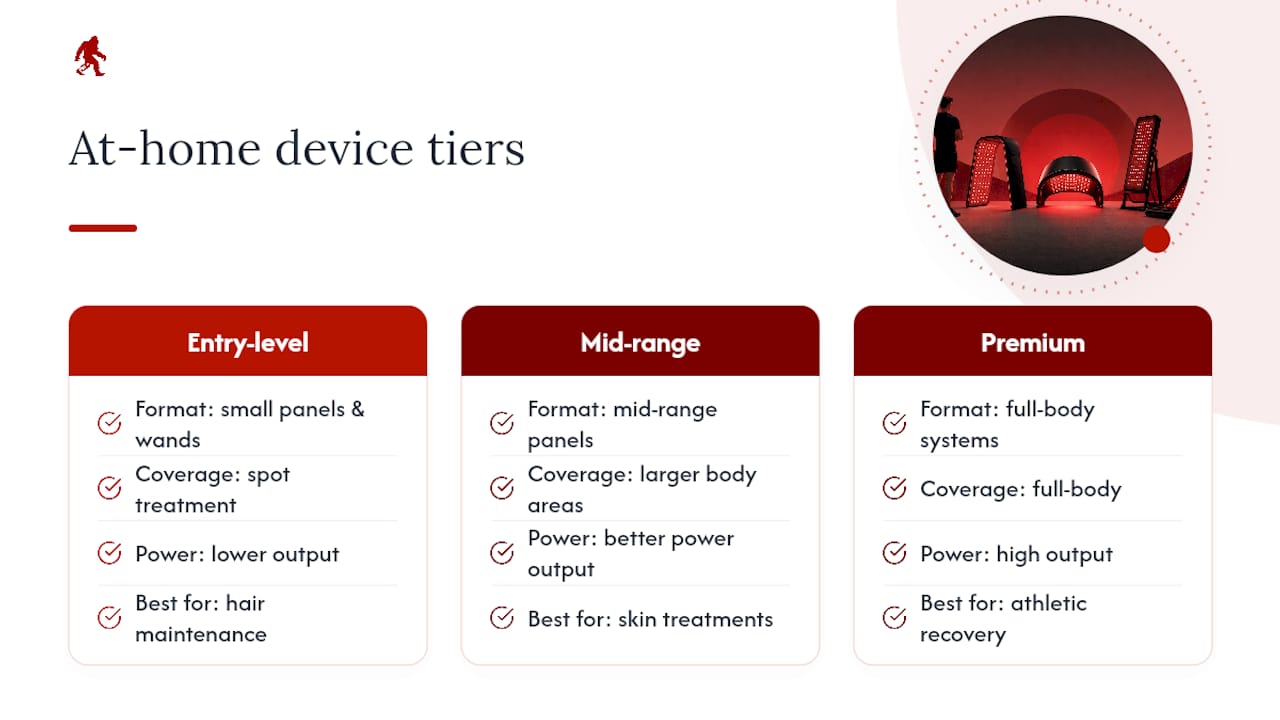
At-home devices span three rough tiers: entry-level small panels and handheld wands for spot treatment, mid-range panels that cover larger body areas with better power output, and premium full-body systems designed for serious recovery use. The right tier depends entirely on your goal. A man chasing hair maintenance doesn't need the same hardware as a man treating full-back recovery after heavy training.
Clinic visits make more sense when you want supervised, higher-power sessions, or when you're combining red light with another procedure a dermatologist recommends. At-home devices make sense for men who want to build a repeatable, low-effort routine without booking appointments around a clinic's schedule, which matters most for something that requires months of consistency to show results.
A few practical money-saving notes: most clinics offer a trial session before committing to a package, which is worth taking before buying a membership. Wellness use of red light devices typically isn't covered by insurance, since it falls outside standard medical treatment categories. And a cheaper starter panel used consistently for months will usually beat an expensive system used sporadically.
What Would a Clinician and a Device Maker Each Tell You to Try First?
If you asked a clinician where to start, the answer would sound almost boring: pick the goal with the strongest evidence, measure your starting point, and run a monitored trial before you touch anything experimental.
For most men, that means starting with hair maintenance or recovery, not testosterone or sexual function. Establish a baseline (a photo, a soreness score, a simple log), commit to 6 to 12 weeks of consistent sessions, and reassess with the same measurement method you started with. That's not a sexy answer, but it's the honest one your body actually responds to.
From a device-maker's perspective, the biggest failure point isn't the light itself, it's adherence. Men buy a panel with good intentions, use it for ten days, and quit because there's no structure telling them what to do next. That's exactly why a male-focused device paired with guided session protocols matters more than raw specs on a page. A device that tells you when to use it, for how long, and tracks whether you're actually showing up closes the gap between "I own a red light panel" and "I ran the protocol long enough to see something change."
Your body isn't broken. It's been sending you a quieter signal for a while now, and most men just haven't had a structured way to answer it. Test one protocol. Track it honestly. If something feels off medically, a clinician is the next call, not a forum thread.
If You Want a Simple, Male-Focused At-Home Option: RedRockit
Primal Red Co built RedRockit specifically for men over 30 who want a real restoration routine, not another gadget that collects dust after week two. The device pairs red and near-infrared output with the companion Rockit IQ app, which walks you through guided sessions instead of leaving you guessing at distance, time, and frequency.

That structure is the whole point. Every protocol in this article, hair maintenance, recovery, skin support, depends on consistency more than any single spec sheet number. RedRockit's app-guided sessions are built to remove the guesswork that kills adherence: it tells you when to run a session, tracks whether you actually did, and adjusts based on your goal. That's a meaningfully different experience than owning a panel with no structure behind it. You can dig into how the guided protocol app works, or explore what men typically try before considering TRT if you're weighing a broader set of options.
If you're ready to start a real routine instead of another false start, check out the RedRockit Activation Method and see which plan fits where you're starting from.
Quick Recap: What Men Should Remember About Red Light Therapy
Red light therapy works for men when applied consistently to hair maintenance, skin repair, and exercise recovery, but it does not reliably raise testosterone or fix erectile dysfunction.
| Point | Details |
|---|---|
| Verdict | Effective for hair, skin, and recovery goals; unproven for testosterone or ED claims. |
| Best evidence | Muscle recovery (lower soreness, lower creatine kinase) and hair density in active follicles. |
| Timeline | Several months are typically needed for visible hair changes; a few weeks may be sufficient for recovery improvements. |
| Safety musts | Eye protection, check photosensitizing medications, avoid active skin lesions, monitor heat. |
| Next step | Try RedRockit's guided 6 week protocol for your specific goal and track results honestly. |
Sources
- Red light therapy: What the science says - Stanford Medicine
- Systematic review on photobiomodulation (PMC6116811)
- 510(k) clearances - U.S. Food and Drug Administration