
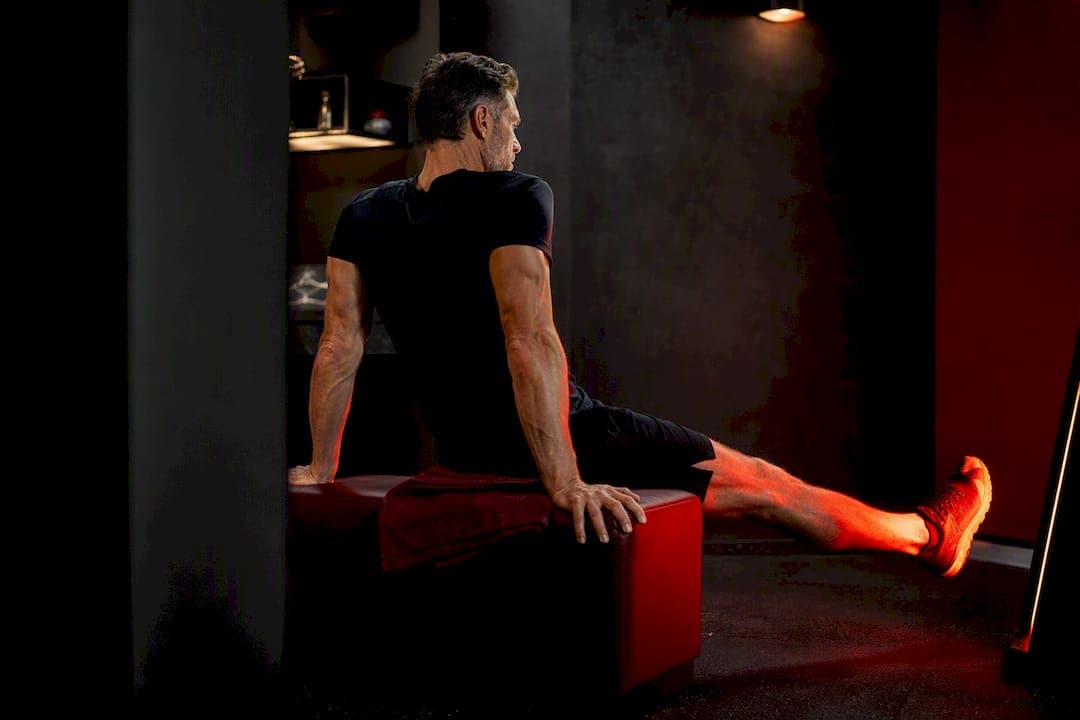
Yes, using red light after a workout can measurably speed up recovery. The clinical evidence points to less delayed-onset muscle soreness, a faster drop in creatine kinase (a marker of muscle damage), and quicker return of strength output. That said, the payoff depends entirely on device strength and showing up for it consistently. A weak panel used once won't move the needle. A capable device used like it's part of the job? That's where the signal comes back.
TL;DR:
- Using a high-quality red and near-infrared device consistently post-workout can reduce soreness and accelerate muscle recovery, especially when applied for 10 to 20 minutes.
- Effectiveness heavily depends on device strength, proper dosing, and the correct combination of wavelength, irradiance, and session timing, with poor-quality devices offering limited benefits.
- Post-workout application is generally more reliable for reducing delayed-onset muscle soreness than pre-conditioning, with strongest results seen after multiple sessions over several weeks.
- Combining red light therapy with other recovery methods like cryotherapy may reduce its effectiveness, so recovery tools should be used separately for optimal results.
- For best results, select devices offering both red and near-infrared wavelengths with published irradiance figures, aim for at least three to four weekly sessions, and track soreness and recovery progress over time.
Table of Contents
- Should You Use Red Light After a Workout? How Photobiomodulation Works
- Should You Use Red Light Before or After Your Workout?
- What's the Right Dose? Translating Research Protocols to Home Devices
- What to Look for in an At-Home Red Light Device
- Is Red Light Therapy Safe? Contraindications and Overuse Risks
- How to Build a Weekly Red Light Recovery Routine
- Quick Takeaways: What to Do This Week
- Nurse Rachel's Take on Red Light and Men's Recovery
- Try RedRockit for Your Post-Workout Recovery Routine
- Sources
Should You Use Red Light After a Workout? How Photobiomodulation Works
The mechanism has a name, and it's worth knowing: photobiomodulation, or PBM. That's the clinical term for what happens when red and near-infrared light hit your tissue and change how your cells behave. If you've seen "red light therapy" used everywhere from skin clinics to sports labs, PBM is the science underneath the marketing.
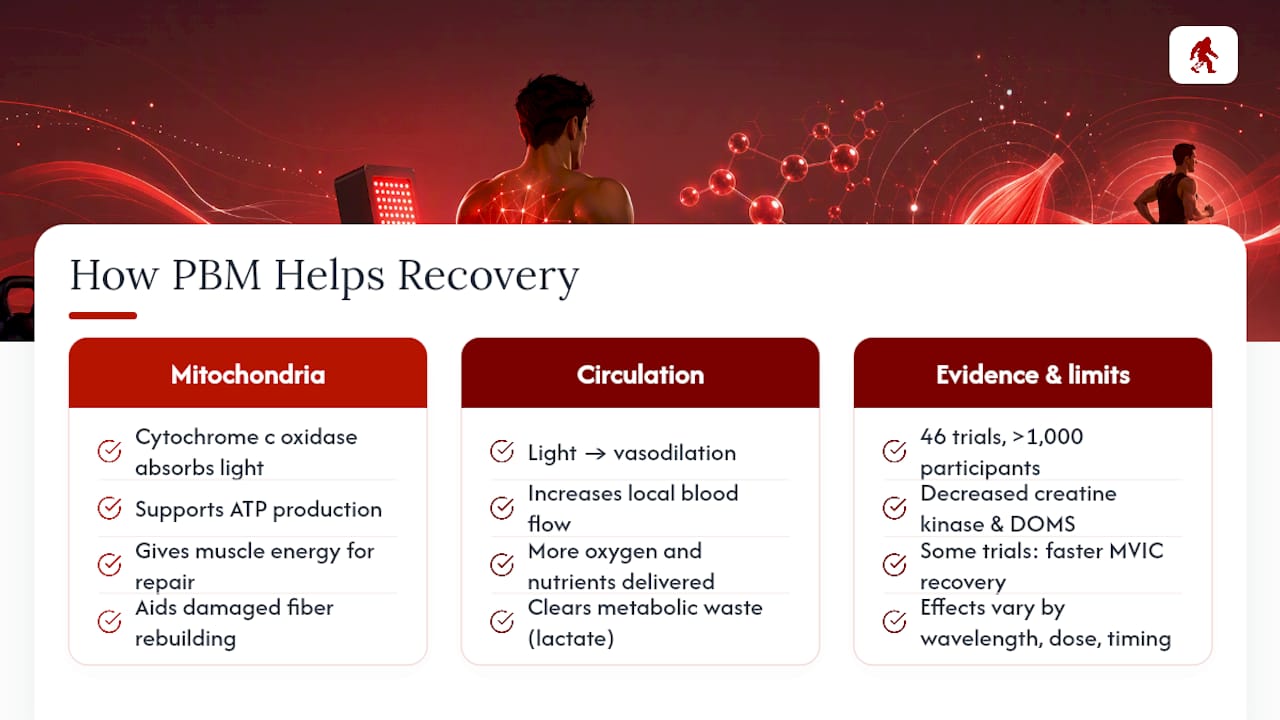
Here's what's actually happening at the cellular level. Red and near-infrared wavelengths get absorbed by a compound in your mitochondria called cytochrome c oxidase, part of the electron transport chain that produces ATP, your cell's energy currency. Light exposure appears to support this process, giving muscle cells more energy available for repair work right when they need it most, post workout, when damaged fibers are trying to rebuild and inflammation is doing its job clearing debris.
Think of your mitochondria as the power plants inside every muscle cell. After a hard training session, those power plants are working overtime. Red light doesn't replace that work. It seems to give the plants a better fuel supply to work with.
The second mechanism is circulation. Red and NIR light exposure is linked to vasodilation, the widening of blood vessels, which increases local blood flow. More blood flow to fatigued tissue means more oxygen and nutrients arriving, and more efficient clearance of metabolic waste like lactate. This is the same basic goal as an ice bath or a foam roller, delivered through a different channel entirely.
So what does the research actually show? A clinical review covering 46 trials with more than 1,000 participants found that PBM applications, whether delivered before or after exercise, decreased creatine kinase and reduced DOMS in a meaningful share of the studies, with some trials also reporting faster recovery of maximum voluntary isometric contraction, or MVIC, a standard measure of how quickly strength returns after fatigue. Not every trial showed every benefit. Effective parameters varied by wavelength, dose, and timing, which is exactly why the "how to actually use this" section further down matters as much as the "does it work" question.
Medical experts add an important gut check here. Stanford Medicine has noted that outcomes depend heavily on device strength and correct dosing, and that clinical evidence is currently stronger for skin and hair applications than for athletic performance specifically. That's not a reason to dismiss the muscle recovery data. It's a reason to take device quality seriously, which is a theme that's going to come up again.
None of this makes red light a magic bullet. It makes it a legitimate lever, one that works at the mitochondrial level to support a repair process your body is already running. The question that actually matters for your routine is timing, and that's where the science gets genuinely interesting.
Should You Use Red Light Before or After Your Workout?
This is the question most men actually want answered, and the honest response is: it depends on what you're trying to accomplish that day.
Pre-workout light exposure, sometimes called pre-conditioning, aims to prime muscle tissue before you load it. The theory is that if mitochondria are running more efficiently before you start lifting or running, you might blunt some of the damage before it happens, potentially protecting performance and reducing how deep the fatigue hole gets. Post-workout light exposure has a different job. It's applied after the damage is already done, aiming to accelerate the repair and inflammation-clearing process that's already underway.
Trial data supports both approaches, but the outcomes they're best at differ.
- Pre-conditioning trials tend to focus on performance protection, things like delayed time to exhaustion, reduced strength loss immediately post-exercise, and in some cases better power output during the session itself.
- Post-exercise trials more consistently report reductions in creatine kinase and DOMS in the 24 to 96 hours following training, which is the window most men actually care about when they're deciding whether to train again the next day.
- Combined protocols, light both before and after, show up in some of the stronger trials, suggesting the two timing windows aren't competing strategies so much as complementary ones.
- A subset of studies used short, high-intensity applications per muscle site rather than long, low-intensity sessions, which tells you dose and duration aren't fixed, they're a variable you can work with depending on your device.
So how do you actually decide? Here's a practical way to think about it.
If you're heading into a max-effort session, a competition, a heavy squat day, a race where performance that day is the priority, pre-workout light exposure aimed at the muscles you're about to load makes sense. You're trying to protect output, not just recover afterward.
If your priority is walking normally tomorrow and training again in 48 hours without your legs feeling like concrete, post-workout light exposure targeted at the muscles you just trained is the better use of your time. This is where most of the DOMS and creatine kinase data lives, and it's the use case that applies to the largest share of men reading this: guys training three to five days a week who need to actually recover between sessions, not just survive one big day.
And if you're in a heavier training block, running both, a short session before you train and a longer one afterward, has support in the research and lines up with how the combined-protocol trials were designed. It's more time investment, so it makes the most sense during phases where you're pushing volume or intensity hard enough that recovery is genuinely the bottleneck.
One caution worth flagging here: modality stacking isn't always additive. At least one trial found that combining PBM with cryotherapy actually reduced PBM's effectiveness compared to using light alone. If you're an ice bath guy, that's not a reason to panic, but it is a reason to separate your recovery tools rather than assuming stacking everything at once compounds the benefit. Sometimes it just gets in its own way.
For a deeper breakdown of which goal maps to which protocol, Primal Red Co's timing guide walks through scenario-specific recommendations in more detail.
What's the Right Dose? Translating Research Protocols to Home Devices
This is where a lot of men get lost, because clinical trials don't hand you a simple "10 minutes, twice a week" instruction. They report wavelengths, irradiance, and joules delivered per site, numbers that mean nothing until you translate them into what your panel at home can actually produce.
Start with wavelength. Research protocols cluster around two ranges: red light between 620 and 660 nanometers, and near-infrared light between roughly 800 and 850 nanometers. Both show up across the trials for a reason. Red light tends to work closer to the surface, useful for skin and shallow tissue. Near-infrared penetrates deeper, which matters more for larger muscle groups like quads, glutes, and the lower back where the fibers you're trying to reach sit further from the skin. A device that only offers one wavelength is leaving something on the table if your goal is muscle recovery specifically, not just skin benefit.
Pro Tip: If you're comparing devices and the spec sheet only lists one wavelength, ask which one, and ask why. A quality panel built for muscle recovery should offer both red and NIR output, not just the red light that photographs well in marketing shots.
Irradiance, measured in milliwatts per square centimeter, is the piece most consumer devices don't disclose clearly, and it's the number that determines how long you actually need to sit in front of the light. Higher irradiance means shorter sessions to hit an effective dose. Lower irradiance means you either need to sit there longer or you're simply not getting a therapeutic dose at all, no matter how long you wait.
Here's the translation problem in plain terms: research trials often deliver site energies in the tens of joules using devices with known, measured irradiance. Working out what that means for a home panel requires knowing your device's actual mW/cm² output at the distance you're sitting from it, then calculating how many minutes get you to a comparable joule count. This is exactly why "10 minutes" on one device and "10 minutes" on another can produce wildly different results. The minutes aren't the dose. The energy delivered is the dose, and minutes are just the delivery mechanism.
Quick reference for translating research to home use:
- Wavelength range that matters: red 620–660 nm and NIR 800–850 nm, ideally both, for muscle-focused applications.
- Session length for most consumer panels: typically 10 to 20 minutes per targeted muscle group, assuming a moderate-to-high irradiance device positioned at the recommended distance.
- Frequency: most trials showing benefit used sessions applied multiple times per week around training days, not a single one-off treatment.
- Distance from device: irradiance drops sharply with distance, so the gap between "6 inches away" and "18 inches away" can be the difference between a real dose and a warm feeling with no measurable effect.
A single session might leave you feeling looser, and that's real, but it's not the outcome the research is measuring. The trials showing reduced CK and DOMS involved repeated exposure over multiple sessions, not a one-time fix. Expectations here should be cumulative, you're building a recovery habit, the same way sleep or protein intake compounds over weeks rather than overnight. Treat the first two weeks as calibration, not results.
What to Look for in an At-Home Red Light Device
Not all panels are built the same, and the gap between a research-grade device and a bargain LED strip is bigger than most marketing pages want you to know. Stanford Medicine has been direct about this: clinic-grade devices typically outperform consumer options because they deliver higher, more consistent irradiance, which means the tissue actually receives a therapeutic dose instead of a warm glow.
Here's what actually separates a device worth buying from one that's mostly good marketing.
- Dual wavelength output. Look for both red (620 to 660 nm) and near-infrared (800 to 850 nm) diodes, not just one. Muscle recovery benefits from the deeper penetration NIR provides.
- Published irradiance figures. If a product page doesn't state mW/cm² at a specific distance, that's a gap, not a footnote. This is the number that determines whether your sessions are actually doing anything.
- Treatment area size. A small handheld unit means multiple repositions to cover a muscle group like your hamstrings or lower back. A larger panel covers more surface area per session, which matters if you're trying to build this into a routine you'll actually keep.
- Build quality and diode density. Cheap panels often use fewer, weaker diodes spread thin to look impressive in photos. Diode count matters less than actual measured output at distance.
- Eye safety features. Look for devices with clear guidance on eye protection or built-in safeguards, since direct exposure to high-intensity LED arrays isn't something to wing.
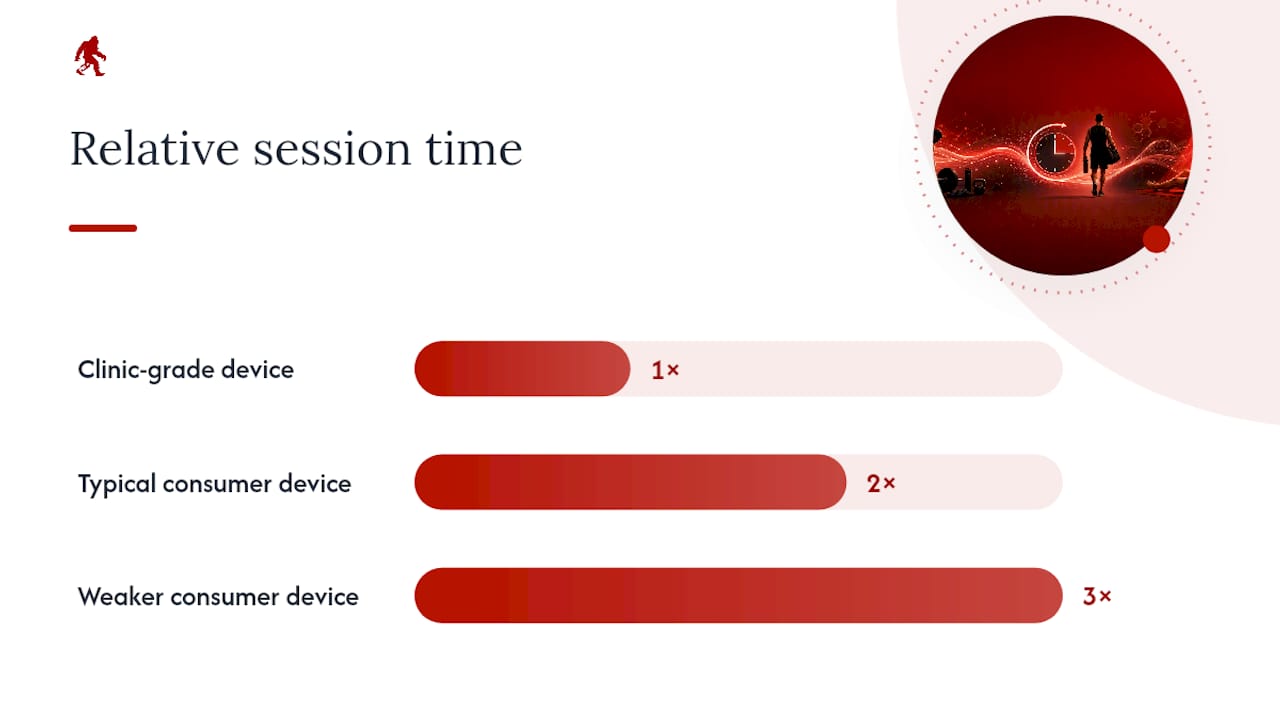
The practical difference between clinic-grade and consumer-grade isn't just price. It's penetration depth and session efficiency. A weaker consumer device might technically work, but it could require sessions two or three times longer than a stronger unit to deliver a comparable dose, which is a real problem if you're trying to fit this into a life that already includes training, work, and everything else.
Red flags worth watching for in marketing copy: vague claims like "clinically proven" with no citation, wavelength ranges listed as a wide vague band instead of specific peak numbers, and total silence on irradiance. If a company can't tell you the mW/cm² output of its own device, ask them directly before buying. A legitimate manufacturer will have that number ready. Primal Red Co's home-use guide breaks down spec comparisons in more depth if you want to go deeper before deciding.
Is Red Light Therapy Safe? Contraindications and Overuse Risks
The safety profile here is genuinely reassuring, which is part of why red light has gained traction outside clinical settings in the first place. The AMA has confirmed that red light therapy is generally safe for most people when used as directed, with mild, temporary redness or eye strain being the most commonly reported issues, and neither is common at that.
That doesn't mean it's a free-for-all. A few groups need to be more careful, and it's worth knowing which one applies to you before you start.
- Photosensitizing medications. Certain antibiotics, acne medications, and some other prescriptions increase skin sensitivity to light. Check with a pharmacist or physician before starting a routine if you're on any of these.
- Active skin conditions or open wounds in the treatment area should be evaluated by a clinician first rather than assumed safe by default.
- Pregnancy. Partners who are pregnant should talk to their doctor before using red light devices, since research in this specific population is limited.
- Higher-risk skin types. Dermatologic guidance suggests starting with shorter, lower-intensity sessions for certain skin types rather than jumping straight to maximum duration.
- Eye exposure. Direct, unprotected eye exposure to concentrated LED arrays isn't advisable. Keep eyes closed or shielded during sessions, especially with higher-output panels.
Overuse is a real, if underdiscussed, concern. More isn't automatically better with PBM. Some research on modality stacking found that combining light therapy with cryotherapy actually reduced its effectiveness compared to using light alone, which suggests the body's response to light exposure has limits, and piling on other recovery interventions at the exact same time doesn't necessarily stack the benefit. Consistency beats intensity here. A simple safety checklist before you start: confirm you're not on a photosensitizing medication, protect your eyes, start with shorter sessions if you have sensitive skin, and treat any unusual skin reaction as a signal to stop and reassess, not push through. For the full breakdown of what to watch for, Primal Red Co's side effects guide covers this in more detail.
How to Build a Weekly Red Light Recovery Routine
Knowing the science is one thing. Actually building it into a week that already includes training, work, and a life is another. Here's how to think about it without overcomplicating something that's supposed to make your life easier, not add another chore to it.
Pre-workout template: if you're targeting performance protection on a heavy day, apply light to the primary muscle groups you're about to train 10 to 15 minutes before your warm-up. Keep it focused, quads and hips before a squat session, chest and shoulders before a heavy press day. This isn't the session to skip warming up for. It's a supplement to your prep, not a replacement.
Post-workout template: this is where most men will get the most consistent return. Within an hour of finishing training, apply light to the muscle groups you just worked for roughly 10 to 20 minutes depending on your device's output. Sequence it after stretching but before your post-workout meal, treating it as part of the cooldown ritual rather than an extra errand tacked onto the end of your day.
Sample weekly structures:
- Strength block (heavy lifting, lower frequency): post-workout sessions on your three to four main training days, targeting whichever muscle groups took the load that day.
- Endurance block (running, cycling, higher frequency): shorter pre-workout sessions on hard-effort days, post-workout sessions on recovery-focused days, since endurance training tends to spread fatigue more broadly across the body.
- Hybrid or general fitness routine: post-workout only, three to five times per week, is a realistic starting point that fits into most schedules without requiring a second daily commitment.
Pro Tip: Track soreness on a simple 1 to 10 scale for two weeks before you change anything else about your routine. That's the fastest way to know if the light is actually doing something for you, rather than guessing based on how you feel on any given day.
Nurse Rachel's guidance to men starting out: don't overthink this. The research supports real, cumulative benefit, but it's a supporting player in your recovery, not the headline act. Pair it with the basics you're probably already neglecting, sleep, protein intake, and actual rest days, and give it three to four weeks before deciding whether it's earning a permanent spot in your week. Primal Red Co's recovery routine guide has additional templates if you want more structure to start from, and independent dosing breakdowns can help you sanity-check what "normal" results look like before you draw conclusions too early.
Quick Takeaways: What to Do This Week
You don't need to overhaul your routine to test this. Here's the shortlist.
- Start post-workout, not pre. It has the most consistent evidence for reducing soreness and speeding recovery, which is the outcome most men actually care about week to week.
- Confirm your device's specs before you commit to a schedule. Wavelength and irradiance determine whether your sessions are doing anything at all.
- Run it for three to four weeks minimum before judging results. This is cumulative, not instant. One session won't tell you anything useful.
- Track soreness and how fast you bounce back between sessions. That's your real feedback loop, more useful than how you feel in the ten minutes right after a session.
- Don't stack it carelessly with ice baths or other recovery tools at the same time without understanding how they interact.
Short term, expect to feel looser and notice a modest dip in next-day soreness. Over several weeks of consistent use, the bigger payoff shows up as faster turnaround between hard training days. One reminder that's worth repeating here since it's the single biggest variable: device quality determines almost everything about whether this works for you.
Nurse Rachel's Take on Red Light and Men's Recovery
Here's where I'll be straight with you: red light therapy is not a replacement for the fundamentals, and it's definitely not TRT in a box. It's a tool. A real one, backed by legitimate clinical research on muscle recovery, but a tool nonetheless, and tools only work if you actually use them right.
What I see too often is men treating recovery like an afterthought until something breaks, a nagging injury, a plateau that won't budge, energy that doesn't come back the way it used to at 25. Red light after a workout isn't going to reverse that pattern on its own. But it's one of the few recovery tools a man can control directly, on his own schedule, without waiting on a clinic appointment or a prescription.
At Primal Red Co, we position red light exactly where the evidence puts it: as a legitimate adjunct, not a cure, and not a substitute for evaluating what's actually going on with your energy, your testosterone, your sleep. If you're using red light and still feel like you're running on empty every day, that's not a device problem. That's your body sending a signal worth paying attention to, and it might be time to look at what's underneath.
My honest recommendation: use it consistently, pick a device with real specs, and treat it as one piece of a bigger restoration routine, not the whole plan.
— Nurse Rachel
Try RedRockit for Your Post-Workout Recovery Routine
RedRockit is built around the same dosing principles covered here: dual red and near-infrared wavelengths, real measured output instead of vague marketing numbers, and a treatment area sized for actual muscle groups rather than just a small patch of skin. It's designed for the man who read this far because he wants a routine that works, not a gadget that looks good on a shelf.

The companion Rockit IQ app removes the guesswork from timing and duration, walking you through guided session protocols so you're not standing there with a stopwatch trying to estimate joules per site. It's built for consistency, because consistency is what the research actually rewards, not a single lucky session. If you're a man over 30 looking to protect your energy, recovery, and drive before bigger decisions land on the table, explore the RedRockit Activation Method and see how it fits into a restoration routine built for where you're at right now, not where you were at 25. For a broader look at what men are searching for before they consider more aggressive options, Primal Red Co's guide on vitality after 40 is worth a read.
Sources
For readers who want to go deeper than this article covers, these sources back the claims made throughout.
- Photobiomodulation in human muscle tissue: an advantage in sports performance? — PMC
- Red light therapy: What the science says — Stanford Medicine
- 6 things patients should know about red light therapy — AMA