
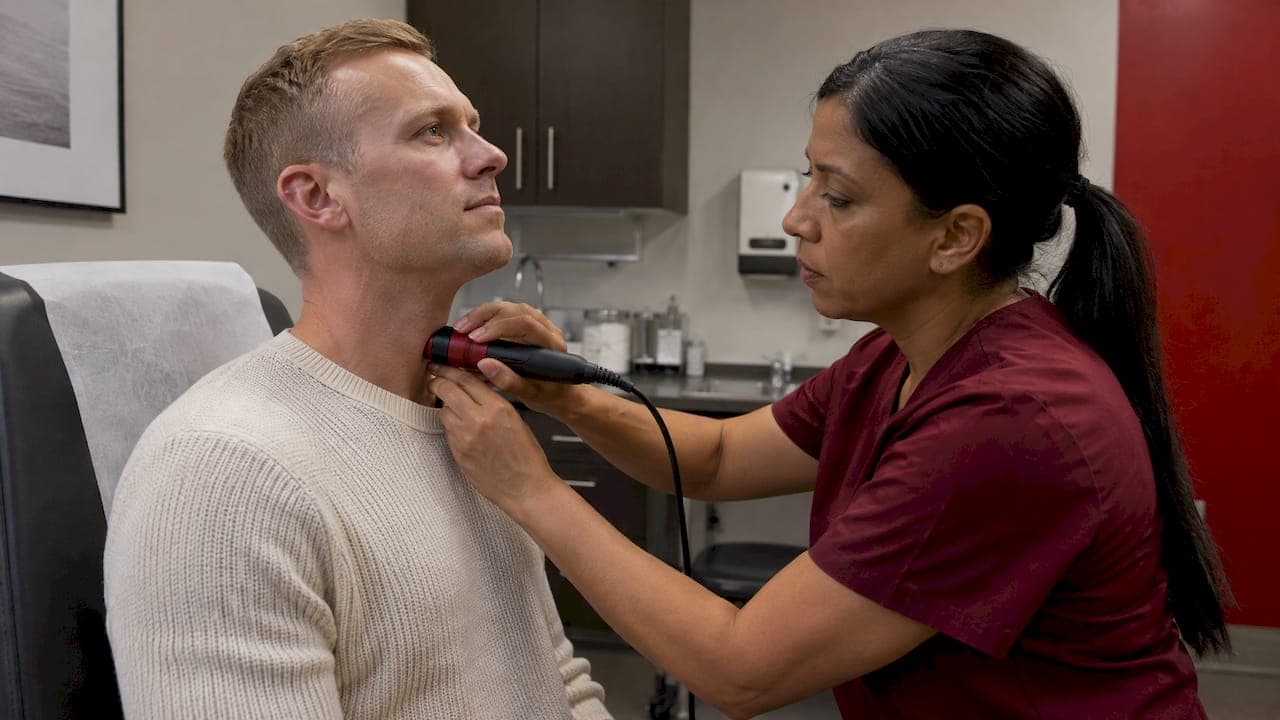
Some small clinical trials suggest that red and near-infrared light aimed at the thyroid can improve certain markers in people with Hashimoto's. Those trials used clinical laser protocols, not a general wellness device. They also did not replace thyroid medication. Light may be a promising add-on. It is not a substitute for levothyroxine, and it is not a fix you try in place of getting your labs checked.
That is the straight answer. Below, we walk through what the studies did, what they found, what they did not find, and how to think about it if you are a man in your 30s, 40s or 50s who is tired, flat and wondering whether your thyroid is part of the story. Or if you are the wife or partner trying to work out why he is not himself.
TL;DR
- Small trials using near-infrared laser over the thyroid found lower thyroid antibody levels and, in one, lower levothyroxine dose needs in Hashimoto's patients.
- A 2026 sham-controlled study reported less fatigue and better sleep in Hashimoto's patients after photobiomodulation.
- A 16-week home LED neck study in healthy women found no significant changes in thyroid tests or ultrasound. Safety in people with known thyroid disease still needs study.
- Medication stays the primary treatment for hypothyroidism. Never stop or change a dose because of a light session.
- Low energy and low drive have many causes. Get your TSH checked before you guess.
Table of Contents
- What "red light on the thyroid" actually means
- What the clinical studies found
- What the studies do not tell you
- Is it safe to point red light at your neck?
- Tired, flat, low drive: is it your thyroid?
- How light fits into a restoration routine
- Our perspective
- Ready to build a routine you can stick with?
- FAQ
- Sources
What "red light on the thyroid" actually means
When people search this topic they usually picture a panel on a wall, pointed at the front of the neck. The research looks different.
Most of the thyroid studies used low-level laser therapy, also called photobiomodulation (PBM). The light was near-infrared, in the 800 to 830 nm range, delivered at specific points over the gland by a trained clinician. Visible red light sits lower on the spectrum, around 630 to 660 nm, and it does not travel as deep. Near-infrared penetrates further, which is why the thyroid work leans on it.
So "red light" in the headline and "near-infrared laser" in the study are not the same thing. Wavelength, power, the number of treatment points and the schedule all matter. If you want the full breakdown of how the two differ, we wrote it up in red light therapy vs infrared.
The mechanism people point to is simple enough. Light at these wavelengths is absorbed by the mitochondria, the energy plants inside your cells. The idea is that cells with a stronger energy supply can do their job better. That is a hypothesis the studies are testing, not a settled fact.

What the clinical studies found
There are not many trials, and they are small. But they are real, and they are worth knowing.
The randomized trial in hypothyroidism
The most cited one is a randomized, placebo-controlled trial of patients with chronic autoimmune thyroiditis who had developed hypothyroidism. It used 830 nm light at 50 mW. The laser group needed lower levothyroxine doses, had lower TPOAb levels and showed greater thyroid echogenicity on ultrasound. TgAb levels did not differ between groups.
TPOAb is the antibody most tied to Hashimoto's. Lower numbers are encouraging. Greater echogenicity on ultrasound suggests the tissue looked healthier. But this was one trial, in one setting, with a clinical laser.
The 2023 trial with supplements
A 2023 non-randomized clinical trial from Kosovo compared PBM plus vitamin D and selenium against supplements alone. The PBM group improved on thyroid measures, weight, BMI and antibody levels more than the supplement-only group. The protocol used 820 nm light at 200 mW and 32 J/cm² per point, twice a week for three consecutive weeks, across eight points over the thyroid area.

Notice how specific that is. Eight points. Three weeks. A defined dose per point. That is a clinical protocol, and it is the opposite of "wave a panel at your neck whenever you remember."
The 2026 sham-controlled study on fatigue
Fatigue is the complaint that brings most men to this topic, so this one matters. A randomized, sham-controlled study from Turkey, published in 2026, indicated that PBM reduced fatigue severity, improved sleep quality and improved behavioral status in people with Hashimoto's compared with sham treatment.
A sham control is the gold standard here. It means the comparison group sat through a treatment that looked the same but delivered no active light. That helps rule out the placebo effect.
At a glance
| Study | Light | Who | What it found |
|---|---|---|---|
| Randomized, placebo-controlled trial | 830 nm laser, 50 mW | Hypothyroidism from chronic autoimmune thyroiditis | Lower levothyroxine need, lower TPOAb, greater echogenicity; no TgAb difference |
| 2023 non-randomized trial, Kosovo | 820 nm, 200 mW, 32 J/cm² per point | Hashimoto's, with vitamin D and selenium | Better thyroid measures, weight, BMI and antibodies than supplements alone |
| 2026 randomized sham-controlled study, Turkey | Photobiomodulation | Hashimoto's | Less fatigue, better sleep and behavior scores than sham |
What the studies do not tell you
Here is where we stay honest, because you deserve that.
These trials are small. Most used clinical lasers at set doses over defined points. None of them tested a consumer red light panel as a treatment for a thyroid disease. And they studied people already diagnosed and under care, not men guessing at the cause of their tiredness.
A systematic review on PBM in chronic autoimmune thyroiditis reached a similar conclusion: randomized, sham-controlled trials are still needed before it can be used clinically. So the right reading is "promising and worth watching," not "proven cure."
Hypothyroidism has a standard treatment, and it works. The American Thyroid Association says clinical hypothyroidism is treated with levothyroxine, with the dose adjusted based on TSH levels. It also notes that Hashimoto's can progress slowly, which is why monitoring TSH over time matters.
If you take thyroid medication, keep taking it. If a light routine ever changes how you feel, your prescriber is the one who adjusts the dose, based on labs. Not you, and not an app.
Is it safe to point red light at your neck?
This is the question behind most of the searches. The honest answer has two parts.
Healthy thyroid, home LED. A 2021 prospective study in South Korea followed 30 women without known thyroid disease who used a home-use LED neck device (630 nm and 850 nm) daily for 16 weeks. Thyroid tests and ultrasound showed no significant changes. The authors concluded it did not appear to harm the gland in healthy adult women. They also said safety in people with known thyroid disease needs further study.
Longer term, laser. A six-year follow-up from Brazil compared low-level laser and placebo groups. Thyroid nodule frequency and antithyroid antibody levels were similar between groups, and no malignant nodules were seen.
That is reassuring. It is not a license to be careless. Any light device can cause problems when it is misused. The FDA's adverse-event database includes a user report of facial skin blistering after using a red-light device, even though the user said they followed the instructions. It is one report, not a statistic, but it is a reminder to respect distance, time and dose.
Practical safety rules
- Know your condition first. If you have a thyroid nodule, a history of thyroid cancer or an active thyroid problem, ask your endocrinologist before pointing any light device at your neck.
- Protect your eyes. Neck sessions put a bright source close to your face. Read our guide on red light eye safety and use eye protection.
- Keep sessions short and consistent. More is not better. Our piece on red light overexposure explains when dose becomes a problem.
- Know the exclusions. Some conditions and medications call for caution. Review the red light therapy contraindications before you start, and see our clinician questions on contraindications.
- Follow the basics. Our home red light safety rules cover distance, timing and skin checks.
Skin redness, warmth or irritation are the most common complaints with any light device. We cover them in red light therapy side effects.
Tired, flat, low drive: is it your thyroid?
Here is the part most thyroid articles skip.
Fatigue, slow recovery, brain fog, low mood and a fading sex drive can come from the thyroid. They can also come from low testosterone, poor sleep, stress, a bad diet, too many hours at the desk, or a combination. The symptoms overlap. That is why guessing is a bad plan.
The move that actually helps is simple:
- Ask for labs. TSH is the standard starting point for the thyroid. Ask your doctor whether a full panel makes sense for you.
- Ask about testosterone too. If you are a man over 30 with low drive and energy, a thyroid result alone may not explain it.
- Write down the pattern. When did it start? Is sleep part of it? Is it every day or in waves?
- Then build the routine. Sleep, strength training, food, daylight and, if you choose, light.
If you are a wife or partner reading this: you are not imagining the change. Tiredness, distance and a short fuse deserve a real answer. Encourage him to book the labs. It is a small ask, and it takes the guessing out of the room.
How light fits into a restoration routine
You will see sites claiming red light "heals" the thyroid. We do not make that claim, and the research does not support it. What the research supports is narrower: in specific clinical settings, near-infrared light showed promise on thyroid markers and fatigue, alongside standard care.
What we can say is how we think about light in a daily routine. Dose matters. Consistency matters. A device that delivers a measured, repeatable session beats a lamp used at random. Our guide to precision red light protocols explains how the energy numbers work, and red light therapy science gives the bigger picture. If mood is your main complaint, read why bright light still leads first.
Our perspective
We hear from men every week who say the same thing: "I'm not sick. I'm just not me." Then they hear the answer is a prescription, or nothing at all.
Here is where we stand. Get your labs. If your thyroid needs medication, take it. That is not up for debate, and no device replaces it.
But labs are not the whole story. A lot of men sit in the gap between "normal range" and "feeling like myself." Energy that used to come automatically now takes effort. Recovery drags. The signal feels quieter. That gap is where a daily restoration routine belongs.
RedRockit was built for that gap. It is a private-use red light wellness device designed to support a simple routine, with the Rockit IQ app guiding your sessions. It is not a clinic. It is not TRT. It does not diagnose or treat a thyroid condition. It is a tool for men who want to protect what they still have and do something before bigger decisions are on the table.
YOU HAVEN'T LOST IT. You may just need to give your body a better signal, and keep showing up for it.
Nurse Rachel
Ready to build a routine you can stick with?
RedRockit is designed for men over 30 who want a daily restoration routine without subscriptions, appointments or a pharmacy run. It comes with a lifetime craftsmanship guarantee and a companion app for guided session protocols.

See RedRockit Primal Restoration. Not sure where you are in the process? Start with what to try before TRT or read about male vitality after 40.
FAQ
Does red light therapy help hypothyroidism?
In one randomized, placebo-controlled trial, patients with hypothyroidism from chronic autoimmune thyroiditis needed lower levothyroxine doses after clinical laser therapy. That is encouraging, but it is a single small trial. Light is not a replacement for medication, and only your prescriber should change a dose.
Is it safe to use red light near the thyroid?
A 16-week study of a home LED neck device in 30 healthy women found no significant changes in thyroid tests or ultrasound. Safety in people with known thyroid disease needs more study. If you have a thyroid condition or nodule, ask your endocrinologist before you try it.
Can red light therapy help Hashimoto's fatigue?
A 2026 randomized, sham-controlled study reported less fatigue and better sleep in people with Hashimoto's after photobiomodulation. It used a clinical protocol, not a general wellness device. Treat it as promising early evidence, and keep up your regular thyroid care.
Where should you not use red light therapy?
Keep light away from your eyes, and use eye protection when sessions are near the face or neck. Avoid areas of unexplained skin changes or lumps until a clinician has checked them. If you take medications that make you sensitive to light, or have a thyroid, skin or eye condition, ask your doctor first.
Could my low energy be low testosterone instead of my thyroid?
It could be either, or both, or neither. Thyroid problems and low testosterone can look alike, and sleep and stress can mimic both. Ask your doctor for the right labs rather than guessing.
Sources
- Low-level laser in the treatment of patients with hypothyroidism induced by chronic autoimmune thyroiditis (randomized, placebo-controlled trial)
- Efficacy of combined photobiomodulation therapy with vitamin D and selenium (2023)
- The effect of photobiomodulation therapy on fatigue in Hashimoto's thyroiditis (2026)
- The use of a light-emitting diode device for neck rejuvenation and thyroid safety (2021)
- Safety and efficacy of low-level laser therapy, six-year follow-up
- American Thyroid Association: Hashimoto's Thyroiditis
- FDA MAUDE adverse event report, red-light device