
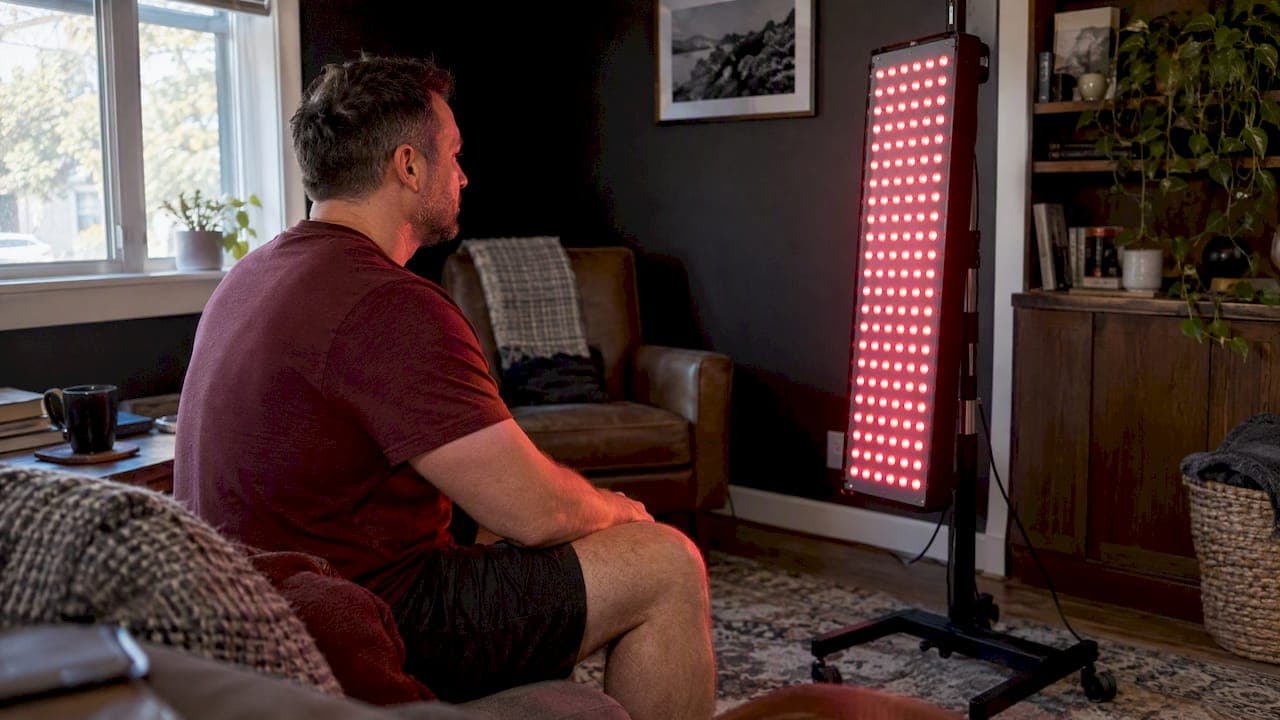
Red and near-infrared light, known as photobiomodulation (PBM), looks promising for low mood, but it is still emerging. A 2024 meta-analysis and the ELATED-2 pilot trial point to real signals, while bright-light therapy remains the established standard for seasonal depression. Treat PBM as an experiment, not a replacement. With clinical depression or bipolar history, talk to a clinician first.
TL;DR:
- A 2024 meta analysis found lower depression scores with PBM than sham (SMD = −0.55), but rated evidence quality moderate to very low.
- ELATED 2 used 823 nm light twice weekly for eight weeks; its effect size reached 1.5 among completers in a small pilot.
- For seasonal depression, bright light therapy remains first line: a 10,000 lux box for 20 to 45 minutes each morning from fall to spring.
- People with bipolar disorder, eye disease, or medications that heighten light sensitivity need clinician guidance before treatment because light can affect mood or vision.
Table of Contents
- What does the evidence say about red light therapy and mood?
- How may red light change mood in the brain?
- What did ELATED-2 and the systematic reviews measure?
- How does red light compare with bright-light therapy?
- Who has been studied, who might benefit, and what should you watch for?
- What wavelengths, doses and session lengths do trials use?
- How do you use red light safely at home and set realistic expectations?
- What mood and energy benefits do men over 30 report?
- How can red light fit into a daily restoration routine for vitality and drive?
- Does red light work differently for men than for the general population?
- How should you combine red light with sleep, food and exercise?
- What do men ask most about red light for mood?
- Which hormonal and brain chemistry changes might red light influence?
- A realistic place for red light in your routine
- Where does RedRockit fit if you want to try this at home?
- FAQ
- Sources
What does the evidence say about red light therapy and mood?
Here is the fast snapshot. Early trials and pooled reviews lean positive, but the studies are small, the protocols differ, and nobody has locked down one dose. That is the honest state of play.
- Meta-analyses report that PBM lowered depressive symptoms compared with sham treatment, which is a fake session using a switched-off or inactive device.
- Transcranial PBM trials, including the ELATED-2 pilot, reported medium to large effects, but with small samples that need replication.
- Reviewers grade the overall quality as mixed because of varied wavelengths, doses, session schedules and follow-up periods.
- Most trials studied people with diagnosed depression, not healthy men who simply feel flat.
A 2024 meta-analysis of randomized controlled trials found PBM reduced depression symptoms (SMD = −0.55, 95% CI −0.75 to −0.35), yet rated the evidence quality as moderate to very low. That gap matters. A real effect size paired with shaky certainty means "worth watching," not "proven."
A separate systematic review points the same direction: red and near-infrared stimulation looks low-risk and shows antidepressant effects in animal and human studies, but clinical protocols vary and large standardized trials are scarce.
So if you wondered whether red light for mood is hype or science, it is both. The science is real and early. The hype runs ahead of it.
How may red light change mood in the brain?
Think of your cells as tiny power plants. The leading model says red and near-infrared light is absorbed by an enzyme in your mitochondria called cytochrome c oxidase. That nudges the cell to make more ATP, its basic fuel.
From there, the proposed chain reaction looks like this:
- Better energy supply in brain cells, especially in the prefrontal cortex, which helps regulate mood and drive.
- Improved cerebral blood flow.
- Less neuroinflammation.
- Possible increases in brain-derived neurotrophic factor (BDNF), a protein tied to the growth and survival of neurons.
A 2024 review lists these mechanisms, including reduced inflammation, inhibition of apoptosis (programmed cell death) and promotion of neurogenesis. Most of that comes from lab and early clinical work, so read it as a working theory.
Delivery matters too. Transcranial PBM aims light at the head to reach the cortex. Systemic PBM treats larger areas of the body and relies on indirect effects. Longer wavelengths generally travel deeper through tissue, which is why trials favor near-infrared for brain targets.
Now the contrast. Bright-light therapy does not work this way. Experts describe it as acting through the eyes, shifting circadian rhythm and monoamine pathways. PBM, by contrast, does not need your retina at all, as mechanistic work notes.

Pro Tip: When you read a product claim about "mitochondria" or "cellular energy," ask which trial used that wavelength and dose. A good mechanism story is not the same as a tested protocol.
What did ELATED-2 and the systematic reviews measure?
Let's look closer at the studies, because details decide whether a result applies to you.
The ELATED-2 pilot trial was a double-blind, sham-controlled study of transcranial PBM for major depressive disorder. It used 823 nm light delivered to the bilateral dorsolateral prefrontal cortex, twice a week for 8 weeks. Participants tolerated it well.
In completers, the ELATED-2 pilot reported a large effect size, with Cohen's d up to 1.5, on depression ratings. Notice the phrase "in completers." People who finished the course did best, and a pilot trial is small by design. Treat that number as a reason to run bigger studies, not as a promise.
Here is what the broader literature adds:
- Pooled results: The 2024 meta-analysis above found a moderate pooled benefit but graded the evidence as moderate to very low.
- Subgroup signals: The same analysis suggested systemic and transcranial PBM protocols can produce different response patterns.
- Delivery factors: A 2024 systematic review of near-infrared stimulation called the approach promising, even comparable to medication in preliminary results, while urging more trials and standardized protocols.
- Cumulative dosing: Trial data suggest benefits often build over 15 to 30 treatments across weeks, not after a single session.
Then the limits, stated plainly. Samples are small. Parameter reporting is inconsistent, so you often cannot tell exactly how much light reached the brain. Follow-up is short, so we know little about what happens months later. Blinding is tricky too, since people can sometimes feel warmth from a real device.
None of that kills the field. It does mean a confident "this treats depression" would run past the data.
How does red light compare with bright-light therapy?
Different tools, different jobs. Bright-light therapy (BLT) has the deeper track record. A review of bright light therapy describes it as a first-line, evidence-backed treatment for seasonal affective disorder, with multiple RCTs and meta-analyses showing meaningful remission rates.
The National Institute of Mental Health describes the standard setup as a roughly 10,000 lux light box used about 20 to 45 minutes each morning from fall to spring. It also advises clinical oversight for people with eye disease or bipolar disorder.
Red light is a different story for seasonal mood specifically. A network meta-analysis of visible light for SAD found white light most effective, with red light less supported in the available comparisons.
- Pick BLT first when: your low mood follows the seasons, worsening in fall and winter and lifting in spring. Work with a clinician on timing and device choice.
- Consider PBM as an experimental add-on when: low mood is persistent and not seasonal, and you have already discussed it with your care team.
- Keep in mind: PBM trials in major depression are earlier-stage, and a systematic review of transcranial and systemic PBM found results depend heavily on parameters.
Plain version: BLT is the proven first move for seasonal patterns. PBM is the interesting newcomer for the rest, and it earns its place through more trials, not louder marketing.
Who has been studied, who might benefit, and what should you watch for?
Researchers have tested light approaches in people with major depressive disorder, seasonal affective disorder, insomnia with mood symptoms and mood changes after traumatic brain injury. Healthy men with a rough month were not the main subjects, so keep that in mind when you read a headline.
Tolerability looks good. In trials, reported side effects were mild and transient, mostly fatigue or a mild headache, and clinical PBM work often used wavelengths in the 800 to 950 nm range.
- Bipolar disorder: light treatments can trigger mania or hypomania in susceptible people. Yale's guidance says bright-light therapy should be supervised by a clinician experienced in mood disorders.
- Medications and eye conditions: anything that makes you sensitive to light, or any eye disease, calls for a clinician's input first.
- Timing and context: a randomized study of red light before bedtime found it affected alertness and, in some participants, increased negative emotions or anxiety. When you use it matters.
- Monitoring: serious adverse events were rare, but check in with yourself and someone you trust if your mood swings in either direction.
Pro Tip: If you notice unusual irritability, racing thoughts or sleeplessness after starting any light routine, stop and call your clinician. Do not push through.
We also lay out device basics in our guide to home red light safety rules, and you can read about red light therapy side effects if you want the long version.
What wavelengths, doses and session lengths do trials use?
Researchers describe red light as roughly 600 to 750 nm and near-infrared as roughly 800 to 950 nm and beyond. Brain-focused trials lean toward the near-infrared end. The ELATED-2 protocol used 823 nm, and our guide to red light versus infrared explains how those bands differ.
- Wavelength: many clinical transcranial studies sit in the near-infrared range, with ELATED-2 at 823 nm.
- Dose: a 2024 review cites typical safe literature ranges of 4 to 30 J/cm² fluence and 5 to 50 mW/cm² irradiance for brain-targeted PBM, though protocols vary by study.
- Schedule: ELATED-2 ran twice weekly for 8 weeks, and other trials stacked 15 to 30 treatments over several weeks.
- Caveat: tissue thickness, age and device output all change the dose that actually reaches the target.
One published review lists fluence of 4 to 30 J/cm² and irradiance of 5 to 50 mW/cm² for brain-targeted PBM, and no single protocol has been validated. Read that last part twice. A device spec sheet that matches the trials is a starting point, not a prescription.
How do you use red light safely at home and set realistic expectations?
Trials needed weeks of consistent sessions, so a home plan should look like a routine, not a one-off.
- Check the device specs: wavelength and irradiance should be stated, not hidden behind vague wellness language.
- Avoid shining intense light into your eyes unless the device was designed for that. PBM does not require retinal exposure.
- Follow the manufacturer's session guidance and any limits your clinician sets.
- Track your mood with a simple 1 to 10 daily score or a short diary, and review it every two weeks.
- Ask your clinician whether the device fits your diagnosis and medications, and whether you need monitoring for mania.
Pro Tip: Write down your baseline before your first session. Without a starting point, you cannot tell a real shift from a good weekend.
For a deeper look at the habit side, our science guide for men over 30 walks through the basics.
What mood and energy benefits do men over 30 report?
Let's be careful here. The controlled trials above are mostly in people with diagnosed depression, not in men over 30 tracking their drive. So what follows is what men tell us and what research hints at, not a clinical result.
Men over 30 who try consistent red light routines may be interested in how the routine affects their energy, mood and motivation. Some also mention better recovery after training, which can lift mood on its own.
Why would that be plausible? Cellular energy, blood flow and inflammation all connect to how you feel. If the mitochondrial model holds up, better energy supply could show up as better energy. But "plausible" is not "proven," and a placebo response is real in any wellness routine.
What we can say: these reports are experiences, not trial outcomes. If your low mood comes with loss of interest, trouble sleeping or hopelessness lasting more than a couple of weeks, that is a clinical question, not a gadget question. Get checked.
How can red light fit into a daily restoration routine for vitality and drive?
You do not need a complicated system. You need one you will actually keep doing.
Anchor it to something you already do. Many men use the same time each day, such as after the morning workout or in the early evening, because consistency is the one thing the trials clearly demand. Given the bedtime study mentioned earlier, avoid assuming late-night sessions are harmless for your sleep; test your own response.
A simple frame:
- Morning: daylight outdoors, movement, then your light session if that suits you.
- Midday: food and a walk, not another screen.
- Evening: wind down, dim the lights, and keep a stable bedtime.
That is the heart of a restoration routine: small, repeatable inputs that stack. Red light is one piece, not the whole house. Our red light recovery routines show how men build this around real schedules.
Keep it modest. Track how you feel over time. If nothing changes, adjust or stop. Drive does not come back from one tool. It comes back when sleep, movement and recovery stop fighting each other.
Does red light work differently for men than for the general population?
Short answer: we do not know, because the trials were not built to answer that.
The pooled results cited earlier come from mixed groups of participants. They did not split out men over 30 as a distinct category with its own effect size. So any claim that red light works better or worse for men specifically goes beyond the evidence.
What differs for men is context, not proven biology. Men are often less likely to bring up low mood, more likely to push through, and more likely to frame it as "low energy" or "no drive." That framing can delay care. It also shapes what men notice and report, which affects how any intervention looks in real life.
Age matters too. Trial reviews note that age and device type influenced the energy delivered to targets, and tissue changes with age. That applies to men and women alike, but it is a fair reason to expect that dose and consistency matter for you.
Bottom line: use the general-population evidence as your guide, treat men-specific claims with suspicion, and judge results on your own tracked numbers.
How should you combine red light with sleep, food and exercise?
Lifestyle does the heavy lifting for mood. Light is the add-on.
Sleep: protect a regular bedtime and wake time. A light routine that wrecks your sleep is a net loss, and the bedtime red light study is a reminder that timing can cut either way.
Exercise: regular training is one of the most reliable mood tools you have. Pair a session with your workout if that helps you stay consistent, and treat the light as recovery support, not a substitute for effort.
Nutrition: steady meals with real protein keep energy from swinging. Heavy alcohol and long gaps between meals tend to sabotage mood, whatever device you own.
Daylight: a morning walk outside does more for your circadian rhythm than most gadgets. For seasonal patterns, that is where bright-light therapy comes in, as covered above.
Stack habits in this order: sleep first, movement second, food third, light fourth. If you reverse that list, you will chase a small effect while ignoring the big ones.
What do men ask most about red light for mood?
We hear the same questions again and again. Here are straight answers.
"Will it fix how I feel?" Maybe not alone. The evidence supports "promising adjunct," not "cure." Plan for weeks, not days.
"Is it safe?" Trials reported mild, transient effects such as fatigue or a mild headache. Bipolar history, photosensitizing medications and eye conditions need clinician input first.
"How long until I notice something?" Trial protocols ran twice weekly for 8 weeks, and many used 15 to 30 sessions. Expect a slow build, if it comes at all.
"Is the dose I see on a spec sheet the dose that reaches my brain?" Not necessarily. Skull thickness, hair, distance and device output all change delivery.
"Should I stop my medication or therapy?" No. Do not change prescribed treatment without your clinician. Red light is something to discuss, not something to swap in.
"What if I feel worse?" Stop and call your clinician, especially for agitation, racing thoughts or poor sleep.
Our partner's overview of photobiomodulation benefits and dosage gives another outside perspective on session formats if you want to compare notes.
Which hormonal and brain chemistry changes might red light influence?
Here is where we stay disciplined. The mood-related mechanisms with the most published support are cellular and neural, not hormonal.
The proposed brain-side effects, covered in a 2024 review, include more cerebral blood flow, reduced inflammation, protection against cell death, support for neurogenesis and higher BDNF. These come mostly from preclinical and early clinical work.
On hormones, we have no trial in our sources showing that red light changes testosterone, cortisol or other hormone levels in men over 30. So we will not claim it does. Many men ask about cortisol and stress physiology, and the honest answer is that it remains an open research question here.
What you can reasonably connect: poor sleep, chronic stress and low energy all affect mood and hormones together. A routine that improves recovery may help you feel better through those indirect routes, even if the light itself never touches your hormones.
If you are worried about low testosterone, ask for bloodwork and a proper conversation. We cover what men should understand before that step in our guide on how to increase testosterone. That is education, not a diagnosis.
A realistic place for red light in your routine
Here is where I land after years at the bedside with men who felt the drift but did not want to say it out loud. Red light is a tool, not a verdict on you. If you feel flatter than you used to, you have not failed. You have a signal worth listening to.
Use PBM like you would any other daily habit: consistently, with measured expectations, next to sleep, training and good food. Keep a clinician in the loop if your mood is heavy or you have any bipolar history. Skip the miracle talk. Do the boring work, track what changes, and adjust.
That is how men stay in the game for their family, their work and themselves.
— Nurse Rachel
Where does RedRockit fit if you want to try this at home?

If you want a structured way to build that routine, we made RedRockit for exactly this. RedRockit™ Primal Restoration is a private-use red light wellness device for men over 30, built as a non-pharmaceutical, at-home restoration tool. It has no subscriptions and no medical appointments attached.
To be clear about what it is: RedRockit is a wellness device, not a clinic, not TRT and not a treatment for depression. We make no claim that it cures anything or outperforms clinical care.
Here is how it supports the consistency the research keeps pointing to:
- A simple daily routine you can keep, instead of a protocol you abandon early.
- Guided session structure through our companion app, so you are not guessing at timing.
- A private, at-home setup that fits around work and family.
If you want protocol details before you buy, read our RedRockit Activation Method page. When you are ready, start with the RedRockit device page, check availability and pick up your routine this week.
FAQ
Does red light therapy change your mood?
It may, but the evidence is still early. A 2024 meta-analysis found PBM reduced depressive symptoms compared with sham, though it rated the evidence quality as moderate to very low. Trials mostly studied people with diagnosed depression.
Why do I feel good after red light therapy?
Several things may play a role: relaxation, a consistent routine, the placebo response and possibly cellular effects on energy and blood flow. The mitochondrial model is still a working theory. Timing matters too, since evening red light affected alertness and emotions differently across participants in one study.
What are the downsides of red light therapy?
Trials reported mild, short-lived effects such as fatigue or a mild headache, as clinical PBM reviews note. The bigger caution is bipolar disorder, where light treatments can trigger mania, so clinician oversight matters. Results also depend on dose, which no single protocol has settled.
Does red light reduce cortisol levels?
We have no trial in our evidence base showing that red light lowers cortisol in men or anyone else, so we will not claim it does. Mood effects studied so far involve brain energy, blood flow and inflammation. If stress hormones worry you, ask a clinician about testing.
Sources
- Pmc
- Photobiomodulation improves depression symptoms: a systematic review and meta-analysis of randomized controlled trials
- Bright Light Therapy: Seasonal Affective Disorder and Beyond