
The two wavelength bands that matter are red light at roughly 630 to 660 nanometers and near-infrared at roughly 830 to 850 nanometers, and everything else in a good protocol flows from those numbers. Most men do well starting with moderate session lengths a few times per week, tapering to fewer maintenance sessions once results show up. Dosing is what actually drives results, not just time in front of the panel, and it depends on your device's irradiance and the biphasic dose response curve, where more light stops helping and starts working against you. Protect your eyes, skip active tumors, and check with a clinician if you're on photosensitizing medication or pregnant.
TL;DR:
- Red light therapy devices should specify wavelengths precisely in nanometers, ideally around 630-660 nm for red and 830-850 nm for near-infrared, for effective mitochondrial absorption.
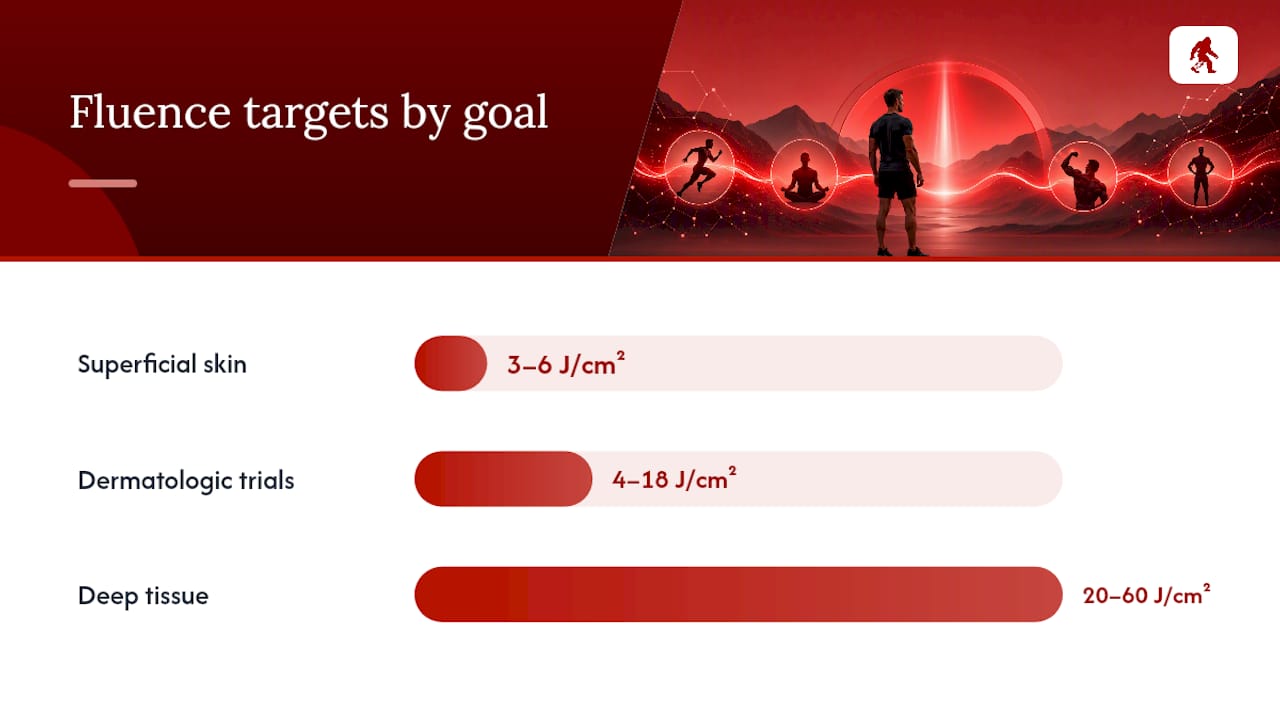
- The actual energy dose, measured in joules per square centimeter, depends on irradiance and session duration, not just time in front of the panel, with targets varying by goal from 3-6 J/cm² for skin to 20-60 J/cm² for deep tissues.
- Overexposure signs include lingering redness and headache; doses should stay within the biphasic window to avoid counterproductive oxidative stress.
- Use higher irradiance panels at closer distances for deep tissue goals and follow phased schedules starting with frequent sessions, then tapering to maintenance once results appear.
- Verify device wavelengths, irradiance, and FDA clearance before purchasing, and ensure the protocol matches specific goals like skin rejuvenation, joint pain, or systemic recovery.
Table of Contents
- What Are the Best Red Light Protocols for Wavelength Selection?
- How Do You Calculate the Right Red Light Dose?
- What Red Light Protocol Fits Your Specific Goal?
- How Should You Schedule Sessions Over Weeks and Months?
- What Safety Rules Should Every Red Light Protocol Follow?
- How Do You Evaluate a Red Light Device Before Buying?
- What Do Real Red Light Protocols Look Like in Practice?
- What Would a Clinician Actually Tell You to Watch For?
- Why Precision Dosing Beats the "Just Sit There" Approach
- How RedRockit Fits Into a Real Red Light Protocol
- Where to Verify These Red Light Protocols Yourself
- Sources
- FAQ
What Are the Best Red Light Protocols for Wavelength Selection?
Your body doesn't respond to red light the way it responds to sunlight. It responds to specific wavelengths absorbed by specific structures inside your cells, and if the wavelength is wrong, the light just bounces off or gets absorbed by something that doesn't do anything useful with it.
Here's the mechanism, kept simple: your mitochondria contain a molecule called cytochrome c oxidase, sometimes shortened to CCO. This molecule absorbs light most efficiently in two narrow windows. One sits in the red range, roughly 630 to 660 nanometers. The other sits in the near-infrared range, roughly 830 to 850 nanometers. When CCO absorbs light in these bands, it kicks off a chain of cellular events tied to energy production and repair signaling. Outside those windows, the effect drops off fast. A review published in PMC confirms these are the two dominant bands used across photobiomodulation research, and flags differential tissue penetration as the reason both bands matter.
That penetration difference is the whole game when you're choosing a protocol.
- Red light (630 to 660 nm) stays mostly in the epidermis and upper dermis. It's the band you want for skin tone, collagen support, and surface healing.
- Near-infrared (830 to 850 nm) pushes deeper, reaching muscle, tendon, and joint tissue several centimeters below the surface, according to the same PMC review.
- Combined panels (660 + 850 nm) cover both depths in one session, which is why most serious at-home devices ship with both diodes rather than one or the other.
Think of it like choosing between a headlamp and a floodlight. Red light is your headlamp, precise and surface-focused. Near-infrared is the floodlight that reaches the stuff you can't see. If your goal is visibly better skin, red alone might do the job. If you're chasing joint pain, sore shoulders, or anything happening under the skin, you need the near-infrared band doing the heavy lifting, and you probably want both bands firing at once so you're not treating two problems with half a solution.
This is also where a lot of cheap devices cut corners. Some panels advertise "red light therapy" without disclosing which wavelength they actually emit, or they blend LEDs so far outside the 630 to 850 nanometer windows that you're getting light, just not the kind your mitochondria care about. Cleveland Clinic's overview notes that red light therapy shows real promise but that evidence quality varies enormously by device and protocol, which is exactly why wavelength transparency matters before you even think about session length.
Pro Tip: If a product page doesn't list exact wavelengths in nanometers, treat that as a red flag, not a minor omission. "Red light" and "near-infrared" are marketing words. 660 nm and 850 nm are engineering specs, and only the specs tell you what your cells are actually getting.
How Do You Calculate the Right Red Light Dose?
Session length by itself tells you almost nothing. What matters is fluence, the total energy density your skin actually absorbs, measured in joules per square centimeter (J/cm²). Two people using the same device for the same 10-minute can get wildly different doses depending on how far they sit from the panel, because distance changes irradiance dramatically.
The formula is simple enough to do in your head:
J/cm² = (mW/cm² × seconds) / 1000
Irradiance, measured in milliwatts per square centimeter (mW/cm²), is how strong the light is at a given distance. Fluence is what you get once you multiply that strength by time. A device sitting close to your skin might deliver 200 mW/cm², while the same device six inches farther back might only deliver 50 mW/cm², because halving your distance from a panel roughly quadruples the irradiance you receive. That single fact explains why two guys with the "same" device can get completely different results, and why blanket advice like "just do 10 minutes" falls apart in practice.
By the Numbers: At 50 mW/cm², a 10 minute session delivers 30 J/cm² (50 × 600 / 1000). At 200 mW/cm², that same 10 minutes delivers 120 J/cm², four times the dose from the exact same time commitment. Distance and irradiance, not the clock, are what determine your actual dose.
Clinical ranges give you a target to aim for, backed by dosing summaries in the photobiomodulation literature:
- Superficial skin goals (tone, fine lines, surface healing): roughly 3 to 6 J/cm²
- Dermatologic protocols studied in clinical trials: often 4 to 18 J/cm²
- Deep tissue targets (joints, muscle, systemic recovery): roughly 20 to 60 J/cm²
Here's the part most guides skip entirely: more dose is not automatically better. Photobiomodulation follows what researchers call a biphasic dose response, sometimes referenced by the Arndt-Schulz principle. Below a threshold, light does nothing measurable. Within a window, it stimulates repair and energy production. Above that window, the benefit flattens out, and past a certain point it can actively work against you, triggering oxidative stress instead of reducing it. This is the single biggest thing that separates a well-run protocol from a wasted one. Piling on extra minutes because you assume "more light equals more healing" is exactly the trap the biphasic curve warns against. Warning signs of overexposure include unusual redness that lingers past an hour, headache after sessions, or skin that feels irritated rather than warm. If you notice any of that, cut your dose in half before your next session and see how your body responds.
What Red Light Protocol Fits Your Specific Goal?
A dosing range only becomes useful once you attach it to something you're actually trying to fix. Here's how the numbers translate across the goals men over 30 chase most.
- Skin and anti-aging. Use the 630 to 660 nm band, aiming for roughly 3 to 6 J/cm² per session. Clinical protocols summarized in the PMC review show measurable improvements in collagen density and skin elasticity with sessions lasting several minutes, done twice a week, sustained over multiple weeks. Skin responds slowly because collagen remodeling itself is slow. Give it the full stretch before judging results, and pair it with skin-support routines like the ones outlined in peptide-based skin protocols if you're stacking approaches.
- Hair support. Caps and helmet-style devices concentrate red and near-infrared light directly at the scalp, while panels require more deliberate positioning to get even coverage. Either way, patience is the real variable. Meaningful changes in hair density typically take 3 to 6 months of consistent 3 to 5 times a week session before you notice anything in the mirror.
- Muscle recovery and athletic performance. Timing matters as much as dose here. A short, lower-dose session before training can prime tissue and reduce perceived fatigue. A longer, higher-fluence session after training, in the 20 to 60 J/cm² range for deeper muscle groups, supports recovery. Don't stack both on the same muscle group in a single day without easing into it.
- Joint pain and arthritis. This is a near-infrared job, since red light won't reach deep enough to matter. Target the higher end of therapeutic fluence, closer to 40 to 60 J/cm², and space sessions out with at least a day of rest between them on the same joint to avoid overloading tissue that's already inflamed.
- Targeted men's-health protocols. Some smaller studies on targeted lower-abdomen exposure report modest testosterone increases, but the research base here is limited and effect sizes are small. These protocols call for short, deliberately localized exposures, not extended sessions, and they carry a real caution around temperature sensitivity and fertility. If you're actively trying to conceive or have any fertility concerns, talk to a clinician before adding targeted sessions to your routine.
How Should You Schedule Sessions Over Weeks and Months?
Jumping straight to twice-a-week maintenance mode skips the phase where most of your progress actually happens. A phased schedule gets you there faster and helps you avoid the plateau that comes from your tissue adapting to a dose that never changes.
Phase 1: Induction (weeks 1 to 4). This is where you push frequency to build momentum. Daily sessions or 5 times a week is standard here, especially for acute goals like joint pain or active skin concerns. Keep the dose within your target range for the goal, just increase how often you show up.
Phase 2: Consolidation (weeks 3 to 12, depending on the goal). Once you notice the early signs of response, whether that's less stiffness, calmer skin, or better energy, pull back to 3 to 4 times a week. This phase is where most of the visible change happens, because your tissue has had time to adapt to the stimulus without being overloaded by daily exposure.
Phase 3: Maintenance (ongoing). Drop to 1 to 2 sessions a week indefinitely. Practitioner guidance from Dr. Michael Ruscio backs this taper pattern directly, noting that daily use fits short induction periods well but long-term routines typically settle into 1 to 2 sessions weekly once the goal is met.
A few adjustment rules worth keeping in mind as you move through the phases:
- If your device has lower irradiance, you'll need longer sessions or more frequent ones to hit the same fluence targets as a higher-output panel.
- If you stop noticing new improvement for two to three weeks running, that's your body telling you it's time to shift phases, not push harder in the same one.
- Skin goals generally need longer consolidation phases than joint or muscle goals, since collagen remodeling runs on a slower clock than inflammation reduction.
What Safety Rules Should Every Red Light Protocol Follow?
Red light therapy has a strong short-term safety record, but "safe" doesn't mean "no rules apply." A few non-negotiables keep it that way.
- Wear eye protection with high-irradiance panels. Bright red and near-infrared light at close range can strain the retina over repeated sessions. Distance from the panel changes how much protection you actually need, so don't assume goggles are optional just because a device feels comfortable to look at directly.
- Check your medication list. Certain drugs increase photosensitivity, including some antibiotics, retinoids, and a handful of blood pressure medications. If you're on any of these, run your protocol by a clinician before starting.
- Avoid direct exposure over active malignancies. This is a firm line, not a gray area. If you have a known active tumor, don't aim light at that site without direct medical guidance.
- Pregnancy and abdominal exposure deserve extra caution. Full-body and targeted abdominal protocols should be discussed with a clinician first if pregnancy is a possibility.
- Pulse-frequency settings matter for photosensitive epilepsy. Devices offering pulsed modes, sometimes in the 10 to 40 Hz range, can pose a risk for people with photosensitive seizure disorders. Stick to steady, non-pulsed settings if this applies to you.
- Watch for overexposure signs. Lingering redness, headache, or skin irritation after a session means you overshot your dose. Cut your next session's fluence in half and rebuild from there.
For a deeper walkthrough of what qualifies as a genuine contraindication versus overcaution, Primal Red Co's clinician Q&A on red light contraindications breaks down the five questions worth asking before you start, and the home safety rules guide covers eye protection specifics in more depth.
Pro Tip: Keep a simple log for your first two weeks: date, distance from panel, session length, and how your skin or joint feels an hour later. This turns "I think it's working" into an actual pattern you can adjust, instead of guessing.
How Do You Evaluate a Red Light Device Before Buying?
Most red light marketing leans on vague, feel-good language because specific numbers invite scrutiny. Your job as a buyer is to force the specifics into the open.
Start by demanding exact wavelengths in nanometers, not just the words "red" or "infrared." Then demand irradiance figures in mW/cm² at a stated distance, since irradiance without a distance is meaningless. A device rated at 100 mW/cm² at two inches is a completely different product than one rated at 100 mW/cm² at twelve inches.
Regulatory status is your next checkpoint. Devices cleared through the FDA's 510(k) pathway are listed in the FDA's AccessGUDID database, and you can cross-reference specific trials tied to a device or its underlying technology through Clinicaltrials or PubMed. Primal Red Co's own breakdown of what FDA clearance actually means for men's devices is worth a read if you want the plain-language version of what these classifications do and don't guarantee.
Watch for these red flags:
- Product pages that use only cosmetic language ("glow," "radiance") with zero mention of wavelength or irradiance.
- Marketing that cites "clinical studies" without linking to a single one.
- No listed FDA status and no explanation of why.
- Session-time recommendations with no mention of distance, which makes the advice functionally meaningless given how much distance changes actual dose.
Device type should match your goal, not just your budget. Panels give you flexibility across multiple body areas and are usually the best all-around choice. Mats suit full-body, lower-irradiance systemic sessions. Caps are built specifically for scalp coverage and don't translate well to other uses. Pads work for small, localized targets like a single joint. Buying a cap for joint pain, or a pad for full-body recovery, is a mismatch no amount of session time will fix.
What Do Real Red Light Protocols Look Like in Practice?
Numbers mean more once you see them applied. Here are three sample protocols built around the dosing math already covered.
- Facial skin panel, combined 660 + 850 nm. Sit 6 inches from a panel rated around 100 mW/cm² at that distance. To land near the 6 J/cm² target for skin, run the math: 6 J/cm² × 1000 / 100 mW/cm² = 60 seconds needed for that exact fluence, but most real sessions build in a buffer and run 8 to 10 minutes to cover the full face evenly rather than one static spot. Clean, dry skin, no lotion or serum underneath, and eye protection throughout.
- High-irradiance panel for joint pain. Move closer, around 4 inches, where irradiance on a strong panel might read 200 mW/cm². To reach a deeper 40 J/cm² target: 40 × 1000 / 200 = 200 seconds, roughly 3 to 4 minutes per joint. Shorter sessions at higher irradiance get you to deep-tissue fluence faster than sitting farther back for longer.
- Full-body mat for systemic recovery. Mats typically run lower irradiance, often in the 20 to 40 mW/cm² range across a larger surface area, so sessions stretch to 15 to 20 minutes to accumulate meaningful fluence across major muscle groups. This protocol suits 3 to 4 times a week rather than daily use, since you're treating your whole system at once rather than one isolated spot.
Across all three, the same hygiene basics apply: bare, clean skin with no oils or lotions blocking absorption, consistent distance measured rather than eyeballed, and eye protection rated for the specific wavelengths your device emits. Primal Red Co's step-by-step at-home guide walks through setup details for readers building their first routine from scratch.
What Would a Clinician Actually Tell You to Watch For?
The men I talk to almost never ask about wavelengths first. They ask why they're tired, why recovery feels slower than it used to, or why something that used to bounce back in a day now takes three. Red light protocols support that recovery signal, but they're not a substitute for basic bloodwork if fatigue has been dragging on for months.
My checklist before starting a targeted protocol: understand your health baseline, consider medication impacts on photosensitivity, and seek specialist advice if symptoms persist despite consistent therapy.
Why Precision Dosing Beats the "Just Sit There" Approach
The biggest gap in most red light advice is the obsession with minutes instead of dose. "Do 10 minutes a day" sounds simple, but it ignores that 10 minutes at 4 inches and 10 minutes at 12 inches deliver wildly different fluence. That's not a nuance. It's the entire difference between a protocol that works and one that quietly does nothing.
Conventional wisdom also underrates the biphasic curve. Men chasing results tend to assume more exposure equals more benefit, and that assumption is where overuse and irritation creep in. The research doesn't support stacking dose endlessly. It supports hitting a defined range, consistently, over a phased timeline.
If you take one thing from this guide, make it this: learn your device's irradiance, do the math once, and build your schedule around fluence targets instead of a stopwatch. Everything else, wavelength choice, session frequency, phase timing, follows naturally once that number is locked in.
— Nurse Rachel
How RedRockit Fits Into a Real Red Light Protocol
Everything in this guide points to the same conclusion: results come from matching the right wavelength to the right depth and hitting a consistent, measured dose over time, not from vague minutes-based guesswork. The device discussed is designed to support a straightforward restoration routine without requiring clinical visits or prescriptions.

If you're the guy who read the dosing section and thought "okay, but how do I actually apply this without doing math every time," RedRockit's companion protocol resources are built for exactly that gap. The RedRockit Activation Method walks you through starter sessions that map to the phased schedule covered earlier, so you're not guessing at distance or timing on day one. It's a strong fit if your priority is energy, recovery, and drive rather than a single narrow skin or joint complaint. There's no subscription lock-in and no recurring appointment to manage, just a device and a guided routine you run on your own time. Check out the RedRockit Primal Restoration product page to see the full specs and decide if it matches what you're trying to fix.
Where to Verify These Red Light Protocols Yourself
Don't take any single guide's word for it, including this one. Cross-check wavelength and dosing claims directly against the sources.
- PMC's photobiomodulation product guide for wavelength and irradiance standards
- Cleveland Clinic's red light therapy overview for a balanced clinical summary
- Clinicaltrials to search active and completed trials by device or condition
- AccessGUDID to confirm FDA 510(k) clearance status on a specific device
Sources
- What to Look for in Red Light Therapy: A Product Guide Backed by Science - PMC
- Red light therapy (Cleveland Clinic)
- Clinicaltrials
FAQ
What Is the Best Protocol for Red Light Therapy?
There's no single universal protocol, but the strongest starting point combines 630 to 660 nm and 830 to 850 nm wavelengths at a dose matched to your goal, roughly 3 to 6 J/cm² for skin and 20 to 60 J/cm² for deeper tissue. Run sessions 3 to 5 times a week during your first month, then taper to 1 to 2 times a week once you notice results, following the phased approach Dr. Michael Ruscio outlines for at-home use.
What Are the Do's and Don'ts of Red Light Therapy?
Do measure your distance from the panel every session, wear eye protection rated for your device's wavelength, and start conservative with dose. Don't treat over active tumors, don't skip a medication check if you're photosensitive, and don't assume longer sessions automatically mean better results given the biphasic dose response.
Why Don't Some Doctors Recommend Red Light Therapy?
Many clinicians stay cautious because large-scale, standardized clinical trials are still limited, even though smaller studies show real promise. Cleveland Clinic's own overview acknowledges this evidence gap directly while still noting the therapy's generally strong short-term safety profile.
Is 10Hz or 40Hz Better for Red Light Therapy?
Neither frequency has a settled advantage backed by strong clinical consensus, and most standard red light protocols don't use pulsing at all, relying instead on steady, continuous light. If your device offers pulsed modes in the 10 to 40 Hz range, stick with steady settings unless a clinician has specifically recommended pulsing for your situation, especially if you have any history of photosensitive seizure activity.
How Long Before I See Results From a Red Light Protocol?
Timelines depend heavily on the goal: skin improvements typically take 4 to 12 weeks of consistent sessions, while hair density changes often need 3 to 6 months. Muscle recovery benefits can show up within a few sessions, since that response is more immediate than tissue remodeling.
Does RedRockit Follow These Same Dosing Principles?
RedRockit is designed around the same wavelength and dosing logic covered throughout this guide, giving men over 30 a structured way to apply red and near-infrared light without calculating fluence manually every time. Current specifications and details are available on the RedRockit product page.