
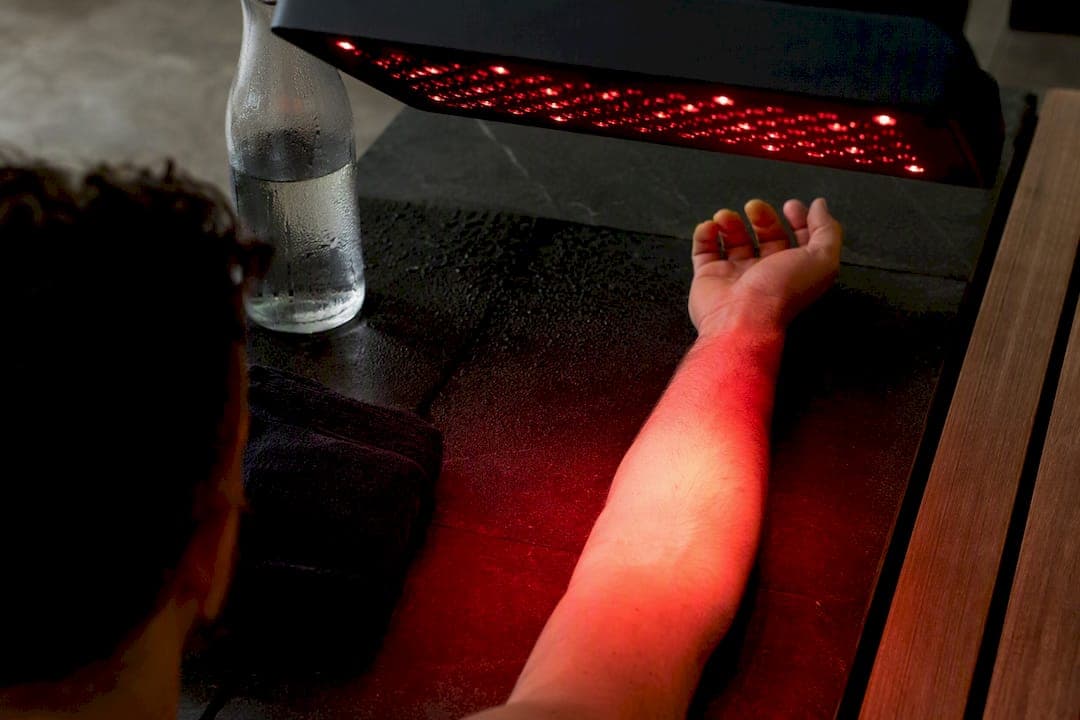
Red light and near-infrared light share the same cellular mechanism but reach different depths in the body, and far-infrared works through heat rather than photobiomodulation. For skin and surface goals, red light in the range approximately 630 to 670 nm is generally used. For sore joints, deep muscle, or brain-related targets, near-infrared (NIR) light in the approximate range of 810 to 850 nm is appropriate. Devices combining both red and NIR wavelengths provide coverage for multiple goals without needing separate tools.
Here's the quick map most men need before buying anything:
- Skin, wrinkles, surface healing: red light alone often does the job.
- Deep muscle, joints, nerve-adjacent recovery: NIR is the one built to reach that far.
- Total-body restoration routine: combined red+NIR panels handle both without two devices.
The rest of this guide breaks down the wavelength science, the dosing math, and the safety checks that separate a real photobiomodulation device from a heat lamp with a fancy name.
Key Takeaways
Red and near-infrared light share the same mitochondrial mechanism but differ in tissue depth, while far-infrared works through heat rather than photobiomodulation entirely.
| Point | Details |
|---|---|
| Red light targets the surface | Best for skin tone, collagen, and surface healing at 630–670 nm. |
| NIR reaches deeper tissue | Use 810–850 nm for joints, muscle, and recovery goals below the skin. |
| Far-infrared is a different therapy | It works through heat, not cellular photobiomodulation, so don't expect the same outcomes. |
| Check specs before buying | Confirm wavelength, irradiance, and fluence rather than trusting the word "infrared" alone. |
| Combined devices cover both goals | RedRockit pairs red and NIR in one panel for men building a full restoration routine. |
Primary Sources for Deeper Reading
For mechanism details, the photobiomodulation review on mitochondrial chromophores is the strongest starting point. For dosing and skin outcomes, the 136-person RCT on broadband light offers real trial data. For device regulation questions, the FDA's medical device classification guide clarifies when a light product falls under formal oversight.
Table of Contents
- Red Light vs Infrared: The Side-By-Side Breakdown
- How Does Red Light Therapy Actually Work at the Cellular Level?
- What Wavelength Reaches Deep Enough for Muscle and Joints?
- Which Band Works Best for Skin, Pain, or Recovery Goals?
- Red Light vs Near-Infrared: A Decision Framework
- What Should You Check Before Buying a Red Light Device?
- Is Red Light Therapy Safe, and What Are the Risks?
- Can You Combine Red Light and Near-Infrared Safely?
- What Does the Research Actually Say About Red Light Therapy?
- So, Red Light or Infrared: Which One Should You Actually Use?
- Sources
Red Light vs Infrared: The Side-By-Side Breakdown
"Infrared" isn't one thing. It's a whole zone of the electromagnetic spectrum, and where you land inside that zone determines whether you're getting a cellular signal boost or just a warm feeling. Here's how the three bands stack up.
| Band | Wavelength Range | Tissue Penetration | Primary Use |
|---|---|---|---|
| Visible red | ~620–670 nm | Roughly 1–5 mm (skin, surface capillaries) | Skin tone, collagen, surface wound healing |
| Near-infrared (NIR) | ~700–1100 nm | Roughly 5 mm–4 cm (muscle, joint, deeper tissue) | Muscle recovery, joint pain, nerve support |
| Far-infrared (FIR) | far-infrared range | Mostly surface heating, minimal cellular penetration | Sauna-style warmth, relaxation, circulation via heat |
A few practical notes fall out of that table immediately:
- Red light stays shallow by design — it's built for the skin, not the shoulder joint underneath it.
- NIR is the workhorse for anything below the surface: think knees, low back, and post-workout soreness.
- Far-infrared isn't photobiomodulation at all. It's a heat therapy, closer to a sauna than to a red light panel, and reviews on the topic are careful to separate the two mechanisms.
Here's the trap: marketing copy uses "infrared" loosely. A product labeled "infrared therapy" could mean bioactive NIR photobiomodulation or it could mean a heating pad with a red glow. Before you buy anything, find the actual wavelength number in nanometers. If the listing doesn't have one, that's your answer.
How Does Red Light Therapy Actually Work at the Cellular Level?
Both red and NIR light work the same way once they hit a cell: they get absorbed by cytochrome c oxidase, an enzyme sitting inside your mitochondria, and that absorption kicks your cell's energy production into a higher gear. This is photobiomodulation, and it's the mechanism behind essentially every real benefit claimed for red light therapy. Research on the process confirms that mitochondrial chromophores like cytochrome c oxidase drive the effect, and that it operates inside a therapeutic window roughly between 600 and 1100 nm. Step outside that window and the light either doesn't penetrate far enough to matter or gets absorbed by water before it reaches anything useful.
Think of the optical window like a signal your cells are built to receive. Wavelengths inside that range get through the noise. Wavelengths outside it get scattered, absorbed too early, or simply bounce off.
Once the photons land where they need to, a chain of downstream effects kicks off:
- ATP production increases, giving cells more usable energy.
- Nitric oxide gets displaced from cytochrome c oxidase, improving local blood flow.
- Inflammatory markers tend to drop in the treated tissue.
- Certain gene expression pathways related to repair and growth get activated.
None of this happens through heat. That's the part people miss. A red light panel that's barely warm to the touch can still be doing real cellular work, while a far-infrared sauna that makes you sweat buckets is working through an entirely different pathway.
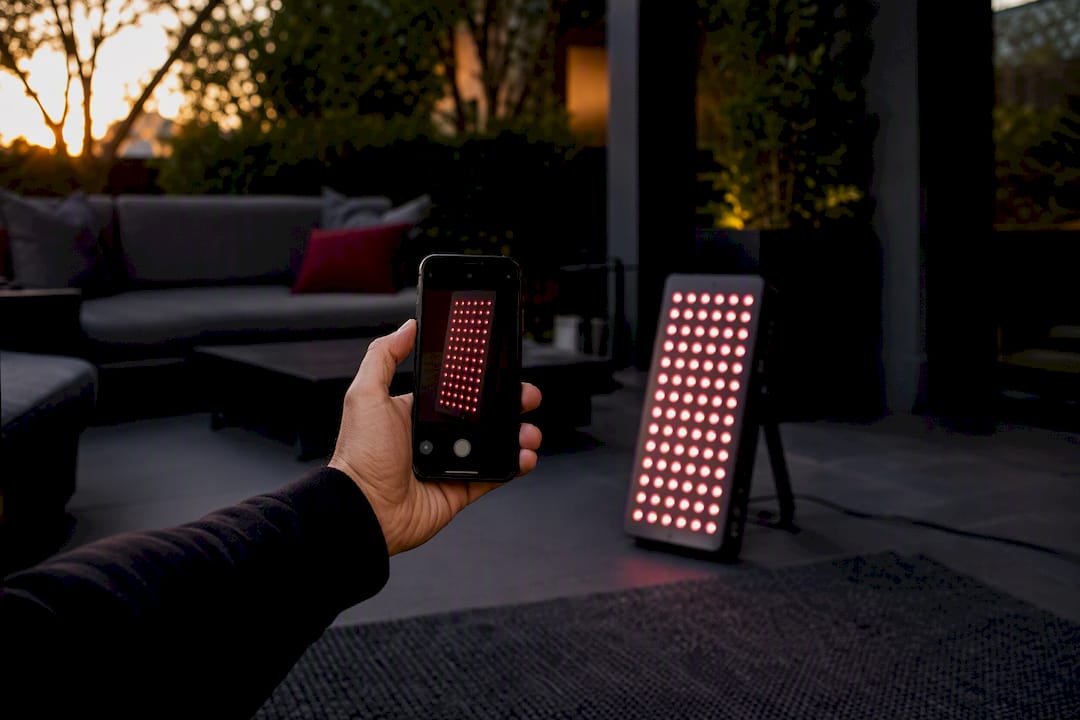
Pro Tip: Most NIR LEDs sit outside the range of human vision, so you can't tell by eye if a panel is actually emitting near-infrared. Point your smartphone camera at the panel while it's running — most phone sensors pick up NIR wavelengths as a faint purple or white glow that your eyes miss entirely. If you see nothing on camera, the "infrared" claim on that product might be more marketing than physics.
For men building an actual restoration routine around this science rather than guessing at it, our practical science primer on red light therapy breaks down how to apply this mechanism to real-world goals.
What Wavelength Reaches Deep Enough for Muscle and Joints?
Wavelength determines depth, and depth determines what a device can actually treat. This is the single most practical thing to understand before spending money on a panel.
Common therapeutic wavelengths break down like this:
| Wavelength | Band | Typical Depth Reached | Best For |
|---|---|---|---|
| 630–670 nm | Red | Skin surface, capillary layer | Collagen, tone, surface healing |
| — | Red/NIR transition | Shallow subcutaneous tissue | Mixed skin and light tissue support |
| 800–870 nm | NIR (optimal window) | Muscle, tendon, some joint tissue | Deep recovery, pain, inflammation |
| — | NIR (upper range) | Similar to 800–870 nm, less efficient | Diminishing returns as water absorption rises |
The physics behind this is straightforward once you see it laid out. Light gets absorbed by three main things in your body: hemoglobin, melanin, and water. Red wavelengths get stopped fairly quickly by hemoglobin and melanin near the skin's surface. As you move into the 800 to 870 nm range, absorption by those chromophores drops off, letting photons travel deeper before water absorption starts pulling energy back out. That's why consumer-facing technical reviews consistently point to 800–870 nm as the sweet spot for non-thermal penetration.
One detail worth flagging for anyone with darker skin: NIR is far less affected by melanin content than red light is. Melanin absorbs strongly in the visible spectrum, which can blunt red light's effectiveness on darker skin tones at the surface, but that same melanin barely touches near-infrared wavelengths. If you have deeper skin pigmentation and you're targeting joint or muscle tissue, NIR is going to perform more consistently for you than red light alone.
Which Band Works Best for Skin, Pain, or Recovery Goals?
Matching the wavelength to the goal is where most buyers get it wrong, usually because they picked a device based on price instead of purpose. Here's how the applications actually sort out by band:
- Skin tone and fine lines: 630–660 nm red light, with visible changes in skin texture and roughness often showing up somewhere in the 4 to 8 week range with consistent use.
- Surface wound healing: red light in the same 620–670 nm range, supporting faster closure in minor cuts and abrasions.
- Joint pain and arthritis: NIR around 810–850 nm, where trials on osteoarthritis patients show meaningful reductions in pain and improved function, largely because NIR actually reaches the joint capsule.
- Muscle recovery after training: NIR in the 800–850 nm range, applied post-workout to reduce soreness and support faster return to training.
- Hair thinning: typically red light in the 630–660 nm range, aimed at the scalp's surface where hair follicles sit.
- Brain-adjacent applications: NIR near 810 nm, chosen specifically because it's one of the only wavelengths with enough reach to matter at that depth.
A randomized trial using broadband polychromatic light between 570 and 850 nm in 136 volunteers found measurable improvements in skin feeling, appearance, and collagen density after 30 sessions, with no thermal damage reported. That's a useful data point because it shows the effect holds even when the light source spans both red and NIR rather than a single narrow wavelength.
Red Light vs Near-Infrared: A Decision Framework
Here's the rule of thumb that cuts through most of the confusion: red for surface, NIR for depth, combined for both.
Break it down by target depth and the choice gets simple:
- If your goal sits within a few millimeters of the skin, like tone, texture, or surface healing, red light alone is usually sufficient.
- If your goal sits below roughly half a centimeter, like a knee, a lower back, or deep shoulder muscle, you need NIR. Red light physically can't reach that far in meaningful quantity.
- If you're chasing both skin and deep tissue goals in one routine, a combined red+NIR panel is the more efficient choice over running two separate devices or two separate sessions.
A red-only device is perfectly fine if your priority is genuinely surface-level. It becomes a problem when someone buys a red-only panel expecting it to fix a stubborn shoulder or hip issue and wonders why nothing changes after a month. That's not the device failing. That's the wrong tool for the depth of the job.
One more caveat worth repeating: if a product's main selling point is heat, warmth, or a sauna-style experience, you're looking at far-infrared, not photobiomodulation. That's not necessarily a bad product, but it's answering a different question than the one this guide is built around.
What Should You Check Before Buying a Red Light Device?
Specs matter more than marketing copy here, and most buyers never check the ones that actually determine whether a device works.
Before buying, verify these five things:
- Reported wavelengths in nanometers, not vague terms like "red" or "infrared."
- Irradiance, measured in mW/cm², which tells you how much power is actually hitting your skin at a given distance.
- Recommended fluence (total dose), measured in J/cm², since this is what most clinical studies actually report.
- LED type, since cheaper panels sometimes mix in filler LEDs that don't contribute meaningful therapeutic output.
- Duty cycle, or whether the device runs continuously or pulses, which affects total delivered dose over a session.
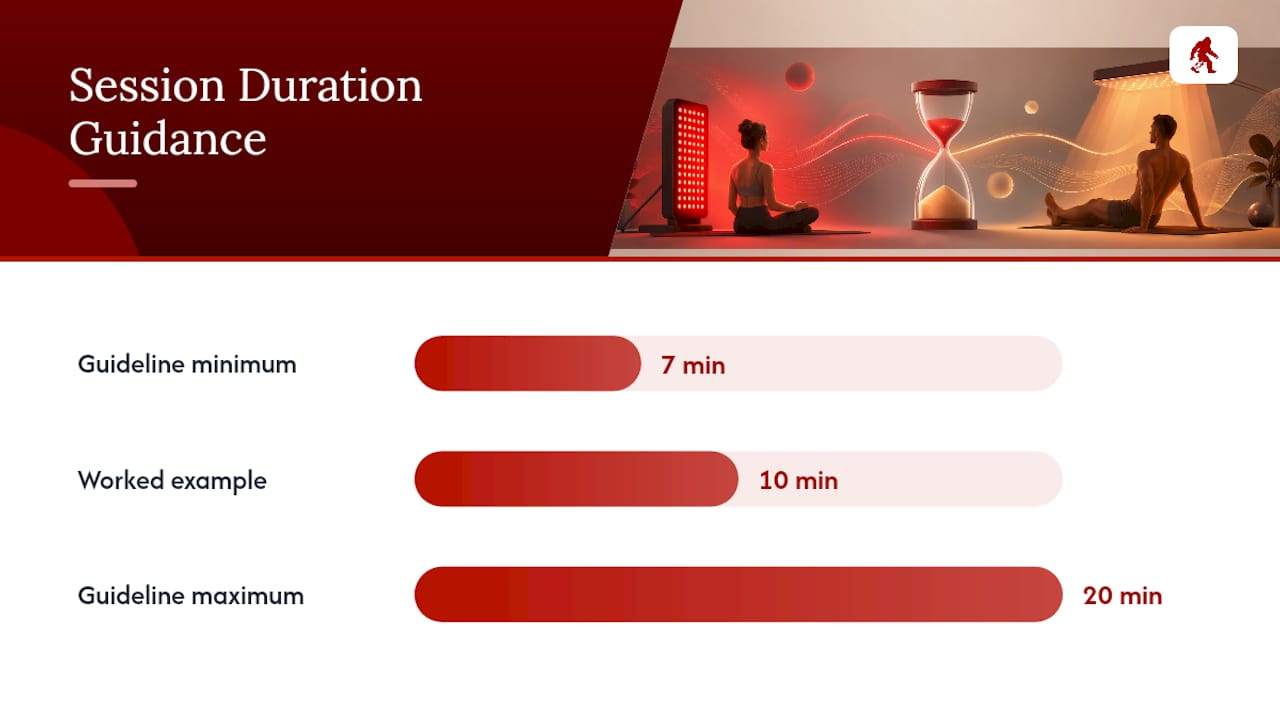
Dose comes down to a simple relationship: irradiance times time equals fluence, and distance from the panel directly affects irradiance. Move twice as far from a panel and the light hitting your skin drops off sharply, not linearly. That's why a device delivering 50 mW/cm² at 6 inches might deliver a fraction of that at 18 inches. A worked example: at 100 mW/cm² irradiance, a 10 minute session delivers roughly 60 J/cm² of fluence, which lands within the range used in many clinical trials for skin and pain applications.
Home-device guidance and clinical protocols generally converge on sessions of 7 to 20 minutes at distances of 8 to 24 inches, run 3 to 5 times per week for both red and NIR applications, though exact ranges shift depending on the device's irradiance output. A guided app that tracks session length and frequency takes the guesswork out of this, which is part of why we built one into our red light therapy companion app.
Pro Tip: If a product page says "infrared" but never lists a wavelength number, ask the seller for it directly before buying. A legitimate manufacturer will have that spec sheet ready. If they can't produce it, assume you're looking at a heat product wearing a photobiomodulation label. For a deeper breakdown of specific devices worth considering, our guide to red light devices for men walks through the comparison in more detail.
Is Red Light Therapy Safe, and What Are the Risks?
Photobiomodulation with red and NIR light is generally non-thermal and well tolerated when dosed correctly. Authoritative health summaries describe the therapy as safe for typical use cases, with the real risks concentrated in three places: overdosing, photosensitivity, and low-quality devices that don't deliver what they claim.
A few situations call for real caution:
- If you're taking photosensitizing medications (certain antibiotics, retinoids, some acne treatments), check with a clinician before starting sessions.
- If you're undergoing active cancer treatment, get clearance from your care team first. This is a genuine clinical caveat, not a formality.
- Eye protection matters, particularly with higher-irradiance NIR panels, since NIR can penetrate the eye without triggering the blink reflex that visible light causes.
- More sessions doesn't mean more benefit. Diminishing returns kick in past a certain dose, and overexposure can leave tissue worse off rather than better.
Far-infrared saunas and heat panels are sometimes marketed alongside photobiomodulation devices as if they're interchangeable. They're not. A far-infrared product working through direct heating carries real burn and overheating risk if used improperly, in a way that a properly dosed red or NIR PBM session generally does not.
If you're managing device emissions and want the technical detail on exposure limits, our breakdown of red light EMF safety covers what's actually worth worrying about versus what's noise.
Can You Combine Red Light and Near-Infrared Safely?
Using red and NIR together is commonly safe and effective, and most modern wellness panels are built specifically to emit both wavelengths at the same time rather than forcing you to choose. Research on simultaneous use confirms this stacked approach is widely used without added risk over using either band alone.
Three simple protocols cover most goals:
- Daily skin routine: red light only, 10 minutes at 8 to 12 inches, 5 days a week, aimed at face or scalp.
- Post-workout recovery: combined red+NIR, 15 minutes at 12 to 18 inches, applied to the trained muscle group within a few hours of training.
- Whole-body weekly session: combined red+NIR, 20 minutes at 18 to 24 inches, once or twice a week for general restoration.
Before stacking sessions or pairing light therapy with other recovery tools, run through this short checklist:
- Space combined sessions at least a few hours apart from intense heat exposure (sauna, hot bath) to avoid overloading tissue.
- Cold exposure after a session is generally fine and doesn't cancel the photobiomodulation effect.
- Don't double up distance and time increases at once. Adjust one variable at a time so you can tell what's actually changing your results.
For a full setup walkthrough, our home red light therapy guide covers space, timing, and routine-building in more depth.
What Does the Research Actually Say About Red Light Therapy?
Evidence strength varies a lot depending on what you're claiming. Skin rejuvenation and surface wound healing have some of the strongest randomized controlled trial support in the field, including the 136-person study on broadband light showing measurable collagen density improvements. Pain relief and joint function, particularly for osteoarthritis, also carry solid trial support at NIR wavelengths. Muscle recovery evidence is promising but more mixed, with study quality varying widely.
The limitations are real and worth naming directly:
- Many trials use small sample sizes, often under 150 participants.
- Dosing protocols vary widely between studies, making direct comparisons difficult.
- Some research is funded by device manufacturers, which doesn't invalidate the findings but does warrant a closer read of methodology.
One nuance that gets lost in most consumer guides: dosing adjustments can sometimes make different wavelengths produce overlapping outcomes, meaning wavelength alone doesn't tell the whole story. Fluence and consistency matter just as much as the number on the spec sheet.
When you read any red light therapy claim, check three things: the exact wavelength used, the dose delivered, and whether the study design included a real control group. Skip any of those and the claim isn't worth much.
So, Red Light or Infrared: Which One Should You Actually Use?
If your priority is skin, tone, or surface healing, red light in the 630 to 670 nm range does the job on its own. If you're dealing with joint pain, deep muscle soreness, or anything below the surface, near-infrared in the 810 to 850 nm range is the wavelength actually built to reach it. If you want both outcomes without running two devices, a combined red+NIR panel is the more practical route.
One concrete next step before you buy anything:
- Pull up the spec sheet for any device you're considering and confirm it lists exact wavelengths and irradiance in mW/cm². If it doesn't, that's a signal to keep looking.
Why This Matters for Men Rebuilding Their Energy After 30
Most men don't lose their drive overnight. It fades in small increments, and by the time you notice, you've been running on empty for a while without realizing it. Understanding the real difference between red and NIR isn't just science trivia. It's the difference between a device that actually supports your restoration routine and one that just makes you feel like you're doing something. This guide was built with input from Nurse Rachel, whose focus at Primal Red Co is helping men understand their bodies before bigger decisions land on the table.
A Combined Red+NIR Option Worth Knowing About
If you've read this far, you already know the smartest move for most men chasing both skin and deep tissue restoration is a combined red+NIR device rather than picking one band and hoping it covers everything.

That's exactly the gap RedRockit was built to close. It's a private-use device that pairs red and near-infrared output in one panel, designed specifically for men over 30 building a restoration routine around energy, recovery, and drive, not a clinic visit. Before you commit to any device, hold it against your own goals: check the wavelengths listed, compare them against what this guide covers, and make sure the specs actually match what you're trying to fix. The RedRockit Activation Method walks through exactly how the device and its guided protocols fit into a daily routine, and our male vitality after 40 guide breaks down how red light fits into the bigger picture of staying in the game. This is not a medical treatment and it's not a substitute for care from a licensed clinician if you're managing a diagnosed condition. If your goals are restoration and maintenance, start by comparing your device's spec sheet against your target depth.