
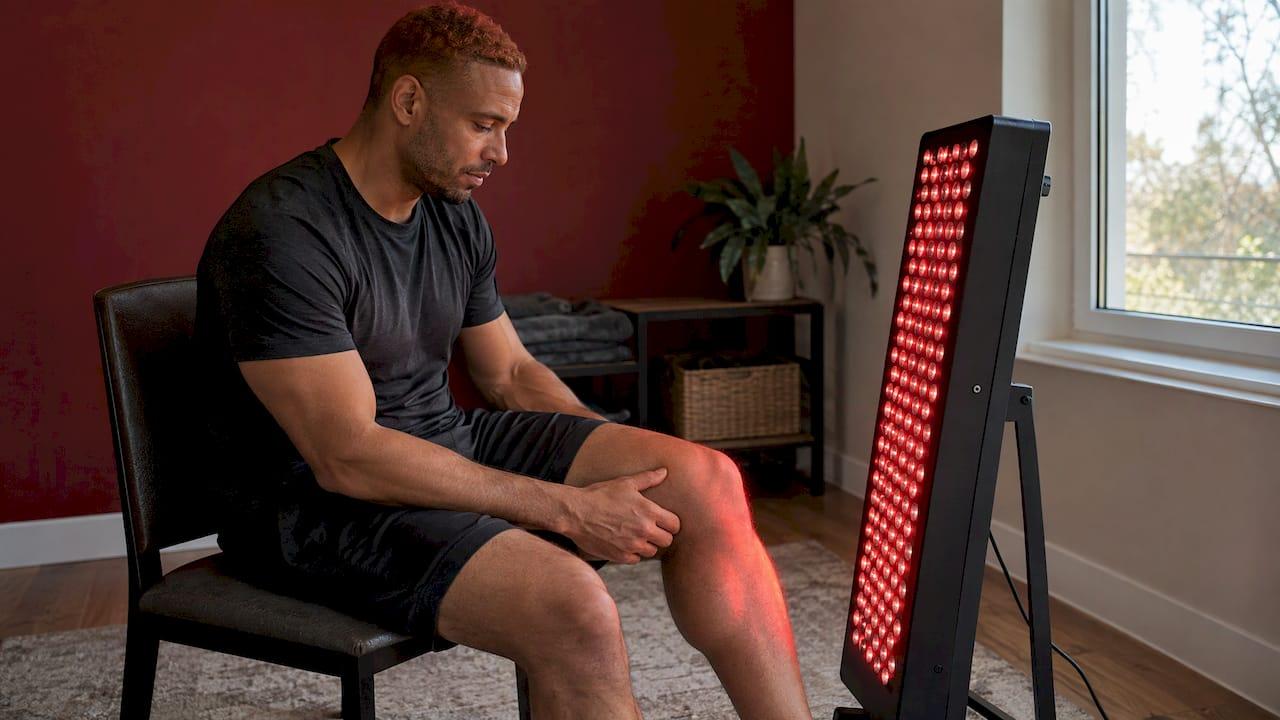
Can red light calm inflammation? Researchers are studying exactly that. The idea is that red light reaches your cells, wakes up the mitochondria and helps stressed tissue do its job. The human evidence is real but mixed. It is strongest for certain pain and fatigue outcomes. It is far thinner for everything else. Here is what the studies found, what the light is believed to do, and how to use it with some sense.
If you are a man over 30 whose recovery has slowed, or a wife who has watched her husband run on empty, you have probably typed this question into a search bar. You deserve a straight answer, not a miracle pitch.
TL;DR
- Red light therapy, also called photobiomodulation, is thought to ease inflammation by stimulating mitochondria. Research is ongoing, and the effect is not guaranteed.
- The best-supported findings are for fibromyalgia fatigue, knee osteoarthritis disability and some pain outcomes. Even there, no outcome reached high-certainty evidence.
- Wavelength matters. Red (about 630 to 660 nm) suits surface and moderately deep targets. Near-infrared (about 810 to 850 nm) travels deeper.
- Home use is considered safe overall. The usual issues are temporary skin redness and eye exposure, so protect your eyes and keep sessions in a sensible range.
- Red light is a routine, not a diagnosis. Constant fatigue, pain or swelling deserves a conversation with your doctor.
Table of Contents
- What red light does at the cellular level
- What human research actually shows
- Red light, fatigue and low energy
- Which color of light for inflammation?
- Dose is where most people go wrong
- Safety: skin, eyes and who should talk to a doctor first
- Our perspective
- Build a routine you will actually stick with
- Where RedRockit fits
- FAQ
- Sources
What red light does at the cellular level
Red light therapy uses continuous red light, between 630 and 700 nanometers, placed on a targeted area of skin. You will also see it called photobiomodulation (PBM) or low-level laser therapy. The working theory is that this light stimulates mitochondria, the small engines inside your cells, to support cell growth and function. That is also why it is thought to help reduce inflammation.
Think of it as a signal. When tissue is stressed, cells have to work harder with less to work with. Light at the right wavelength and dose is believed to nudge those cells back toward doing their job. It is not a drug. It does not force a hormone or a chemical into your body. It is an input your cells may respond to.
That is also the honest limit of what we can say. Mechanism is a theory built from lab and clinical work. What matters to you is what happens in people, so let's go there.
What human research actually shows
Start with the biggest picture. A 2025 umbrella review of 15 meta-analyses covered 204 randomized trials and more than 9,000 participants. It found moderate-certainty evidence that PBM improved:
- Fatigue in fibromyalgia (eSMD 1.25, 95% CI 0.63 to 1.87)
- Disability from knee osteoarthritis (eSMD 0.65, 95% CI 0.14 to 1.15)
- Pain from burning mouth syndrome (eSMD -0.92, 95% CI -1.38 to -0.46)
No outcome reached high-certainty evidence. The authors conclude that PBM looks beneficial for some conditions, and that better trials and standardized protocols are needed.
A larger 2026 umbrella review of 100 systematic reviews found that 62 reached conclusions favoring the light-therapy intervention, 34 were neutral or mixed and 4 were unclear. Most reviews had low or critically low confidence ratings, and the differences in treatment settings from study to study make results hard to compare.

Read that the way a smart man reads a training log. The direction is encouraging. The dose and protocol need to be tighter before anyone can promise a result.
Joints and tendons
Inflammation most often shows up as a stiff knee, a cranky tendon or a shoulder that will not settle. A 2024 meta-analysis of 10 placebo-controlled trials with 542 people found that PBM produced a moderate reduction in knee osteoarthritis pain at rest (SMD -0.70, 95% CI -1.10 to -0.20), though the certainty of evidence was rated very low.
For tendons, a 2021 review of 17 randomized trials with 835 participants found that PBM plus exercise reduced pain and improved function compared with sham plus exercise. Evidence quality ranged from very low to moderate. Notice the pairing: light plus movement. It was not light alone doing the heavy lifting.
If joints and tendons are your main concern, red light therapy for joints is one of the areas where studies have focused most.
Recovery after training
A 2024 systematic review of 12 systematic reviews on low-level laser therapy and sport found beneficial outcomes for exertion and recovery, including muscle strength, endurance and reduced fatigue. It was typically delivered before exercise. The authors also rate the quality of the underlying papers as low, and they found no peer-reviewed guidelines for laser use in athletic recovery.
The pattern repeats. Promising signals, uneven protocols.
Pain relief and what the FDA has cleared
Some devices carry FDA clearance for narrow uses. A Blue Shield of California medical policy lists cleared low-level laser devices for things like temporary relief of minor chronic pain, knee pain and neck and shoulder pain. ConsumerLab adds that this kind of 510(k) clearance is not the same as FDA approval, and that there is not yet enough information to recommend these devices for any one specific condition. We would rather you know that than hear it from someone else. For more on what that clearance language means for you, read our piece on FDA red light therapy for men 30+.
Red light, fatigue and low energy
Inflammation and fatigue travel together. A tank that never fills is one of the most common complaints we hear from men over 30 and from the women who live with them.
The cleanest finding is the one already above: the 2025 umbrella review found moderate-certainty evidence that PBM reduced fatigue severity in people with fibromyalgia. That is a specific group with a specific diagnosis. It does not prove red light will lift every tired man out of the fog. What it does show is that fatigue is a real outcome researchers can measure with light, and that is worth taking seriously.
What about testosterone? A 2025 scoping review in the Canadian Urological Association Journal found that most studies showed non-significant or marginal changes in testosterone after light therapy. The authors point to small samples and little long-term follow-up, and call for larger trials. So the question is open, and anyone promising a specific hormone number is ahead of the science. We go deeper in red light therapy and testosterone: what men over 30 should know.
What does that mean for a man who feels the shift coming? Persistent fatigue, low drive and slow recovery are reasons to get bloodwork and a real conversation with your doctor. A restoration routine can sit alongside that. It does not replace it.
Which color of light for inflammation?
The research draws a clean line. According to a precision medicine review in PMC, visible red wavelengths around 630 to 660 nm are relevant to superficial or moderately deep targets, while wavelengths around 810 to 850 nm generally travel through overlying tissue better for deeper delivery.
| Light | Typical wavelength | Where it is aimed |
|---|---|---|
| Red | about 630 to 660 nm | Skin and moderately deep targets |
| Near-infrared | about 810 to 850 nm | Deeper tissue, through overlying layers |
So "what color is best?" has a plain answer: it depends on how deep the target sits. If you want the side-by-side, we wrote it up in red light vs infrared and which one you need.
Dose is where most people go wrong
Here is the part nobody puts on the box. A 2026 product guide in PMC stresses that irradiance levels vary widely across published trials, and that devices which do not disclose irradiance or fluence may operate outside the therapeutic range. Dose is not a detail. It is the whole game.
More is not better. The same guide notes that PBM has dose-dependent side effects such as redness and blistering. A review in PMC reports two randomized studies where blistering or prolonged redness appeared at 480 to 640 J/cm². A safety study registered on ClinicalTrials.gov tested high-fluence red light from 160 up to 640 J/cm² in healthy volunteers, with nine sessions over three weeks. Expected side effects were mild and temporary: warmth, redness and swelling.
The lesson for your routine: pick a protocol, keep it consistent and stay inside the range. Our guides on precision red light protocols and red light overexposure walk through the numbers.

Safety: skin, eyes and who should talk to a doctor first
The American Academy of Family Physicians states that red light therapy appears safe overall. The most common side effect is self-limited skin redness from heat-related vasodilation, and the DNA damage tied to ultraviolet and blue light does not occur with red light. It also notes that people with skin of color may experience hyperpigmentation and blistering with LED red light, and that the light has the potential to cause retinal damage.
In a review of randomized chronic pain trials, 13 of 14 studies reported no adverse events. The other reported only transient warmth, mild discomfort and temporary tingling. No serious adverse events were reported.
Practical rules that follow from this:
- Protect your eyes. Brown University Health says red light can damage the eyes, so protective goggles matter. Our friends have a clear guide to red light eye safety and goggles, and we cover it in red light eye safety.
- Watch your skin. Mild redness that fades is common. Blistering or lasting redness means stop and reduce your dose. If you have darker skin, choose conservative settings, since the PMC product guide notes higher Fitzpatrick skin types may need a lower safety threshold.
- Mind medications. If you take a drug that makes your skin more sensitive to light, ask your doctor or dermatologist before you start.
- Do not chase inflammation you cannot explain. Swelling, heat, joint pain that wakes you at night or fatigue that never lifts needs a clinician, not a gadget.
- Know the red flags. Our clinician questions on contraindications, side effects guide and home safety rules cover the rest.
PBM also appears to increase blood flow for up to 30 minutes after treatment, according to the same product guide. That is part of the mechanism, not a problem. It is just good to know your skin may look flushed right afterward.
Our perspective
Here is what we see every week. A man in his 30s, 40s or 50s says he is not sick. He is just not himself. Recovery takes longer. Energy used to come automatically and now it does not. His wife sees it before he admits it.
We are not a clinic. We are not TRT. We do not diagnose, prescribe or tell men they are broken. We believe men deserve more than "just get the shot" as the first answer, and we believe in paying attention before bigger decisions are on the table.
That is why we built RedRockit: a private-use red light wellness device designed to support a simple restoration routine, paired with the Rockit IQ app for guided session protocols. Our approach is designed around a cellular signal, with no pills, no prescriptions, no subscriptions and no appointments to keep it going. It is backed by a lifetime craftsmanship guarantee.
The research tells us light is worth taking seriously, and that dose and consistency matter more than hype. A guided routine takes the guessing out. YOU HAVEN'T LOST IT. Your body may have forgotten a signal, and a restoration routine is built to remind it.
Nurse Rachel
Build a routine you will actually stick with
Studies are one thing. Your Tuesday night is another. A few principles from the research translate directly:
- Consistency beats intensity. The safety trial above used three sessions a week over three weeks. Protocols in studies are regular, not heroic.
- Pair light with movement. The tendon research tested PBM plus exercise, and sport studies used light before training.
- Track what you feel. Energy, soreness, sleep and recovery are all worth a note after a few weeks.
- Stay inside a known dose. Use a device and protocol that tell you what you are getting, because undisclosed output is the problem the product guide flags.
- Keep your doctor in the loop. Especially if fatigue, low drive or pain is part of the picture.
For her: if you are the one noticing, you are probably right. A husband who is tired, flat or pulling away is not lazy. Start the conversation gently, suggest a checkup and remember that a routine you do together is easier to keep.
Where RedRockit fits
RedRockit is our private-use red light wellness device for men over 30 who want to maintain energy, drive, recovery and vitality through a daily restoration routine. The Rockit IQ companion app guides your session protocols, so you are not guessing at timing. We designed it to be a non-pharmaceutical, non-supplement, non-prescription tool you use at home.
See the product on the RedRockit Primal Restoration page. If you are weighing your options, what to try before TRT and alternatives to TRT lay out the thinking, and the page for her speaks to the partner doing the research.

Start the routine before the crash, not after.
FAQ
What color light is best for inflammation?
Research points to red light at about 630 to 660 nm for the skin and moderately deep targets, and near-infrared at about 810 to 850 nm for deeper tissue. The right choice depends on how deep the area you are targeting sits.
Can red light therapy help with fatigue?
A 2025 umbrella review found moderate-certainty evidence that PBM reduced fatigue severity in people with fibromyalgia. That is a specific group, and results will differ by person. Ongoing fatigue should be checked by your doctor.
Where should you not use red light therapy?
Never shine it at unprotected eyes, since red light can damage them. Stay off irritated or blistered skin, and talk to a doctor first if you take medication that increases skin sensitivity to light or have a condition of concern. Our contraindications guide covers the details.
Is red light therapy safe to use at home?
The American Academy of Family Physicians says it appears safe overall, with temporary skin redness the most common side effect. Wear eye protection, follow your device's protocol and stop if your skin blisters or stays red.
Does red light therapy raise testosterone?
A 2025 scoping review found mostly non-significant or marginal testosterone changes after light therapy, and the authors call for larger trials. We do not claim RedRockit treats low testosterone. It is built to support a restoration routine.
Sources
- Red Light Therapy: Benefits, Safety and Things to Know (Brown University Health)
- Effects of photobiomodulation on multiple health outcomes: umbrella review (2025)
- Umbrella review of low-level light therapy (PMC, 2026)
- Red and near-infrared photobiomodulation in precision medicine (PMC)
- PBM for tendinopathy: systematic review and meta-analysis (2021)
- Photobiomodulation as Medicine: Low-Level Laser Therapy (PMC, 2024)
- Low Level Laser Therapy medical policy (Blue Shield of California)
- Red and Near Infrared Light Therapy: Safety and Effectiveness (ConsumerLab)
- Light therapy and men's urologic health, scoping review (Canadian Urological Association Journal, 2025)
- What to Look for in Red Light Therapy: A Product Guide (PMC, 2026)
- High Fluence LED-Red Light safety study (ClinicalTrials.gov)
- Red Light Therapy: Potential Applications (American Academy of Family Physicians)
- Red light therapy for joints
- Red light eye safety and goggles