
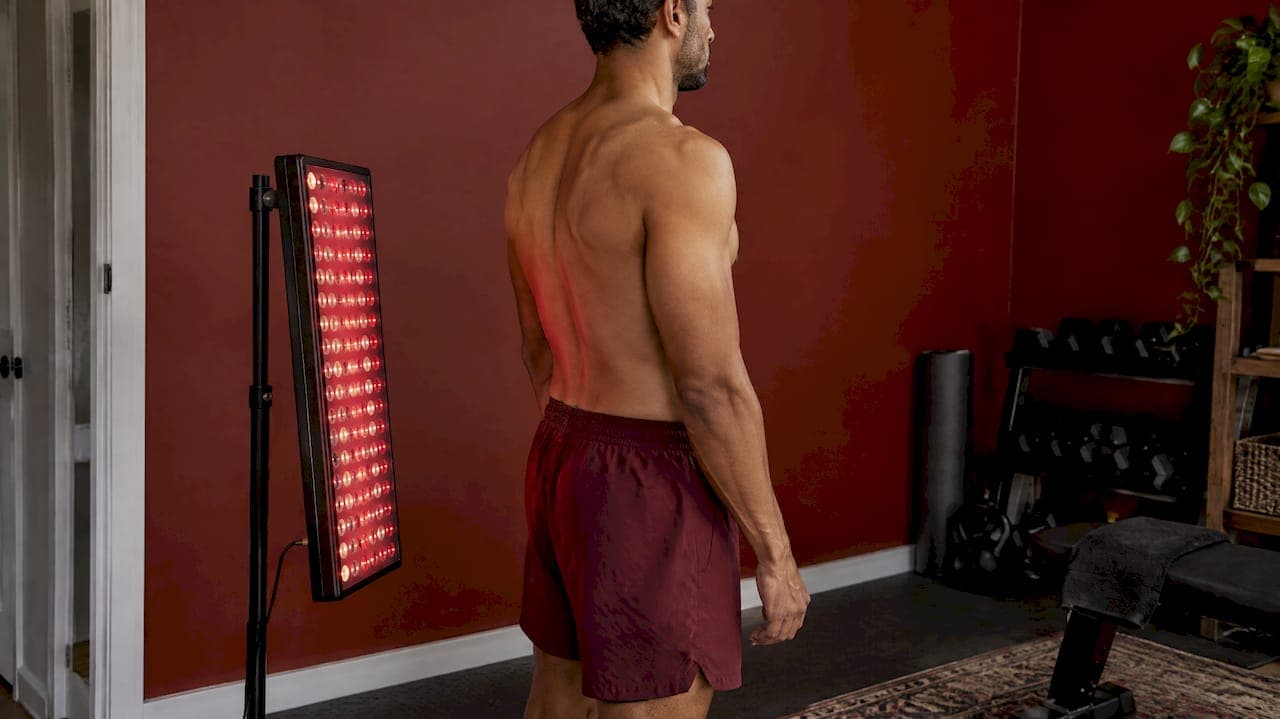
Red light for back pain is a maybe, not a miracle. Some research suggests low-level light may take the edge off pain for some people. The best recent reviews of controlled trials found little difference over a sham treatment. If you have ordinary, non-specific low back pain, red light is an option to talk through with a clinician. It is not a replacement for finding out why your back hurts.
We sell a red light device, so you might expect a sales pitch. You won't get one. Our device is built for a men's restoration routine, not for treating back pain. You deserve the straight story on what the studies say, who should be careful, and where red light fits.
TL;DR
- Evidence for red light on low back pain is mixed: some reviews see possible short-term benefit under certain doses, while a 2020 review of 12 trials found no clinically important difference from sham treatment.
- Doses, wavelengths and schedules vary so much between studies that nobody can give you one proven protocol.
- It has a good safety record when used appropriately, but pregnancy, photosensitivity, certain medications and medical conditions call for a clinician's input first.
- Back pain with trauma, fever, bowel or bladder changes, leg weakness or numbness needs medical care, not a light panel.
- Our RedRockit is a men's restoration device, not a back pain treatment, and we don't market it as one.
Table of Contents
- What red light therapy for back pain actually is
- Does it work? What the research shows
- Which kinds of back pain are we talking about?
- How long and how often? The answer nobody wants to hear
- Safety: who should be careful
- Don't let red light delay a real diagnosis
- What about the cheap pads and panels online?
- Our perspective: restoration, not repair shop promises
- If your goal is energy, drive and recovery
- A smart way to try red light for a sore back
- FAQ
- Sources
What red light therapy for back pain actually is
The research literature rarely says "red light." It uses terms like low-level laser therapy, photobiomodulation, or low-intensity laser and LED therapy. They describe the same basic idea: shining red or near-infrared light on tissue at a low intensity, without heating it enough to burn, and hoping the cells respond.
The National Center for Complementary and Integrative Health (NCCIH) describes low-level laser therapy as a light-source treatment, and says its mechanisms for relieving pain are not well understood. That is a fair summary of the field. The popular story is that light nudges the energy-making machinery inside cells and calms inflamed tissue. It sounds neat. It is a theory, and the clinical proof lags behind it.
One review of low-intensity laser and LED therapy reports that photobiomodulation with enough energy can inhibit nerve action potentials and produce analgesia as soon as 10 to 20 minutes after treatment. That points to a possible quick, temporary effect on pain signals. It does not tell you the back is healing.

Does it work? What the research shows
Here is the honest scoreboard, from friendliest to toughest.
The case for
NCCIH reports that a review found low-level laser therapy may benefit low back pain under some dose and duration conditions. The American College of Physicians' 2017 guideline lists it among the nonpharmacologic options for the initial management of chronic low back pain, but it rests on low-quality evidence. That wording matters. "Included as an option" is not "proven."
The American Council on Exercise takes a measured view too. Its expert perspective is that photobiomodulation may temporarily reduce musculoskeletal pain and inflammation, but should not be presented as a treatment for a disease or used in place of proper healthcare evaluation.
The case against
A 2020 systematic review pooled 12 randomized controlled trials with 1,046 participants. It found no clinically important differences in pain or disability between photobiomodulation and sham treatment for non-specific low back pain. Sham means the device looked and felt real but delivered no meaningful light dose. If the real light does not beat the fake one, something besides the light may be doing the work: rest, attention, expectation, a quiet ten minutes.
A Cochrane review reached a similar place earlier. It found small, clinically unimportant pain relief in some trials, and too little data to draw firm conclusions.

Why the studies disagree
Part of the answer is that the studies are not testing the same thing. A scoping review of dosage variables found that the doses were varied and inconsistently reported, which prevented conclusions about how dose relates to outcomes. One trial may use a clinical laser at high power. Another uses a handheld LED. Another uses a pad. Lumping them together can hide a real effect, or invent one.
So here is where we land: possible short-term relief for some people, no proven protocol, and no good basis for promising anyone that a panel will fix a back.
Which kinds of back pain are we talking about?
Most studies look at non-specific low back pain: the dull, achy, stiff kind with no clear structural culprit. That is also the most common kind of back pain in men who sit all day, lift awkwardly, or train hard and sleep badly.
The picture changes when something specific is going on.
What about a bulging or herniated disc?
Light alone does not heal a disc. One 2025 study looked at high-intensity laser therapy added to collagenase chemonucleolysis, a medical procedure, in lumbar disc herniation. It suggested early, short-term improvement in pain and function, but no significant difference remained by 3 months. Note two things. The laser was high-intensity and used in a clinical setting alongside a procedure. And the benefit faded. That is a long way from a home device curing a disc.
If you have pain that runs down a leg, a disc problem is on the list, and that deserves an exam.
Pain from arthritis, muscle strain or tension
Plenty of product pages claim light helps all three. The research summary above covers low back pain in general. We won't promise you more than it does. If your pain has a diagnosis, ask the clinician who made it whether light is worth trying alongside what they recommend.
How long and how often? The answer nobody wants to hear
You will find confident schedules online: ten minutes, five days a week, six inches from the skin. Those numbers come from marketing and habit more than from settled science.
The scoping review mentioned above found heterogeneous dosage parameters. It also found no statistical difference in application duration between studies where people improved and studies where they didn't. The American Council on Exercise adds that studies vary substantially in wavelength, power, frequency and total duration, which makes one standard recommendation difficult. It says device instructions and professional guidance matter.
Practical takeaways:
- Follow the manufacturer's instructions for your specific device. Don't improvise longer or closer sessions hoping for more.
- More is not better. We cover the exposure question in our piece on red light overexposure.
- Give yourself a fair, time-limited trial and track your pain on a simple 0 to 10 scale. If nothing moves, stop and move on to something that does.
- Ask a physical therapist or physician about timing relative to your other treatment.
Curious about timing across a day? Our guide on the best time for red light therapy, by goal walks through it, though for pain specifically the science is thin.
Safety: who should be careful
NCCIH notes that low-level laser therapy has a good safety record when used appropriately, but may not be risk-free for everyone, and that health conditions and special circumstances like pregnancy may affect safety. It also advises that you talk with your healthcare provider about any complementary approach, including red light, to weigh safety, interactions and whether it suits your situation.
The American Council on Exercise names more specific groups who should use caution and talk to a clinician first:
- People with photosensitive conditions
- People taking photosensitizing medications
- People with medical conditions
- Anyone considering photobiomodulation for pain, injury or disease-related symptoms
That last line includes you if you are reading this because your back hurts. Run it by your doctor. For a deeper look at who should sit this out, read about red light therapy contraindications, and see our own clinician questions on contraindications.
Two more habits worth building:
- Protect your eyes. Bright red and near-infrared light is not something to stare into. See our guide to red light eye safety.
- Know the possible side effects before you start: what to expect and what to watch for.
Our broader home red light safety rules cover the basics for any device you bring home.
Don't let red light delay a real diagnosis
This is the part that matters most, so read it twice. A heating pad or a light panel feels like action. Meanwhile something that needs attention can sit there.
Mayo Clinic lists the signs. Seek emergency care for back pain after trauma, with new bowel or bladder-control problems, or with fever. Arrange a medical visit if the pain:
- Has not improved after a week of home treatment
- Is constant or intense
- Spreads down one or both legs
- Comes with leg weakness, numbness or tingling
- Comes with unintended weight loss
- Occurs with back swelling or a change in skin color
If any of that sounds like you, put the device down and call someone who can examine you. Men are famously bad at this. We say it with love: don't tough it out.
What about the cheap pads and panels online?
Search for this topic and you'll see wraps, pads and belts sold for back pain, with big promises about relief. Treat the claims with skepticism. Consumer "red light" products vary widely in wavelength, power and build, and nothing about being sold legally guarantees a device will meaningfully improve your back. Our article on what FDA status actually means for red light devices explains why a product listing is not proof of results.
If you try something, ask:
- Does the maker publish the wavelengths and power output?
- Do the instructions give a specific session length and distance?
- Do the claims stay within what the research supports?
- Is there a clear way to stop if it doesn't work?
If the page promises to cure a disc, a pinched nerve or arthritis, close the tab.
Our perspective: restoration, not repair shop promises
We built Primal Red Co. for men over 30 who feel the shift coming and want to do something before bigger decisions land on the table. We are not a clinic. We are not TRT. We don't diagnose, prescribe, or tell any man he's broken.
So when a man asks whether red light will fix his back, we answer the way we'd want to be answered. The science does not back a promise like that, and we won't make it. What we do see is that men who let aches, slow recovery and low energy pile up quietly often stop moving, stop training, stop sleeping well, and the whole picture sinks. Back pain and low drive feed each other.
That is where a consistent restoration routine earns its place. Light is one piece of the picture, next to movement, sleep, strength work, and a doctor who looks at what's really going on. Not a magic wand. A habit you can actually stick with.
YOU HAVEN'T LOST IT. But if your back is screaming, get it looked at first.
— Nurse Rachel
If your goal is energy, drive and recovery
If what you really want is to maintain energy, drive and bounce-back as you get older, that is what RedRockit is designed for: a private-use red light wellness device for a simple daily restoration routine, with the Rockit IQ companion app for guided session protocols. It is not a pain treatment, and it isn't built to be one.
Want to see how it fits a routine? Start with RedRockit Primal Restoration, or read our red light recovery routines for men. If energy is the bigger worry, our page on male vitality after 40 lays it out.
A smart way to try red light for a sore back
If your doctor has no objection and you want to experiment, keep it disciplined.
- Get the cause checked first. Rule out the red flags listed above.
- Pick one change at a time. If you start light, a new stretching plan and new pillows in the same week, you won't know what worked.
- Set a baseline. Rate your pain morning and evening for a week.
- Follow the device instructions. Don't stretch time or distance. Our at-home red light guide covers setup.
- Protect your eyes and skin. Stop if anything feels wrong.
- Review after a few weeks. If your numbers haven't moved, the light is not your answer. Tell your clinician and try something else.
And keep the unglamorous basics going: walking, strength training for your core and hips, breaking up long sitting, decent sleep. They have a better track record for chronic back pain than any gadget.
FAQ
Does red light therapy really work for back pain?
Maybe, for some people, a little. The American College of Physicians includes low-level laser therapy as an option for chronic low back pain based on low-quality evidence, but a 2020 review of 12 trials found no clinically important difference from sham treatment. Talk to your clinician before relying on it.
How long should I do red light therapy for back pain?
No proven standard exists. Studies vary widely in wavelength, power, frequency and total duration, and the shortest or longest sessions did not clearly separate better results from worse. Follow your device's instructions and your clinician's advice rather than adding minutes.
Can red light therapy heal a bulging disc?
No good evidence says it can. A 2025 study found that high-intensity laser therapy added to a medical procedure gave short-term early improvement in lumbar disc herniation, but the difference was gone by 3 months. A disc problem needs a proper exam and a plan from a clinician.
What is the downside of red light therapy?
The main downsides are wasted time and money if it doesn't help, and a delay in finding the real cause of your pain. Safety is generally good when used appropriately, but pregnancy, photosensitivity, certain medications and medical conditions call for a clinician's input first. Protect your eyes during any session.
Sources
- Low-Back Pain and Complementary Health Approaches (NCCIH)
- 9 Things You Should Know About Chronic Pain and Complementary Health Approaches (NCCIH)
- Photobiomodulation therapy does not decrease pain and disability in non-specific low back pain (2020 systematic review)
- Low level laser therapy for low-back pain (Cochrane)
- Low-Level Laser Light Therapy Dosage Variables vs Treatment Outcomes (scoping review)
- Low-intensity laser and LED (photobiomodulation therapy) review
- High-intensity laser therapy with collagenase chemonucleolysis for lumbar disc herniation (2025)
- Red Light Therapy: Benefits, Risks and Evidence (American Council on Exercise)
- Back pain: When to see a doctor (Mayo Clinic)