
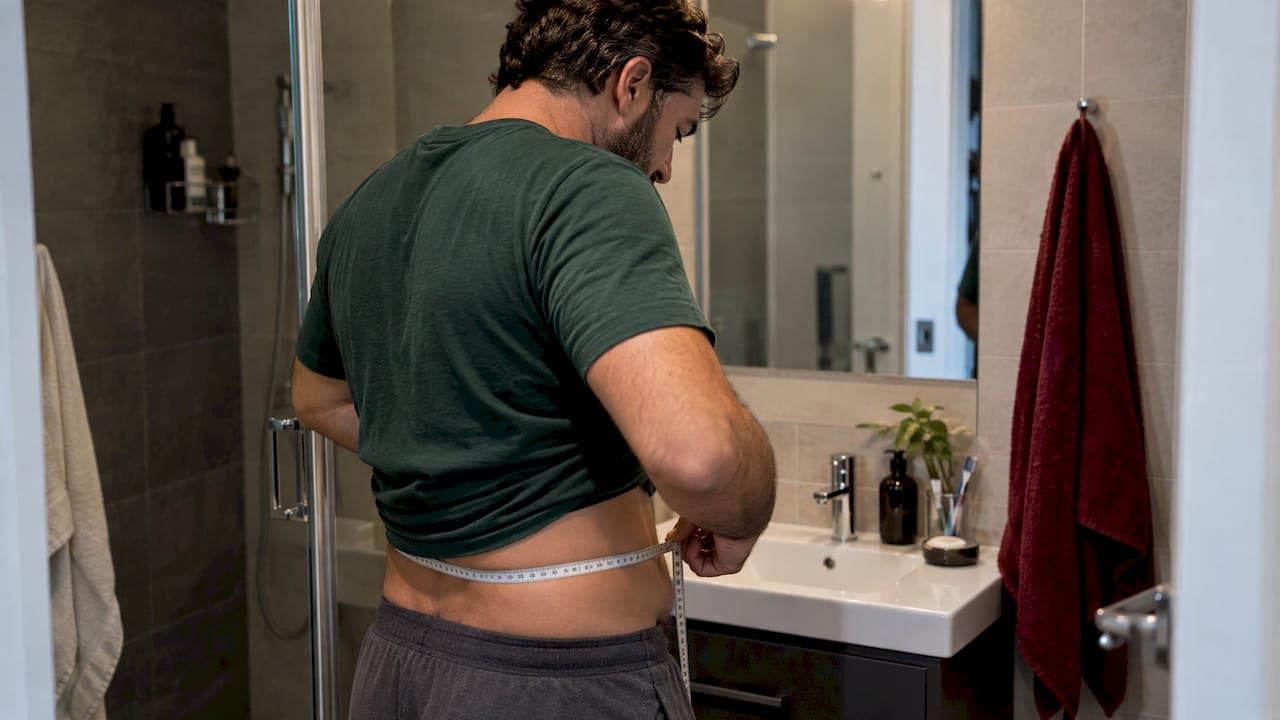
Belly fat and testosterone are tied together, and the link runs both ways. Visceral fat, the kind packed around your organs, pushes testosterone down. Lower testosterone makes it easier to store more of that fat. That loop is why the gut can keep growing even when you feel like you are doing everything right.
You are not broken, and the loop can be interrupted. Here is how it works, what a belly actually tells you, how low T is properly diagnosed, and the moves that matter most.
TL;DR
- Visceral belly fat lowers testosterone, and low testosterone encourages more belly fat. It is a two-way cycle, not a one-way street.
- A big waistline does not prove you have low T. Diagnosis takes symptoms plus at least two early-morning blood tests.
- Weight loss is the usual first step when excess weight is the likely driver, and it can substantially reverse obesity-related drops in testosterone.
- Strength training, steady activity, sleep and a morning-first routine are the foundation. You cannot burn fat from one spot.
- Get the bloodwork before you decide anything. Then build a routine you can actually keep.
Table of Contents
- Why belly fat and testosterone are linked
- What makes visceral fat different from the fat you can pinch
- Does a belly mean you have low testosterone?
- What happens when you lose the weight
- What actually shrinks a belly
- Where TRT fits, and what to understand first
- Perspective: stop treating the belly as the enemy
- Make the routine easy to keep
- For her: what to look for if you are worried about him
- FAQ
- Sources
Why belly fat and testosterone are linked
Think of it as a signal that got scrambled. Fat tissue is not just storage. It is active tissue that talks to your hormones.
In men, testosterone and belly fat have an inverse relationship. Researchers describe it as reciprocal: high visceral fat suppresses testosterone production, while low testosterone contributes to further visceral fat gain and loss of muscle.
Two things drive the suppression:
- Aromatase. Fat tissue contains this enzyme, which can convert androgens into estrogens. Those estrogens can reduce the LH pulses that tell the testes to make testosterone.
- Inflammation and insulin resistance. Excess visceral fat suppresses the hypothalamic-pituitary-gonadal axis through these routes, the control line between your brain and your testes.
The other direction is just as real. In a study where healthy young men had their sex steroids experimentally shut down, fat mass rose within 10 weeks. So lower testosterone can push the body toward storing fat.
That is the cycle: more belly fat, less testosterone, less muscle, more belly fat.
What makes visceral fat different from the fat you can pinch
Subcutaneous fat sits under the skin. Visceral fat is stored near your internal organs, and the National Institute on Aging calls it a specific risk factor for cardiovascular and metabolic disease.
That matters here because visceral fat is the type most tied to testosterone. A 2026 analysis of U.S. men in the Journal of the Endocrine Society found visceral adiposity to be a dominant determinant of circulating testosterone, with a stronger inverse association than total body fat. An analysis of U.S. men from 2013 to 2016 found that a higher Visceral Adiposity Index was linked to lower total testosterone and a higher risk of testosterone deficiency, especially in men with obesity.
Translation: where you carry the weight matters more than the number on the scale.
How to check your own middle
You do not need a scan to get a rough read. Waist circumference tracks closely with abdominal fat, and risk is generally flagged above 40 inches for men. Measure at the level of your navel, relaxed, after a normal exhale.
The American Heart Association notes that visceral fat is commonly assessed by waist circumference, waist-to-height or waist-to-hip ratio, and that these ratios predict cardiovascular death independently of BMI. A man with a "normal" BMI can still be carrying the risky kind of fat.
The stakes go beyond testosterone. Excess fat in and around the stomach is among the factors most strongly tied to metabolic syndrome, which affected about 35% of the U.S. population as of the AHA's 2016 figures.
Does a belly mean you have low testosterone?
Not by itself. This is where men get ahead of themselves, and where wives and partners often see the pattern first: tired, flat, less drive, a waistline that keeps moving. It is a reasonable reason to look. It is not a diagnosis.
The Endocrine Society is clear on the standard. A diagnosis of hypogonadism requires symptoms of testosterone deficiency and at least two early-morning (7 to 10 AM) blood tests showing low testosterone. Its 2026 statement adds that clinicians should first rule out reversible contributors such as obesity and confirm consistently low total and free testosterone.
Why mornings? Testosterone runs high early and drops through the day, so an afternoon draw can mislead you. We cover the timing in our guide to circadian steps for testosterone and the lab pitfalls in our TRT bloodwork breakdown. If your numbers come back and you are unsure how to read them, start with normal testosterone levels in men. If SHBG is part of your report, see what high SHBG means.
One more thing. Low energy and low mood overlap a lot. If you are not sure which one you are dealing with, read how to tell depression from low testosterone. Talk to your primary care doctor or an endocrinologist about any symptoms that are persistent or severe.

What happens when you lose the weight
Here is the encouraging part. If the belly is pushing your testosterone down, shrinking it can lift testosterone back up.
A 2025 clinical review in the Journal of Clinical Endocrinology & Metabolism reports that weight loss in men with obesity substantially reverses obesity-related reductions in testosterone and improves vague symptoms that resemble androgen deficiency. The Endocrine Society's 2026 statement says that when low testosterone is tied to overweight or obesity (BMI over 27) with no other cause found, weight loss is typically first-line therapy.
That is the opening. You do not have to wait for a crash. You can work the other side of the loop now.
What actually shrinks a belly
No gimmicks. The basics, done consistently, beat any trick.
Train your whole body, not your abs
You cannot choose where fat leaves. Crunches strengthen the muscle under the fat; they do not selectively pull the fat off. What works is training that burns energy and builds muscle across your body.
The National Institute on Aging notes that strength exercise builds muscle, increases metabolism, and helps keep weight and blood sugar in check. Build a week around:
- Two to three full-body strength sessions: squats or leg press, a hinge such as deadlifts, a push, a pull, and a carry.
- At least 150 minutes of moderate activity a week, which is the AHA benchmark. Brisk walking counts.
- Balance and mobility work so you stay in the game for years, not months.
Also worth knowing: the NIA points out that fitness may matter more for mortality risk than fat mass alone, so improved fitness correlates with lower health risk even in men who are still carrying extra weight. Do not wait for the scale to move to count a win.
Eat to a plan, not to a mood
The AHA recommends a nutrient-rich diet and working with your medical team to track blood sugar, cholesterol and blood pressure. Build meals around protein, vegetables, whole foods and enough fiber. Cut back on the drinks and late-night snacks that quietly add hundreds of calories.
On fasting windows: in a study of people with obesity, time-restricted eating (16 hours of fasting) led to weight loss, but visceral fat did not drop more than in a Mediterranean diet group. So the best plan is the one you can hold. If you are curious about the broader picture, this overview of intermittent fasting research looks at what fasting does beyond the waistline.
Protect the basics that move testosterone
Sleep, stress and your morning routine set the stage for everything else. Short sleep and a chaotic start to the day make hunger harder to control and training harder to repeat. Our five morning steps that protect testosterone and the guide to morning testosterone, sleep and strength give you a simple order of operations. If drive has slipped too, fixing low libido in your 30s starts in the same place.
Where TRT fits, and what to understand first
TRT is a medical treatment for diagnosed hypogonadism, and it is a decision for you and your clinician. The point is the order. The Endocrine Society notes that terms like "late-onset" or "functional" hypogonadism are hard to define and can blur normal aging with treatable disease, which is why it stresses clinician-led diagnosis with standardized testing. Its 2018 guideline also recommends against routine screening of men without symptoms.
If you are weighing your options, what to try before TRT and whether TRT is for life lay out the questions to settle before bigger decisions are on the table.
Perspective: stop treating the belly as the enemy
Most men come to us angry at their stomach. We get it. But the belly is a message. It is your body telling you the signal slipped.
We built Primal Red Co. for men over 30 who feel the shift coming and refuse to wait for the crash. We are not a clinic. We are not TRT. We do not diagnose, and we do not tell men they are broken. We believe "just get the shot" should not be the first answer every man hears.
Here is what we believe works: get your morning bloodwork, lift heavy, walk daily, protect your sleep, and give your body a daily restoration routine it can stick with. That last piece is why RedRockit exists. It is a private-use red light wellness device designed to support a simple restoration routine, with no subscriptions and no appointments. Pair it with the habits above and you build the kind of consistency that changes a man's direction.
YOU HAVEN'T LOST IT. You just need to restart the signal.
Nurse Rachel
Make the routine easy to keep
The men who win here are not the most extreme. They are the most consistent. RedRockit is our private-use red light wellness device, designed to support a daily restoration routine for men who want to maintain energy, drive, recovery and vitality. It comes with the Rockit IQ companion app for guided session protocols, so you are not guessing about what to do each day. It is built to sit alongside training, nutrition and sleep, not replace them.
See how it works and decide if it fits your routine: RedRockit Primal Restoration. If you are earlier in your research, male vitality after 40 is a good place to start.
For her: what to look for if you are worried about him
If you are reading this for your husband or partner, you are probably not asking about hormones. You are asking why he is tired, distant and heavier through the middle. Here is what to watch for: low energy that sleep does not fix, less interest in sex, irritability, slower recovery, and a waistline that keeps growing. Any of these can have several causes, so the kindest move is not a diagnosis at the kitchen table. It is a push toward a morning blood draw and a walk together after dinner. We wrote about the relationship side in low testosterone and marriage, and about testosterone and confidence.
FAQ
Does losing belly fat raise testosterone?
Often, yes, in men whose low testosterone is tied to excess weight. A 2025 clinical review found that weight loss in men with obesity substantially reverses obesity-related reductions in testosterone. Results vary by person, so recheck your levels with your clinician after meaningful weight loss.
Can low testosterone cause belly fat?
It can contribute. Lower testosterone is linked with greater visceral fat, and experimental testosterone suppression in healthy young men increased fat mass within 10 weeks. Poor sleep, diet, inactivity and aging also play a role, so it is rarely one cause.
How do I know if my belly fat is visceral?
A firm, round belly that sticks out in front, rather than soft fat you can pinch, often signals visceral fat. The practical check is waist circumference: above 40 inches is a common risk flag for men. Ask your doctor about waist-to-height ratio and metabolic bloodwork for a fuller picture.
What is the best exercise for belly fat?
There is no single move that targets the belly, because you cannot spot-reduce fat. Combine two to three full-body strength sessions with at least 150 minutes of moderate activity each week, and keep your eating consistent. That combination works on total fat, including visceral fat.
When should I get my testosterone tested?
Get tested when you have real symptoms such as low energy, low drive or poor recovery. Testing means at least two early-morning blood draws, between 7 and 10 AM, ordered through your doctor.
Sources
- Androgens and Adipose Tissue in Males: A Complex and Reciprocal Interplay
- Lowered testosterone in male obesity: Mechanisms, morbidity and management
- Adiposity, not chronological aging, is the dominant determinant of testosterone (Journal of the Endocrine Society)
- The Impact of Visceral Adiposity on Testosterone Levels in U.S. Men
- Approach to the Patient: Low Testosterone Concentrations in Men with Obesity
- Statement on Testosterone Replacement Therapy, Endocrine Society
- Hypogonadism in Men, Endocrine Society
- Testosterone Therapy for Hypogonadism Guideline Resources, Endocrine Society
- Timeframe of 8-hour restricted eating irrelevant to weight loss, National Institute on Aging
- Reducing Chronic Disease and Disability, National Institute on Aging
- What is Metabolic Syndrome?, American Heart Association
- More belly weight increases danger of heart disease even if BMI does not indicate obesity, American Heart Association
- Waist Circumference overview, ScienceDirect
- Intermittent Fasting and Bone Density: What the Research Shows