
High SHBG in men often means testosterone that looks fine on paper but doesn't feel fine in the body. The protein binds testosterone and locks it away from your tissues, so the free, usable hormone drops even when total testosterone sits in range. The fix starts with two blood draws, not guesswork: order total testosterone and SHBG together, calculate free testosterone, then figure out what's driving the number up before anyone talks about treatment.
TL;DR:
- Men with high SHBG can have normal total testosterone levels but experience symptoms of low bioavailable testosterone due to decreased free hormone.
- Elevated SHBG is often linked to liver disease, thyroid disorders, certain medications, and lifestyle factors like calorie deficits or excessive endurance exercise.
- Testing should include morning measurements of total testosterone, SHBG, and albumin to accurately calculate free testosterone, which guides diagnosis and treatment.
- Managing high SHBG focuses on addressing underlying causes such as thyroid issues or medication effects rather than the SHBG number itself.
- Chronic high SHBG can contribute to long-term health risks including muscle loss, osteoporosis, metabolic decline, and may distort other hormone levels like estradiol.
Table of Contents
- What Is High SHBG in Men, and Why Does It Change How Testosterone Works?
- Common Causes and Drivers of High SHBG in Men
- Symptoms and Clinical Consequences Men Experience with High SHBG
- Testing and Interpreting Results: Total T, SHBG, and Free Testosterone
- Management and Treatment Approaches for Men with High SHBG
- When to See a Clinician and What to Bring With You
- Why SHBG Is a Marker, Not the Target, in Clinical Decisions
- Impact of High SHBG on Fertility and Sperm Parameters
- Do SHBG Levels Differ Across Ethnic Groups and Populations?
- How High SHBG Interacts with Estrogen and DHEA
- Long-Term Health Risks Tied to Chronically High SHBG
- How High SHBG Skews Other Hormone Test Results
- Nurse Rachel: Practical Clinic Tips for Men Worried About Hormone Changes
- Where a Restorative Routine Like RedRockit Fits In
- Sources
What Is High SHBG in Men, and Why Does It Change How Testosterone Works?
Sex hormone binding globulin, or SHBG, is a protein your liver makes and releases into the bloodstream. Its job is to grab hold of testosterone and other sex hormones and ferry them around your system. That sounds harmless. It isn't, because testosterone attached to SHBG can't do anything. It can't reach your brain, your muscle, or your erectile tissue. It's cargo, not fuel.
Roughly 60% of the testosterone circulating in a man's blood is bound tightly to SHBG. Another chunk, usually 20 to 40%, binds loosely to albumin. What's left over, typically only 1 to 2%, floats free and unbound. That small free fraction, plus the albumin-bound portion that can detach easily, makes up what clinicians call bioavailable testosterone. It's the part that actually signals to your tissues.
Here's where high SHBG becomes a problem instead of a curiosity:
- When SHBG climbs, more testosterone gets locked to it, so less remains free and active.
- A man can have a total testosterone reading that looks completely normal on a standard lab report.
- That same man can still walk around with functional low testosterone, because the usable fraction has quietly collapsed.
- Total testosterone alone, without SHBG, tells you almost nothing about how much hormone your body can actually use.
SHBG tends to climb with age, which is part of why testosterone complaints in men over 40 don't always match what the total T number suggests. A 55 year old and a 25 year old with identical total testosterone can have very different symptom experiences, and SHBG is frequently the reason.
Common Causes and Drivers of High SHBG in Men
Elevated SHBG rarely happens for no reason. It's usually a downstream signal of something else going on, which is why chasing the number itself misses the point. A retrospective clinical review of men with raised SHBG found the causes cluster into a few recognizable categories, including liver dysfunction, thyroid disease, and certain medications.
Medical conditions account for a large share of cases:
- Liver disease, including fatty liver and cirrhosis, since the liver both produces SHBG and clears it
- Hyperthyroidism, which directly stimulates SHBG production
- HIV infection, particularly with certain antiretroviral regimens
- Estrogen exposure, whether from endogenous shifts or external sources
- Normal aging, which gradually pushes SHBG upward in most men
Medications and substances are an underappreciated driver:
- Anticonvulsants like phenytoin and carbamazepine
- Estrogen-containing therapies
- Drugs that induce liver CYP enzymes, which indirectly raise SHBG output
Energy and nutrition status matters more than most men expect:
- Chronic calorie deficits, including aggressive dieting or under eating relative to training load
- Excessive endurance exercise without adequate fueling
- Very low fat diets sustained over long periods
A smaller subset of cases stay idiopathic, meaning no clear driver turns up despite a thorough workup. That doesn't mean nothing's wrong. It means the investigation needs to be more careful, not abandoned.
Pro Tip: Before you accept "it's just aging" as the answer, pull every medication and supplement you take and check it against a current list of SHBG-raising drugs with your clinician. A prescription you started two years ago for something unrelated could be the actual driver.
Symptoms and Clinical Consequences Men Experience with High SHBG
The lab number is abstract. The symptoms aren't. Men with elevated SHBG describe a specific pattern that overlaps heavily with classic low testosterone complaints, and that overlap is exactly the point.
Sexual symptoms show up first for most men:
- Low libido that doesn't track with stress or relationship changes
- Erectile dysfunction, particularly difficulty maintaining rather than achieving
- Fewer or weaker morning erections
- Fertility concerns, since sperm production depends on adequate local testosterone signaling
Systemic symptoms follow close behind:
- Fatigue that sleep doesn't fix
- A general drop in vitality and drive
- Reduced muscle mass despite consistent training
- Exercise intolerance, where workouts that used to feel manageable now wreck you for two days
Mental and mood effects round out the picture, including low mood and reduced concentration that men often attribute to stress or aging rather than hormone availability.
Longitudinal cohort data from the European Male Ageing Study found that men who developed or maintained high SHBG over time experienced new or worsened erectile dysfunction, low sexual desire, fatigue, and reduced physical and cognitive performance, independent of their total testosterone level.
That last detail is the one worth sitting with. These men weren't diagnosed as low testosterone by the standard total T cutoff. Their symptoms tracked with SHBG anyway. That's functional hypogonadism hiding behind a normal-looking lab report, and it's the exact scenario this article exists to help you catch.
Testing and Interpreting Results: Total T, SHBG, and Free Testosterone
Get this part right and everything downstream gets easier. Get it wrong and you'll spend months chasing symptoms with the wrong data.
Order these tests together, from the same morning blood draw:
- Total testosterone, drawn before 10 AM when levels peak
- SHBG, drawn at the same time as total testosterone
- Albumin, if your calculator requires it (most standard labs report this routinely anyway)
Morning timing matters because testosterone follows a daily rhythm and drops meaningfully by afternoon. A single SHBG blood test is typically ordered when a man has symptoms of low testosterone or a total testosterone result that sits in a borderline zone, and it gets interpreted alongside that total T value, never alone.
Reference ranges vary by lab, but a large US-based reference interval study established simplified sex- and age-specific cutoffs for SHBG, and found that low SHBG affects roughly 3.3% of US men, with abnormal readings, high or low, common among men already being evaluated for testosterone concerns. High SHBG doesn't have one universal number that applies to every lab and every man. It has a normal range specific to the assay your lab uses, and results should always get read against that specific range.
Calculating free testosterone is the step most primary care visits skip, and it's the one that actually answers the question you came in with. The Vermeulen method uses total testosterone, SHBG, and albumin to estimate the free fraction mathematically. Clinical reviews recommend this calculated approach over some direct free-testosterone assays, because those direct immunoassays carry known accuracy problems at the low end of the range, which is exactly where the clinically important answers live. If your provider hands you a total T number and stops there, ask for the calculation. It takes five minutes and changes the entire conversation.
If a result looks off or doesn't match your symptoms, ask for a repeat draw before accepting it as your baseline. Learn what normal testosterone levels actually look like by age so you know whether your number is a genuine outlier or within expected variation.
Management and Treatment Approaches for Men with High SHBG
The single most important principle in managing high SHBG: you don't treat the number. You treat what's causing the number.
- Identify and correct the underlying driver first. If hyperthyroidism is pushing SHBG up, treating the thyroid resolves both problems at once. If a medication is the cause, a supervised switch or dose adjustment often does the same. This is always step one, before anything else gets considered.
- Review every medication and supplement with your clinician. Never stop a prescribed drug on your own. Bring your full list to the appointment and ask directly whether anything on it is known to raise SHBG.
- Address nutrition and training load. Chronic under eating, especially paired with heavy endurance training, is a fixable driver. Adequate calories, particularly adequate fat and protein intake, support healthier hormone binding patterns over weeks to months.
- Prioritize sleep and moderate resistance training. Both influence hormone production and metabolic health, and neither requires a prescription to start this week.
- Cut back alcohol intake. Chronic heavy drinking stresses the liver, which is the organ producing and clearing SHBG in the first place.
- Reserve TRT for the right scenario. Testosterone replacement gets considered when calculated free testosterone is genuinely low and symptoms are present, not simply because SHBG is elevated. TRT carries fertility tradeoffs worth understanding fully before starting, and it requires ongoing monitoring rather than a one-time decision.
Medications designed to directly lower SHBG, like danazol, exist but carry real downsides, including androgenic side effects and liver strain, which is why they're rarely a first choice. Chasing the SHBG number itself with a drug is treating a symptom of a symptom.
Pro Tip: If you're weighing TRT against fertility preservation, look into enclomiphene as an alternative before committing to a testosterone protocol you can't easily reverse. It's a conversation worth having with your provider before, not after, you start.
For men who want a broader lifestyle-first framework before any medical intervention, strategies for increasing testosterone after 40 cover the daily habits that move the needle without a prescription pad.
When to See a Clinician and What to Bring With You
See a clinician promptly if you notice new erectile dysfunction, a sharp drop in libido, unexplained fatigue lasting weeks, or muscle loss you can't train through. Any of those alongside jaundice, unexplained weight change, or heat intolerance warrants faster evaluation, since those can signal liver or thyroid disease.
Bring this checklist to the appointment:
- A written symptom timeline, including when things changed
- A full medication and supplement list
- A request for total testosterone and SHBG from the same morning draw
- A direct question: "Can we calculate my free testosterone, not just look at total T?"
Expect a follow up visit once results are back, and don't accept "everything's normal" without seeing the actual numbers yourself.
Why SHBG Is a Marker, Not the Target, in Clinical Decisions
Research consistently treats SHBG as a diagnostic clue, not a treatment goal. The European Male Ageing Study data linking rising SHBG to symptomatic hypogonadism, even at normal total T, is why clinicians now use SHBG to recalibrate free testosterone thresholds rather than reading total T in isolation. A meaningful subset of cases stay idiopathic, and in those, management shifts toward symptom control and honest conversation rather than chasing a number that won't move.
Impact of High SHBG on Fertility and Sperm Parameters
Fertility runs on local testosterone concentration inside the testicles, not on what your total testosterone reads on a lab report. High SHBG reduces the free, bioavailable testosterone reaching that local environment, and that matters for spermatogenesis, the process that produces sperm.
Men investigating unexplained fertility struggles sometimes discover elevated SHBG as part of the workup, particularly when semen analysis shows lower sperm concentration or motility without an obvious structural cause. The connection isn't always straightforward. Total testosterone can look adequate while the functional signal at the tissue level runs low, which is the same disconnect that drives libido and energy symptoms elsewhere in the body.
This is also where treatment decisions get genuinely complicated. TRT suppresses natural sperm production by shutting down the signaling pathway your body uses to make testosterone internally, which makes it a poor first choice for men actively trying to conceive. If fertility is a near-term goal, understanding what TRT does to fertility before starting matters as much as understanding what high SHBG is doing to your symptoms.
Alternatives that raise testosterone without shutting down natural production, like clomiphene-based approaches, get discussed more often in men balancing symptom relief against family planning. If you're in that exact spot, a conversation with a reproductive endocrinologist or fertility-focused urologist before starting any hormonal treatment saves you from a decision that's hard to undo quickly. Semen analysis alongside your hormone panel gives a fuller picture than testosterone numbers alone ever will.
Do SHBG Levels Differ Across Ethnic Groups and Populations?
Yes, and the differences are large enough to matter when you're reading your own lab result against a generic reference range. Population studies establishing SHBG reference intervals have found measurable variation by ethnicity, body composition, and geography, which is part of why simplified age and sex-specific cutoffs exist rather than one single universal number.
Body composition plays a substantial role in this variation. Higher body fat percentage, particularly visceral fat, tends to correlate with lower SHBG, while leaner body composition often tracks with higher SHBG. Since body fat distribution varies across populations for genetic and environmental reasons, average SHBG levels shift accordingly. Insulin sensitivity ties into this as well. Populations or individuals with higher insulin resistance tend to run lower SHBG, since insulin directly suppresses the liver's SHBG output.
Diet and regional patterns add another layer. Populations with diets higher in refined carbohydrates and lower in fiber, tend to show patterns associated with lower SHBG through their effects on insulin and liver metabolism, while other dietary patterns push in the opposite direction.
None of this means your personal number should be judged against population averages instead of your own baseline and symptoms. What it does mean is that a "normal" SHBG range on a lab report is a statistical average across a very mixed population, not a precise target for any one man. If your result sits at the edge of a range, that's a prompt for more context and testing, not an automatic verdict either way.
How High SHBG Interacts with Estrogen and DHEA
SHBG doesn't just bind testosterone. It grabs estrogen too, specifically estradiol, though typically with somewhat different binding affinity than testosterone. That matters because a man's estrogen balance depends partly on how much estradiol is floating free versus locked to SHBG, the same dynamic playing out with testosterone.
Here's where it gets genuinely interesting: rising estrogen can actually push SHBG production higher, since the liver responds to estrogen signaling by making more of the protein. That creates a loop worth understanding. A man with elevated estrogen relative to testosterone, sometimes seen with excess body fat since fat tissue converts testosterone to estrogen, can end up with SHBG climbing partly in response to that estrogen shift. High SHBG then locks up more testosterone, worsening the free testosterone to estrogen ratio that actually drives symptoms like reduced libido or gynecomastia concerns.
DHEA, the adrenal precursor hormone that converts into both testosterone and estrogen downstream, has a more indirect relationship with SHBG. DHEA itself doesn't bind SHBG with much affinity, but the hormones it converts into absolutely do. Men who take DHEA supplements hoping to boost testosterone sometimes see disappointing results specifically because a chunk of what their body converts gets bound up by SHBG before it can do anything useful, especially if SHBG is already running high.
This is a big part of why supplementing individual hormones without addressing SHBG first tends to underdeliver. You can raise the raw materials all you want. If the binding protein locks most of it away, the usable signal barely budges.
Long-Term Health Risks Tied to Chronically High SHBG
Persistently elevated SHBG isn't just a libido and energy problem in the moment. Left unaddressed for years, it correlates with a broader pattern of health decline that goes beyond how a man feels on any given day.
Chronic functional low testosterone, the direct downstream effect of sustained high SHBG, has been associated with progressive loss of lean muscle mass and bone density over time. That combination raises fall and fracture risk later in life, particularly once a man moves past 60. Reduced muscle mass also slows metabolism, which can compound weight gain in a cycle that's genuinely hard to break without intervention.
Cardiovascular and metabolic health show up in the long-term picture as well. Chronic low free testosterone has associations with adverse changes in body composition and metabolic markers over extended periods, though this relationship runs in both directions since metabolic dysfunction itself can also drive SHBG changes. Mood and cognitive effects that start as occasional brain fog or low motivation can settle into a more persistent pattern if the underlying driver, whether liver related, thyroid related, or nutritional, goes uncorrected for years.
The practical takeaway isn't to panic over a single lab result. It's to treat a confirmed, persistent high SHBG reading as worth solving rather than living with indefinitely. A man who identifies and corrects the driver early, whether that's a thyroid condition, a medication, or a chronic energy deficit, has a meaningfully different trajectory than one who lets the same pattern run unaddressed for a decade.
How High SHBG Skews Other Hormone Test Results
Once you understand that SHBG distorts total testosterone readings, the next logical question is what else it distorts. The answer: several hormones beyond testosterone get filtered through the same binding mechanism, and skipping that context leads to misread results across the board.
Free estradiol is the clearest example. Total estradiol testing, without accounting for SHBG, can suggest a man's estrogen sits comfortably in range when the free, active fraction tells a different story. A man with high SHBG might show adequate total estradiol while his free estradiol runs low, or the reverse pattern depending on his specific binding dynamics. This matters directly for symptom interpretation, since it's free estradiol driving effects on mood, libido, and body composition, not the total number sitting on the lab report.
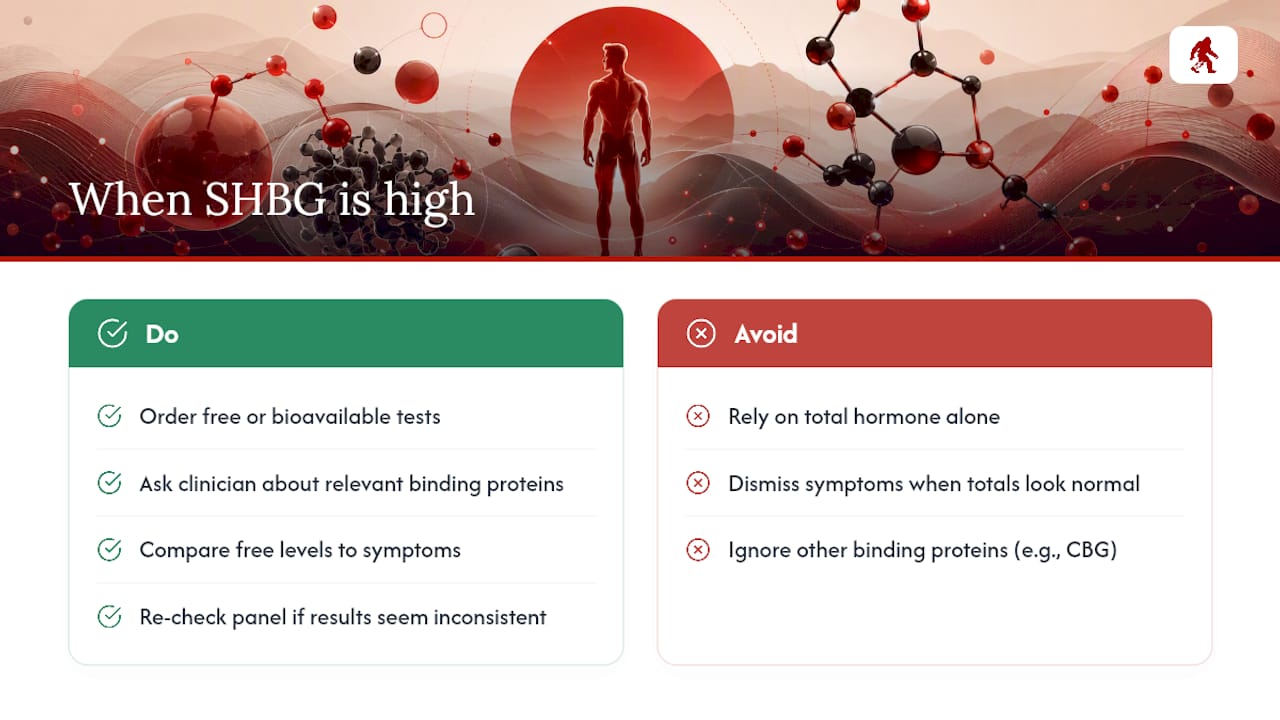
Cortisol interpretation runs into a related, though distinct, complication through cortisol binding globulin, a separate transport protein that behaves similarly to SHBG for a different hormone. The general principle carries over: a bound hormone isn't an active hormone, regardless of which binding protein is doing the holding.
The practical implication is straightforward even if the biochemistry gets complex. Any time a man with known high SHBG gets a hormone panel back that looks contradictory or doesn't match his symptoms, the binding protein question deserves consideration before the result gets dismissed as inconsistent or the symptoms get written off as unrelated. Ask your clinician specifically whether the hormone in question has a binding protein worth accounting for, and whether a free or bioavailable measurement exists for it.
Nurse Rachel: Practical Clinic Tips for Men Worried About Hormone Changes
The most common misstep I see is a man getting one total testosterone number, hearing "you're fine," and walking away still exhausted. That number means little without SHBG next to it.
Three things to do this week: start a simple symptom log, request total testosterone and SHBG from the same draw, and review your medication list with your provider before touching anything yourself. Give lifestyle changes eight to twelve weeks before judging results. Hormones move slowly, but they do move.
— Nurse Rachel
Where a Restorative Routine Like RedRockit Fits In
Everything above is about diagnosis and treating root causes. None of that changes overnight, even once you've identified the driver. That's where a consistent daily habit earns its keep, not as a fix for SHBG, but as support for the energy, recovery, and drive you're trying to protect while your medical picture gets sorted out.

There are private-use red light wellness devices built around simple daily activation routines, sometimes paired with companion apps for guided sessions. It's not hormone therapy. It's not TRT, and it doesn't diagnose or treat high SHBG or anything else. What it does is give you a consistent, low-effort restoration habit you can run alongside whatever your clinician recommends, whether that's a thyroid correction, a medication change, or simply time and better sleep.
Think of it as the daily maintenance layer under the medical work, not a replacement for it. Explore male vitality strategies after 40 or check out the RedRockit activation method to see how the routine works and whether it fits into your week.
Sources
For deeper reference, MedlinePlus explains SHBG testing indications in plain language. The NIH hosts broader endocrine health resources for patients and clinicians alike. Men researching related liver and metabolic contributors may also find value in reviewing elevated ferritin and its hormonal connections, and those weighing sexual symptom treatment options can review erectile dysfunction treatment approaches for additional context.
This article is general information, not a substitute for advice from a qualified doctor. Consult a qualified healthcare professional about your own circumstances before acting on anything here.