

For most adult men in the United States, total testosterone typically spans a broad range, but that single range hides a lot. Testosterone levels should be interpreted with age context, meaning a 25-year-old and a 55-year-old with the same measurement may have different clinical significance. Age-specific context is everything.
Here is a general overview of testosterone level interpretations:
- Below 300 ng/dL (any age): Clinically low by the most common threshold, but research from the Journal of Urology argues this cutoff was derived from older populations and misses clinically relevant deficiency in younger men. A 30-year-old at 310 ng/dL may still be functionally low for his age.
- Levels just above traditional low thresholds may be borderline, requiring symptom assessment, repeat testing, and clinical context before diagnosis.
- Moderate testosterone levels within commonly observed ranges are generally considered healthy for many adult men.
- Higher testosterone levels are often seen in younger men.
- Elevated testosterone levels, especially without exogenous testosterone use, warrant clinical evaluation.
Got your lab result in hand? If your number is below range for your age group, repeat the test on a different morning before drawing any conclusions. If it is within range but you feel off, free testosterone may tell a different story. If it is above 1,000 ng/dL without explanation, bring it to a clinician. The number is a starting point, not a verdict.
Table of Contents
- What are the normal testosterone ranges by age for men?
- How is testosterone actually measured, and what should you ask your doctor?
- What are the signs of low testosterone, and what causes it?
- How do clinicians interpret your results, and what happens next?
- What can you try before starting testosterone therapy?
- Key Takeaways
- The number on your lab report is not the whole story
- RedRockit: a daily restoration routine while you do the work
- Useful sources and further reading
What are the normal testosterone ranges by age for men?
The 300 ng/dL floor that most people have heard of comes from guidelines built largely on older male populations. When researchers looked specifically at younger men, the picture shifted. A Journal of Urology study reported middle-tertile total testosterone ranges for U.S. men as follows:
| Age Group | Middle-Tertile Range (ng/dL) | Age-Specific Low Cutoff (ng/dL) |
|---|---|---|
| 20–24 | 409–558 | 409 |
| 25–29 | 413–575 | 413 |
| 30–34 | 359–498 | 359 |
| 35–39 | 352–478 | 352 |
| 40–44 | 350–473 | 350 |
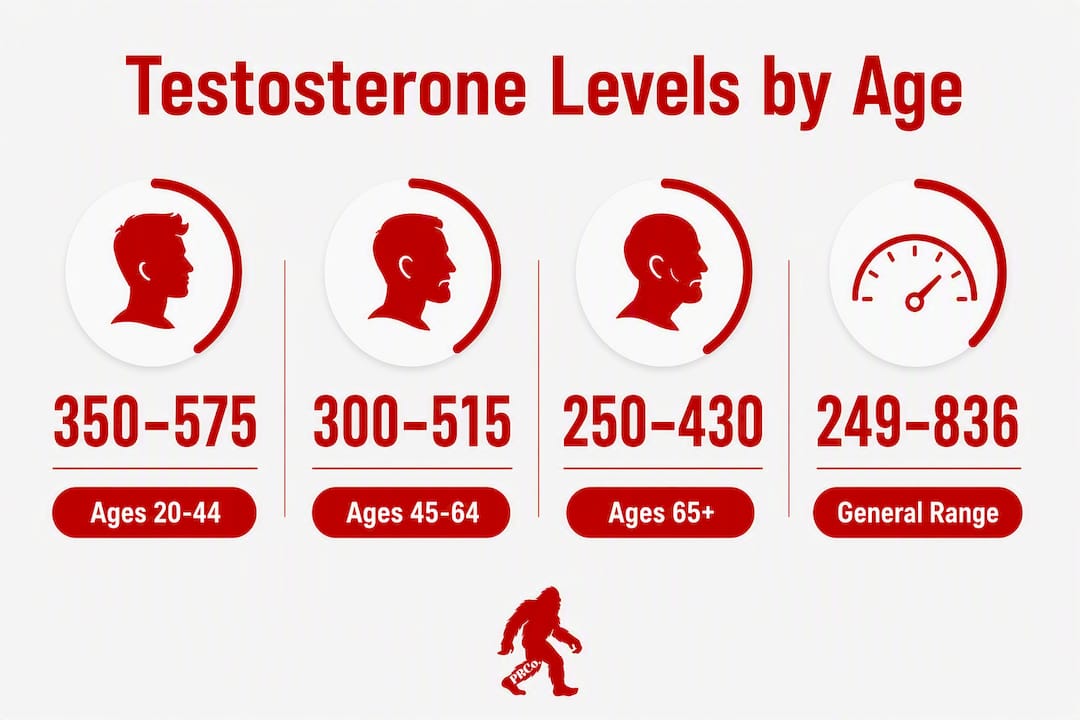
For broader context, MedlinePlus lists general lab reference intervals of 249–836 ng/dL for men aged 17–50 and 193–740 ng/dL for men over 50, with a clear note that ranges vary by lab and testing method.
A separate harmonization study published on PMC found that in healthy nonobese men aged 19–39, the 2.5th percentile was 264 ng/dL and the 97.5th percentile was 916 ng/dL, with a median around 531 ng/dL. That is a wide spread, and it reinforces why a single cutoff tells an incomplete story.
Two things are worth understanding here. First, "middle tertile" is not the same as a lab reference interval. A lab reference interval captures the full range seen in a tested population, including men with undiagnosed conditions. The middle tertile strips out the top and bottom thirds to show where healthy men cluster. Second, testosterone declines roughly 1%–2% per year after age 30, which means a 45-year-old at 380 ng/dL is tracking differently than a 25-year-old at the same level.
Pro Tip: When you get your lab result, ask which reference range your lab used and whether it is age-stratified. Many labs still use a single adult range that does not reflect your age group.
How is testosterone actually measured, and what should you ask your doctor?
Two numbers matter on a testosterone panel: total testosterone and free testosterone. Total testosterone measures everything circulating in your blood, bound and unbound. Free testosterone is the biologically active fraction, the portion your cells can actually use.
Here is why that distinction matters. Sex hormone-binding globulin (SHBG) binds to testosterone and makes it unavailable. If your SHBG is high (which happens with aging, thyroid disease, or low body weight), your total testosterone can look normal while your free testosterone is genuinely low. Clinical literature recommends assessing free testosterone when total testosterone does not match the clinical picture.
On the assay side, not all tests are created equal. Most standard labs run immunoassays, which are fast and affordable but carry more measurement variability. LC–MS/MS (liquid chromatography–tandem mass spectrometry) is the gold standard for accuracy, particularly when results are borderline or clinical decisions depend on precision. If your result is near a threshold, it is worth asking whether your lab uses LC–MS/MS.
Timing is the other variable most men miss. Testosterone peaks in the early morning, typically between 7 and 10 AM, then drops through the afternoon. A blood draw at 2 PM can read 20–25% lower than a morning draw from the same man on the same day. MedlinePlus confirms that clinicians typically require multiple early-morning tests before diagnosing deficiency.
What to request on your lab order:
- Draw time documented (request before 10 AM)
- Total testosterone and free testosterone (or calculated free T)
- SHBG if free T is not directly measured
- Repeat confirmation if the first result is low or borderline
You can also explore home testosterone testing options as a starting point, though a clinical draw with a documented morning time remains the most reliable baseline.
Pro Tip: Never make a clinical decision based on a single testosterone measurement. One low result on an afternoon draw has sent more than a few men down a treatment path they did not need.
What are the signs of low testosterone, and what causes it?
Low testosterone does not always announce itself loudly. The signal fades gradually, and most men chalk it up to stress, age, or a bad stretch at work. The Cleveland Clinic lists the most common symptoms:
- Reduced sex drive and low libido
- Fatigue and low energy that sleep does not fix
- Difficulty building or maintaining muscle mass
- Increased body fat, particularly around the midsection
- Mood changes, irritability, or low motivation
- Erectile dysfunction or reduced morning erections
- Difficulty concentrating or brain fog
On the other end, unusually high testosterone (above 1,000 ng/dL without exogenous use) can cause acne, aggression, sleep disruption, and elevated red blood cell counts. It is less common as a spontaneous finding and more often seen in men using anabolic steroids or testosterone therapy without monitoring.
The causes of low testosterone split into two categories. Primary hypogonadism originates in the testes (injury, genetic conditions, chemotherapy). Secondary hypogonadism originates in the hypothalamic-pituitary axis, meaning the brain is not sending the right signal to the testes. Distinguishing between them requires measuring LH and FSH alongside testosterone: low T with high LH points to primary hypogonadism, while low T with low or normal LH suggests a secondary cause.

Several causes are modifiable. Obesity, obstructive sleep apnea, chronic stress, heavy alcohol use, and certain medications (opioids, corticosteroids, some antidepressants) all suppress testosterone. The Cleveland Clinic emphasizes that addressing these contributors can improve levels without hormonal therapy. That matters, because treating a reversible cause is always the cleaner path.
Testing is appropriate when you have symptoms. Routine screening without symptoms is not standard practice. If your first result is borderline, retest within a few weeks under the same morning conditions before pursuing further evaluation.
How do clinicians interpret your results, and what happens next?
A single number below 300 ng/dL does not automatically mean you have hypogonadism. Context drives the clinical interpretation. Research published in PubMed recommends multiple early-morning draws and evaluation of LH, FSH, and SHBG before any diagnosis is confirmed.
The standard confirmatory sequence looks like this:
- Repeat early-morning total testosterone on at least two separate days
- Add free testosterone and SHBG if total T is borderline or symptoms are present despite normal total T
- Check LH and FSH to distinguish primary from secondary hypogonadism
- Review medications and recent illness, both of which can temporarily suppress levels
If results remain low after confirmation, the next step depends on the cause. Secondary hypogonadism with a pituitary origin warrants imaging and endocrinology referral. Primary hypogonadism typically moves toward a urology or endocrinology conversation about treatment options, including testosterone replacement therapy (TRT). Understanding TRT side effects before that conversation is worth your time.
Pro Tip: Bring a symptom diary, your full medication list, and any previous lab results to your appointment. Clinicians make faster, better decisions when they can see a timeline rather than a single data point.
What can you try before starting testosterone therapy?
The clinical best practice is clear: address reversible causes before starting TRT. That is not a delay tactic. It is the smarter path, because exogenous testosterone suppresses your body's own production and creates a dependency that is difficult to reverse.
Here is what the evidence supports:
- Weight loss: Obesity directly suppresses testosterone. Meaningful fat loss, particularly visceral fat, can raise levels without any hormonal intervention.
- Resistance training: Compound lifts (squats, deadlifts, presses) consistently support testosterone production. Reactive strength and compound loading are particularly relevant for men focused on performance outcomes alongside hormonal health.
- Treating obstructive sleep apnea: Untreated sleep apnea is one of the most underdiagnosed suppressors of testosterone. A CPAP trial can produce measurable improvement in levels and symptoms.
- Alcohol moderation: Heavy drinking suppresses the hypothalamic-pituitary axis. Reducing intake is one of the fastest modifiable levers.
- Medication review: Work with your prescribing physician to evaluate whether any current medications are contributing to suppression.
- Nutritional support: Adequate zinc, vitamin D, and dietary fat all support testosterone synthesis. Chronic caloric restriction also suppresses production.
Beyond lifestyle, some men explore non-clinical restoration routines as adjuncts while they work on the modifiable causes. Red light wellness is one such adjunct. The evidence on testicular red light therapy is still developing, but it represents the kind of low-risk, daily-routine approach that fits alongside, not instead of, clinical evaluation.
For a structured look at what to try before the TRT conversation, Primal Red Co's guide on options before TRT lays out a practical sequence.
Pro Tip: Give lifestyle interventions at least 12 weeks before retesting. Testosterone responds to sustained change, not a two-week sprint. Document your sleep, weight, and training during that window so your clinician can see what changed.
Key Takeaways
Normal testosterone levels for men vary significantly by age, and a single 300 ng/dL cutoff misclassifies many younger men whose age-specific low threshold sits closer to 350–413 ng/dL.
| Point | Details |
|---|---|
| Age-specific ranges matter | Middle-tertile ranges for men 20–44 run 350–575 ng/dL; the 300 ng/dL cutoff was derived from older populations. |
| Test protocol is critical | Two early-morning draws plus free testosterone and SHBG give a far more accurate picture than a single afternoon result. |
| Modifiable causes come first | Obesity, sleep apnea, alcohol, and certain medications all suppress testosterone and should be addressed before TRT. |
| Decline is gradual but real | Testosterone drops roughly 1%–2% per year after age 30; lifestyle choices accelerate or slow that trajectory. |
| Primal Red Co's approach | RedRockit supports a daily restoration routine as a non-clinical adjunct for men over 30 working on their baseline before bigger decisions. |
The number on your lab report is not the whole story
There is a version of this conversation that goes: "Your testosterone is low. Here is a prescription." And for some men, that is the right answer. But for a lot of men, that conversation happens before anyone asked about sleep, weight, alcohol, medications, or stress. Before anyone ran a repeat test at 8 AM. Before anyone checked whether the signal was actually gone or just buried under a lifestyle the body was never designed to sustain.
The 300 ng/dL cutoff bothers me not because it is wrong, but because it is applied without age context. A 28-year-old at 310 ng/dL is not the same as a 58-year-old at 310 ng/dL. The research from the Journal of Urology makes that case clearly, and clinical practice is slowly catching up. But in the meantime, men are getting diagnosed and treated based on a threshold that was never meant to apply to them.
What I want men to take from this: get the number, understand what it means for your age, repeat the test properly, and address the modifiable causes before you commit to a therapy that changes your body's own production permanently. That is not anti-TRT. TRT is a legitimate medical option for men who genuinely need it. It is pro-information. Men deserve the full picture before they decide.
RedRockit: a daily restoration routine while you do the work
Most men reading this are somewhere in the middle. Not in crisis. Not ready to call a clinic. But feeling the shift and wanting to do something real about it.

RedRockit is Primal Red Co's private-use red light wellness device, built for men over 30 who want a consistent daily restoration routine that supports energy, drive, and recovery. It is not TRT. It is not a supplement. It is a structured, at-home protocol you can run in minutes, designed to fit into a real life. The companion app, Rockit IQ, walks you through guided session protocols so you are not guessing.
If your labs are low or your symptoms are significant, see a clinician first. That is the right call. But if you are in the "something feels off and I want to act before it gets worse" zone, a daily restoration routine is exactly where to start. Explore male vitality restoration for men over 40 and see whether RedRockit fits your routine.
Useful sources and further reading
The claims in this article draw from the following clinical and research sources. Bring any of these to your clinician if you want to discuss age-specific interpretation of your results.
- Testosterone: MedlinePlus Medical Encyclopedia — Lab reference intervals for total testosterone by age group, with notes on lab-to-lab variation.
- Journal of Urology: Rethinking the 300 ng/dL Cutoff — Age-specific middle-tertile ranges for U.S. men 20–44 and the case for moving beyond a single universal threshold.
- Cleveland Clinic: Testosterone Overview — Age-stratified ranges, symptoms, causes, and lifestyle contributors.
- PMC: Assay Accuracy and Free vs Total Testosterone — Why LC–MS/MS outperforms immunoassays and when free testosterone changes the clinical picture.
- PubMed: Age-Specific Testosterone Research — Confirmatory testing protocols and distinguishing primary from secondary hypogonadism.
- PMC: Harmonized Reference Ranges Across U.S. and European Cohorts — Percentile-based reference values for healthy nonobese men aged 19–39.
- Labcorp: Testing for Testosterone by Age — Practical overview of age-related decline and testing considerations.
For practical restoration routines and related reading, explore low testosterone symptoms in men and how to increase testosterone after 40 on the Primal Red Co site.
This article is general health information, not medical advice. Consult a qualified clinician or your primary care provider to interpret your specific lab results and determine appropriate next steps.