

Clomid raises your body's own testosterone by telling your pituitary to stop listening to estrogen's "off" signal. That's the short version. The longer version is that clomiphene citrate, sold as Clomid, is FDA-approved for female infertility but used off-label in men to treat secondary hypogonadism and low sperm count. It works. It preserves fertility. And for a lot of men, it's worth knowing about before anyone hands you a testosterone injection.
Here's what the clinical picture looks like:
- Clomid blocks estrogen receptors at the pituitary, increasing LH and FSH, which signal the testes to produce more testosterone naturally
- Total testosterone, sperm concentration, and sperm motility improve in clinical studies
- Symptom improvements, including better energy, libido, and erectile function, typically appear within a few months
- Unlike TRT, Clomid keeps your testes working and your sperm production intact
- Side effects exist but are generally mild and manageable
- Treatment can safely extend from months to years with proper monitoring
How does Clomid actually raise testosterone in men?
Your body runs on feedback loops. Normally, the pituitary releases LH and FSH, which tell your testes to produce testosterone. A small amount of that testosterone converts to estrogen, which signals the pituitary to slow down. That's the "off" switch. In men with obesity, insulin resistance, or other metabolic factors, excess estrogen from fat tissue hits that switch too hard, and testosterone production drops.
Clomid blocks estrogen receptors at the hypothalamus and pituitary, silencing that "off" signal. LH and FSH rise. The testes respond. Testosterone goes up, and spermatogenesis continues uninterrupted.
The clinical numbers are real. In a randomized controlled trial, men taking 50 mg of clomiphene citrate daily for 3 months saw mean serum testosterone climb from 371.97 ng/dL to 805.94 ng/dL, a mean difference of 433.97 ng/dL. Sperm count and motility improved significantly in the same group. A separate retrospective study of 153 hypogonadal men found 89% achieved a biochemical increase in total testosterone, with 74% reporting subjective symptom improvement.
| Marker | Before Clomid | After Clomid |
|---|---|---|
| Serum testosterone | Baseline | Increased |
| Sperm count | Baseline | Increased |
| Progressive motility | Baseline | Increased |
| LH and FSH | Low/normal | Elevated |
| Symptom improvement | Baseline | 74% improved |
Hormonal changes often appear within 6 weeks. Symptom relief, in the retrospective cohort, had a median onset of 3 months. Some men notice the shift in energy and drive before their labs confirm it.
Pro Tip: Ask your doctor to check both total testosterone and free testosterone at baseline. Clomid raises both, and tracking free testosterone gives you a clearer picture of how much is actually available to your tissues.
Enclomiphene, an isomer within Clomid, is increasingly used through compounding pharmacies as an alternative with potential fertility advantages and a cleaner side effect profile, though it is not FDA-approved and costs more.
What are the real risks and side effects of Clomid in men?
Clomid's side effect profile in men is manageable. A meta-analysis of 10 clinical studies found no serious adverse effects across the study populations. That's a meaningful data point, not a guarantee, but it puts the risk in perspective.
The side effects men actually report:
- Vision disturbances: Blurred vision or "floaters." If this happens, stop treatment and contact your doctor immediately.
- Mood changes: Clomid can worsen existing depression or anxiety. Men with psychiatric conditions need closer monitoring.
- Breast tenderness: Caused by elevated estradiol, which rises alongside testosterone during treatment.
- Headaches: Generally mild and often resolve as the body adjusts.
A long-term study of 400 patients treated for up to 7 years found that among men on Clomid for more than 3 years, 88% achieved normal testosterone levels, 77% reported improved symptoms, and only 8% reported any side effects. The most common were mood changes in 5 patients, blurred vision in 3, and breast tenderness in 2. No serious adverse event occurred in any patient.
One thing Clomid does NOT do: it does not raise hematocrit or PSA levels the way TRT can. That means fewer specialized monitoring requirements and a lower risk of polycythemia, one of TRT's more serious long-term concerns.
Clomid vs. TRT: which one is right for you?
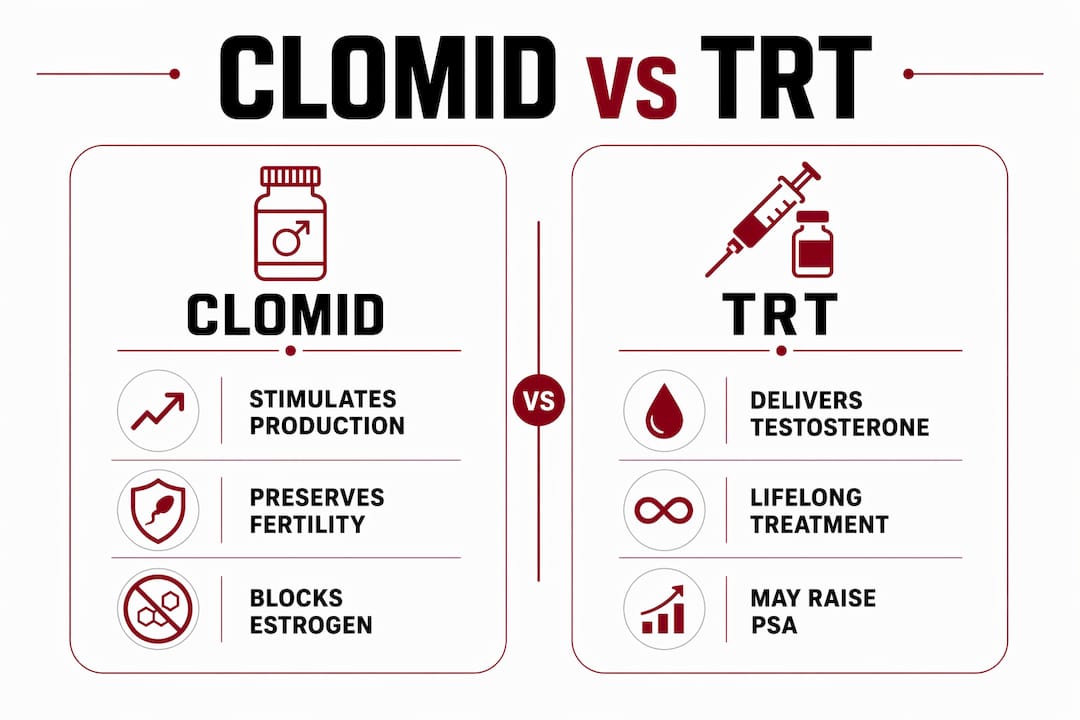
The core difference is simple. TRT delivers testosterone from outside your body. Clomid tells your body to make more of its own. That distinction has real consequences for fertility, monitoring, and long-term commitment.

| Dimension | Clomid | TRT |
|---|---|---|
| Mechanism | Stimulates natural production | Supplies exogenous testosterone |
| Fertility impact | Preserves sperm production | Often suppresses sperm production |
| Hematocrit/PSA risk | Minimal | Elevated with long-term use |
| Administration | Oral tablet | Injections, gels, or patches |
| Testicular function | Maintained | Can atrophy with prolonged use |
| Monitoring required | Testosterone, LH, FSH, semen | Testosterone, hematocrit, PSA |
| FDA approval for men | Off-label | Approved for hypogonadism |
Clomid is particularly favored for men with secondary hypogonadism who want to preserve fertility or avoid the lifelong commitment that TRT often requires. If you want to understand what stopping TRT actually involves, that's a separate conversation worth having before you start. The TRT side effects picture is more complicated than most men realize going in.
TRT wins on reliability of dosing and is the standard first-line treatment for primary hypogonadism, where the testes themselves are the problem. Clomid cannot fix a testicular defect; it only works when the pituitary-testicular axis is intact.
Who is actually a good candidate for Clomid therapy?
Clomid works best for a specific type of man. Not every low-T patient will respond, and knowing the profile saves time and frustration.
Good candidates:
- Men with secondary hypogonadism (pituitary or hypothalamic dysfunction, not testicular failure)
- Men who want to preserve fertility or are actively trying to conceive
- Younger men who want to avoid permanent testicular suppression from TRT
- Men with obesity or insulin resistance, where excess estrogen from fat tissue is driving the problem
- Men who prefer an oral medication over injections or topical gels
Clomid is less likely to work, or may be contraindicated, in:
- Men with primary hypogonadism (elevated LH already, testes not responding)
- Men with active vision problems or a history of serious psychiatric conditions
- Men whose testosterone is low due to primary testicular failure (e.g., Klinefelter syndrome, though some respond).
The Cleveland Clinic notes that obese, insulin-resistant men are the most common group where Clomid produces a strong biochemical response. If your low testosterone is driven by metabolic factors, Clomid is often the first-line alternative worth trying before committing to TRT.

Verified US clinics offering Clomid and testosterone therapy
Finding a clinic that actually understands Clomid for men, not just TRT, takes some work. These four US clinics offer specialized men's hormone care with documented experience in testosterone therapies.
| Clinic | Location | Services | Specialization | Lab Testing | Convenience | Rating |
|---|---|---|---|---|---|---|
| Chicagoland Men's Health | Chicago, IL | Low-T therapy, hormone treatment | Personalized low-T and hormone care | Available | Flexible appointments | 5★ (518 reviews) |
| Renew Vitality NYC | New York, NY | Testosterone, peptides, weight loss | Comprehensive hormone and vitality therapy | Available | Doctor-led, personalized plans | 5★ (220 reviews) |
| Gameday Men's Health Bend | Bend, OR | TRT, hormone optimization | Advanced hormone treatment, health optimization | On-site, same-day | Flexible appointments | 5★ (104 reviews) |
| Gameday Men's Health Mountain View | Mountain View, CA | TRT, ED treatment, wellness | Men's wellness, hormone services | Same-day labs | Life-enhancing hormone services | 5★ (104 reviews) |
Chicagoland Men's Health is a strong option for men in Illinois seeking a dedicated low-T clinic with a track record of personalized hormone care. Renew Vitality NYC goes broader, pairing testosterone therapy with peptide protocols and weight management, which matters if metabolic factors are driving your hormone issues. Both Gameday Men's Health locations stand out for same-day lab testing and flexible scheduling, a real advantage when you're monitoring hormonal response every 6–8 weeks.
When choosing a clinic, look for:
- A physician who orders baseline labs before prescribing, including LH, FSH, total testosterone, and free testosterone
- Willingness to discuss Clomid as an option, not just TRT
- On-site or same-day lab access for ongoing monitoring
- Clear communication about off-label prescribing and insurance navigation
How to start Clomid treatment in the US: insurance, legality, and next steps
Clomid is legal in the United States. It is not a controlled substance. Any licensed physician can prescribe it off-label for male hypogonadism. The practical hurdles are insurance and finding the right specialist.
Insurance coverage is variable. Many commercial plans cover generic clomiphene citrate, but they typically require a documented hypogonadism diagnosis and specialist authorization. Working with a urologist, endocrinologist, or a men's health clinic experienced with off-label prescribing makes the coverage process significantly smoother.
Steps to get started:
- Get baseline labs: total testosterone, free testosterone, LH, FSH, and a semen analysis if fertility matters to you
- See a urologist or endocrinologist familiar with Clomid for men, not just a general practitioner
- Confirm your hypogonadism type. Secondary hypogonadism responds; primary often does not
- Discuss dosing. Typical starting doses range from 25 mg every other day to 50 mg daily
- Schedule follow-up labs at 6–8 weeks to assess testosterone and gonadotropin response
- Track symptoms alongside labs. Biochemical response and symptom relief don't always move together
Typical Clomid treatment runs 3–6 months initially, with the option to extend safely under monitoring. The medication itself is inexpensive compared to TRT. The cost of doctor visits and labs varies by clinic and insurance coverage.
Understanding low testosterone before you commit to any treatment
Low testosterone has two root causes, and the treatment path depends entirely on which one you have. Primary hypogonadism means the testes themselves are failing. Secondary hypogonadism means the signal from the brain is weak. Clomid addresses the second type. TRT addresses both, but at a cost.
Alternatives to TRT worth considering before any prescription:
- Weight loss and metabolic improvement, especially for obese men where estrogen from fat tissue is suppressing the pituitary
- Sleep optimization, since testosterone production peaks during deep sleep
- Resistance training, which has a documented effect on LH and testosterone
- Vitamin D and zinc repletion, where deficiency is a contributing factor
- Clomid or enclomiphene for secondary hypogonadism with fertility goals
Medical evaluation is not optional. A testosterone number without LH and FSH context tells you almost nothing about which treatment will work. Regular hormonal and semen analyses during Clomid therapy are how physicians tailor treatment individually and catch non-responders early. If you're noticing the early signs, the low testosterone symptoms page at Primalredco breaks down what to watch for before your first appointment.
Primalredco: for men who aren't waiting to crash
The clinics above are the right call when you need a prescription and a physician in your corner. But a lot of men reading this aren't at the prescription stage yet. They feel the shift. Energy down. Drive quieter. Recovery slower. They're not broken. They just want to do something before the bigger decisions land on the table.

That's exactly who Primalredco built RedRockit for. It's a private-use red light wellness device designed to support a daily restoration routine for men over 30, targeting energy, drive, and recovery without a clinic visit, a prescription, or a commitment to exogenous hormones. It's not Clomid. It's not TRT. It's the restoration routine for men who want to protect what they still have while they figure out what comes next. If you're in that space, the male vitality after 40 content at Primalredco is a good place to start.
Key Takeaways
Clomid raises natural testosterone by blocking estrogen's pituitary feedback, making it a fertility-preserving alternative to TRT for men with secondary hypogonadism, with 89% of patients achieving a biochemical testosterone increase in clinical data.
| Point | Details |
|---|---|
| How Clomid works | Blocks estrogen receptors at the pituitary, raising LH and FSH to stimulate natural testosterone production. |
| Clinical response rate | 89% of hypogonadal men achieved a biochemical testosterone increase; 74% reported symptom improvement. |
| Fertility advantage | Unlike TRT, Clomid preserves sperm production, making it the preferred option for men with fertility goals. |
| Safety profile | Long-term use up to 7 years shows no serious adverse events; side effects are mild and affect a small minority. |
| Primalredco | RedRockit supports daily restoration for men over 30 who want to maintain energy and drive before bigger treatment decisions. |