

Your body runs on signals. Testosterone is the one most men think about, but estrogen is in the mix too, and when it climbs too high, the whole system starts sending the wrong messages. High estrogen in men, clinically measured as elevated estradiol or total estrogen beyond normal male reference ranges, disrupts the hormonal balance your body depends on for drive, sexual function, mood, and physical composition. Normal total estrogen in men generally stays within typical male reference ranges, with estradiol at low picogram per milliliter levels. Push past those thresholds and the body starts showing you.
The core symptoms you need to know:
- Gynecomastia (breast tissue growth or tenderness)
- Erectile dysfunction and reduced libido
- Infertility from impaired sperm production
- Fatigue, mood changes, and increased body fat around the hips and chest
The main causes driving those symptoms:
- Increased aromatase activity, especially in excess body fat
- Testosterone replacement therapy (TRT) without proper monitoring
- Liver disease, including cirrhosis
- Insulin resistance and metabolic dysfunction
- Rare estrogen-secreting tumors
One thing to understand upfront: the estrogen-to-testosterone ratio tells clinicians more than an absolute estrogen number alone. A man with moderately elevated estrogen but tanked testosterone is in a different situation than one with the same estrogen level and healthy testosterone. Context matters here.
What causes high estrogen levels in men?
The engine behind most cases of male estrogen dominance is an enzyme called aromatase. It converts testosterone into estrogen, and it lives primarily in fat tissue. The more body fat you carry, the more aromatase activity you generate, and the more testosterone gets quietly converted before your body can use it. That feedback loop is why obesity and high estrogen so often travel together.
But body fat is not the only driver. Here are the key causes:
- Obesity and insulin resistance: Fat tissue amplifies aromatase output, directly raising estrogen while depleting available testosterone.
- Testosterone replacement therapy: Men on TRT often see estrogen climb as exogenous testosterone converts via aromatization, making monitoring non-negotiable.
- DHEA supplementation: This precursor hormone can convert to both testosterone and estrogen, sometimes tipping the balance in the wrong direction.
- Liver disease: The liver metabolizes and clears estrogen. Cirrhosis and other liver conditions impair that clearance, letting estrogen accumulate.
- Aging: Testosterone declines naturally after 30, while aromatase activity can stay elevated, shifting the ratio toward estrogen over time.
- Estrogen-secreting tumors: Rare, but markedly elevated total estrogen above 350 pg/mL may signal a tumor requiring specialized evaluation.
- Medications and environmental estrogens: Certain drugs and endocrine-disrupting chemicals found in plastics and pesticides can influence estrogen signaling.
- Chronic stress: Elevated cortisol suppresses testosterone production, indirectly worsening the estrogen-to-testosterone ratio.
If you are on TRT and nobody has talked to you about monitoring estrogen, that is a gap worth closing. The TRT side effects conversation almost always includes estrogen management, for exactly this reason.
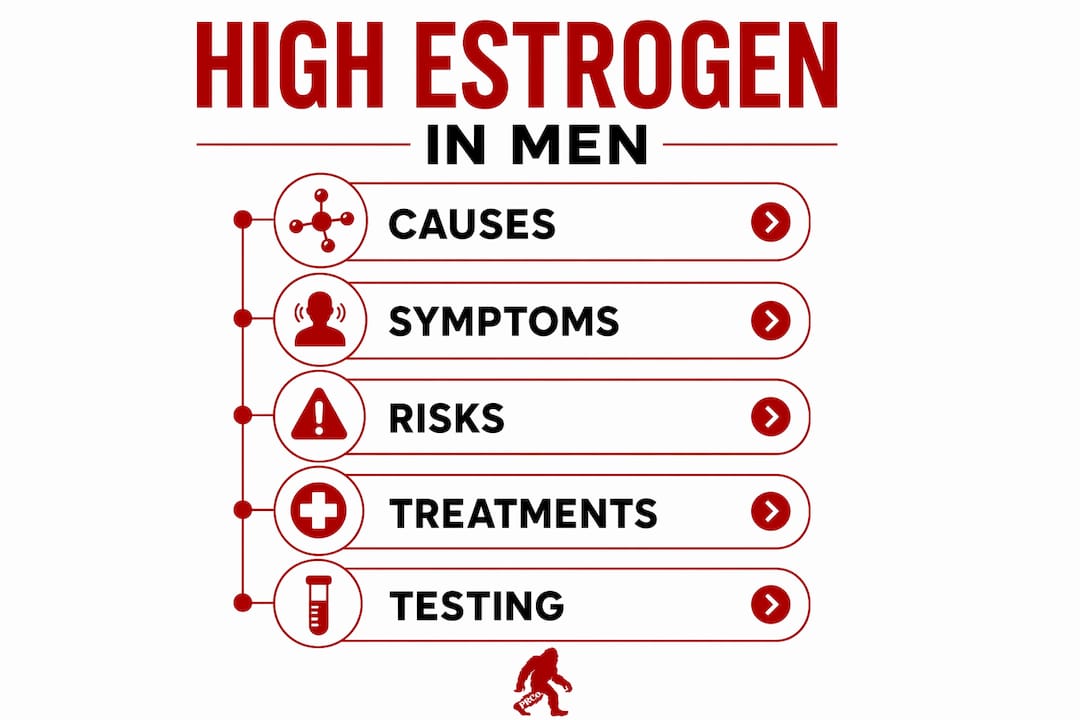
Signs and symptoms of high estrogen you should not ignore
Some of these symptoms are easy to dismiss. Fatigue? Must be work. Low sex drive? Stress, probably. That is how elevated estrogen stays under the radar for years in men who are otherwise functioning.
The most recognized symptoms of high estrogen in males:
- Gynecomastia: Breast tissue growth or tenderness, often appearing as a firm lump under the nipple. This is one of the clearest physical signs of estrogen dominance in men.
- Erectile dysfunction: Elevated estrogen can impair the hormonal signaling needed for normal erections, independent of testosterone levels.
- Reduced libido: Loss of sexual drive that does not respond to the usual fixes.
- Infertility: Estrogen plays a role in sperm maturation, and excess levels can impair sperm production and function.
- Fatigue and low energy: The kind that does not improve with sleep.
- Mood changes: Irritability, low motivation, and depressive symptoms that feel hormonal rather than situational.
- Increased body fat: Particularly around the hips, chest, and lower abdomen, even without major dietary changes.
Here is the critical caveat: symptoms like gynecomastia and erectile dysfunction are common but not definitive for high estrogen without medical evaluation. These same symptoms overlap with low testosterone, thyroid dysfunction, and other conditions. You cannot self-diagnose from a symptom list. You need the blood work.
If you are seeing several of these signs and wondering whether your hormones are behind it, the low testosterone symptoms picture often looks nearly identical, which is exactly why testing matters.

Health risks tied to elevated estrogen in men
This is not just about feeling off. Untreated estrogen imbalance carries real clinical risks, and some of them are serious.
- Male breast cancer: High estrogen increases male breast cancer risk by approximately 2.5 times compared to men with low estrogen levels. Male breast cancer is rare overall, but this elevation in relative risk is clinically significant.
- Persistent erectile dysfunction and infertility: Sexual health consequences can become entrenched when the hormonal environment stays disrupted long-term.
- Depression and mood disorders: The connection between estrogen imbalance and depressive symptoms in men is increasingly recognized in endocrine research.
- Inflammatory states: Chronic hormonal dysregulation contributes to systemic inflammation, which compounds metabolic and cardiovascular risk.
- Underlying disease progression: When elevated estrogen stems from liver disease or a hormone-secreting tumor, the primary condition continues to worsen without targeted treatment.
The risks compound when the root cause goes unaddressed. A man who attributes his symptoms to aging and never gets tested may be living with a treatable condition that is quietly doing damage.
Treatment and management options for high estrogen
Treatment is not one-size-fits-all. The right approach depends entirely on what is driving the elevation, which is why diagnosis comes first.

Diagnosis starts with blood work. A comprehensive estrogen levels test typically includes total estrogen and estradiol, but clinicians rarely stop there. Liver function panels, thyroid assessments, and a full endocrine workup are standard when estrogen is abnormal in a symptomatic man. If a tumor is suspected, imaging follows.
Treatment options, in order of typical priority:
- Address the underlying cause first. Treatment focuses primarily on root causes like obesity or liver disease before medications enter the picture. Weight loss alone can meaningfully reduce aromatase activity and bring estrogen back toward normal.
- Aromatase inhibitors (AIs): Medications like anastrozole or letrozole block the aromatase enzyme, directly reducing testosterone-to-estrogen conversion. Used in men when estrogen is elevated due to TRT or other causes, under physician supervision.
- Selective estrogen receptor modulators (SERMs): Drugs like tamoxifen or clomiphene block estrogen's action at specific receptors without lowering estrogen itself. SERMs are often used for gynecomastia management and, in the case of clomiphene, to stimulate natural testosterone production.
- Gynecomastia treatment: Medical management works best in early stages. Established gynecomastia that does not respond to hormonal correction may require surgical removal.
- ED therapies: PDE5 inhibitors address erectile dysfunction symptomatically while the hormonal cause is being treated.
- Lifestyle modifications: Weight loss, resistance training, stress reduction, and limiting alcohol all reduce aromatase activity and support a healthier hormone ratio.
Pro Tip: Before starting any medication for estrogen management, get a full hormone panel including free testosterone, total testosterone, estradiol, LH, FSH, and a liver panel. Treating estrogen in isolation without understanding the full picture can create new imbalances.
Hormone balance after 30: the bigger picture
Here is what most men do not hear until something goes wrong. Testosterone and estrogen are not opponents. They are part of the same system, and after 30, that system starts shifting. Testosterone production gradually declines, but aromatase activity does not necessarily follow. The result, for a growing number of men, is a ratio that tilts toward estrogen even when absolute testosterone levels look "normal" on paper.
This is why the estrogen-to-testosterone ratio carries more clinical weight than either number alone. A man can have testosterone in the low-normal range and estrogen at the high end of normal and still be experiencing estrogen dominance functionally.
Key factors that accelerate this shift after 30:
- Increasing body fat percentage, even without dramatic weight gain
- Insulin resistance, which amplifies aromatase output
- Exogenous androgens from TRT or DHEA supplements converting to estrogen
- Declining liver efficiency reducing estrogen clearance
- Chronic stress suppressing the hypothalamic-pituitary-gonadal axis
The lifestyle levers that push back against this are real and well-supported. Weight loss and stress reduction can meaningfully reduce estrogen by lowering aromatase activity. Resistance training improves insulin sensitivity. Sleep quality directly affects cortisol and testosterone production. None of this replaces medical treatment when it is needed, but it changes the hormonal environment your body is working in.
Primal Red Co. was built for exactly this window, the years before a man hits a wall and starts asking bigger questions. Understanding your hormone system, not just chasing a single number, is what keeps you in the game. If you want to understand what to do before TRT becomes the conversation, exploring your options early is where that starts.
What happens when high estrogen goes untreated for years
Short-term symptoms are uncomfortable. Long-term neglect is a different story.
Men who carry chronically elevated estrogen without treatment face a compounding set of consequences. Gynecomastia that might have resolved with early hormonal correction becomes structural, requiring surgery. Infertility that could have been addressed becomes a harder problem the longer the hormonal environment stays disrupted. The male breast cancer risk elevation does not reset on its own.
Beyond the reproductive and oncological risks, the metabolic picture worsens. Estrogen dominance in men is closely tied to insulin resistance and visceral fat accumulation, both of which feed back into higher aromatase activity. It becomes a self-reinforcing cycle. More fat means more aromatase, which means more estrogen, which promotes more fat storage.
Mood and cognitive function take a hit too. Chronic hormonal imbalance is associated with depressive symptoms, reduced motivation, and the kind of mental fog that men often attribute to stress or age. When the underlying hormonal cause goes unaddressed, those symptoms do not resolve on their own.
The men who fare best are the ones who get tested before the symptoms become entrenched. If you have been feeling the shift and putting off the conversation with your doctor, that delay has a cost.
When to see a doctor and get your estrogen tested
You do not need to wait until something is obviously wrong. If you are over 30 and noticing any combination of low libido, fatigue, mood changes, unexplained body fat gain, or breast tenderness, those are enough reason to ask for a hormone panel.
Specific situations that warrant prompt evaluation:
- Visible or tender breast tissue growth at any age
- Erectile dysfunction that is new or worsening without an obvious cause
- Infertility concerns, especially if you have been trying to conceive
- You are currently on TRT or DHEA and have not had estrogen monitored
- Fatigue and mood changes that do not respond to sleep or lifestyle changes
- Any total estrogen reading above 350 pg/mL on a prior test
Ask your doctor for a full panel, not just total testosterone. Request estradiol, free testosterone, LH, FSH, and a liver function panel. If your doctor is not familiar with interpreting the estrogen-to-testosterone ratio in men, an endocrinologist or urologist with hormone expertise is worth seeking out.
Understanding what is happening in your body is not weakness. It is the move that keeps you ahead of the problem. If you want to understand the hormone balance picture after 40 before you are sitting in a clinic waiting room, that knowledge is available to you now.
Primal Red Co. and the restoration routine that starts before the crisis

Most men do not think about their hormones until something breaks. Primal Red Co. was built for the men who want to think about it before that happens.
RedRockit is a private-use red light wellness device designed to support a daily restoration routine for men over 30. It is not a prescription. It is not TRT. It is a tool for men who want to stay in the game and support their body's natural recovery signals before bigger decisions land on the table.
If you are reading this because something feels off and you are not ready to go straight to a clinic, start with the signal. That is what Primal Red Co. is here for.
Key Takeaways
High estrogen in men is a treatable hormonal imbalance driven primarily by excess aromatase activity, and addressing the root cause, whether obesity, TRT, or liver disease, is more effective than chasing the estrogen number alone.
| Point | Details |
|---|---|
| Normal range matters | Total estrogen exceeding normal male reference ranges warrants clinical evaluation. |
| Ratio over absolute level | The estrogen-to-testosterone ratio provides better clinical insight than an isolated estrogen reading. |
| Cancer risk is real | High estrogen increases male breast cancer risk by approximately 2.5 times compared to men with low estrogen. |
| Treat the cause first | Weight loss, liver treatment, and TRT adjustment come before aromatase inhibitors or SERMs in most cases. |
| Do not wait for a crisis | Symptoms like fatigue, low libido, and breast tenderness are enough reason to request a full hormone panel now. |
Recommended
- Low Testosterone Symptoms in Men: What Changes After 40 Can Feel Like | RedRockit
- TRT Side Effects: What Men Search Before Starting Testosterone | RedRockit
- What to Try Before TRT: Male Vitality, Energy, and Restoration | RedRockit
- Low Libido After 40: Why Men Start Searching Testosterone | RedRockit