
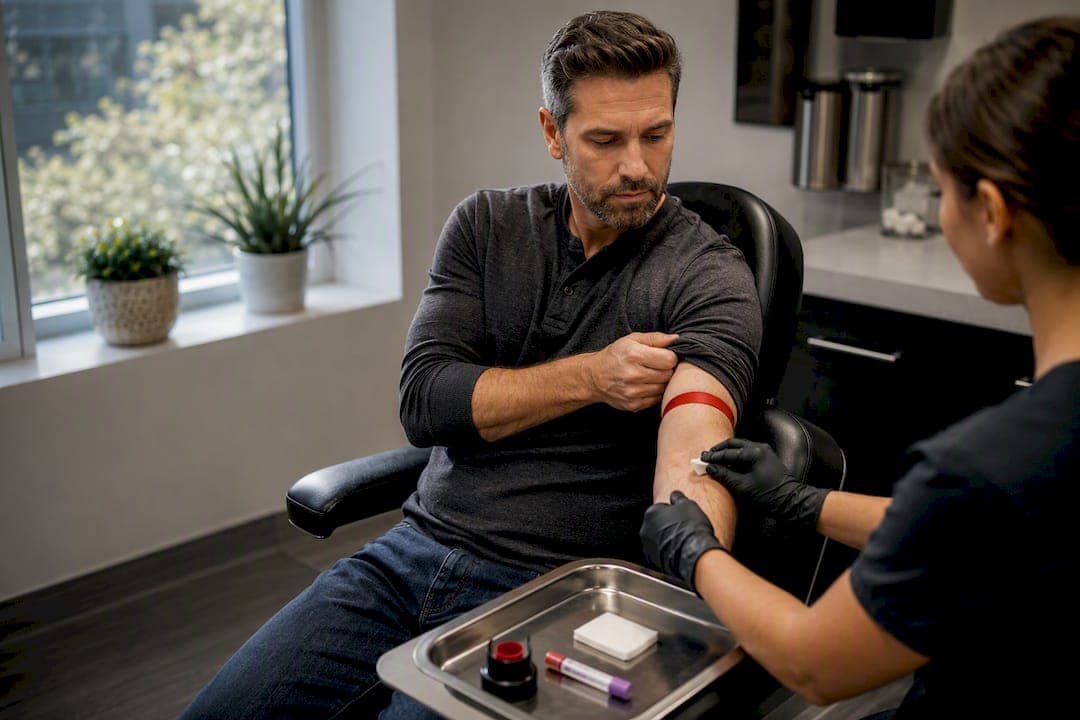
If your energy is gone and your drive left with it, low testosterone is often the bigger suspect, especially when sexual symptoms show up alongside the fatigue. If the dominant feeling is hopelessness or a flat, joyless static over everything, depression is usually driving the bus. Both can hit at once. The next move either way is the same: get evaluated, ask for a morning testosterone test and a depression screen, and if you're having thoughts of hurting yourself, skip the research and call for help now.
TL;DR:
- Testing should include a morning total testosterone check, repeat results on different days, and assessment of LH, FSH, prolactin, or TSH for accurate diagnosis.
- Sexual dysfunction, especially persistent loss of libido or weak morning erections, is a key symptom that warrants specific testing for low T.
- Many overlapping factors like sleep apnea, obesity, medications, and age influence both depression and testosterone levels, complicating diagnosis without full workup.
- Testosterone therapy benefits men with confirmed low T and depressive symptoms, but it should be monitored regularly and not used as a general mood treatment.
- Rule out other conditions such as hypothyroidism, sleep apnea, or chronic illnesses before attributing symptoms solely to depression or low testosterone.
Table of Contents
- Depression or Low Testosterone: The Symptom Checklist
- Why Do Depression and Low Testosterone Look So Similar?
- How Do Doctors Test for Low Testosterone?
- Does Testosterone Therapy Actually Improve Mood?
- What Should You Do This Week?
- Nurse Rachel's Clinical Take on Sorting This Out
- Could Something Else Be Causing These Symptoms?
- The Bottom Line on Sorting Depression From Low T
- An Adjunct Option Worth Knowing About: RedRockit
- Sources
Depression or Low Testosterone: The Symptom Checklist
Here's the frustrating part. Fatigue, low libido, brain fog, and restless sleep show up in both conditions. Your body doesn't hand you a labeled diagnosis. It just hands you the shutdown, and you're left guessing why the signal went quiet.
Some symptoms overlap almost perfectly between low T and depression:
- Fatigue that doesn't lift with rest
- Reduced sex drive
- Trouble concentrating or "brain fog"
- Disrupted or unsatisfying sleep
Other signs point harder in one direction. If you're noticing physical changes, that's your body sending a more specific message about hypogonadism, not just mood:
- Losing muscle mass or strength despite training the same as before
- Breast tissue growth or tenderness (gynecomastia)
- Thinning body hair, especially in the groin and underarms
- Fewer or weaker morning erections
Depression, on the other hand, tends to announce itself with a different flavor entirely:
- Persistent sadness or a flat, numb mood most of the day
- Anhedonia, meaning you've lost interest in things that used to matter to you
- Suicidal thoughts or a sense that life isn't worth continuing
- Psychomotor changes, like moving and speaking noticeably slower, or restless agitation
Pay attention to sexual dysfunction specifically. It's one of the most useful clues you have, and it's worth testing rather than guessing about. Roughly 40% of men with major depression report decreased libido, and about 32% report erectile dysfunction, which means sexual symptoms alone don't confirm low T. They're a flag for both conditions, and the only way to sort out which one is driving yours is a lab test paired with a real conversation about your mood.
Why Do Depression and Low Testosterone Look So Similar?
The overlap isn't a coincidence. Testosterone helps regulate the serotonin and dopamine systems that govern motivation, reward, and mood. When testosterone drops, those systems can lose some of their drive, and the result feels a lot like depression from the inside, even when the root cause is hormonal.
The relationship runs both directions, too. Depression itself, and several of the medications used to treat it, can suppress the hypothalamic pituitary testis axis, the signaling chain that tells your testes to produce testosterone. Selective serotonin reuptake inhibitors are notorious for causing sexual dysfunction on their own, which means a man on an antidepressant can develop low libido and erectile trouble that has nothing to do with his testosterone level and everything to do with the prescription he's taking. That's a genuinely confusing overlap, and it's one clinicians miss more often than they should.
Then there's the pile of confounders that muddy both sides of the equation at once. Age lowers testosterone gradually, often starting in a man's 30s. Sleep apnea suppresses testosterone production and wrecks mood independently. Obesity converts testosterone to estrogen through aromatase activity in fat tissue, and it's linked to depressive symptoms on its own. Heavy alcohol use blunts testicular function and is a well-known depressant. Several common medications, from opioids to certain blood pressure drugs, quietly lower testosterone too. None of these factors act in isolation, which is exactly why a simple story like "low T causes depression" or "depression causes low T" rarely captures what's actually happening in a real man's body.
There's also a wildcard most men never hear about: androgen receptor sensitivity. Two men with an identical blood testosterone number can experience wildly different symptom burdens, because the receptors reading that hormone signal aren't equally responsive from one man to the next. That's part of why one guy feels fine at a testosterone level that leaves another man exhausted and irritable. The number on the lab report is only half the story. Genetics writes the other half.
If you want a deeper look at how estrogen dominance factors into this same overlap, our breakdown of high estrogen in men covers a piece of the puzzle that rarely gets airtime.
How Do Doctors Test for Low Testosterone?
Getting an accurate read on your testosterone takes more discipline than most men expect, and skipping the discipline is exactly how misdiagnoses happen. Here's the sequence a competent clinician should follow:
- Start with a validated mood screen, typically the PHQ-9, alongside a total testosterone draw taken in the morning, ideally before 10 a.m., since testosterone follows a daily rhythm and peaks earlier.
- Check free testosterone if total levels sit near the borderline or if sex hormone binding globulin is abnormal, since SHBG can distort what the total number actually reflects. Our guide to normal testosterone levels in men walks through how total and free values differ in practice.
- Repeat a low result on a separate morning before anyone labels you hypogonadal. A single low draw proves almost nothing on its own.
- Order LH and FSH to figure out whether the problem originates in the testes (primary) or in the brain's signaling to the testes (secondary), and add prolactin or TSH testing if the clinical picture suggests a pituitary or thyroid issue.
The biggest pitfall in this whole process is treating one lab value as gospel. Acute illness, poor sleep, recent alcohol use, or even a bad week can temporarily suppress testosterone in a man who is otherwise perfectly healthy. A competent clinician reads the number in context. They don't diagnose off a single draw, and neither should you.
Pro Tip: Ask your clinician to write down your sexual function, your prior and current medications, and your sleep quality directly in the chart alongside the lab order. A testosterone number without that context is close to useless, and a rushed ten-minute visit rarely captures it unless you insist.
Does Testosterone Therapy Actually Improve Mood?
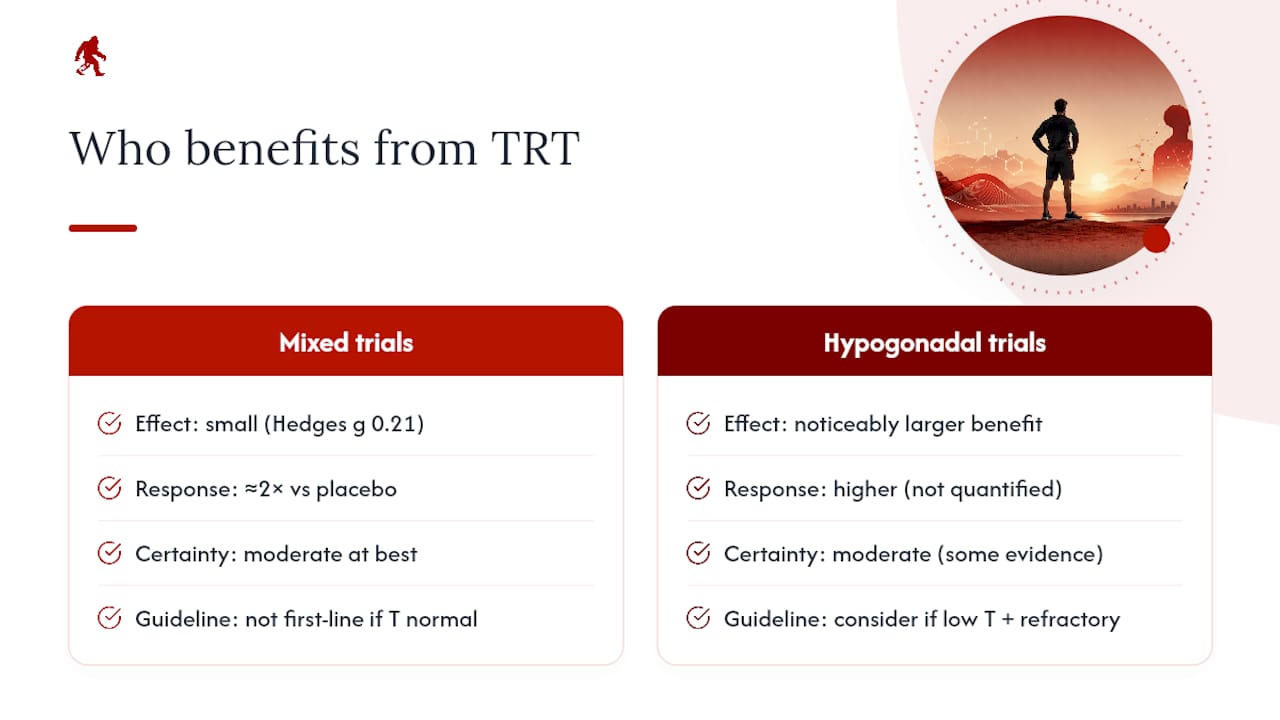
Sometimes, and the honest answer stops there for most men. A meta-analysis of 27 randomized controlled trials covering 1,890 men found that testosterone treatment produced a small but statistically significant reduction in depressive symptoms, with an effect size (Hedges g) of 0.21 and men on treatment roughly twice as likely to respond compared with placebo.
The number that matters most here isn't the average effect. It's who it comes from. Trials that preselected men with genuinely low baseline testosterone and clear depressive symptoms showed noticeably larger benefits than trials that lumped in eugonadal men who had no hormonal deficiency to correct in the first place.
That selection effect is the whole story. A 2026 systematic review reached a similar conclusion: testosterone therapy can meaningfully improve depressive symptoms and some cognitive function in men who are hypogonadal or who haven't responded to standard antidepressants, but the certainty of that evidence is moderate at best, and researchers are still calling for larger, longer trials to nail down who benefits and by how much.
Here's what that means for you in practice. No major clinical guideline recommends testosterone therapy as a first line treatment for major depression in a man with normal testosterone. It simply isn't built for that job. Testosterone functions more like a mood modulator than a direct antidepressant, and it earns its place in treatment only when biochemically confirmed low T coexists with depressive symptoms that haven't improved with standard care, and often specifically when sexual dysfunction is part of the picture too.
Older clinical research backs this up from a different angle. Testosterone replacement in confirmed hypogonadal men has shown real improvements in energy and reductions in irritability and low mood, but those gains tend to plateau once serum testosterone reaches a minimally adequate range. More isn't better past that point. It's just more.
If you do go down the TRT road, ongoing monitoring matters. Expect regular hematocrit checks, since testosterone therapy raises red blood cell counts and pushes some men toward dangerously thick blood. PSA monitoring is typically part of the picture for older men too. None of this happens without a doctor tracking it, which is precisely why testosterone therapy belongs under endocrine oversight rather than the "just get the shot" mentality that treats hormone replacement like a supplement refill. If fertility is part of your calculus, our article on Clomid as an alternative to TRT is worth reading before you commit to anything.
What Should You Do This Week?
Waiting and hoping the fog lifts on its own rarely works. Here's the sequence worth following, starting today:
- Take a self administered PHQ-9. It takes five minutes. If your score lands in the moderate to severe range, or if you're having any thoughts about suicide, contact a clinician immediately, or go to an emergency room if the thoughts feel urgent. This step overrides everything else on this list.
- Book a primary care appointment and specifically request a morning total testosterone draw alongside your depression screening. Bring a written log covering libido, morning erections, sleep quality, and energy over the past two weeks. Specifics move a diagnosis forward faster than "I've just been tired lately."
- Start the self care measures that help both conditions regardless of the cause. Prioritize consistent sleep timing, add resistance training two to three times a week, cut back on alcohol, and get evaluated for sleep apnea if you snore heavily or wake up gasping. Weight loss, even modest amounts, tends to move testosterone and mood in the same favorable direction.
- Ask about a referral to endocrinology if your labs confirm hypogonadism, or psychiatry if your mood symptoms are severe or treatment resistant. Follow up appointments should track your symptom log alongside repeat labs, not just a single number six weeks later.
Nurse Rachel's Clinical Take on Sorting This Out
The mistake I see most often in clinics isn't a bad diagnosis. It's a rushed one. A single morning testosterone draw gets treated as the final word, medication side effects never get investigated, or a man with clear sexual symptoms gets handed an antidepressant without anyone checking his hormones first. All three shortcuts happen constantly, and all three leave men undertreated.
Track your morning erections and libido for a full week before your appointment. Keep a short symptom diary. Get your labs drawn at the same time of morning every time, because timing consistency is what makes a repeat test meaningful instead of noise.
And to be clear about where restoration routines fit into this: they support the man who's already doing the real work of getting tested and treated. They don't replace it. A daily routine can help you feel steadier while you wait on results or work through treatment, but it isn't a diagnostic tool and it isn't a substitute for a lab report. If your levels come back low, our piece on normal testosterone levels in men is a good next stop.
Could Something Else Be Causing These Symptoms?
Before you settle on either depression or low testosterone as the answer, rule out the other conditions that mimic both. Hypothyroidism causes fatigue, low libido, and mood flattening that looks remarkably like depression on the surface, and it's a simple blood test to check. Sleep apnea deserves a hard look too, since it suppresses testosterone production directly and leaves men exhausted regardless of what their hormone panel shows.
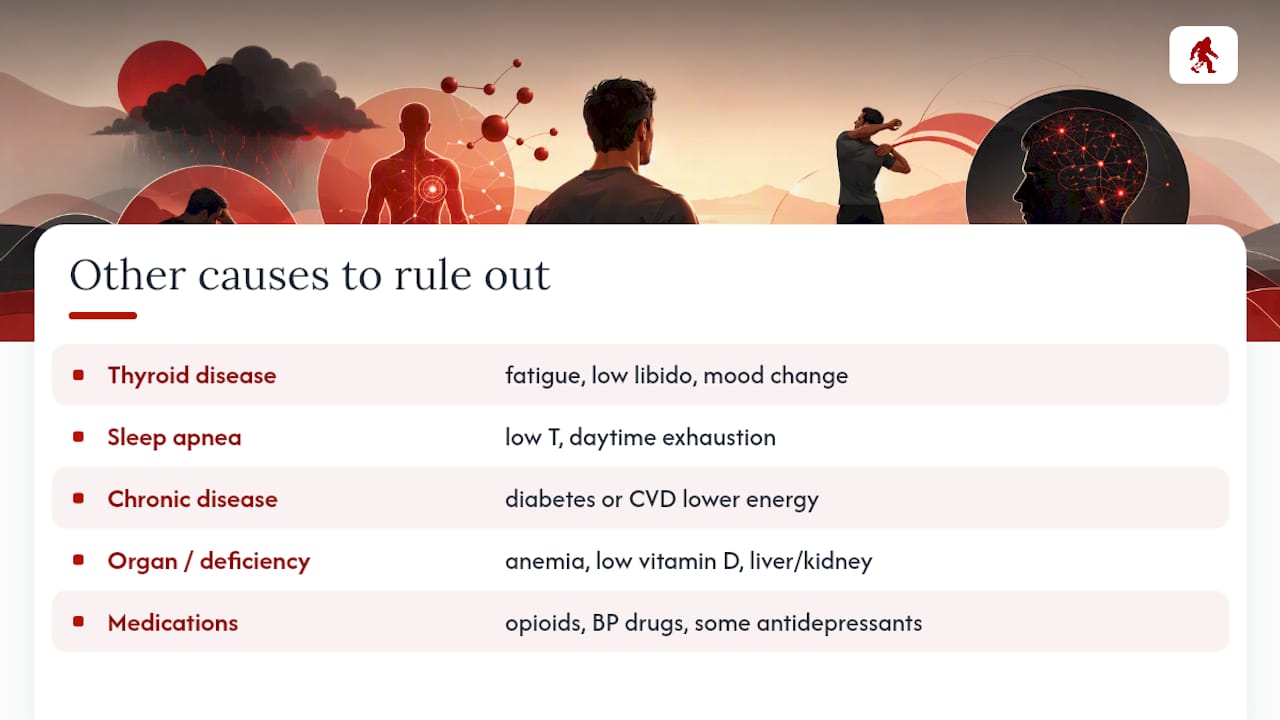
Chronic conditions like diabetes and cardiovascular disease also drag down both energy and hormone levels simultaneously, which is part of why comorbidities complicate this picture so much for men past 40. Anemia, vitamin D deficiency, and undiagnosed liver or kidney disease can all produce fatigue that gets misread as either depression or low T when it's actually neither. Medication side effects are worth a careful review too. Opioids, certain blood pressure medications, and some antidepressants themselves can suppress testosterone or cause the exact sexual dysfunction that muddies this whole diagnostic picture.
This is why a thorough clinical workup, not a symptom checklist alone, is what actually separates these possibilities. A good primary care visit should include a basic metabolic panel, thyroid function testing, and a review of every medication you're taking before anyone lands on a final answer. Skipping that step is how men end up treated for the wrong condition for months.
The Bottom Line on Sorting Depression From Low T
The research here supports a specific judgment: testosterone is a mood modulator, not a mood fix, and the men who benefit most from correcting it are the ones who are actually deficient and symptomatic, not every man who feels run down. Conventional advice often skips straight past that nuance, either dismissing hormones entirely or treating a testosterone shot like a cure all for a bad year.
What the evidence actually supports is patience with the process. Get tested properly, more than once, before accepting either label. Rule out sleep apnea and medication side effects before you rule in a diagnosis. And if sexual dysfunction is part of your symptom picture, don't let it get waved off as "just stress." It's one of the more reliable clues you have.
Prioritize the screening and the lab work first. Everything else, including any restoration routine you build around your results, works better once you actually know what you're dealing with.
— Nurse Rachel
An Adjunct Option Worth Knowing About: RedRockit
Testing and treatment come first, always. But once you know what you're dealing with, or while you're waiting on results, a lot of men want something they can do daily that supports the fight instead of sitting on the sidelines of it. That's where RedRockit comes in.

RedRockit is a private use red light wellness device designed to support energy, recovery, and libido maintenance as part of a daily routine, guided by a companion app for session protocols. It's designed to complement the work you're already doing with your doctor, not replace the diagnostic testing or prescribed therapy that should always come first if your labs confirm low testosterone or your PHQ-9 score points toward depression. If you're an otherwise healthy man looking to protect your energy and drive before bigger medical decisions land on the table, this is exactly the kind of routine worth building. If you're dealing with confirmed hypogonadism or moderate to severe depressive symptoms, get that addressed clinically first, and consider a restoration routine the supporting cast, not the lead. Related reading on how red light therapy relates to testosterone and how other men over 40 experience low libido can help you decide if it fits your situation. Ready to see how it works? Check out the RedRockit activation method and start building your routine.