

Sleep, resistance training, body composition, and a handful of nutritional corrections are the levers that actually move morning testosterone levels without a prescription. Get those four right and most men see measurable change in 8 to 12 weeks, often in the range of 15 to 25 percent for men who were genuinely off track. This is a maintenance and support strategy, not treatment. If you're dealing with persistent fatigue, low drive, or other symptoms that don't budge, talk to a clinician.
TL;DR:
- Improving sleep to 7 to 9 hours per night can boost morning testosterone levels by up to 25 percent over 8 to 12 weeks, especially in men who are currently sleep-deprived.
- Resistance training three times weekly with compound lifts and progressive overload supports hormone health and helps increase testosterone sustainably.
- Maintaining a healthy body composition by reducing visceral fat through gradual fat loss is crucial, as visceral fat converts testosterone into estrogen.
- Correcting vitamin D deficiency and ensuring adequate zinc and magnesium intake can raise testosterone levels, but only if deficiencies are present.
- Consistent wake times, bright light exposure within 10 minutes of waking, and a supportive morning routine are key to optimizing hormonal rhythms naturally.
Table of Contents
- What Actually Drives Morning Testosterone Levels?
- What Should You Eat to Support Testosterone Naturally?
- How Do You Build a Morning Routine Around This?
- How Long Until You See Results, and When Should You See a Doctor?
- Nurse Rachel's Take: Stop Overthinking and Start With the Boring Stuff
- Where a RedRockit Session Fits Into Your Morning
- Key Studies and Resources Cited in This Guide
- Sources
- FAQ
What Actually Drives Morning Testosterone Levels?
Your body doesn't produce testosterone evenly throughout the day. It builds it overnight and releases the bulk of it during deep and REM sleep, which is why peak testosterone levels show up shortly after waking and taper as the day goes on. Mess with the input and you mess with the output. That's the whole game.
Sleep is the loudest signal here; for athletes looking to optimize recovery and hormone health, understanding the importance of rest is crucial as detailed in this descanso para deportistas: guía práctica de recuperación. A JAMA study found that cutting sleep to 5 hours a night for just one week dropped daytime testosterone by 10 to 15 percent in healthy young men. Separate research on older men found that total sleep time independently predicts morning testosterone levels, meaning the men logging more consistent hours were showing stronger numbers, full stop. The fix isn't complicated. Aim for 7 to 9 hours, and lock in a wake time that doesn't shift by more than an hour on weekends. Sleep debt is cumulative. You don't get to "catch up" on Saturday and call it even.
Resistance training is the second pillar, and it's not optional. A recent Journal of Clinical Medicine review confirms that moderate to high intensity free weight training is the most effective exercise approach for supporting testosterone and preserving muscle. Three sessions a week, built around compound lifts, is the floor.
- Squats, deadlifts, presses, rows. Movements that recruit multiple muscle groups.
- Progressive overload. Add weight or reps over time, don't just repeat the same session forever.
- Avoid chronic overtraining. Piling on endless cardio volume or training in a constant calorie deficit can suppress the hormonal signaling you're trying to protect.
Body composition matters more than most men realize. Visceral fat, the kind that sits around your organs, contains an enzyme called aromatase that converts testosterone into estrogen. Carry more of it, and you're actively working against yourself. Gradual fat loss, not crash dieting, is the target.
Stress rounds out the list. Chronic cortisol elevation competes directly with testosterone for the same biochemical resources. Structured stress reduction, whether that's a consistent wind-down routine, moderate exercise, or basic mindfulness practice, isn't a soft add-on. It's load-bearing.
Pro Tip: If you only fix one thing this month, fix your wake time. A consistent wake time anchors your whole circadian rhythm, and testosterone release follows that rhythm closely.
What Should You Eat to Support Testosterone Naturally?
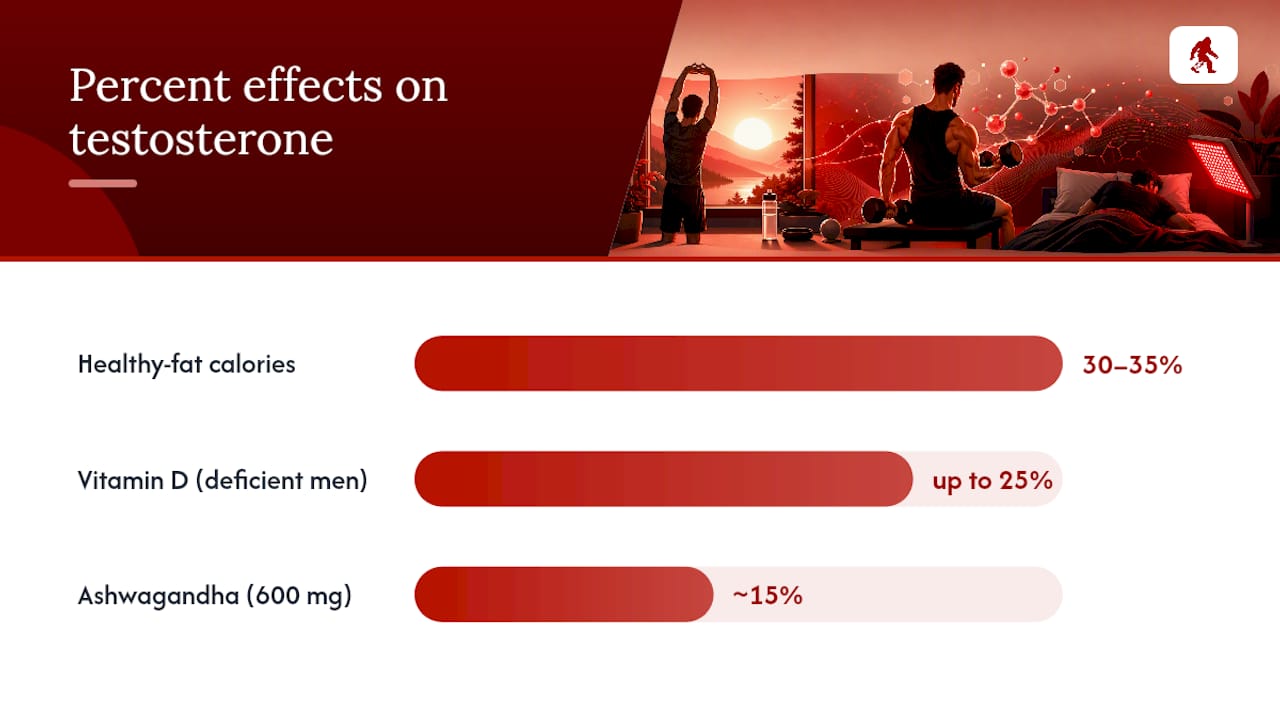
Food alone won't override bad sleep or a sedentary lifestyle, but it sets the ceiling for what your body can do with the levers you're already pulling. A Mediterranean-style pattern, with roughly 30 to 35 percent of calories from healthy fats, gives your body the raw material it needs for hormone production while cutting the systemic inflammation that drags testosterone down.
Build meals around these staples:
- Olive oil, avocados, and fatty fish like salmon or sardines for monounsaturated and omega-3 fats.
- Eggs and full-fat dairy, which support cholesterol availability, the actual precursor to testosterone synthesis.
- Leafy greens, nuts, and legumes for magnesium and zinc.
- Limited ultra-processed food, which recent reviews tie to lower testosterone when combined with poor sleep.
A few micronutrients deserve specific attention. Vitamin D deficiency is common, and correcting it has shown testosterone increases as high as 25 percent in deficient men over a year in one trial. Zinc and magnesium support enzymatic processes tied to hormone production, and both are easy to run low on if your diet skews processed. Ashwagandha, a well-studied adaptogen, showed roughly 15 percent increases at 600 mg daily in stressed men over 8 weeks in controlled trials, though effects vary by population.
The caveat matters: these results concentrate in men who were actually deficient. If your levels are already adequate, megadosing supplements won't push you higher; it's worth getting vitamin D and zinc checked before you start stacking pills. For more food-first strategy, see our breakdown of testosterone-supporting foods.
How Do You Build a Morning Routine Around This?
Your morning window is where the biggest hormonal shifts already happen naturally. The goal isn't to force something. It's to stop interfering with what your body is already trying to do.
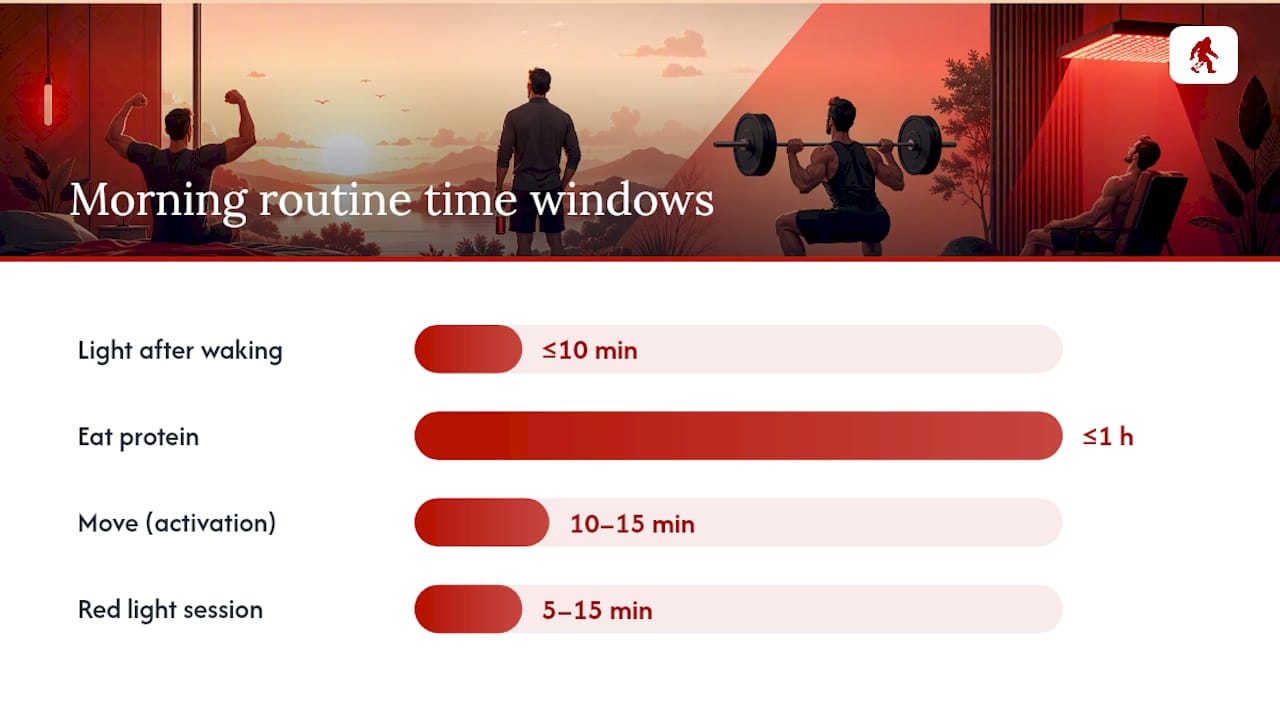
- Get bright light within 10 minutes of waking. Natural light or a bright indoor light anchors your circadian clock, which regulates the sleep architecture responsible for overnight testosterone release. Our circadian rhythm guide covers this in more depth.
- Hydrate before coffee. A glass of water first thing supports the metabolic processes you're about to ask your body to run.
- Eat protein within the first hour. Eggs, Greek yogurt, or a protein shake, paired with some healthy fat, gives your body building blocks instead of a sugar spike.
- Move for 10 to 15 minutes. A short bodyweight circuit or a brisk walk works. This isn't your training session, it's activation.
- Use a red light session if it's part of your routine. A 5 to 15 minute session, positioned after your light exposure and before you head into your day, is a reasonable slot for a supportive cellular signal tool like RedRockit.
Pro Tip: Stack the red light session with something you already do daily, like brushing your teeth or making coffee. Habits that piggyback on existing routines survive longer than ones that need their own reminder.
One thing to be clear about: red light is a supportive tool for recovery and routine consistency. It's not diagnostic, and it doesn't replace medical evaluation if something's actually wrong.
How Long Until You See Results, and When Should You See a Doctor?
Give it 8 to 12 weeks before judging anything. That's the window documented in lifestyle intervention research for meaningful change, with many consistent responders landing in that 15 to 25 percent improvement range.
Track both sides of the ledger:
- Subjective: morning energy, mood, gym performance, and drive.
- Objective: sleep duration, strength numbers on your main lifts, waist measurement, and body weight.
- Optional: a morning blood draw if you want hard numbers to confirm what you're feeling.
See a clinician if you're dealing with persistent fatigue, ongoing sexual dysfunction, or symptoms that don't move despite months of consistent effort. This routine supports maintenance. It's not a substitute for diagnosis.
Nurse Rachel's Take: Stop Overthinking and Start With the Boring Stuff
Every man wants the shortcut. I get it. But the guys who see real change are the ones who fix their wake time and show up for lifting three times a week before they touch a single supplement bottle.
Track your numbers, give it the full 8 to 12 weeks, and don't panic in week three when nothing feels different yet. That's not failure, that's just how bodies work. A tool like RedRockit fits into this as part of a prevention-first mindset. You're not waiting for a crash. You're building the routine before you need it.
— Nurse Rachel
Where a RedRockit Session Fits Into Your Morning
RedRockit is not a substitute for the sleep, training, and nutrition changes above. It's built to support the routine once you're already doing the real work. A 5 to 15 minute red light session, timed after your morning light exposure and activation movement, gives your body a consistent, supportive cellular signal without adding a pill, a prescription, or a subscription you'll forget you're paying for.

Primal Red Co built the RedRockit Activation Method for exactly this reason: men over 30 who feel the shift coming and want a tool that fits into a real morning, not a clinic appointment. No ongoing dependence, no monthly refill. Just a routine one can control. Learn more about how the RedRockit device supports recovery and consistency, and decide if it belongs in your morning stack.
Key Studies and Resources Cited in This Guide
The sleep restriction findings referenced above come from a controlled JAMA study on young healthy men, and the older-adult sleep correlation data comes from research published in Sleep. Training guidance draws on a Journal of Clinical Medicine review, and nutrition and supplement guidance draws on a narrative review on testosterone and nutrition. For further reading, see our posts on circadian rhythm and testosterone and testosterone-supporting foods.
Sources
- Effect of 1 Week of Sleep Restriction on Testosterone Levels in Young Healthy Men (JAMA, 2011)
- Testosterone optimization in 2026 focuses on lifestyle precision over quick fixes (IdeaFit, 2026)
- Testosterone-Optimizing Strategies in Athletes (Journal of Clinical Medicine review, 2026)
FAQ
What Time of Day Are Testosterone Levels Highest?
Testosterone typically peaks in the early morning hours shortly after waking, following the overnight release tied to deep and REM sleep cycles. Levels decline gradually through the day, which is why consistent sleep timing has such an outsized effect on morning hormone levels.
Can You Really Raise Morning Testosterone Without Medication?
Yes, within a range. Consistent lifestyle changes to sleep, training, and body composition have produced 15 to 25 percent increases over 8 to 12 weeks in many men who were previously off track, though results vary by starting point.
How Much Does Poor Sleep Actually Hurt Testosterone?
Just one week of sleep restricted to 5 hours a night dropped daytime testosterone by 10 to 15 percent in a controlled study of healthy young men. That's a fast, measurable hit from a single habit.
Do I Need Supplements to See Results?
Not necessarily. Sleep, resistance training, and fat loss produce the largest effects; supplements like vitamin D, zinc, or ashwagandha mainly help when you're actually deficient or notably stressed, and testing beats guessing.
How Does RedRockit Fit Into a Testosterone Routine?
RedRockit is a private-use red light device designed to support recovery and routine consistency as part of a broader lifestyle approach, not a replacement for sleep, training, or medical care. Pricing and details are available on the RedRockit product page.