
Sex and testosterone are connected, but not the way the internet says. Testosterone helps power desire and erections. Sex itself, though, does not reliably raise your baseline testosterone, and going without it does not build you a stronger one. The real levers sit somewhere else: sleep, stress, body fat, training load and, when symptoms are real, a proper blood test.
That is the short version. Here is the long one, for the man who feels his drive slipping and for the wife or partner trying to work out why.
TL;DR
- Sex may cause a brief testosterone blip, but research on short-term effects is conflicting and nothing shows a lasting rise in your baseline.
- Abstinence and NoFap are not proven testosterone boosters. One small study saw a mild bump after three weeks, and the evidence stops there.
- Testosterone matters for libido and erections, but a high sex drive does not prove high testosterone, and a low one does not prove low testosterone.
- Low testosterone is a diagnosis: at least two early-morning blood tests plus symptoms. Guessing from the couch is not.
- Sleep, stress, training load and body composition move the needle more than how often you have sex.
Table of Contents
- What testosterone actually does for sex
- Does sex increase testosterone?
- Abstinence, NoFap and testosterone
- What really moves testosterone more than sex frequency
- Is low testosterone real? When to get tested
- For her: when he seems tired, distant or flat
- Our perspective: you have not lost it
- Where RedRockit fits
- A simple plan for the next 30 days
- FAQ
- Sources
What testosterone actually does for sex
Testosterone is not a switch. It is more like the power supply to a house. When it is cut, nothing works well. Once it is on, adding more power does not make the lights any brighter.
The science backs up the first half. The Sexual Medicine Society of North America's basic science committee describes testosterone as playing an important role in sexual function, including by stimulating nitric oxide synthase, an enzyme involved in the process that lets blood flow into erectile tissue. In plain language: the signal that tells your body to want sex and be ready for it leans on testosterone.
So when levels are truly low, you can expect trouble. Desire fades. Erections get unreliable. Energy drains, and that tank that used to fill on its own stays half empty.
Now the second half, the part most articles skip. Research suggests the relationship is not a straight line. Researchers writing in the journal Proceedings of the Royal Society B found that day-to-day changes in testosterone were not tied to changes in sexual desire, and proposed that testosterone above a minimum threshold does not push desire higher. Above the floor, other things drive the bus: stress, sleep, mood, how you feel about your partner, and how you feel about yourself.

Does a high sex drive mean high testosterone?
No. Desire is not a lab value. A man can have a strong drive with ordinary testosterone, and a man can have low desire with perfectly normal levels because he is exhausted, stressed or depressed. The reverse happens too. That is why a drive check is a starting point for a conversation with a clinician, never a diagnosis.
If you want to know what "normal" even means on paper, we break the ranges down in normal testosterone levels in men.
Does sex increase testosterone?
Short answer: maybe for a moment, and not for good.
The Cleveland Clinic's summary of the evidence says sexual activity can temporarily boost testosterone, which then returns to regular levels after orgasm, and that research on short-term effects is conflicting. Read that twice. Temporary. Conflicting.
The individual studies are why that wording is so careful:
- In a study of healthy men, researchers found that prolactin rose during and after orgasm, while other hormones, including testosterone, were not significantly affected by arousal and orgasm.
- A 2021 pilot study of young healthy men found that masturbation might affect free testosterone but did not change hormone ratios such as testosterone to cortisol. The authors could not establish that a single episode boosts muscle growth.
Small samples. Young men. Short windows. Nothing there tells you that more sex builds a higher baseline at 35, 42 or 55.
Why a short change does not equal a gain
Testosterone naturally rises and falls through the day and through the week. A blip after sex lands inside that normal swing. It is like checking your pulse after climbing stairs and calling it a fitness gain. Your hormones respond to the moment. Your baseline reflects your whole life.
The other direction: does low testosterone come from too much sex?
No. The same Cleveland Clinic source states that frequent masturbation or sex does not cause hypogonadism and that sexual activity has no proven long-term negative effect on testosterone. If anyone has told you that you are "draining" yourself, that is a story, not a finding.
Abstinence, NoFap and testosterone
This is where the myths get loud. So let us be direct.
A few studies are passed around online. One, by Exton and colleagues in 2001, looked at the endocrine response to masturbation-induced orgasm and is the source of the "mild variation after abstinence" claim. The Cleveland Clinic notes that one study found mildly higher testosterone after three weeks of abstinence, while the research overall is conflicting.
Mild. One study. Short term. That is the entire foundation of the "seven days of NoFap gives you a testosterone spike" claim.
A 2020 review in the journal on abstinence from masturbation and hypersexuality went further. It concluded there is currently no evidence for beneficial effects of abstinence from masturbation, whatever the reports of higher serum testosterone. The same paper found that men's motivation to abstain was mostly tied to attitudes, especially seeing masturbation as unhealthy, not to measured hormone changes.
What men on NoFap report, and why it may be real anyway
Many men say they feel sharper, more confident, more driven during a streak. We are not here to call them liars. A challenge brings structure. Sleep tends to improve. Porn and late-night scrolling shrink. A man who feels in control of one part of his life often acts like it everywhere else.
That can feel like a hormone surge. It is usually behavior. And behavior is something you can keep doing without a counter on your phone.
If the real issue is that sex, porn or masturbation feels compulsive, or that guilt and shame are running the show, that is a different problem from a hormone problem. A licensed therapist is the right professional. Plenty of men find that online therapy for men is an easier first step than walking into an office.
What really moves testosterone more than sex frequency
If you want a straight line to better numbers and better energy, start here. These show up again and again as the things that matter.
| Factor | What it does | Where to start |
|---|---|---|
| Sleep | Testosterone follows your circadian rhythm, with morning peaks | Fixed wake time, dark room, no screens in bed |
| Training load | Too much hard training without recovery can drag levels down | Add rest days, then retest if symptoms persist |
| Body composition | Excess body fat is tied to lower testosterone | Strength training, protein, daily walking |
| Chronic stress | Stress hormones crowd out the drive signal | Boundaries, daylight, honest conversations |
| Alcohol and medications | Can blunt energy, desire and erections | Review with your doctor |
Two of those deserve their own reading. Testosterone peaks in the morning, which is why timing matters for both life and lab work: see circadian steps for men over 30. And if you lift hard, run hard and feel flat, read about overtraining and low testosterone before you assume the worst.
Notice what is missing from the table: a sex schedule. Intimacy is worth having for its own sake. It is good for your marriage and your mood. Just do not treat it as a hormone protocol.
Is low testosterone real? When to get tested
Yes. Low testosterone is a recognized medical condition called hypogonadism. The Endocrine Society explains that it involves consistently low blood levels together with physical symptoms. Diagnosis takes at least two early-morning blood tests showing low testosterone, plus signs and symptoms typical of low testosterone.

The American Urological Association's guideline treats a total testosterone below 300 ng/dL as a reasonable cut-off to support a diagnosis. That is a guideline number, not a verdict on any one man. Your symptoms, your history and your doctor's judgment all count.
Symptoms worth a conversation with a doctor
Talk to your primary care doctor or a urologist or endocrinologist if you notice:
- A significant drop in libido that does not bounce back
- Erectile dysfunction, especially losing morning erections
- Loss of energy that sleep does not fix
- Low mood, brain fog or slipping confidence
- Slower recovery from workouts, or loss of muscle
Several of those overlap with depression, thyroid problems, sleep apnea and medication side effects. We lay out how to tell them apart in depression or low testosterone. And if you are heading for the lab, avoid the usual traps: two morning tests are the standard, not one random afternoon draw.
Also know what testosterone treatment is not. The Endocrine Society states that boosting testosterone is not FDA-approved for athletic performance, appearance or treating aging-related issues, and that using it for those purposes may be harmful. It is medicine for a diagnosed condition. Questions about risks, such as hematocrit and fertility, belong with your prescriber, and we cover the issues in TRT risks.
For her: when he seems tired, distant or flat
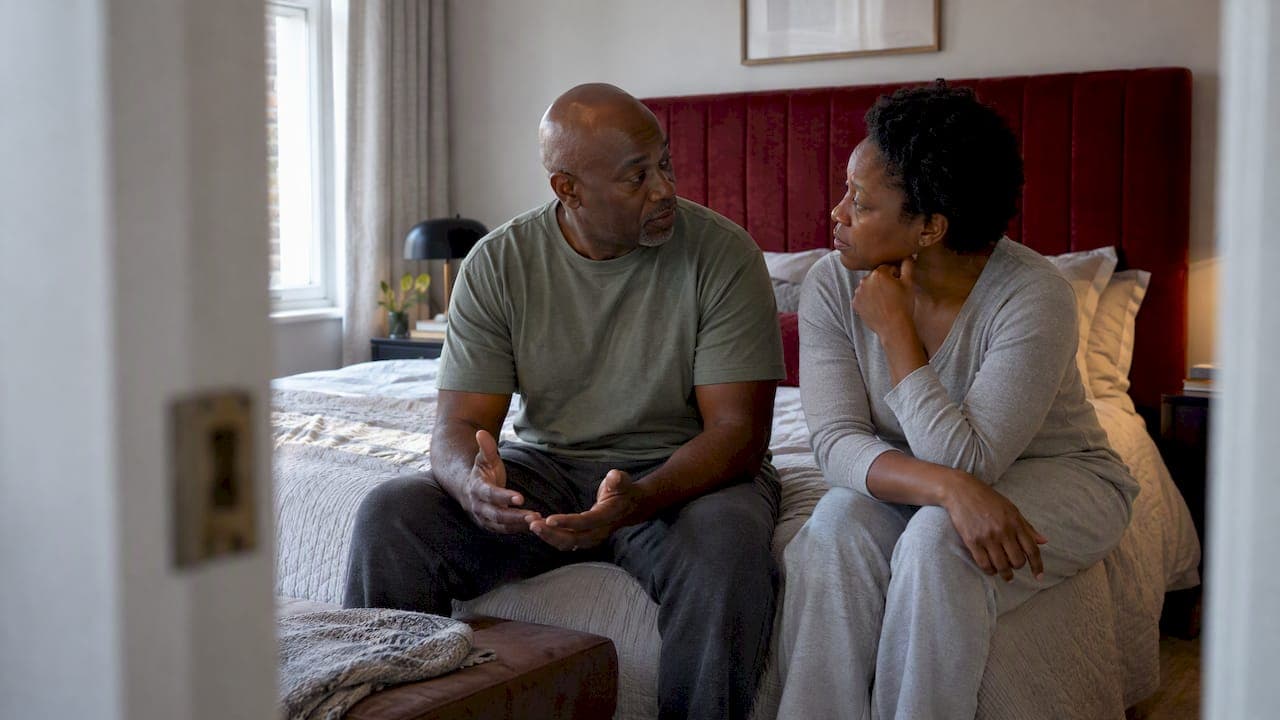
If you are the wife or partner reading this, here is what we want you to know. Less interest in sex is rarely about you. It is also rarely just about testosterone.
A man who is worn down by work, poor sleep, worry about money, a low mood or a slow decline in his own confidence often pulls away without saying why. He may feel ashamed. He may think he has to fix it alone. So he goes quiet.
What helps:
- Start with care, not scorekeeping. "I miss you" lands better than "what is wrong with you?"
- Name what you have seen. Energy, mood, sleep, drive. Specifics are easier to hear.
- Suggest a checkup together. Frame it as maintenance, like a dentist visit. Morning bloodwork is simple.
- Do not push a supplement or a device as a diagnosis. Tests first, then choices.
Confidence and testosterone are linked, but not simply. If that is part of what you see, our look at what 27 trials show about testosterone and confidence is a good next read.
Our perspective: you have not lost it
We built Primal Red Co for men over 30 who feel the shift coming and refuse to wait for a crash. We are not a clinic. We are not TRT. We do not diagnose anyone, and we will not tell you that you are broken.
Here is what we believe about sex and testosterone.
First, the internet sells men a lie: do this one trick, abstain this long, and your numbers shoot up. The research does not say that. We would rather you know what the science really shows than chase a streak.
Second, when symptoms are real, get tested. Two morning draws. A real conversation with a real clinician. If your numbers are low and your doctor recommends treatment, that is a medical decision, and it is yours to make with them. We have written about when TRT fixes sex but not energy because many men find the story is more complicated than "just get the shot."
Third, there is a big stretch of ground between "I feel fine" and "I need a prescription." That is where most men over 30 live. Drive is slipping. Recovery is slower. The energy that used to come automatically now takes effort. In that stretch, daily habits count: sleep, training, stress, sunlight, connection. That is the restoration routine we care about, and it is built to be something you can stick with.
YOU HAVEN'T LOST IT. Your body is sending a signal. Listen to it, check it, then act on it.
— Nurse Rachel
Where RedRockit fits
RedRockit is our private-use red light wellness device for men over 30, paired with the Rockit IQ companion app for guided session protocols. It is a daily restoration tool: no prescriptions, no appointments, no subscriptions, and it comes with a lifetime craftsmanship guarantee.
It is not a testosterone treatment and it does not replace testing or medical care. If you have symptoms, get checked first. If your routine is dialed in and you want one more simple habit to support energy, drive and recovery, see RedRockit Primal Restoration.

Curious about the research on light and testosterone before you decide? Read what men over 30 should know about red light therapy and testosterone and what the evidence shows on testicular red light therapy. We would rather you buy informed than buy hyped. You can also read about male vitality after 40.
A simple plan for the next 30 days
You do not need a streak. You need a baseline and a routine.
- Week 1: Observe. Track sleep, energy, mood and drive on a simple 1 to 5 scale each morning.
- Week 1 or 2: Book bloodwork if symptoms persist. Ask for early-morning draws, two on separate days.
- Weeks 1 to 4: Fix the basics. Fixed wake time, strength training three times a week with real rest days, daily walking, less alcohol.
- Weeks 2 to 4: Talk. If you have a partner, share what you are noticing. Intimacy often improves when pressure drops.
- Week 4: Review. Look at your notes and your results with a clinician. Decide what is next.
That plan is boring. It also works better than any streak counter.
FAQ
Does sex increase testosterone?
Only briefly, if at all. Sexual activity can cause a temporary bump that returns to regular levels, and studies on short-term effects conflict. There is no evidence that more sex permanently raises your baseline.
Does abstinence raise testosterone?
Not reliably. One study found mildly higher levels after three weeks without sex, but a 2020 review found no evidence of benefit from abstaining from masturbation. Any change is small and not proven to last.
Does NoFap boost testosterone?
There is no solid proof it does. Benefits men report, like better focus or mood, may come from sleep, routine and a sense of control. If porn or masturbation feels out of control, a therapist can help more than a streak.
Can too much sex cause low testosterone?
No. Frequent sex or masturbation does not cause hypogonadism, and no proven long-term negative effect on testosterone exists. Low testosterone has other causes, and a doctor can check them with morning blood tests.
How do I know if my low sex drive is low testosterone?
You can't tell from drive alone. Stress, depression, poor sleep and other conditions mimic it. A diagnosis takes two early-morning blood tests plus symptoms, so see your doctor if desire or erections have dropped.
Sources
- Translational Perspective on the Role of Testosterone in Sexual Function (SMSNA)
- Higher Testosterone Isn't a Solution for Low Sex Drive in Men, Newsweek
- What Can (and Can't) Cause Low Testosterone, Cleveland Clinic
- Neuroendocrine and cardiovascular response to sexual arousal and orgasm in men
- Hormonal response after masturbation in young healthy men
- Endocrine response to masturbation-induced orgasm in healthy men
- Abstinence from Masturbation and Hypersexuality
- Hypogonadism in Men, Endocrine Society
- Testosterone guideline, American Urological Association
- The Truth About Testosterone Treatments, Endocrine Society
- Why more men are choosing online therapy