

TRT is medically appropriate when a clinician documents symptomatic hypogonadism on repeat morning testosterone tests. Done right, it reliably restores sexual function and can rebuild bone and lean mass. It does not reliably fix low energy, brain fog, or that flat feeling you can't quite name, and it carries real risks to your blood, your prostate, and your fertility that require ongoing monitoring for as long as you're on it.
TL;DR:
- Men with symptoms, confirmed low morning testosterone levels, and no reversible causes are proper candidates for TRT.
- TRT primarily improves sexual function, bone density, and muscle mass, but has limited effects on energy, cognition, or fatigue.
- Risks include blood thickening, clotting, prostate and breast sensitivity, and permanent fertility suppression, requiring ongoing monitoring.
- Formulation choice (injectable, gel, oral) influences blood level stability and side effects, but regular labs and PSA checks are essential regardless.
- Before starting TRT, addressing sleep apnea, weight, medications, and fertility alternatives is advised, with close follow-up for at least six months.
Table of Contents
- TRT Pros and Cons at a Glance
- Who Actually Qualifies for TRT
- What the Evidence Actually Shows TRT Can Do
- The Risks Nobody Skips Past Quickly Enough
- How Doctors Monitor and Manage the Risks
- What to Try Before You Commit to TRT
- Nurse Rachel's Take: Questions to Bring and Habits That Actually Matter
- Your Next Move: A Simple Decision Path
- Sources
TRT Pros and Cons at a Glance
You want the scorecard before you read the fine print. Fair. Here's the honest tally, no spin in either direction.
What TRT reliably improves:
- Sexual function, including libido and erectile quality, in men with confirmed low levels
- Bone density over time, which matters more the older you get
- Lean muscle mass, especially when paired with resistance training
- Mood, in some men, particularly when low testosterone was contributing to depressive symptoms
What TRT usually does not fix on its own:
- Energy and "vitality" in men whose testosterone was only mildly low to begin with
- Cognitive sharpness or memory
- Fatigue that's actually coming from poor sleep, stress, or weight
What you're signing up to manage:
- Acne, oily skin, and fluid retention are common and mostly cosmetic
- Gynecomastia (breast tissue growth) can show up if estrogen conversion runs high
- Sleep apnea can worsen, which matters if you already snore or feel wiped out mid-afternoon
- Erythrocytosis (thickened blood) and elevated clot risk are the serious ones that require lab work
- Fertility takes a hit, sometimes a lasting one, because TRT shuts down your body's own signal to produce sperm
Most men notice libido changes within a few weeks. Bone and muscle gains take months. And here's the part nobody likes to hear: TRT is rarely a short course. Stop it, and your body typically drifts back toward wherever it started. This is a commitment, not a tune-up.
Who Actually Qualifies for TRT
Not every man with "low T on paper" is a candidate for treatment, and that distinction is where a lot of men get steered wrong before they've even had a real conversation with a doctor.
Here's how a competent workup actually goes:
- Symptoms come first. Low libido, erectile changes, unexplained loss of strength, low mood, these are what trigger testing in the first place. A number on a lab slip with no symptoms attached usually isn't a reason to treat.
- Testing happens in the morning, more than once. Testosterone peaks early and drops through the day, so a single afternoon draw tells you almost nothing. The American Academy of Family Physicians recommends confirming low results with a second morning test on a different day before anything gets diagnosed.
- Guideline thresholds get applied, with caveats. Clinical guidance generally treats total testosterone at or below 300 ng/dL as the threshold worth investigating, but labs vary in their reference ranges, and borderline cases sometimes call for checking free testosterone and SHBG (sex hormone binding globulin) for a clearer picture.
- Reversible causes get ruled out first. Obesity, poorly controlled sleep apnea, certain medications, and thyroid disease can all suppress testosterone. Mayo Clinic recommends measuring testosterone at least twice before recommending treatment, precisely because these fixable issues get missed too often.
The real distinction that matters here: hypogonadism versus normal aging. Testosterone drifts downward gradually for most men after their 30s. That drift, on its own, isn't a diagnosis. It's biology. TRT is built for men whose levels have dropped low enough, with symptoms severe enough, to clear an actual clinical bar, not for every guy who feels less sharp than he did at 25.
What the Evidence Actually Shows TRT Can Do
Sexual function is where the data is strongest. The American College of Physicians reviewed the evidence for men with age-related low testosterone and found a small but real improvement in sexual function, with a standardized mean difference of 0.35. That's not a miracle, but it's consistent enough across studies that most guideline bodies treat it as a genuine benefit.
Bone density and lean mass show real gains too, particularly in men who were meaningfully deficient to start. This matters more than it sounds. Bone loss is silent until it isn't, and rebuilding density is one of the few things TRT does that's hard to fake with lifestyle changes alone.
Mood improved in some trials, especially among men whose low testosterone was tangled up with depressive symptoms. That's a real subgroup benefit, not a blanket claim that TRT functions as an antidepressant.
Here's where expectations need adjusting: energy, vitality, cognition, and physical function (things like walking speed or general stamina) show little to no consistent benefit in the trial data. The ACP guideline is blunt about this. If you're hoping TRT will hand you back the energy you had at 28, the evidence doesn't back that up for most men with only mildly low levels. A pooled analysis of 35 trials involving over 5,600 participants found the clearest, most reliable wins were in sexual function and quality of life, not the vague "I just feel better" category men are usually chasing when they first ask about treatment.
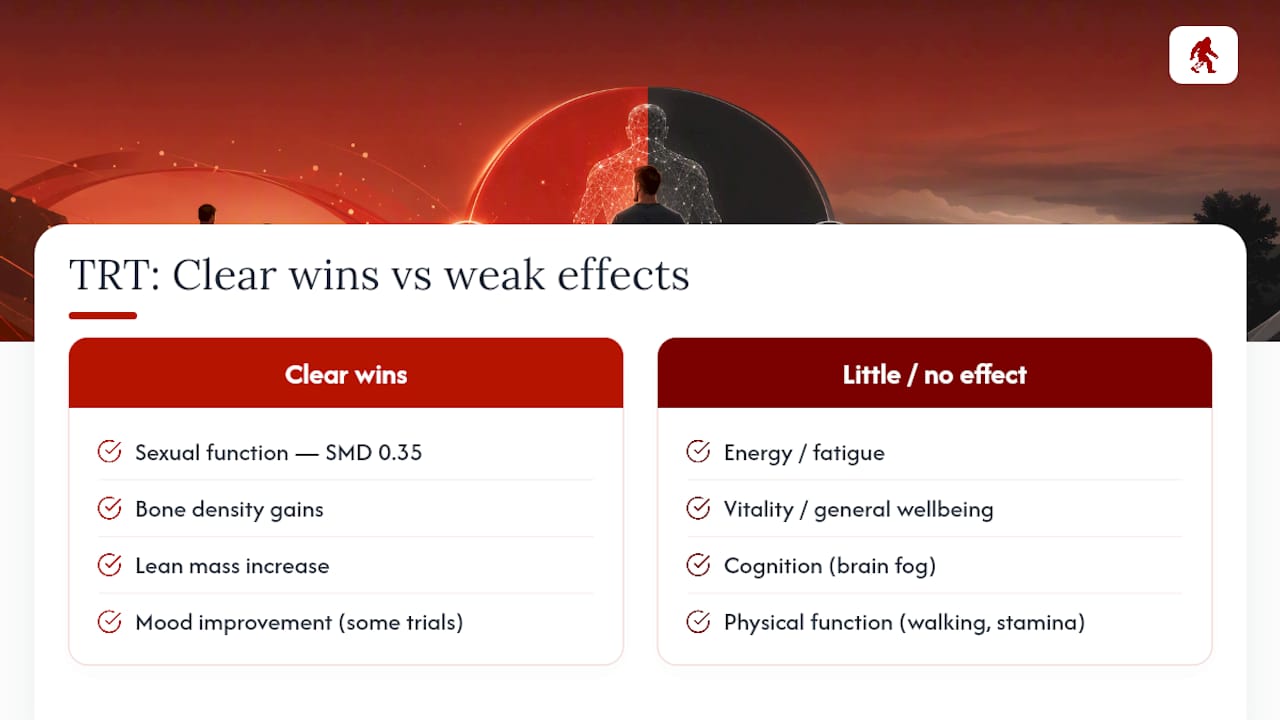
This is the gap that trips people up: TRT treats a diagnosis, not a vibe. If your main complaint is fatigue and brain fog with formal testosterone, TRT is a poor bet for fixing it.
The Risks Nobody Skips Past Quickly Enough
The blood risk is the one that gets underestimated. TRT raises hematocrit, the concentration of red blood cells in your blood, and thicker blood means higher clot risk. Intramuscular formulations like enanthate and cypionate raise hematocrit by roughly 4.0%, while oral undecanoate raises it by about 4.3%, according to a recent review of TRT adverse effects.
- Erythrocytosis (elevated red blood cell count) is common enough to require baseline and follow-up monitoring in everyone on TRT
- Thrombotic events, while not proven to spike dramatically in short-term trials, remain a real enough concern that guidelines treat elevated hematocrit as an action item, not a footnote
- Contraindications include active prostate cancer and active breast cancer; PSA gets checked because prostate tissue is sensitive to androgen signaling
The cardiovascular picture is more reassuring than it used to be, but it's not closed. Earlier observational studies raised alarms about heart attack and stroke risk. More recent randomized evidence, including the TRAVERSE trial, hasn't confirmed a large increase in cardiovascular events for men with clear deficiency over short-to-medium follow-up. A pooled analysis of trial data found no significant difference in cardiovascular or cerebrovascular incidence between TRT and placebo groups (odds ratio 1.07). That's a genuinely more nuanced consensus than the headlines from a decade ago, but "no signal yet in short-term trials" is not the same as "safe forever." Long-term data past a few years is still thin.
Fertility is the risk men think about least until it's too late to reverse cheaply. Exogenous testosterone tells your brain you've got plenty, which shuts down the signal (LH and FSH) that tells your testicles to keep producing sperm. According to Cleveland Clinic, restoring fertility after TRT-induced suppression can be difficult and expensive, and it isn't guaranteed. If having more kids is even a maybe for you, this conversation needs to happen before you start, not after.
How Doctors Monitor and Manage the Risks
Good TRT management isn't a prescription and a goodbye. It's a repeating cycle of labs, and skipping that cycle is how men end up blindsided by a hematocrit crisis or a PSA spike they never saw coming.
- Baseline labs before anything starts: serum testosterone, hematocrit, and PSA, plus a clear record of which symptoms you're actually treating.
- Recheck at 3 to 6 months to see whether symptoms improved and whether the numbers are moving somewhere safe.
- Annual monitoring after that, at minimum. The AAFP specifically recommends checking testosterone, hematocrit, and PSA at baseline and at least once a year for men 40 and older.
- Manage high hematocrit directly if it climbs, usually with therapeutic phlebotomy once it crosses 52%, or by adjusting dose or switching formulation.
- Know your stop criteria going in: no meaningful symptom benefit after a fair trial, hematocrit that won't come down, or a new contraindication like a prostate cancer diagnosis.
Formulation matters here too. Injectables (enanthate, cypionate) tend to produce bigger swings in testosterone and hematocrit between doses. Transdermal gels and patches produce steadier levels but come with their own absorption quirks and skin-transfer risks to partners and kids. Newer oral options exist and shift the monitoring conversation slightly, but the basic labs, hematocrit and PSA, stay non-negotiable regardless of which route you choose. Managing estrogen levels on any formulation is its own piece of the monitoring puzzle, since aromatization can vary by delivery method.
Pro Tip: Bring your last three sleep-quality nights and your last three "how did I actually feel" notes to your follow-up appointment. Doctors can only manage what you report accurately, and vague answers get vague adjustments.
What to Try Before You Commit to TRT
TRT isn't the first move. It's often the last one, after the cheaper, reversible stuff has been ruled out or actually tried.
- Get sleep apnea evaluated and treated if you snore heavily or wake up exhausted. Untreated apnea suppresses testosterone directly, and fixing it can move your numbers without a single injection.
- Lose the weight that's carrying extra estrogen conversion. Fat tissue converts testosterone to estrogen, and dropping body fat is one of the few interventions that reliably raises natural testosterone.
- Lift heavy, sleep more, drink less. Resistance training and better sleep hygiene both have real evidence behind them for supporting natural hormone production.
- Check your medications and thyroid. Some common prescriptions and undiagnosed thyroid disease can tank testosterone without you ever suspecting the cause.
- If fertility matters to you, ask about clomiphene citrate or hCG before jumping to standard TRT. These fertility-preserving alternatives raise your own testosterone production while keeping sperm production intact, though they require a specialist managing the details.
A daily restoration routine built around consistent sleep, training, and recovery habits won't replace a clinical diagnosis. But it's the groundwork most men skip before deciding they need an injection, and it's worth doing the groundwork first.
Nurse Rachel's Take: Questions to Bring and Habits That Actually Matter
Here's what separates men who navigate TRT well from men who get blindsided: preparation. Walk into that appointment with specific questions. Ask what the monitoring schedule looks like. Ask directly whether this affects fertility, and whether that matters to you right now. Ask what formulation fits your life, because a man who hates needles and gets prescribed injectables is a man who won't stay compliant.
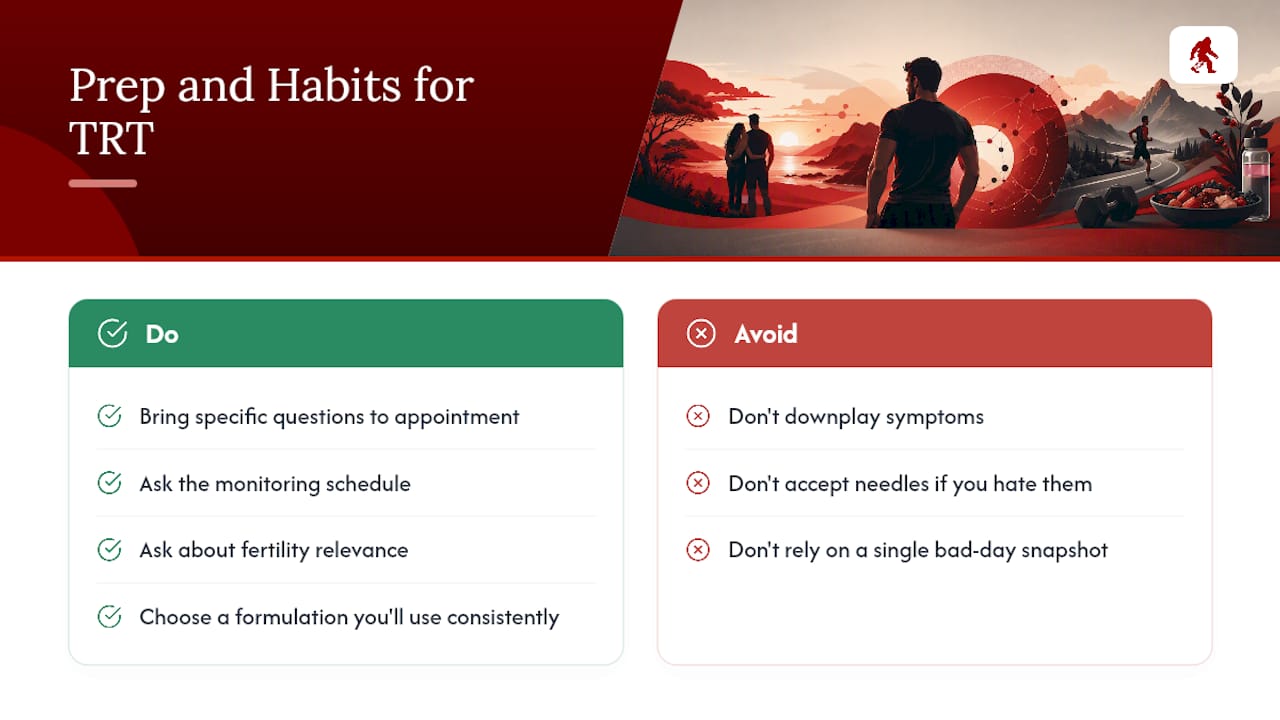
Testing prep matters more than men think. Get your blood drawn in the morning, consistently. Report your symptoms honestly instead of downplaying them, and track them for a few weeks before your appointment so you're working from real patterns instead of a bad-day snapshot.
None of this replaces a clinical relationship. But a body that's rested, trained, and paying attention to its own signals gives you a clearer read on what's actually happening, before you decide what to do about it.
— Nurse Rachel
Your Next Move: A Simple Decision Path
You don't need to solve this today. You need a next step.
- Get tested properly. Two separate morning draws, not one rushed lab slip.
- Rule out the reversible stuff first. Sleep apnea, weight, medications, thyroid function.
- Bring your results and your questions to a clinician, not a forum thread.
- If you start TRT, expect a 3 to 6 month reassessment, then annual labs going forward if you're 40 or older.
- Refer out when needed. Fertility concerns go to a reproductive specialist. Prostate concerns go to urology. Complex hormone patterns sometimes need endocrinology.
| Situation | What to Do Next |
|---|---|
| Symptoms present, no testing yet | Get two morning testosterone tests on separate days |
| Low results, reversible causes not checked | Address sleep apnea, weight, medications first |
| Confirmed hypogonadism, fertility matters | Ask about clomiphene or hCG before standard TRT |
| Already on TRT | Confirm your hematocrit and PSA monitoring schedule |
If you're still in the "trying to avoid bigger decisions" stage, that's exactly the window this kind of restoration routine can support. Explore what a daily restoration routine can support before testosterone becomes the only conversation on the table, and if fertility is part of your calculus, read through what to know about TRT and fertility before you start anything.
This article is general information, not a substitute for advice from a qualified doctor. Consult a qualified healthcare professional about your own circumstances before acting on anything here.
Sources
- Testosterone replacement therapy: male hypogonadism. American Academy of Family Physicians. 2024
- Testosterone Treatment in Adult Men With Age-Related Low Testosterone: American College of Physicians Clinical Guideline. 2020
- Management of Adverse Effects in Testosterone Replacement Therapy. PMC review (2025-04-29).
- Testosterone therapy: Potential benefits and risks as you age — Mayo Clinic. 2024