
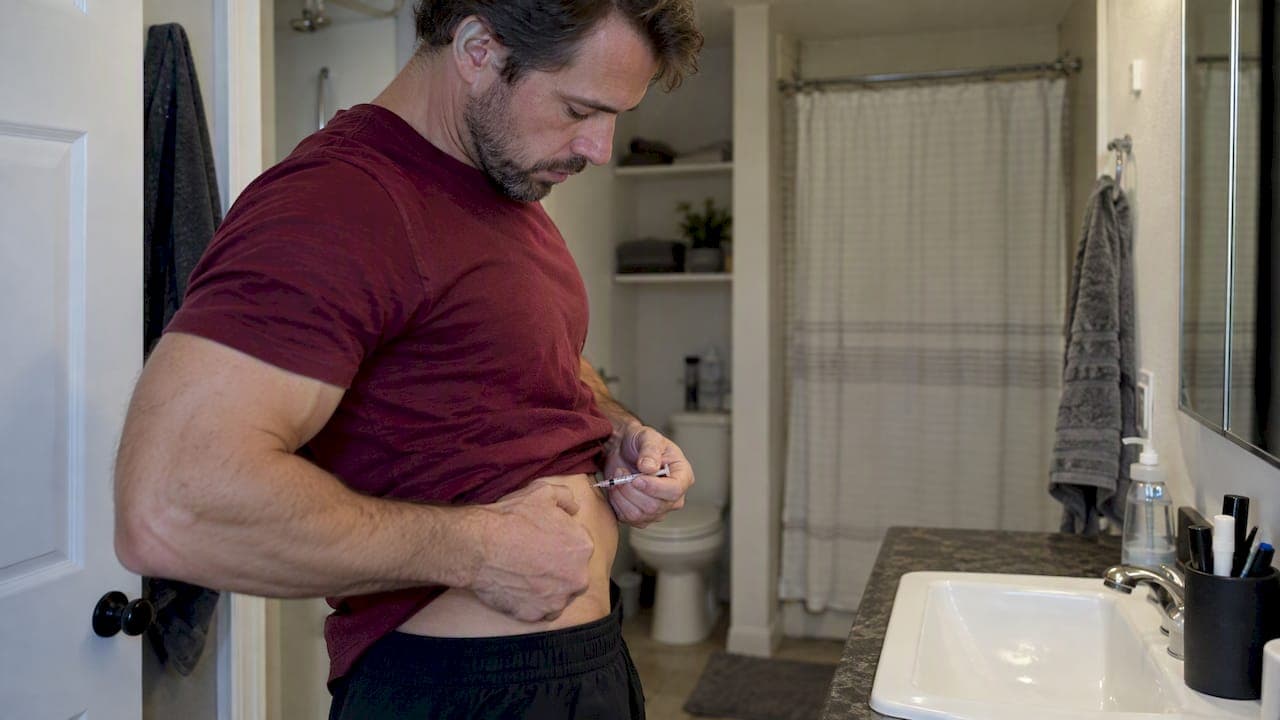
Microdosing TRT means taking testosterone in smaller doses, more often, usually a little each day or every other day, instead of one large injection every one to four weeks. The goal is steadier blood levels with fewer swings. It's a dosing style, not a different treatment. You still need a real diagnosis, a prescription and regular bloodwork. Here's what that looks like in practice, who it suits, and what to sort out first.
TL;DR
- Microdosing TRT splits a weekly testosterone dose into small, frequent injections, often under the skin, to avoid the peaks and crashes of bigger, less frequent shots.
- It's still TRT. It still suppresses your own production, still needs hematocrit, PSA and testosterone monitoring, and still requires a confirmed diagnosis.
- Guidelines require low testosterone on two morning tests plus symptoms. Microdosing doesn't skip that step.
- If you're a man over 30 who hasn't been diagnosed and wants to act early, there are non-prescription steps to take first, and you can still get tested.
Table of Contents
- What microdosing TRT actually means
- The benefits people point to
- What microdosing does not change
- Is microdosing TRT worth it?
- Before you ask for it: get the diagnosis right
- For her: what to know if you're the one reading this
- Our perspective: restoration before escalation
- A private, at-home restoration routine
- Questions men ask about microdosing TRT
- Sources
What microdosing TRT actually means
Standard testosterone cypionate labeling lists a recommended dose of 50 mg to 400 mg every two to four weeks, given as a deep intramuscular injection. That's the classic model: a big dose, a spike, then a slow slide until the next shot.
Many men feel that slide. Great on day two. Flat by day ten. The tank that never quite fills.
Microdosing is the clinic-side answer. Take that same total and cut it up. A man on 100 mg a week might do about 14 mg a day, or 50 mg twice a week. Some prescribers use a small insulin syringe and inject just under the skin instead of into muscle. Any specific schedule is a call for you and your prescriber. Note that the FDA label above describes intramuscular use, so subcutaneous protocols are a prescriber's individual choice, not the labeled standard.

The idea is simple: smaller doses, smaller swings, levels closer to the flat line your body used to hold on its own.
The benefits people point to
When men search for the benefits of microdosing TRT, they usually mean four things:
- More even energy and mood. Fewer peaks and troughs can mean fewer "good week, bad week" cycles.
- Less hematocrit pressure. Injectables carry a higher risk of raising red blood cell concentration than some other forms, and the AUA guideline treats a hematocrit of 54% as the point where you intervene. Smaller doses may help some men stay below it. That's a reasonable hope, not a guarantee.
- Fewer estrogen surges. Big spikes can mean big conversion. Steadier dosing may smooth that out. Our guide on TRT and estrogen explains how to test and read it.
- More comfortable injections. A tiny needle under the skin is easier than a deep gluteal shot every couple of weeks.
Here's the honest part. Most of what you read online comes from clinics that sell this protocol. The Endocrine Society's guidance centers on diagnosing hypogonadism properly, choosing a therapy, and monitoring. It doesn't crown one injection frequency as the winner. A protocol is good when your symptoms improve and your safety markers stay in range. How often you inject is a preference inside that framework.
What microdosing does not change
This is where men get misled.
It doesn't remove the need for a diagnosis. The AUA guideline says a total testosterone below 300 ng/dL is a reasonable cut-off in support of a low testosterone diagnosis, and therapy fits men who have both that low number and consistent symptoms. Not one reading. Not just "I'm tired."
It doesn't make it "just a little." Exogenous testosterone tells your body to stop making its own. Your brain dials down the signals (LH and FSH) that tell the testes to work. That can affect sperm count and fertility regardless of how small or frequent the dose is. If kids are in your future, say so before you start. We cover that in our piece on the 54% hematocrit risk and protecting fertility.
It doesn't skip monitoring. Hematocrit, PSA, testosterone levels and lipids all get checked at baseline and again over time. AUA guidance calls for periodic hematocrit checks. A prescription for tiny doses is still a prescription.
It isn't cleared for "just getting older." The AUA guideline notes that safety and efficacy haven't been established for age-related, late-onset low testosterone alone. Aging with symptoms and a normal-range lab is a different situation from diagnosed deficiency.
It doesn't settle every question about risk. The 2023 TRAVERSE trial followed 5,246 men and found no increase in major cardiovascular events versus placebo over a median of 33 months. The same write-up notes higher rates of atrial fibrillation and pulmonary embolism in the treated group. A 2026 review of long-term TRT safety describes the picture as more reassuring than a decade ago, but says TRT still carries meaningful risks. Those trials were of standard TRT in diagnosed men. They weren't about microdosing specifically.

Is microdosing TRT worth it?
It depends on who you are.
| Your situation | Does microdosing fit? |
|---|---|
| Two morning tests under 300 ng/dL plus clear symptoms, and you've decided on TRT | Worth discussing with a prescriber. It's one of several schedules. |
| On TRT, feeling roller-coaster effects between shots | A fair question to bring to your prescriber. |
| On TRT and hematocrit trending up | Dose, schedule or other changes are all on the table. Your prescriber decides. |
| Tired, low drive, one low or borderline number | Not yet. Repeat the test and look at the whole picture first. |
| Normal labs, feeling off | Not a TRT conversation. Look at sleep, stress, medications, mood and routine. |
| Want kids soon | Talk fertility first. TRT can work against that goal. |
And the other question people ask: is 100 mg a week enough, or is 0.5 ml a week enough? There's no universal number. Dose depends on the product concentration, your labs, your symptoms and how you respond. A prescriber individualizes it. The label itself says to individualize the dose and schedule based on response and adverse reactions. Copying a dose from a forum is the fastest way to a bad outcome.
Before you ask for it: get the diagnosis right
Most men who go looking for microdosing never had a clean workup. Fix that first.
- Two morning tests. Testosterone swings through the day and from day to day. Draw blood in the morning, on two separate days. The FDA label says to confirm the diagnosis with morning measurements on at least two separate days. Our guide to TRT bloodwork mistakes walks through the timing.
- Rule out the look-alikes. Depression, poor sleep, and some medications can mimic low T. Read how to tell depression from low testosterone with a morning test, and what happens with SSRIs and testosterone.
- Know the tradeoffs. TRT can help some symptoms and leave others untouched. See when TRT fixes sex but not energy.
- Ask about fertility and alternatives. Some men are offered options that keep their own production running. Here's what to know about Clomid for low testosterone.
- Bring questions to a licensed prescriber. An endocrinologist, urologist or men's health physician can interpret your labs, history and goals. We can't, and neither can a website.
For her: what to know if you're the one reading this
If you're researching this because he's tired, short-fused, distant, or just not himself, you're not wrong to notice. Don't diagnose him from the outside, though. Those same signs show up with poor sleep, stress, depression, medication side effects and low testosterone.
The best thing you can do is nudge him toward two morning blood tests and a real conversation with a clinician. Not a forum protocol. Not a friend's vial. If he lands on TRT, microdosing is one of the schedules to ask about, and you should know it still comes with lab checks and fertility implications.
Our perspective: restoration before escalation
We're not a clinic. We don't prescribe, diagnose or do TRT. We built Primal Red Co. for the man who feels the shift coming and wants to act before the big decisions are on the table.
So here's where we stand on microdosing TRT.
If you're diagnosed, symptomatic, and you and your doctor choose TRT, a steadier schedule is a legitimate conversation. Good. Have it. Do the bloodwork. Don't skip the monitoring because the dose is small.
But we see a different pattern more often. A man is 35, 42, 47. Energy used to come automatically. Now it doesn't. Recovery drags. Drive is quieter. He reads that "the best way to do TRT is microdosing," and suddenly he's shopping for a protocol when he's never had a proper test, never fixed his sleep, never tried a consistent routine. That's skipping the first chapters.
YOU HAVEN'T LOST IT. You may just have stopped giving your body the signal to bring it back.
A daily restoration routine, built on sleep, training, nutrition, stress and a tool you'll actually use, isn't a replacement for medicine when medicine is needed. It's what you do while you're deciding, and what you keep doing after. Men shouldn't hear "just get the shot" as the only first answer. They also shouldn't ignore a real deficiency. Both things are true.
If you want to look at where red light fits, our breakdown of red light therapy and testosterone is honest about what's known and what isn't. For the timeline question, see TRT in weeks versus natural support in months. If you're curious what a typical in-person session looks like, this overview of 10 to 20 minute red light sessions gives a feel for the format.
— Nurse Rachel
A private, at-home restoration routine
RedRockit™ is our private-use red light wellness device, built to anchor a simple daily routine for men over 30 who want to maintain energy, drive, recovery and vitality. It comes with the Rockit IQ companion app for guided session protocols. It isn't a drug, a supplement or a prescription, and it isn't a substitute for TRT if you've been diagnosed and need it. There are no subscriptions and no appointments. If you want to see how it works, start with RedRockit™ Primal Restoration.
Questions men ask about microdosing TRT
Can you microdose on testosterone?
Yes, a prescriber can split a weekly dose into smaller, more frequent injections. It's a scheduling choice within TRT, not a separate therapy. You still need a confirmed diagnosis and ongoing lab monitoring.
Is microdosing TRT worth it?
For some men on TRT who feel peaks and crashes between injections, it's worth raising with their prescriber. Guidelines don't rank one injection frequency above another. What matters is symptom relief with hematocrit, PSA and lipids staying in safe ranges.
Is 100 mg of TRT a week enough?
There's no one right number. Dose depends on the product, your lab values, your symptoms and your response, and it's adjusted over time. Your prescriber sets it, not a forum or a clinic's marketing page.
Does microdosing protect fertility?
Not on its own. Testosterone therapy suppresses your body's own signaling to the testes whatever the injection frequency. If you want children now or later, tell your doctor before starting and ask about options.
Sources
- AUA Testosterone Deficiency Guideline
- AUA Guideline PDF: diagnosis of testosterone deficiency
- Endocrine Society: Testosterone Therapy for Hypogonadism guideline resources
- FDA label: Testosterone Cypionate Injection
- IQ Healthspan: the 2023 TRAVERSE trial
- World Pharma Today: TRT safety and long-term use