
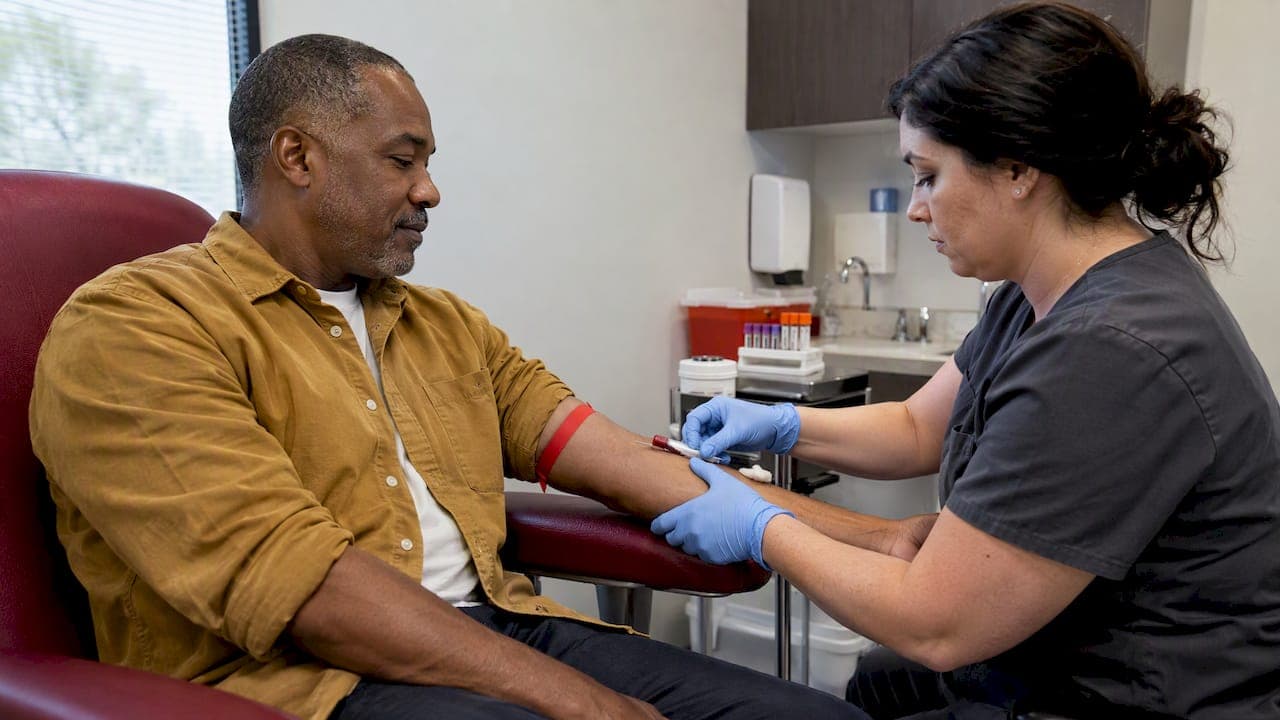
Low estrogen in men almost always means low estradiol (E2), the active form of estrogen your body makes largely from testosterone. Yes, men need it. It helps your bones, your drive and your sexual function. But there is no single magic number that proves you have a problem, and the fix is never "grab a supplement and hope." It starts with the right blood test and a clinician who looks at the whole picture.
If you are tired, flat and less interested than you used to be, and someone told you "it's your estrogen," read on. Maybe you are the wife trying to figure out what changed in your husband. Same answer for you. Let's sort signal from noise.
TL;DR
- Low estrogen in men means low estradiol. It is made mostly by converting testosterone, so low testosterone often comes with low estradiol.
- Possible signs: lower libido, more body fat, weaker bones, and, when levels are suppressed hard, hot flashes, night sweats, poor sleep and fatigue.
- Labs matter. Standard immunoassays tend to overestimate low male estradiol, so ask about a sensitive LC/MS test and read the result against your lab's male reference range.
- Do not self-treat with estrogen, blockers or "natural estrogen" foods. Get testosterone, LH and FSH checked first, and review your medications.
- If you want kids soon, tell your doctor before any hormone therapy.
Table of Contents
- What "low estrogen" actually means in a man
- Signs and symptoms of low estrogen in men
- Why the number is only as good as the test
- Common causes worth ruling out
- Why men need estradiol: bones, drive and more
- Does low estrogen cause infertility?
- What to do first: the evaluation
- Don't self-treat: estrogen, blockers and "natural sources"
- Our perspective: YOU HAVEN'T LOST IT
- Where RedRockit fits
- FAQ
- Sources
What "low estrogen" actually means in a man
Most men think estrogen is a women's hormone. Both hormones exist in both sexes. Researchers reviewing what happens when prostate cancer treatment wipes out estradiol describe estradiol as a hormone with essential roles in male reproductive and sexual function, not a bystander.
In men, much of your estradiol comes from an enzyme called aromatase, which converts testosterone into estradiol. That gives you a simple chain: less testosterone to convert means less estradiol. Men with low testosterone commonly have low estradiol too.

So "low estrogen" is rarely a standalone diagnosis. It is usually a clue. The question is always: why is the signal low?
Signs and symptoms of low estrogen in men
The recognized possible features, per that same 2024 endocrine review, include reduced libido, increased body fat and low bone density. When estradiol is severely suppressed, men can also get hot flashes, sweating, sleep disruption and fatigue.
How severe is severe? The review reports that androgen-deprivation therapy for prostate cancer suppresses estradiol by more than 80%. In one observational study of 250 men on that therapy, 80% had vasomotor symptoms, the medical term for hot flashes and sweats. That is an extreme case, not your average 42-year-old with a slow Monday.
Here is the catch. Almost every symptom on that list overlaps with something else:
- Low libido: low testosterone, stress, depression, relationship strain, certain medications.
- Fatigue and bad sleep: sleep apnea, thyroid problems, overtraining, alcohol.
- More belly fat: insulin resistance, poor sleep, low testosterone.
- Joint stiffness: age, training load, inflammation.
A symptom list can't tell you which one is driving things. Blood work and a real conversation can.
A quick self-check before you book the appointment
Write down answers to these. They make your visit ten times more useful.
- When did the shift start, and was it gradual or sudden?
- Are morning erections less frequent?
- How is your sleep, and does your partner say you snore or stop breathing?
- Are you taking any new medication, supplement or blocker?
- Are you or your partner hoping to conceive in the next year or two?
Why the number is only as good as the test
This is the part nobody tells you. Men naturally carry small amounts of estradiol, so measuring it accurately is hard.
The Association for Diagnostics & Laboratory Medicine says male estradiol should be measured with a sensitive LC/MS-based assay, because standard immunoassays tend to overestimate estradiol at low concentrations, roughly below 50 pg/mL. The same guide says the result should be interpreted against the laboratory's own sex- and age-appropriate reference interval.
Translation:
- A "normal" result on a cheap immunoassay might hide a truly low level.
- An isolated low result is a reason to confirm, not to panic.
- A number copied from an internet forum is not a target.
- The result alone doesn't name a cause. Symptoms and related tests do.
If your doctor orders estradiol, ask which method the lab uses. It is a fair question and a good one.
Common causes worth ruling out
Because estradiol comes from testosterone, the first suspects are anything that lowers testosterone or interferes with the conversion.
- Low testosterone (hypogonadism). Primary, from the testicles, or secondary, from the pituitary or hypothalamus. This is why doctors check LH and FSH.
- Aromatase inhibitors and estrogen blockers. These are sometimes used alongside testosterone therapy or taken on their own. Overuse can push estradiol too low.
- Medications and conditions. The AUA guideline lists opioid use and chronic corticosteroid use among reasons to consider testing for testosterone deficiency, along with anemia, bone-density loss, diabetes, infertility and pituitary disease.
- Prostate cancer treatment. Androgen-deprivation therapy suppresses estradiol dramatically, as covered above.
- Rare genetic causes. Aromatase deficiency exists, but it is rare and usually found early in life.
Notice what is not on the list: ordinary aging. Hormones do drift down slowly. But "slowly" is the key word, and a sudden crash deserves a closer look.
Why men need estradiol: bones, drive and more
The best proof that estrogen matters in men comes from rare cases where men couldn't make it. In a 1997 case in the New England Journal of Medicine, researchers examined how testosterone and estradiol acted in a man with aromatase deficiency. In a later case report, researchers tested different doses of transdermal estradiol on bone mineral density in a man with congenital aromatase deficiency.
The research summary we work from adds that population genetic research in 11,097 men found evidence of a causal link between circulating estradiol and bone mineral density. That is rare-disease and population evidence. It supports the idea that estrogen signaling matters. It is not a dosing guide for typical men, and it is not a reason to supplement.
If bone health is on your mind, it helps to understand where osteopenia versus osteoporosis falls on a bone density scan, since low T-scores are the practical end point of years of weak hormone signaling. A bone density scan is something to ask your doctor about, especially if you have low testosterone, long-term steroid use or a family history of fractures.
Does low estrogen cause infertility?
Not on its own. Fertility depends on sperm production and reproductive anatomy as well as hormone signals. Low estradiol can travel with broader gonadal or pituitary problems, which is where fertility trouble can come from.
Here is what matters more: the Endocrine Society guideline recommends against starting testosterone in men planning fertility in the near term, because outside testosterone can suppress sperm production. Many men find this out too late.
If you are trying to conceive, ask for a semen analysis and see a reproductive urologist or endocrinologist before you start any hormone product. We go deeper on the fertility-first path in our piece on nurse-led TRT steps that protect fertility.
What to do first: the evaluation
If the worry is low energy, low drive, erectile change, poor recovery or fertility, the first step is a clinician evaluation. Not an estrogen pill. Not an automatic prescription.
What a solid workup looks like, based on the AUA guideline and the Endocrine Society's hypogonadism guidance:
- Two early-morning total testosterone tests. One test isn't enough. The Endocrine Society calls for repeat morning, fasting measurements.
- Free testosterone when indicated.
- LH and FSH. These help separate a testicular problem from a pituitary or hypothalamic one.
- Estradiol by LC/MS when symptoms or treatment make it relevant. The AUA recommends measuring it particularly in testosterone-deficient men with breast symptoms or gynecomastia before TRT.
- Other tests based on your symptoms, such as thyroid, blood sugar, blood count or a sleep study.
- A full medication and supplement review.
Our guide to avoiding lab mistakes on TRT bloodwork covers timing and fasting in detail.
The thresholds, in plain terms
Guidelines don't agree on one cutoff, and that's normal.
| Source | Testosterone threshold | Key condition |
|---|---|---|
| AUA | Total testosterone below 300 ng/dL as a reasonable cutoff | Symptoms plus consistently low levels on two early-morning tests |
| Fifth International Consultation on Sexual Medicine (2025) | Symptomatic men below 12 nmol/L (350 ng/dL) should be treated | Shared decision-making, regular monitoring, hematocrit below 54%, avoid in men seeking fatherhood |
These thresholds are guideline-specific. They are not interchangeable, and neither is a number for estradiol.
Don't self-treat: estrogen, blockers and "natural sources"
People also ask about natural sources of estrogen. Here is the honest answer: food-based estrogens are not a standard or reliable treatment for low estradiol in men. Estrogen replacement, aromatase inhibitors, supplements and TRT can all shift your hormone balance, so none of them should be self-prescribed.
The right approach is to find the cause, review medications and health conditions, and treat a confirmed disorder under medical supervision. If you are already on a blocker and feeling joint stiffness, flat libido, sweats or fatigue, talk to the prescriber who started it before changing anything. Our article on TRT and estrogen explains how testing and managing estradiol works on therapy, and the other side of the coin is covered in high estrogen in men.
Also keep in mind that TRT is not a general anti-aging tool. The Endocrine Society frames it as treatment for documented hypogonadism, not a shortcut for ordinary aging, stress, poor sleep, obesity or relationship strain. The 2025 international consultation is blunt: don't use testosterone therapy in men whose testosterone is normal.
Low SHBG can also muddy the picture. If your numbers look odd, see why we say check liver and metabolic health first. And if fertility is a goal, the medication conversation changes; our pieces on Clomid for low testosterone and enclomiphene versus clomiphene explain what to raise with a specialist.
Our perspective: YOU HAVEN'T LOST IT
We talk to a lot of men who feel the shift coming. Energy that used to come automatically. A tank that never fills. And a partner who sees it before he says it out loud.
Here is where we land on low estrogen.
First, the signal matters more than any one number. Estradiol is downstream of testosterone. Chasing it alone is like fixing the dashboard light and ignoring the engine. Get the full picture from a clinician.
Second, we are not a clinic and we are not TRT. We don't diagnose, prescribe or tell men they are broken. If your labs show a confirmed deficiency, you deserve medical care and a real conversation about options, fertility included. Our own breakdown of when TRT fixes sex but not energy is honest about what therapy does and doesn't do.
Third, for the huge group in the middle, the men who are tired, not crashed, and not yet at the point of big decisions, routine matters. Sleep, strength training, food, alcohol, stress and a daily restoration habit you will actually keep. That is the ground we stand on. If you want the evidence-first version, start with six steps to try before testosterone therapy, or read how TRT in weeks compares with natural in months.
And for her: if you are the one noticing he is quieter, more distant, less himself, you are not nagging. You are paying attention. Hand him this article. Offer to go to the appointment.
— Nurse Rachel
Where RedRockit fits
RedRockit is a private-use red light wellness device for men over 30, built to support a simple daily restoration routine for energy, drive and recovery. It comes with the Rockit IQ companion app for guided session protocols. It isn't a medication, a supplement or a prescription, and it is not a treatment for low estradiol or any diagnosed condition.
It is for the man who has been cleared to focus on lifestyle, or who wants a routine in place while he works through testing and decisions with his doctor. No subscriptions and no medical appointments are needed to use it. See how RedRockit works, or read about male vitality after 40.
FAQ
What are the symptoms of low estrogen in men?
Possible signs include lower libido, more body fat and lower bone density. When estradiol is severely suppressed, men can also get hot flashes, sweating, sleep problems and fatigue. These overlap with low testosterone, sleep apnea and stress, so blood work is the only way to tell them apart.
Can low estrogen cause infertility in men?
Low estrogen alone doesn't establish infertility. Sperm production and reproductive anatomy matter too, and low estradiol can accompany wider gonadal or pituitary problems. If you are trying to conceive, ask for a semen analysis and see a specialist before starting testosterone, which can suppress sperm production.
How do you increase estrogen in men naturally?
There is no standard, reliable natural way to raise estradiol in men, and foods marketed as estrogen sources are not proven treatments. The safe route is to find out why it is low, review your medications and treat any confirmed cause with your doctor. Never add estrogen or stop a prescribed blocker on your own.
What is a normal estradiol level for a man?
There is no universal number. Labs publish their own sex- and age-appropriate reference ranges, and the ADLM recommends an LC/MS assay for accuracy at low concentrations. Read your result with a clinician, along with your symptoms and testosterone levels.
Sources
- The Loss of Estradiol by Androgen Deprivation in Prostate Cancer Patients Shows the Importance of Estrogens in Males
- Estradiol Testing in Men, ADLM
- Evaluation and Management of Testosterone Deficiency: AUA Guideline
- Testosterone Therapy for Hypogonadism Guideline Resources, Endocrine Society
- Testosterone Therapy in Men With Hypogonadism: An Endocrine Society Clinical Practice Guideline
- Male hypogonadism: recommendations from the Fifth International Consultation on Sexual Medicine
- Effect of Testosterone and Estradiol in a Man with Aromatase Deficiency, NEJM
- Estrogen Replacement Therapy in a Man with Congenital Aromatase Deficiency, JCEM