
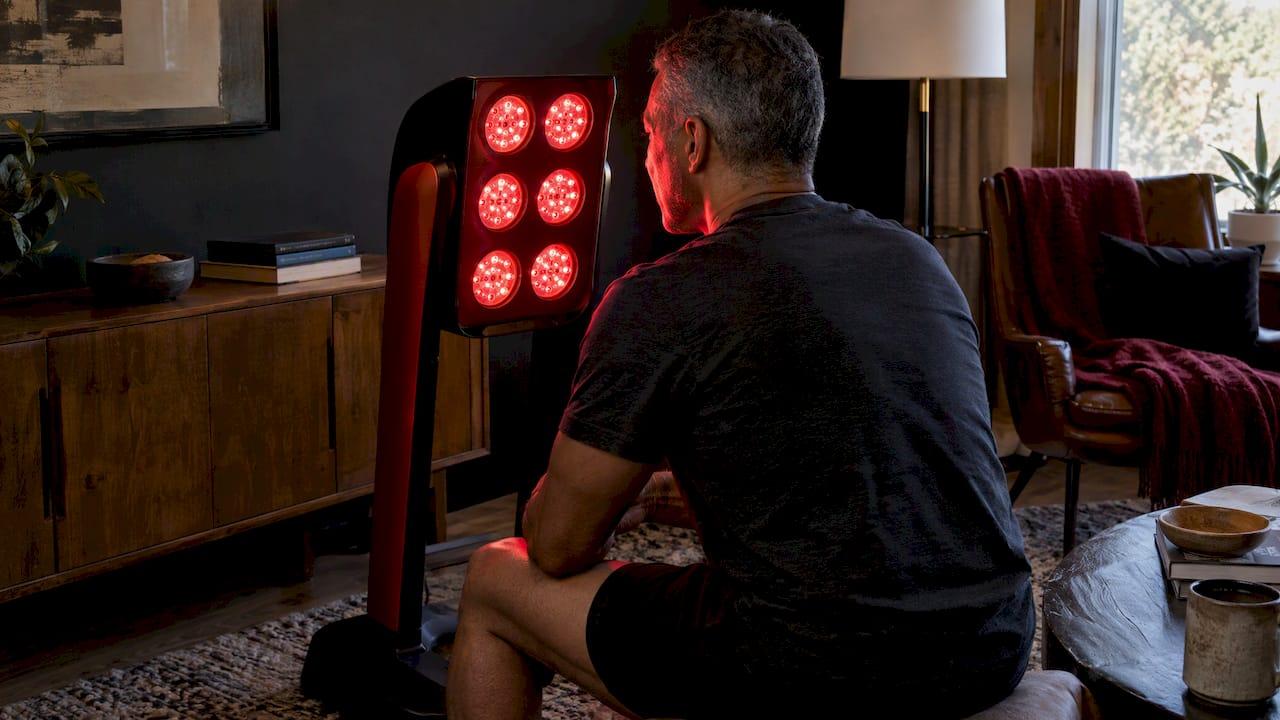
You're wired and tired at the same time. The tank never fills. You wake up already behind, and by 3 p.m. you're running on fumes and caffeine. So you ask whether red light can take the edge off.
Here's the straight answer. Red light is not a stress pill and it is not a cortisol switch. What the research does show is that red light behaves differently from the bright white and blue light that wind your system up, and that near-infrared light is being studied for anxiety. Used on a steady schedule, red light fits a daily restoration routine that gives your body a calmer rhythm to work with. That is how we use it, and it is what this page covers, for him and for her.
TL;DR
- Red light does not push your body's alert system the way bright white or blue light does, which is why it suits a wind-down routine.
- Cortisol follows your light exposure. Morning and evening light choices shape it more than any single device.
- A 2022 systematic review of photobiomodulation (light-based therapy) recommended it for anxiety disorder, using near-infrared light studied under clinical protocols.
- Consistency beats intensity. A short, repeatable session at the same time each day is the point.
- Stress that won't lift, panic, or low mood deserve a conversation with your doctor, not just a routine.
Table of Contents
- Why stress shows up as low energy, low drive, and bad sleep
- What light has to do with cortisol
- What the research says about red light and a calmer body
- Red light, near-infrared and anxiety
- How a stress-smart red light routine works
- For her: what stress looks like in the man you love
- Safe use: what to know before you start
- Where this fits in the bigger picture
- Our perspective
- Make the routine easy to keep
- FAQ
- Sources
Why stress shows up as low energy, low drive, and bad sleep
Stress isn't just a feeling. It's a chain reaction. Your brain senses pressure, and a control system called the HPA axis (hypothalamus, pituitary, adrenal glands) releases cortisol. Cortisol is the hormone that gets you moving. In a healthy rhythm, it peaks in the morning and fades by night.
The trouble starts when the rhythm flattens. Late nights, screens, work pressure and poor sleep keep the system switched on when it should be winding down. Men over 30 often feel it first as a pattern: slower recovery, shorter fuse, less drive, less interest in the people they love. Partners notice it before the man does. He's tired, distant, flat. It looks like he stopped caring. Usually, he's just running on empty.
If that's your house, you're not broken and you're not imagining it. You're living in a body that lost its rhythm. Rhythm can be rebuilt.
What light has to do with cortisol
Light is the master clock for that rhythm. A 2023 review of 12 studies with 337 healthy participants describes the pathway: special light-sensing cells in the eye signal the brain's body clock, and that clock coordinates cortisol through the HPA axis. These cells are most sensitive around 480 nm, which is blue. The same review found that bright light in the late night or early morning can raise cortisol compared with dim light, and blue or green light usually raises it more than red.
Read that the way a man under pressure should read it. The light you live in decides how loud your stress system is. Bright white and blue light at the wrong hour turn the volume up. Red sits at the quiet end of the spectrum.
A study from the 2010s adds a useful detail. Researchers kept 12 people awake for 27 hours and exposed them to one hour of blue or red light at night. Blue light cut nighttime melatonin, the sleep hormone, while red light did not. Red light is the one color that doesn't fight your sleep chemistry. That matters if your stress problem really begins at 11 p.m., scrolling in bed.
Want the other half of that story? Read our breakdown of blue light at night and seven ways to fix it.

What the research says about red light and a calmer body
Cortisol is only one way to read stress. Another is heart rate variability, or HRV: the tiny variation between heartbeats. Higher vagally-mediated HRV generally signals a body that is shifting toward rest and recovery.
A 2025 systematic review of 25 studies looked at how light affects that calming signal. It found that lower-illuminance warm-colored light, such as red or dim white, showed potential to increase vmHRV. The authors link red light's gentle profile to its minimal activation of melanopsin, the pigment in the eye that drives alertness. The field is young and still being built out, which is exactly why a measured, routine-based approach makes sense.
So what does that mean for you? Three practical things:
- Red light is a low-alertness light. It doesn't pull your brain toward daytime mode the way bright white or blue light does.
- It is compatible with a night routine. It does not suppress melatonin the way blue light does.
- The calming effect comes from the routine around it. Same time, same place, phone down, ten quiet minutes.
That third point is the one most men skip, and it's where most of the benefit lives.
Red light, near-infrared and anxiety
Two kinds of light get lumped together online. Visible red light sits around 620 to 700 nm. Near-infrared, which you can't see, sits at roughly 800 nm and beyond. Much of the clinical research on mood and anxiety uses near-infrared, under the name photobiomodulation therapy (PBMT), meaning light used to influence how cells work.
A 2022 systematic review covered 16 studies, including four randomized controlled trials, two of them rated high quality. It concluded that PBMT can be recommended for anxiety disorder. The most commonly used settings were 800 to 830 nm light, a power density of 250 mW/cm², and 60 to 120 J/cm² of energy.
Those are clinical research settings, delivered in studied protocols. We bring them up so you understand the direction of the science, not to promise that any at-home device reproduces a trial. RedRockit is a private-use wellness device. It is not a clinic, not a treatment for anxiety, and not a replacement for care.
What the science does tell a regular man: light is a real input into how your brain and body regulate stress, and researchers are taking it seriously.
How a stress-smart red light routine works
Stress doesn't respond to heroic one-off efforts. It responds to rhythm. Here's the routine logic we'd hand a friend.
Pick one anchor time
Pick a time you can keep five days out of seven. Morning sessions pair well with a clear start to the day. Evening sessions pair well with a wind-down. Our guide to the best time for red light therapy, by goal walks through the trade-offs.
If evenings are your problem, make the session the signal that work is over. Phone in another room. Lights low. No inbox.
Keep it short and steady
Short and repeatable wins. The protocols in published research run for weeks: for example, twice-weekly near-infrared sessions for 8 weeks in one depression trial, and twice weekly for 12 weeks in another. The common thread is time. A routine you do for months beats a burst you quit in ten days. Our companion app, Rockit IQ, provides guided session protocols so you're not guessing at the setup.
Fix the light around the session
A red light session won't undo four hours of bright screens at midnight. Dim the room an hour before bed. Use warm lamps. Keep the bedroom dark. You're handing your body one consistent message: day is day, night is night.

Stack it with the basics
The things that move stress the most are boring and they work: sleep, daylight in the morning, lifting or walking, real meals, and a few minutes of quiet. Red light slots in beside them. Some men also add a practice like hypnotherapy for stress to work on the mental side. The routine is the tool. The device keeps it simple.
Track what you can feel
After two to four weeks, ask yourself plain questions. Are you falling asleep faster? Do you wake up less wired? Is your temper a notch slower? Does your recovery feel closer to what it used to be? Write the answers down. Your own notes beat any headline.
For her: what stress looks like in the man you love
If you're reading this for your husband or partner, here's what stress often looks like from the outside. He's snappy, then silent. He's exhausted but can't sleep. He loses interest in things he used to love, including you. He says he's fine.
A lot of men don't have words for it. They just feel "off" and assume it's age or work. Stress, poor sleep and a shifting hormone picture can all feed each other, and sorting them apart is hard from the inside.
Some ways to help that don't sound like criticism:
- Start with the routine, not the diagnosis. "Want to try ten quiet minutes together after dinner?" lands better than "something is wrong with you."
- Protect his sleep. A dark room, no phone in bed, same bedtime.
- Notice what changes over a month, not a day.
- Encourage a checkup. If he's also had low drive, persistent fatigue or mood changes, a doctor can run bloodwork. We cover the bigger picture in red light therapy and testosterone for men over 30 and red light therapy and libido.
You are not the problem. And you don't have to fix him. You can give him a routine that makes it easier to come back to himself.
Safe use: what to know before you start
Red light is generally a gentle routine, but safe use matters. In the transcranial near-infrared studies, researchers excluded people with forehead skin conditions or tattoos, people taking light-activated medication within two weeks, and people with head implants. In an analysis of three studies with 80 subjects, more frequent sessions over several weeks were not linked to more or worse adverse events.
Practical rules:
- If you take a medication that makes your skin sensitive to light, ask your doctor or pharmacist before using any light device.
- Protect your eyes and follow the device instructions every time.
- Stop and talk to your doctor if you notice skin irritation, headaches or anything unusual. Our page on red light therapy side effects covers what to watch for.
And the bigger line: a routine is not a substitute for care. If you have constant anxiety, panic attacks, trouble functioning at work or home, or thoughts of harming yourself, see a doctor or mental health professional now. In an emergency, call your local emergency number.
Where this fits in the bigger picture
A lot of men researching stress end up asking about testosterone. That makes sense. Chronic stress, short sleep and low drive travel together. You can start by asking whether a restoration routine is the first step, before bigger medical decisions are on the table. Our pages on what to try before TRT and alternatives to TRT lay out that thinking. If your doctor recommends treatment, that is your call to make with them. A routine and a medical plan aren't enemies.
For related reading on how light works for the mind, see red light therapy for mood in men. If recovery is your main pain point, try red light recovery routines for men.
Our perspective
We don't tell men they're broken. We tell them the signal got quiet.
Stress is the loudest thing in most men's lives. It crowds out sleep, then recovery, then drive. By the time it shows up in the bedroom or at the dinner table, he's been running on empty for years.
What we see in the science is that light is one of the cleanest ways to talk to your body's clock. Red light is the quiet end of that conversation: it doesn't hammer your alertness system and it leaves melatonin alone. That's why we built a routine around it, not a promise.
RedRockit is a private-use device you use at home. No clinic visits. No subscriptions. No ongoing dependence. We're not TRT and we're not here to diagnose or prescribe. We're here for the man who feels the shift coming and wants to do something about it now, on his own schedule, with a tool that backs a daily habit.
YOU HAVEN'T LOST IT. You've been running without a rhythm. Build one.
Nurse Rachel
Make the routine easy to keep
The best stress routine is the one you actually do. RedRockit is a private-use red light wellness device made to support a simple daily restoration routine for energy, drive, recovery and vitality, with the Rockit IQ companion app for guided session protocols. There are no subscriptions and no appointments, and it comes with a lifetime craftsmanship guarantee.
Meet RedRockit Primal Restoration

Want the method behind the sessions first? Read how the RedRockit Activation Method is built, or see our page on male vitality after 40.
FAQ
Does red light therapy lower cortisol?
Cortisol responds to light timing, intensity and color more than to any single device. A 2023 review found that red light tends to raise cortisol less than blue or green light does in the early morning. That makes red a gentler choice around your sleep window. We treat it as part of a daily routine, not a cortisol fix.
Can red light therapy help with anxiety?
A 2022 systematic review of 16 studies recommended photobiomodulation for anxiety disorder, mostly with near-infrared light at clinical settings. A home wellness device is not a treatment for anxiety. If anxiety is steady or heavy, talk to your doctor or a mental health professional.
When should I use red light if I'm stressed?
Pick a time you can keep daily. Many men like the evening because it marks the end of the workday and pairs with dim lights and no screens. Morning works if mornings are when you feel most tense. Our timing guide covers both.
How long before I notice a difference?
Research protocols run for weeks, often 8 to 12, so give a routine at least a month before you judge it. Track sleep, mood and recovery in a simple notebook. Changes tend to show up in small ways first: easier sleep, a slower temper, steadier afternoons.
Is this safe to use every day?
In studies of near-infrared light, more frequent sessions were not linked to more or worse side effects. Always follow your device instructions, protect your eyes, and check with your doctor if you take a light-sensitizing medication or have a skin condition on the treatment area.
Sources
- The Influence of Light Wavelength on Human HPA Axis Rhythms (2023 review)
- The Effects of Red and Blue Lights on Circadian Variations in Cortisol, Alpha Amylase, and Melatonin (Figueiro and Rea, 2010)
- Effects of light exposure on vagally-mediated heart rate variability (2025 systematic review)
- Photobiomodulation therapy in mood disorders: a systematic review (2022)
- Tolerability and Safety of Transcranial Photobiomodulation (Cassano et al., 2022)
- Hypnotherapy for Stress: What the Evidence Actually Shows