
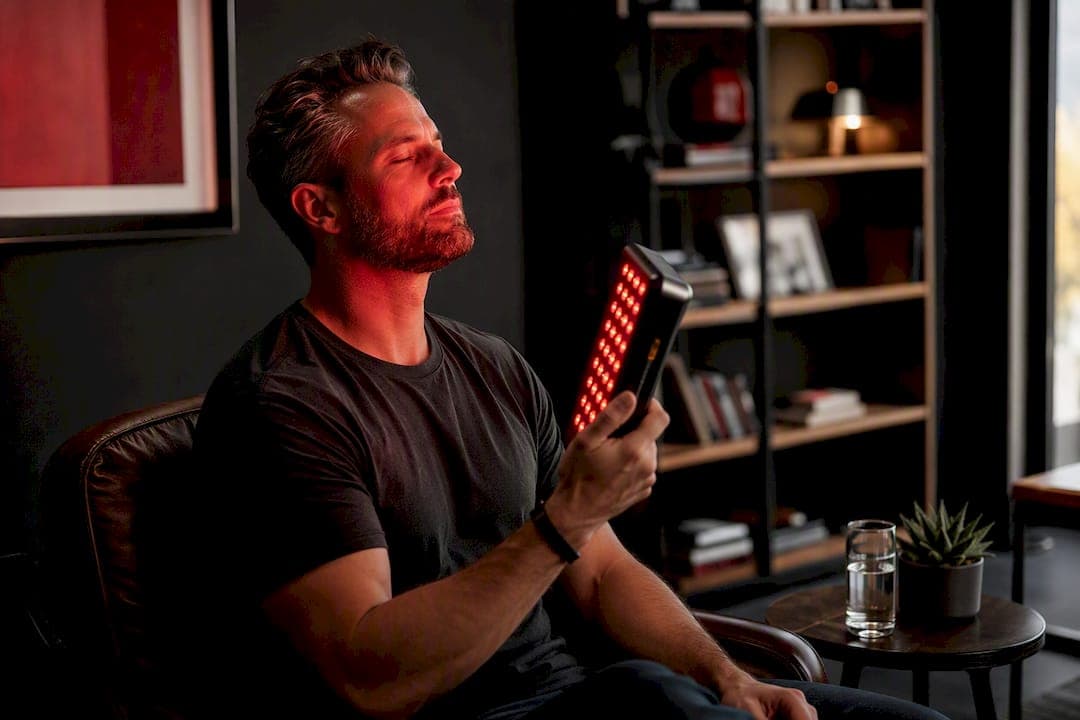
Red light can modestly improve how well you feel you slept, especially when you use it at low intensity for 20 to 30 minutes in the hour before bed. It is not a cure for insomnia, and it will not replace a real sleep hygiene routine. The strongest data comes from a small but real body of randomized trials, including a 2026 meta-analysis showing a modest improvement in sleep quality scores compared to sham treatment.
That is the honest bottom line. Here is what it means for you.
- What works: Red or near-infrared light, used consistently, tends to improve subjective sleep quality more reliably than objective measures like actigraphy.
- What to try first: Sit near a panel or wear a red/NIR device for 20 to 30 minutes, finishing 30 to 60 minutes before lights-out.
- What to watch: High-intensity red light can still suppress melatonin. Keep sessions dim and short.
The number that matters: the pooled effect from that 2026 systematic review found a Pittsburgh Sleep Quality Index improvement of MD = −1.25 versus sham, drawn from five trials and 240 people. That is real, but modest, and the trials were small enough that the certainty is limited.
If you have an eye condition, take photosensitizing medication, or plan to expose your face directly to a panel, talk to an eye care provider before you start. Otherwise, this is a low-risk experiment worth running for a few weeks.
Key Takeaways
Red light modestly improves subjective sleep quality for many people when used at low intensity for 20 to 30 minutes before bed, but objective sleep measures shift less reliably, and evidence remains preliminary.
| Point | Details |
|---|---|
| Evidence is real but modest | A 2026 meta-analysis found a PSQI improvement of MD = −1.25 versus sham across five small trials. |
| Subjective beats objective | People report feeling more relaxed and rested more consistently than actigraphy detects measurable change. |
| Intensity and timing matter | Use low-lux exposure for 20 to 30 minutes, finishing 30 to 60 minutes before lights-out. |
| Run a real self-trial | Track a one-week baseline, then log sleep diary data for 2 to 4 weeks before judging results. |
| Pair it with real sleep hygiene | Red light supports, but does not replace, consistent bedtimes, dim lighting, and a cool, dark room. |
| Primal Red Co's role | RedRockit is positioned as a private-use restoration tool for men 30+, meant to support a nightly routine, not diagnose or treat a sleep disorder. |
Table of Contents
- Where the Evidence on Red Light Sleep Stands Right Now
- How Red Light Talks to Your Circadian System
- What the Studies Actually Test: Wavelengths, Devices, and Protocols
- Safety Rules Before You Try Red Light at Night
- A Practical Nightly Protocol for Red Light Sleep
- Who Should Be Cautious and What the Evidence Still Can't Tell Us
- How Primal Red Co Sees the Research
- Red Light Versus Other Sleep Light Strategies
- Does Red Light Help Specific Sleep Problems?
- Does the Benefit Last, or Fade Over Time?
- How to Fold Red Light Into a Real Sleep Hygiene Routine
- Common Myths About Red Light and Sleep
- What the Research Actually Supports, and What It Doesn't
- RedRockit as Your Next Step
- Sources
Where the Evidence on Red Light Sleep Stands Right Now
The research on red light and sleep is younger and thinner than most wellness marketing suggests. That does not mean it is worthless. It means you need to read the actual numbers instead of the confident claims plastered around them.
The most rigorous data point available is the 2026 systematic review and meta-analysis of photobiomodulation trials, which pooled five randomized controlled trials covering 240 participants. It found a Pittsburgh Sleep Quality Index improvement of MD = −1.25 (95% CI −2.38 to −0.11, p = 0.03) for photobiomodulation versus sham. Translation: people using red or near-infrared light reported meaningfully better sleep quality scores than those in the placebo arm, but the effect size is small and the confidence interval brushes right up against zero. The trials also showed moderate heterogeneity (I2 = 36.2%), meaning the studies did not use the same wavelengths, doses, or protocols, which weakens how much you can generalize from any single number.
One of the better-designed trials in this space is a randomized, sham-controlled trial of a cervical red/NIR collar. Thirty adults wore either an active or sham device for 25 minutes every other night, in the hour before bedtime, over three weeks. The active group reported better relaxation and perceived sleep quality. Here is the catch: objective actigraphy, the wrist-worn measure that tracks actual movement and sleep onset, showed no difference between groups. People felt better. Their sleep data, mostly, did not move.
"Subjective relaxation and perceived sleep improved in the active group, but objective actigraphy measures did not differ between groups." This is the central tension running through nearly every red light sleep study published so far. People consistently report feeling better rested. The instruments that measure sleep architecture do not always agree.
Why does this gap exist? A few explanations are plausible, and none of them cancel each other out.
- Expectancy and ritual effects are strong in photobiomodulation trials. Lying still with a warm light for 25 minutes is relaxing on its own, regardless of wavelength.
- Actigraphy measures movement, not the felt experience of restfulness, so it may simply be blind to the kind of improvement red light produces.
- Session protocols vary so much across studies (wavelength, dose, timing, device type) that comparing "red light" across trials is a little like comparing "exercise" across studies that range from a walk to a marathon.
The heterogeneity problem is real and worth naming directly. Trials have used different wavelengths, different irradiance levels, and different device types, from full-body panels to cervical collars to goggles. Some sessions ran nightly, others every other night. Some measured outcomes with the PSQI, others leaned on daily diaries. Until researchers agree on standardized parameters, every pooled statistic, including the −1.25 figure above, comes with an asterisk. That is not a reason to dismiss the findings. It is a reason to treat them as a promising early signal rather than settled science.
How Red Light Talks to Your Circadian System
Your eyes contain a third type of light sensor most people have never heard of: intrinsically photosensitive retinal ganglion cells, or ipRGCs. These cells sit separately from the rods and cones that let you see shapes and color, and their entire job is to tell your brain what time it is. They are most sensitive to short blue wavelengths around 460 to 480 nanometers, which is exactly why scrolling your phone at midnight keeps you wired. Red light sits at the opposite end of the visible spectrum, typically 600 to 670 nanometers, where ipRGCs respond far more weakly.
That difference is the entire mechanistic argument for red light sleep therapy. Because ipRGCs barely register red wavelengths, red light is markedly less likely than blue or white light to suppress melatonin, the hormone that signals your body it is time to wind down. UAB sleep researchers are careful to note this is a matter of degree, not immunity. All light can suppress melatonin at sufficient intensity, red included. A dim red bulb across the room behaves very differently than a bright red panel six inches from your face.
Beyond the eyes, a second and distinct mechanism is doing work: photobiomodulation, or PBM. This is where near-infrared and red wavelengths penetrate skin and shallow tissue and get absorbed by a mitochondrial enzyme called cytochrome c oxidase. That absorption appears to nudge several downstream processes:
- Increased ATP production inside cells, giving tissue more usable energy.
- Release of nitric oxide, which affects local blood flow and cellular signaling.
- Reductions in markers of neuroinflammation, at least in early PBM research.
None of this is settled clinical mechanism. The meta-analysis authors describe these pathways as plausible biological bases for sleep effects, not proven ones. But the distinction matters practically: PBM's effects on tissue and mitochondria are a completely separate pathway from the ocular, circadian-entrainment effect of red light hitting your ipRGCs. A cervical collar working through skin and blood flow is doing something physiologically different than a panel positioned to catch your eyes.
There is a third, less discussed route: simple parasympathetic activation. Sitting still, feeling warmth on your skin, and dimming the room for 20 minutes activates the "rest and digest" branch of your nervous system independent of any wavelength-specific biology. Some of what people report as red light benefit may be this and the wavelength doing the work together, not the wavelength alone.
What the Studies Actually Test: Wavelengths, Devices, and Protocols
If you want to run your own experiment, you need to know what the trials that generated the promising numbers actually did. Most published protocols cluster around a narrow set of parameters, and the gap between "red light" as a marketing term and "red light" as a controlled variable is significant.
Trial wavelengths tend to fall into two bands. Pure red sits around 660 nanometers. Near-infrared, often paired with red in combination devices, ranges from roughly 740 up through 870 nanometers. NIR is invisible to the eye but penetrates tissue more deeply than visible red, which is why many PBM devices combine both bands rather than using red alone.
Device form factor varies more than most people expect. Studies have used flat panels positioned a couple of feet from the body, wearable collars targeting the neck and upper chest, and in some protocols, goggles for more direct ocular exposure. Each targets a different pathway. A panel used for general exposure leans on both ocular and skin effects. A cervical collar is almost entirely a PBM, non-ocular play. This matters because a device built for one mechanism will not necessarily deliver the other.
| Protocol Element | Typical Range Used in Trials |
|---|---|
| Red wavelength | Around 660 nm |
| Near-infrared wavelength | Roughly 740 to 870 nm |
| Session length | 20 to 30 minutes |
| Timing | Within the hour before bedtime |
| Frequency | Nightly or every other night |
| Trial duration | 3 weeks and up |
Timing across trials is remarkably consistent even when other parameters differ. Most protocols schedule sessions in the final hour before bed, and several ran every-other-night rather than nightly, which suggests researchers were not confident daily exposure adds proportional benefit. The cervical collar trial used 25 minutes, alternate nights, for three weeks, which is a useful real-world benchmark if you are building your own routine.
The outcome measures split cleanly into two camps, and this split is the single most important thing to understand before you try red light for sleep:
- Subjective outcomes (sleep diaries, PSQI scores, self-rated relaxation) improve fairly consistently across trials.
- Objective outcomes (actigraphy, polysomnography) show smaller or no measurable differences in several of the same studies.
This is not a contradiction so much as a limitation of what each tool can detect. A sleep diary captures how rested you feel. Actigraphy captures whether your wrist moved less. Those are related but not identical things, and a therapy that improves the felt experience of sleep without dramatically restructuring sleep architecture is still a meaningful outcome for most people, just not the dramatic clinical win that headlines sometimes imply.
Safety Rules Before You Try Red Light at Night
Red light has a good general safety profile at the doses used in most research, but "generally safe" is not the same as "no rules apply." A few precautions separate a smart self-trial from an unnecessary risk.
- Keep intensity low. UAB researchers are blunt about this: all light can suppress melatonin, and bright red light is no exception. Choose devices with published irradiance specifications rather than guessing based on how the light looks to your eye.
- Check your medications and conditions. Certain acne medications, retinoids, and autoimmune conditions like lupus increase photosensitivity. If you take a photosensitizing drug or manage a light-sensitive condition, talk to your prescriber before adding regular light exposure to your routine.
- Protect your eyes. Never stare directly into a red or NIR panel. If you plan any facial or ocular exposure as part of your routine, get a baseline check from an optometrist or ophthalmologist first, especially if you have any pre-existing eye disease.
- Respect skin sensitivity. If you notice unusual redness, irritation, or heat sensitivity at the exposure site, stop and reassess distance and session length before continuing.
- Watch how you feel, not just how you sleep. A small subset of people report increased alertness or anxious energy after red light sessions. If that happens to you, that is a signal to adjust, not push through.
Pro Tip: Distance is your simplest safety lever. Doubling your distance from a panel roughly quarters the intensity hitting your skin and eyes, so if a session feels too bright or too warm, step back before you assume the device itself is the problem.
None of this is meant to make red light sound dangerous. It is meant to make sure you treat it the way you would any tool that interacts with your hormones and your eyes: with a little respect for dosage and a plan for who should check in with a professional first.
A Practical Nightly Protocol for Red Light Sleep
Here is where the science turns into something you can actually do tonight. Building a routine around red light does not require guesswork if you follow the parameters the trials themselves used.
Choosing a device. Look for a wavelength range in the 600 to 670 nanometer band for red, or 740 to 870 nanometers if the device also delivers near-infrared. The manufacturer should publish irradiance or wattage specifications, not just marketing language like "clinical grade." If eye safety is a concern for your use case, an FDA-cleared device gives you a documented safety baseline the average unregulated panel does not.
Running the session. Sit roughly 0.5 to 1 meter from a panel, or use a targeted device like a cervical wrap, for 20 to 30 minutes. Finish 30 to 60 minutes before you intend to be asleep, not the moment you climb into bed. Repeat nightly or every other night for 2 to 4 weeks before you judge whether it is working. This mirrors the protocol timing used in the strongest trials in this space.
Set up matters as much as the device itself.
- Dim competing light sources in the room during your session, since bright ambient light will muddy any circadian benefit you are chasing.
- Keep the same time window each night. Consistency, not intensity, is what the every-other-night trial protocols suggest actually drives results.
- Pair the session with something low-stimulation, like reading a physical book, rather than a lit-up phone screen a few feet away.
Running your own trial like a scientist. This is the step almost everyone skips, and it is the difference between a real self-experiment and wishful thinking.
- Track a baseline for one full week before you start. Log sleep onset time, number of wakeups, and a simple 1 to 10 sleep quality rating each morning.
- Begin your red light protocol and continue logging the same metrics for 2 to 4 weeks.
- Note changes specifically in sleep onset speed, subjective sleep quality, and morning grogginess. Those three are the outcomes most likely to shift based on the trial data.
- If you have access to a wearable that tracks sleep, layer that data on top of your diary, but weight your diary more heavily. Subjective outcomes moved more reliably than objective ones in the randomized trial evidence, so your own felt experience is a legitimate primary measure, not a lesser one.
- Give it the full window before judging. A single good or bad night tells you nothing; three to four weeks of logged data tells you something real.
Pro Tip: Log your morning grogginess separately from your sleep quality rating. They usually track together, but when they diverge, that gap often reveals whether red light is helping you fall asleep faster or actually improving how restored you feel, which are two different wins.
An app-guided protocol can take some of the guesswork out of session timing and duration, which matters more than most people assume when you are trying to isolate whether a change in sleep is really coming from the light and not from a shift in your bedtime routine generally.
Who Should Be Cautious and What the Evidence Still Can't Tell Us
The honest limitation of this entire field is sample size. The 2026 meta-analysis pooled just five trials and 240 people total, and the review authors flag heterogeneous wavelengths, inconsistent dosimetry, and limited use of objective measures like polysomnography as recurring weaknesses across the field. Placebo and expectancy effects run strong in this kind of research; lying still under a warm light for 25 minutes is inherently relaxing, which makes isolating the wavelength's specific contribution difficult.
Individual response also varies more than marketing copy tends to admit. One study on red light's effects on mood and sleep found it increased subjective alertness and negative emotions in some participants, rather than helping them relax. If your sleep gets worse, or you feel wired instead of calm after a session, that is your data telling you this particular tool is not for you right now.
A few groups should loop in a clinician before starting:
- Anyone with diagnosed eye disease, given the ocular exposure involved in facial-directed devices.
- Anyone with bipolar disorder, since light exposure protocols can influence mood cycling in ways that deserve professional oversight.
- Anyone with severe or long-standing insomnia, where red light is a supportive tool at best, not a substitute for proper clinical evaluation.
- Anyone on photosensitizing medication or managing a photosensitive condition like lupus.
Red light is a reasonable low-risk experiment for most healthy adults. It is not yet, and may never be, a stand-alone treatment for a diagnosed sleep disorder.
How Primal Red Co Sees the Research
We built RedRockit for men who feel the shift before it becomes a crisis, and sleep is usually one of the first signals that gets ignored. Your body doesn't announce that recovery is slipping. It just quietly stops giving you the deep, restorative nights that used to come automatically. Poor sleep and low drive feed each other in a loop most men don't notice until they're both bad.
RedRockit is a private-use restoration tool, not a medical device, and not a sleep cure. We frame it the way the actual research supports: a low-risk addition to a real routine, not a replacement for one.
Track your baseline for a week before you start anything. Log what changes, not what you hope will change. Pause and talk to a professional if sleep gets worse instead of better.
That's the whole checklist. No overclaiming, no shortcuts. If you want to see how RedRockit's guided protocol fits into a broader restoration routine, that's the next step.
Red Light Versus Other Sleep Light Strategies
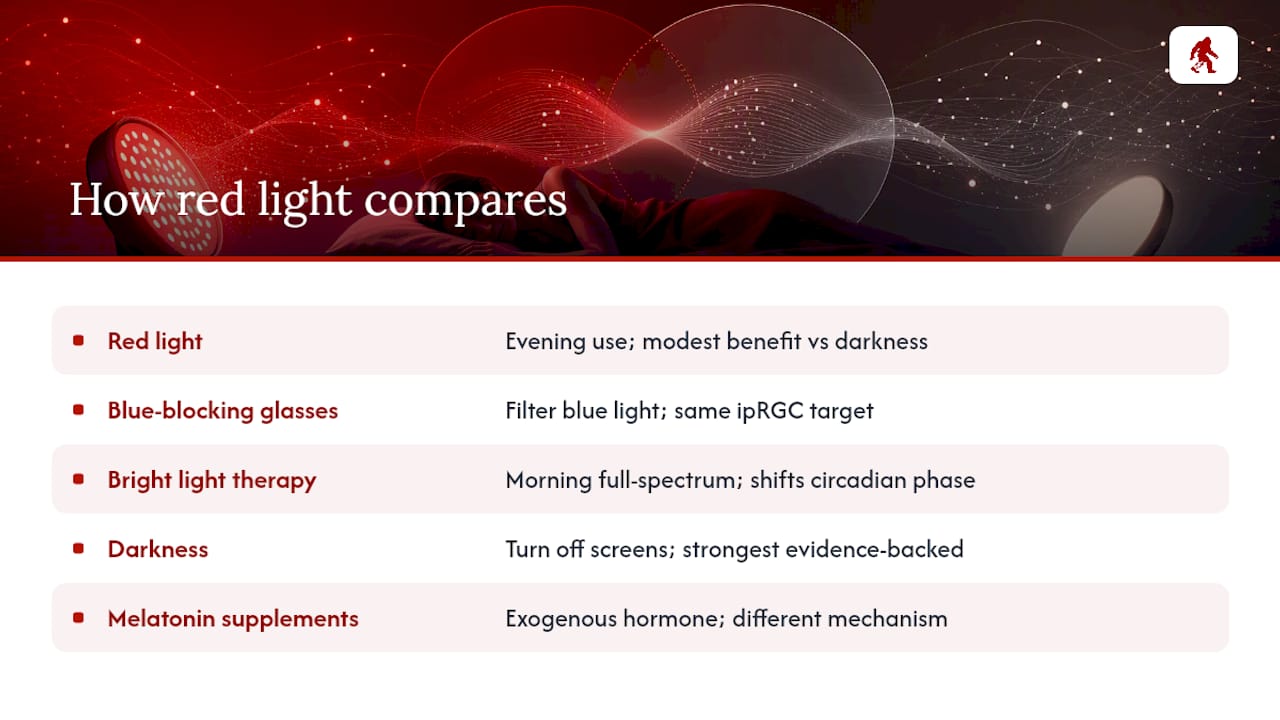
Red light is one option in a broader category of light-based sleep tools, and it is worth knowing how it stacks up. Blue-light-blocking glasses work on the same ipRGC pathway from the opposite direction: instead of choosing a wavelength that barely triggers those cells, you filter out the wavelength that triggers them most. Both approaches target the same mechanism, just with different tools.
Bright light therapy, typically full-spectrum white light delivered in the morning, works on an entirely different problem: shifting a delayed circadian rhythm earlier. It is well-established for seasonal affective disorder and some circadian rhythm disorders, but it is a morning intervention, not an evening one, and it is not interchangeable with red light's proposed evening role.
Simple darkness, meaning turning off screens and dimming household lights an hour before bed, remains the most evidence-backed light-based sleep intervention there is. Sleep Foundation guidance frames red light as a complement to that darkness-first approach, not a substitute for it. Red light's advantage over simply sitting in a dark room is modest: it lets you do a deliberate wind-down ritual with some light present rather than none, which some people find easier to stick with than sitting in total darkness.
Compared to melatonin supplements, red light works through a different route entirely; it does not add exogenous hormone, it aims to avoid suppressing the hormone your body already makes. That is a meaningfully different mechanism, even if the end goal, easier sleep onset, looks similar on paper.
Does Red Light Help Specific Sleep Problems?
The trial evidence so far has mostly studied general adult populations, not people with a diagnosed sleep disorder, which limits what you can conclude about conditions like chronic insomnia or circadian rhythm disorders specifically.
That said, the mechanism gives a reasonable basis for cautious optimism in a few areas. For people whose sleep struggles stem partly from evening light exposure, phone use, bright kitchens, blue-lit living rooms, swapping that light for red in the pre-bed window addresses a real contributing factor, even if it will not fix insomnia rooted in anxiety, pain, or a medical condition.
For circadian rhythm disorders specifically, such as delayed sleep phase, red light's low ipRGC stimulation makes it a plausible evening tool for avoiding further phase delay, though it is not a substitute for the morning bright-light protocols that actually shift circadian timing forward. The two work in different directions and address different halves of the same clock.
For general poor sleepers without a formal diagnosis, the pooled trial data is the most directly applicable: a modest PSQI improvement, concentrated in subjective quality rather than measurable sleep architecture changes. If your sleep complaint is "I don't feel rested" more than "I have a diagnosed disorder," you are closer to the population these trials actually studied.
Nothing here supports red light as a treatment for sleep apnea, restless leg syndrome, or other conditions with a distinct physiological cause unrelated to light exposure.
Does the Benefit Last, or Fade Over Time?
No published trial has followed participants long enough to answer this with confidence. Existing studies run three weeks to a few months, which tells you whether red light works in the short term but says nothing about whether the benefit holds at three months, six months, or a year of consistent use.
What we do know points toward consistency mattering more than any single session. The every-other-night protocols used in trials suggest the effect, whatever its true size, builds through repeated exposure and routine rather than a single dramatic session. That lines up with how most circadian and relaxation-based interventions behave generally: benefits tend to compound with regularity and fade when the habit lapses.
There is also a real possibility that some of the durable benefit comes from the routine itself, not the wavelength. A consistent pre-bed ritual, dimmed lights, a fixed 20 to 30 minute wind-down window, less screen time, is independently associated with better sleep regardless of what color the light in the room happens to be. Red light may be doing double duty: a modest direct effect plus the scaffolding for a habit you would benefit from anyway.
The realistic expectation is this: give any protocol a full 2 to 4 week trial before judging it, then keep going if it is working. Stopping and restarting repeatedly is unlikely to show the same results as sustained, consistent use over weeks and months.
How to Fold Red Light Into a Real Sleep Hygiene Routine
Red light works best as one piece of an evening routine, not a stand-alone fix. Sleep Foundation's own guidance is explicit on this point: pair red light exposure with proven sleep hygiene practices rather than treating it as a replacement for them.
Build your evening in layers. Start by dimming overhead lights and switching off screens roughly an hour before bed. Add your red light session inside that same window, 20 to 30 minutes, finishing at least half an hour before you plan to sleep. Keep your bedroom cool and dark once the session ends, since a warm, glowing room right up until lights-out works against the darkness your circadian system actually wants at that point.
Timing consistency across your whole routine, not just the light, matters. Going to bed and waking at roughly the same time daily remains one of the most reliable levers for sleep quality, and it is worth prioritizing over any single tool, red light included. Caffeine cutoff times, alcohol moderation, and a cool bedroom temperature all still apply. None of that changes because you have added a red light step.
Think of red light as the low-effort addition, not the load-bearing wall. If your evening routine currently includes bright lights, a phone in bed, and inconsistent bedtimes, fixing those three things will move your sleep more than any device will. Add red light once the fundamentals are already in place, and you are optimizing an already-solid routine rather than trying to patch a broken one with a gadget.
Common Myths About Red Light and Sleep
Myth: red light has zero effect on melatonin. Not true. UAB researchers are clear that all light can suppress melatonin at sufficient intensity, red included. It suppresses melatonin less readily than blue light because ipRGCs respond weakly to red wavelengths, but "less" is not "none."
Myth: more light exposure means more benefit. The trial protocols consistently used short, dim, time-limited sessions, not extended or bright exposure. There is no evidence that a longer or brighter session multiplies the benefit, and it may increase your risk of the melatonin suppression you were trying to avoid in the first place.
Myth: red light is a proven insomnia treatment. The actual evidence base is a modest pooled effect from five small trials. That is a promising early signal, not a clinically validated insomnia treatment, and no major sleep medicine body has endorsed it as a first-line intervention.
Myth: any red bulb will replicate the study results. Trial devices used specific wavelength ranges, typically 660 nanometers for red and 740 to 870 for near-infrared, with documented irradiance. A household red bulb with no published specs is not the same tool the research tested.
Myth: if it doesn't show up on your smartwatch, it isn't working. Objective actigraphy measures did not move in some trials even when subjective sleep quality clearly improved. Your felt experience of rest is a legitimate outcome, not a lesser one just because a wearable failed to detect it.
What the Research Actually Supports, and What It Doesn't
The conventional advice on red light sleep therapy tends to swing between two extremes: breathless claims that it fixes insomnia, or dismissal because the effect sizes are small. Both miss the point. A modest, real improvement in how rested you feel, backed by actual randomized trials, is exactly the kind of low-risk tool worth adding to a routine you are already trying to build.
What gets underestimated is the role of consistency over novelty. The every-other-night protocols in the strongest trials suggest this is a habit-building tool, not a one-night fix, and most people quit before the 2 to 4 week mark where change would show up.
Prioritize the fundamentals first: dark room, consistent bedtime, screens off. Add red light as the next layer, not the first move, and judge it with a real logged trial instead of a gut feeling after night one.
RedRockit as Your Next Step
If the evidence in this piece has you thinking about adding a private-use red light device to your evening routine, that is exactly the reader Primal Red Co built RedRockit for. This isn't a clinic, and it isn't TRT. It's a tool for men over 30 who feel the shift starting and want to do something about recovery, drive, and energy before bigger decisions land on the table.

RedRockit pairs the device with the Rockit IQ app, which guides your session length and timing so you are not stuck guessing at protocols pulled from a dozen different studies. That structure matters more than it sounds: the trials showing benefit used specific, repeatable parameters, not random exposure whenever you remembered. A guided routine gets you closer to what actually got tested.
If you want to see how a private-use device fits into a full restoration plan, not just sleep but energy, drive, and recovery, start with RedRockit's activation method or read more about what a real restoration routine looks like after 40.
Sources
- Photobiomodulation and sleep quality: systematic review and meta-analysis | Lasers in Medical Science | Springer Nature Link
- A randomized, sham-controlled trial of a novel near-infrared phototherapy device on sleep and daytime function - PMC
- Is Red Light Good for Sleep? | Sleep Foundation
- Does red light therapy improve sleep? | UAB News