
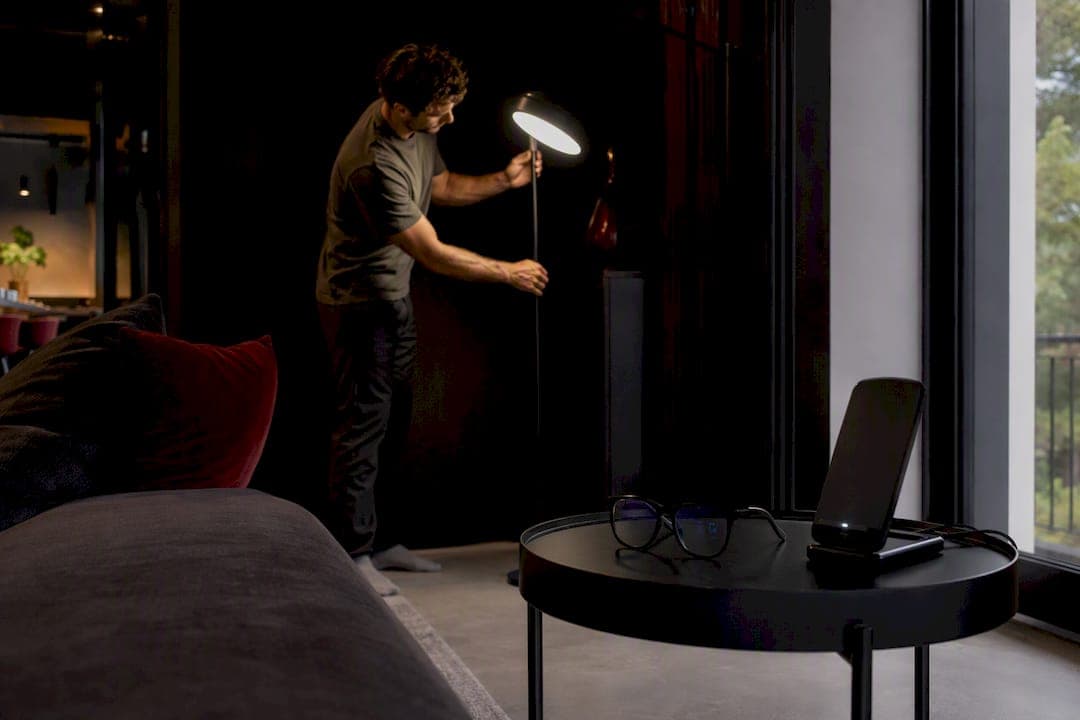
Yes. Blue light in the evening delays sleep by suppressing melatonin, and the fastest fix is cutting bright, blue-rich light in the few hours before bed. That single window matters more than almost anything else in your evening routine.
Two moves you can make tonight:
- Dim your overhead lights starting two to three hours before you plan to sleep, and switch bedside lamps to warm or red bulbs.
- If you can't put the phone down, turn on the strictest night mode your device has and drop brightness as low as it will go.
Some people need to take this more seriously than others. Shift workers, anyone dealing with insomnia, and habitual late-night scrollers are working against a stacked deck. Harvard Health notes that experts commonly recommend turning off devices a few hours before bed specifically because blue wavelengths interfere with the body's wind-down signal more aggressively than other colors of light. If that's you, the two steps above aren't optional extras. They're the baseline.
Key Takeaways
Blue light at night suppresses melatonin and delays sleep onset, and cutting bright, blue-rich light in the few hours before bed is the single most effective evening habit for protecting sleep.
| Point | Details |
|---|---|
| Cut screens 2 to 3 hours before bed | This window matches how long melatonin needs to recover after blue-heavy exposure stops. |
| Choose warm light over bright light | Bulbs rated 2700K or lower and brown-tinted glasses reduce melatonin suppression far more than clear lenses. |
| Use melanopic irradiance, not lux | Low mEDI settings on devices matter more for sleep than raw screen brightness alone. |
| Don't eliminate blue light entirely | Morning blue light supports alertness; the goal is timing management, not blanket avoidance. |
| Combine light changes with sleep hygiene | Consistent sleep schedules, a cool room, and limited late caffeine reinforce lighting fixes. |
This article is general information, not a substitute for advice from a qualified doctor. Consult a qualified healthcare professional about your own circumstances before acting on anything here.
Table of Contents
- What Blue Light Does to Your Sleep Signal
- Does the Research Actually Back This Up?
- Which Lights and Devices Are Sabotaging Your Sleep?
- Your Evening Light Reset: A Step-by-Step Plan
- Do Blue-Light Glasses and Night Mode Apps Actually Work?
- Melanopic Irradiance: The Number That Actually Matters
- What Chronic Nighttime Light Exposure Means for Your Long-Term Health
- Nurse Rachel's Checklist: Tonight, This Week, This Month
- Why Kids, Adults, and Older Adults React to Blue Light Differently
- When Cutting Blue Light Backfires
- Making Blue Light Management Part of Real Sleep Hygiene
- What Sets a Man Up to Actually Feel Rested
- Sources
What Blue Light Does to Your Sleep Signal
Your body runs on a light-triggered clock, and blue light is the loudest input it listens to. Blue wavelengths sit in the 450 to 495 nanometer range of visible light, the shortest and most energetic band your eyes register. That range matters because your retina has a special class of cells built to detect exactly this kind of light, and they're not there for vision.
Those cells are called intrinsically photosensitive retinal ganglion cells, or ipRGCs. They contain a light-sensitive protein called melanopsin, and they don't send signals to the part of your brain that processes images. They send signals straight to your suprachiasmatic nucleus, the master clock sitting in your hypothalamus. When melanopsin absorbs blue light, it tells that clock "it's daytime," and the clock responds by clamping down on melatonin production. Melatonin is the hormone that tells the rest of your body it's time to power down. Cut its supply late at night, and you've told your system to stay in day mode when you need it in night mode.
Timing changes everything here. Morning blue light, from sunlight or a bright lamp, is doing exactly what it should: anchoring your circadian rhythm to the day and helping you feel alert. The same wavelength at 10 p.m. is fighting against the signal your body is trying to send itself. Dose matters too. Even relatively dim light, as low as roughly 8 lux, can measurably suppress melatonin, which is dimmer than most nightlights. That's why simply "turning the lights down a little" often isn't enough. The suppression threshold is lower than most people assume.
The clearest demonstration of how much color matters comes from a controlled comparison of light exposure at night.
Blue light suppressed melatonin for about twice as long as green light exposure of comparable brightness, shifting circadian rhythms by roughly twice as much, according to Harvard Health's summary of the research.
That's not a small variance. It means the same lamp, at the same intensity, produces a dramatically different biological outcome depending on which part of the spectrum it emits. A few practical implications follow directly from this mechanism:
- Brightness alone is a poor predictor of circadian disruption. Color matters as much or more.
- Screens held close to the face deliver more effective light exposure than ambient room lighting, because proximity increases the dose your retina actually receives.
- The 2 to 3 hour pre-bed window isn't an arbitrary number. It roughly matches how long it takes melatonin secretion to recover once blue-heavy light exposure stops.
Understanding this mechanism is what separates useful advice from vague "reduce screen time" platitudes. You're not managing a bad habit. You're managing a light-sensitive hormonal switch, and once you know where that switch is, you can start flipping it on purpose.
Does the Research Actually Back This Up?
Here's the honest answer: yes, but with real nuance you deserve to hear instead of a blanket scare headline. A 2022 systematic review of blue light's effects on young adults found genuinely mixed results across the studies it examined. Roughly half reported decreased tiredness and reduced sleep efficacy tied to blue light exposure, while outcomes on sleep duration and latency varied considerably from trial to trial. That heterogeneity isn't a weakness in the science. It reflects real differences in study design, exposure duration, participant age, and how "blue light exposure" was even defined from one lab to the next.
What that means practically: the signal for melatonin suppression is consistent and well-replicated. The signal for exactly how much it delays sleep onset, or how much it degrades next-day performance, is less uniform. Some trials show measurable increases in sleep latency, the time it takes to fall asleep, after blue light exposure. Others show smaller effects, particularly when exposure was brief or dim. This is normal for behavioral sleep science, where lab conditions rarely mirror how you actually use your phone in bed.
| Research Question | What the Evidence Shows |
|---|---|
| Does blue light suppress melatonin? | Well-established across multiple trials, including direct blue-versus-green comparisons |
| Does it increase sleep latency? | Mixed but leaning affirmative; several studies show a measurable delay |
| Does it reduce sleep duration? | Inconsistent across trials, likely dependent on exposure timing and dose |
| Does it affect next-day alertness? | Variable; some studies show reduced tiredness the following day, which cuts both ways |
| Are findings consistent across age groups? | Limited data outside young adult populations |
The limitations are worth naming directly. Many trials use small, relatively young, healthy participant pools, which limits how confidently the findings generalize to older adults or people with existing sleep disorders. Most studies also run short, often a single night or a few days, which tells you something about acute effects but very little about what happens after months of habitual late-night scrolling. Endpoints vary too. One study measures salivary melatonin, another measures self-reported sleepiness, and a third tracks actigraphy-based sleep duration. Comparing across them is like comparing test scores graded on different curves.
Pro Tip: Don't wait for perfect research consensus before acting. The mechanism (melatonin suppression) is well-supported even where downstream effects on sleep duration are mixed. Treat the physiology as your evidence, not the still-evolving edge cases.
So where does that leave you? The melatonin suppression finding is strong enough to act on tonight. The sleep-latency findings are a real, moderately supported signal, not a guarantee for every person every night. And claims about long-term cumulative effects on sleep architecture remain the least settled part of the picture, which is exactly why the mitigation strategies later in this piece lean on the mechanism you can control rather than promises about outcomes that vary person to person.
Which Lights and Devices Are Sabotaging Your Sleep?
Your phone is the obvious offender, but it's rarely working alone. The average bedroom at 9 p.m. is a small constellation of blue-rich light sources, most of which you've stopped noticing because they've been there so long.
Screens carry the most concentrated dose because you hold them close to your face and stare directly at the emitting surface. Phones, tablets, and laptops all lean blue-heavy by default, especially at higher brightness settings. Televisions matter less per minute of exposure since you're typically farther away, but hours of evening viewing at high brightness still adds up.
Household lighting is the sneaky culprit. Cool-white LED bulbs and compact fluorescent lamps (CFLs), the kind chosen for kitchens and bathrooms because they look "bright and clean," emit a much higher proportion of blue wavelengths than warm incandescent or amber-toned bulbs. If your overhead lights have a bluish-white cast rather than a yellowish warmth, you're bathing your living room in circadian-disrupting light for hours before bed without a screen in sight.
Smaller sources add up more than people expect:
- Smart bulbs and smart speakers with cool-white status lights or displays.
- Alarm clock displays, especially the bright blue-digit kind common in older models.
- Charging cables and docking stations with blue LED indicator lights positioned right next to the bed.
- Router and modem lights, particularly in studio apartments where the bedroom doubles as living space.
Outdoor light pollution plays a role too, though it's harder to control directly. Streetlights and neighboring buildings with cool-white exterior lighting can leak into a bedroom through thin curtains, adding a low but steady dose of circadian-relevant light exposure through the night.
Here's a fast visual check: look at your bedside lamp with the room otherwise dark. If the light has a crisp, bluish-white quality, it's likely a high correlated color temperature bulb, generally above typical warm light ranges. If it looks warm, amber, or slightly orange, you're in safer territory, generally in the low warm light range. Bulb packaging almost always lists the Kelvin rating. That number is one of the most useful things you'll ever read on a lightbulb box.
Your Evening Light Reset: A Step-by-Step Plan
Fixing this doesn't require buying anything new tonight. It requires a sequence, and the order matters because some changes carry far more weight than others.
- Start the 2 to 3 hour wind-down window. This is your highest-leverage move. Harvard Health and multiple sleep researchers point to this window because it roughly matches how long melatonin needs to recover once blue-heavy exposure stops. If a full screen shutdown isn't realistic on a given night, this is the one rule worth protecting above all others.
- Dim overhead lights and swap to warm bedside lamps. Warm or red-toned lighting is the least likely to shift circadian rhythm, according to the Sleep Foundation. A single warm lamp on a dimmer, used for the last hour before bed, does more for your sleep signal than most people realize.
- Choose warm CCT bulbs for evening rooms. Look for bulbs rated 2700K or lower for any room you occupy after dinner. This is a one-time purchase that pays off every night afterward.
- Enable night mode and drop screen brightness. Every major phone and laptop now ships with a built-in filter that shifts the display toward warmer tones in the evening. Turn it on, and push it further than the default setting allows if your device permits it.
- Reset your bedroom environment. Blackout curtains block outdoor light pollution. Move phone chargers, routers, and any device with a status light out of direct line of sight from the pillow.
- Set a "lights down" alarm. Treat the start of your wind-down window like an appointment. A recurring alarm at the same time each night trains the habit faster than willpower alone ever will.
- Replace scrolling with low-impact evening activities. Reading under a warm lamp, stretching, or a short breathing exercise fills the same time slot without fighting your melatonin curve.
Pro Tip: If you can only change one thing this week, change your bedside lamp. It's the cheapest fix on this list, and it's the one you'll actually use every single night without having to remember to do it.
None of this requires perfection. A night where you skip step one but nail steps two and five still moves the needle. The goal is a lower average nightly exposure, not a flawless routine you'll abandon by Thursday.
Do Blue-Light Glasses and Night Mode Apps Actually Work?
Three categories of tools exist to reduce your exposure without asking you to give up your evening screen time entirely, and they don't all perform the same.
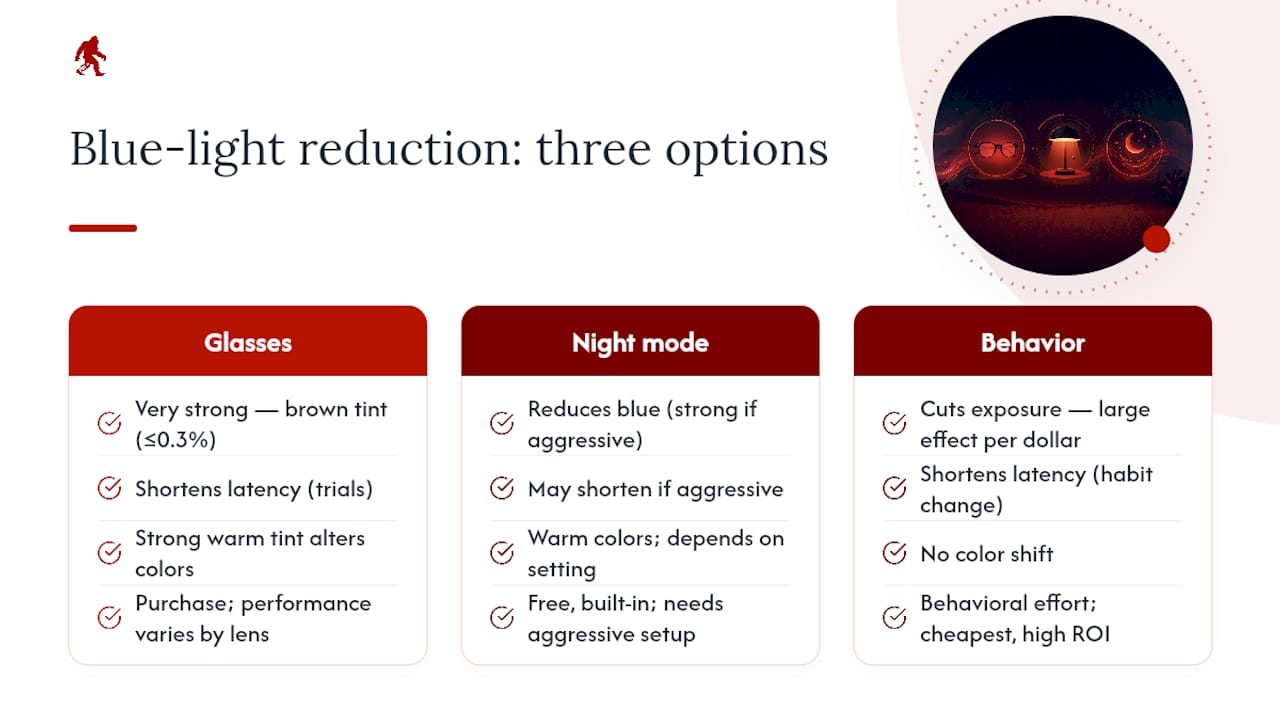
Amber or brown-tinted eyewear is the most studied intervention outside of behavioral change. Research on blue-light-blocking glasses shows they reduce evening melatonin suppression and can shorten sleep latency in trials, but effectiveness depends heavily on the lens's spectral profile. Lightly tinted or clear "blue light glasses" sold as general accessories often filter far less than their marketing suggests.
Software night modes shift your screen's color temperature toward warm tones after sunset. They're free, already built into most phones and laptops, and genuinely reduce the blue content reaching your eyes when set aggressively rather than left on the default mild setting.
Tunable lamps that dial down to low color temperatures are the most controllable option for your bedroom itself. A recent measurement study on residential lighting found that tunable lamps reduced estimated melatonin suppression dramatically when adjusted from high to low color temperature settings, a dramatic drop achieved with nothing more than dialing a lamp toward warm.
That same study measured actual eyewear performance rather than relying on marketing claims, and the results were telling:
Brown-tinted blue-light-filtering lenses reduced estimated melatonin suppression to below 0.3 percent in direct measurement, while many generic clear or lightly tinted lenses fell far short of that performance.
If you're buying glasses for sleep rather than daytime eye comfort, look specifically for a brown or amber tint rather than a clear lens marketed simply as "blue light blocking." The color of the lens is doing the actual work, not the label on the box.
There are real trade-offs to know before you commit. Warm-toned lighting and amber lenses both shift how colors look, which some people find visually unpleasant at first. Tunable lamps cost more upfront than a standard bulb. And for most people, the behavioral changes, dimming lights, shortening screen time, setting a consistent wind-down window, deliver more benefit per dollar than any gadget. Tools are a multiplier on good habits. They're a poor substitute for skipping the habits altogether.
Melanopic Irradiance: The Number That Actually Matters
Lux, the standard unit for measuring brightness, tells you almost nothing useful about how disruptive a light source is to your sleep. Two lamps can register the same lux reading and produce wildly different effects on your melatonin, because lux measures total visible light without accounting for color. Melanopic irradiance, often abbreviated mEDI, fixes that blind spot by weighting light specifically according to how strongly it activates melanopsin, the exact protein your ipRGCs use to signal your circadian clock.
Controlled display studies confirm why this distinction matters. Research measuring screen exposure found a clear dose-dependent relationship: as mEDI rises, sleep latency lengthens and melatonin suppression increases in a predictable, measurable pattern. That's a much cleaner signal than lux alone could ever provide, because it's measuring the specific input your circadian system actually responds to.
You don't need a light meter to use this insight. A few practical rules of thumb translate the science into something usable:
- Favor low mEDI settings on your devices in the evening. This is what an aggressive night mode is actually trying to accomplish, even if it doesn't display the number directly.
- Warm color temperature and low intensity together produce lower mEDI than either change alone.
- Distance and duration compound the effect. A dim, warm light held six inches from your face for two hours can still add up to meaningful exposure.
- Treat mEDI as the reason your night mode setting matters more than your total screen time, since a warm, dim display run for an hour can carry a lower circadian dose than a bright, cool one run for ten minutes.
Manufacturers and app developers are starting to build around this metric directly. Spectral tuning, whether achieved through software filters or hardware changes, can meaningfully lower melanopic content without fully sacrificing color accuracy, which means the technology to protect your sleep and still use your devices at night already exists. You just have to turn the settings up.
What Chronic Nighttime Light Exposure Means for Your Long-Term Health
The conversation about blue light usually stops at sleep, but there's a longer arc worth understanding, even if the science here asks for more humility than the sleep-latency data.
Epidemiological research has found associations between chronic exposure to artificial light at night, often abbreviated ALAN, and outcomes including metabolic disruption and, in some studies, certain cancer risks. These are observational associations, not proven cause-and-effect relationships, and that distinction deserves real weight. Observational studies can show two things moving together without proving one causes the other. People with heavy nighttime light exposure often share other risk factors, irregular schedules, shift work, disrupted sleep patterns generally, that could independently explain some of the association.
Chronic ALAN exposure shows a consistent association with circadian disruption and downstream metabolic effects in population studies, though researchers are clear that causal pathways remain an open question requiring further work.
Who should weigh this most heavily? Shift workers, whose exposure to bright and blue-rich light at biologically "wrong" times is sustained and structural rather than occasional. People with consistently heavy screen use late into the night, night after night, for years rather than weeks. And anyone with a personal or family history of metabolic conditions, where an added circadian stressor may compound existing risk, even without a proven direct causal line.
None of this is a reason for alarm over one late night with your phone. It's a reason to treat consistent, nightly light discipline as a reasonable long-term habit rather than a short-term fix you abandon once your sleep feels fine again. Reducing nighttime light exposure protects tonight's sleep and, as a sensible extension of that same logic, likely supports your broader circadian and metabolic health over years, even where the research hasn't drawn a straight causal line yet.
Nurse Rachel's Checklist: Tonight, This Week, This Month
You don't fix years of bad light habits in one evening, but you can start tonight and build from there. Here's how I'd break it down for a patient asking me where to begin.
- Tonight: Dim your overhead lights two to three hours before bed and switch your bedside lamp to a warm or red bulb if you have one available. If you're stuck on a screen, turn night mode all the way up and drop brightness as low as it goes.
- This week: Buy one warm-toned bulb (2700K or lower) for your bedroom lamp, and physically move your phone charger, router, or any device with a status light out of eyesight from your pillow.
- This month: Build the wind-down window into your actual schedule with a recurring alarm, and replace one nightly screen habit with a low-light alternative, reading under a warm lamp, a short stretch, a few minutes of quiet breathing.
Consistency beats intensity here. A moderate routine you actually keep up beats a strict one you abandon after four days.
One safety note worth taking seriously: if you've made these changes and you're still lying awake most nights, waking frequently, or feeling unrefreshed no matter what you adjust, that's not a lighting problem anymore. Persistent insomnia, sleep apnea symptoms like loud snoring or gasping, or sleep issues tied to shift work scheduling deserve a conversation with a clinician rather than another lighting tweak. Light management is a genuinely powerful lever. It isn't a substitute for treating an underlying sleep disorder.
Pro Tip: Track your bedtime and how rested you feel for one week before making changes, then compare it to a week after. You'll have your own before-and-after data, and it's more convincing than anything I can tell you.
Why Kids, Adults, and Older Adults React to Blue Light Differently
Blue light sensitivity isn't uniform across a lifetime, and knowing where you or your family fall on that curve changes how urgently you should act.
Children and teenagers tend to show heightened sensitivity to evening light. Younger eyes have clearer lenses that transmit more blue light to the retina than older, naturally yellowing lenses do, which means the same phone screen delivers a stronger circadian signal to a 12 year old than to their grandparent. Combine that with the shifting sleep timing common in adolescence, and screens before bed can hit teenagers with an outsized effect on both melatonin timing and total sleep duration.
Working-age adults sit in the middle. Lens clarity is still relatively high, and most adults in this range carry the heaviest evening screen habits of any group, phones, laptops, work emails answered from bed, which combines moderate biological sensitivity with the highest actual exposure levels.
Older adults generally experience reduced blue light transmission to the retina as the eye's lens yellows with age, which can blunt the melatonin-suppressing effect somewhat. But older adults also tend to produce less melatonin overall and often already contend with lighter, more fragmented sleep, so even a smaller relative disruption can matter more against an already thinner margin.
The practical takeaway: don't assume one household rule fits everyone under your roof. A teenager's phone habit likely needs stricter limits than a retired parent's evening television time, even if the screens look identical from across the room.
When Cutting Blue Light Backfires
Reducing blue light isn't without trade-offs, and pretending otherwise sets you up for frustration. Blue light during the day is doing real work for you: it's central to daytime alertness and cognitive performance, which is exactly why the goal here is timing management, not blanket elimination. Wearing amber glasses at 2 p.m. or slapping a warm filter on your work laptop all day can leave you groggier and less sharp when you need to be at your best.
There's also a mood and alertness cost when people overcorrect at the wrong time. Bright, blue-enriched light in the morning helps anchor your circadian rhythm and lifts alertness for the day ahead. Block that morning light too, and you can end up pushing your internal clock later rather than earlier, the opposite of what most people actually want.
Comfort matters too. Some users find warm-toned screens and amber lenses genuinely unpleasant for color-sensitive tasks like photo editing or design work, which is a legitimate reason to reserve the strictest filtering for the true wind-down window rather than running it around the clock.
And there's a psychological trap worth naming: treating glasses or apps as a total fix can quietly excuse worse habits elsewhere, later bedtimes, more total screen time, less physical activity, because "I'm wearing my blocking glasses, so it's fine." Tools reduce one input. They don't cancel out everything else that disrupts sleep.
The fix isn't avoiding blue light altogether. It's applying it deliberately: bright and blue-rich in the morning, warm and dim in the two to three hours before bed. Precision beats elimination here.
Making Blue Light Management Part of Real Sleep Hygiene
None of this works in isolation; for broader restorative-night routines that enhance skin regeneration and overnight repair, see The Role of Sleep in Skin Health and Radiance. Blue light management is one lever on a larger dashboard, and pulling it alone while ignoring the rest of your sleep hygiene will leave you disappointed.
Pair your lighting changes with a consistent sleep and wake schedule, even on weekends. Your circadian clock responds to regularity as strongly as it responds to light itself, and an erratic schedule can undercut even a well-executed evening light routine. Keep your bedroom cool, generally in the 60s Fahrenheit, since temperature and light work together to signal "sleep time" to your body.
Watch your caffeine and alcohol timing too. Caffeine's half-life is long enough that an afternoon coffee can still be affecting you at bedtime regardless of how dark your room is, and alcohol fragments sleep architecture even when it helps you fall asleep faster initially.
Think of it as a stack rather than a single fix: consistent schedule, cool dark room, minimal late caffeine, and reduced blue-rich light in the evening window. Each layer supports the others. A perfectly dim, warm bedroom won't save you from a midnight espresso, and cutting screens won't fix a sleep schedule that shifts by three hours every weekend.
Start with whichever piece feels most broken in your current routine, not necessarily the light. If your schedule is already a mess, fix that first and let the lighting changes reinforce a foundation rather than trying to compensate for one that isn't there yet.
What Sets a Man Up to Actually Feel Rested
The conventional advice on blue light usually stops at "wear the glasses" or "turn on night mode," and honestly, that's where most guides quit too early. The mechanism is what deserves your attention, not the gadget aisle. Melatonin suppression is the real event happening in your body every time you scroll under a cool-white bulb at 11 p.m., and once you understand that, the fixes stop feeling like arbitrary rules and start feeling like something you're doing on purpose.
Here's what I think gets underweighted: the bedroom itself. Men will buy the glasses and download the app, then leave a cool-white overhead light blazing while they wind down. Your environment is working against you the whole time you think you've solved the problem with a $20 pair of lenses.
Priority order matters. Fix your light exposure first, because it's free and it works tonight. Then look at the rest of your evening: what's keeping you wired, what's keeping your energy inconsistent, what's making "just going to bed earlier" feel impossible even when you try. That broader restoration conversation, energy, drive, staying sharp instead of sliding into autopilot after 30, is worth having with resources like Primal Red Co's guide to male vitality. Sleep is the floor. Building on it is the real work.
— Nurse Rachel
Sources
- Blue light has a dark side — Harvard Health Publishing
- The influence of blue light on sleep, performance and wellbeing in young adults: A systematic review — PMC
- Home lighting, blue-light filtering, and their effects on melatonin suppression | Scientific Reports
- Blue Light: What It Is and How It Affects Sleep — Sleep Foundation