
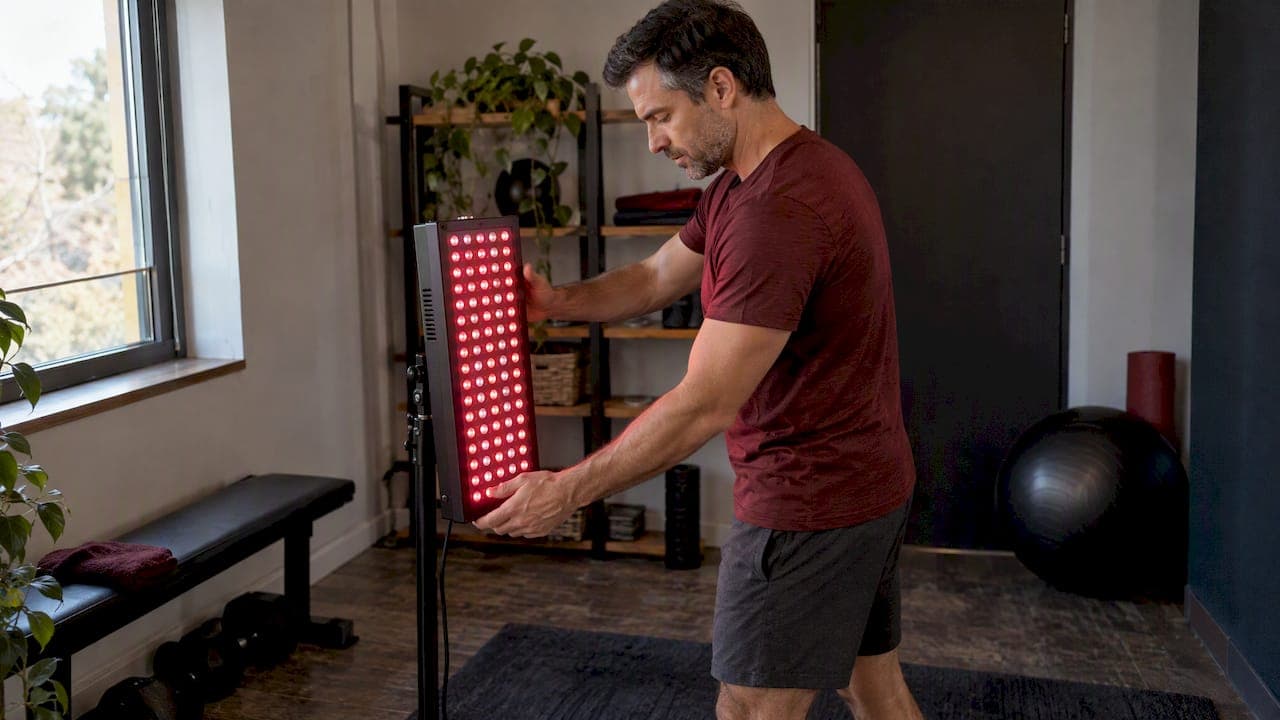
The strongest signals in the research sit in two bands: red light around 630 to 670 nm and near-infrared light around 800 to 890 nm. Most of the testosterone gains show up in animal studies, not men. Human data lean heavily toward sperm motility, not serum testosterone. Dose, distance, and consistency appear to influence outcomes, though effects vary widely.
TL;DR:
- Human studies show consistent improvements in sperm motility at wavelengths around 633 nm and 810 nm, but no definitive evidence of increased serum testosterone.
- Animal data indicate testosterone rises mainly occur in injury-recovery models, not in healthy men, with outcomes heavily dependent on dose, duration, and consistency.
- Variability in protocols, small sample sizes, and short follow-ups mean large, standardized trials are necessary before confirming long-term benefits or safety.
- Red light therapy should be used cautiously, respecting device guidelines, avoiding heat, and consulting a clinician if there are hormone-sensitive conditions or active testicular issues.
- Red light devices marketed for general wellness are not approved for treating hormone deficiencies and should not replace medical diagnosis or treatment.
Table of Contents
- What the Studies Found by Wavelength
- Why Wavelength Changes What Your Cells Do
- How Researchers Measured Dose in These Studies
- Where the Safety Data Stands Today
- What We Tell Men Who Ask Us About This
- Red Light Versus Other Approaches: What Actually Compares
- Does the Effect Last After You Stop?
- Who Should Think Twice Before Trying This
- Does Combining This With Other Habits Help?
- Turning Lab Protocols Into Something You Can Actually Do
- Is This Even Approved for Hormone Use?
- Our Honest Read on This Research
- Where RedRockit Fits Into This
- Sources
- FAQ
What the Studies Found by Wavelength
Here's the thing nobody tells you upfront: the research on red light and testosterone is scattered across species, doses, and outcomes that don't always line up. You haven't been lied to, exactly. You've just been handed marketing copy where you needed a map. So let's build the map.
A narrative review covering photobiomodulation therapy across 600 to 1100 nm found a repeated pattern: red and near-infrared light stimulate sperm motility and reduce markers of oxidative stress in a wide mix of animal and human studies. The same review notes that serum testosterone increases show up mainly in animal models, with human evidence for a testosterone bump much thinner on the ground. That matters. Sperm motility and testosterone are related but separate outcomes, and conflating them is where a lot of hype gets built.
At the human level, an 810 nm near-infrared study on men with asthenozoospermia (a clinical term for reduced sperm motility) used 1 watt of output applied for 60 seconds per square centimeter. Progressive motility improved right after treatment, and researchers found no spike in lipid peroxidation, a marker of oxidative damage. No testosterone measurement here, just a motility response at a specific, named dose.
A separate human study using a 633 nm red laser found increased sperm swimming speed with no significant oxidative DNA damage at the tested intensities. Again: motility, not hormone levels. But it's a second data point confirming that red light in the 630s has a measurable, repeatable effect on sperm function in actual men, not just mice.
On the animal side, researchers working with heat-injured azoospermia mice applied an 890 nm laser at a low energy density and reported increased serum testosterone along with recovery of the seminiferous epithelium, the tissue layer where sperm production happens. This is one of the few studies in this entire body of research where testosterone itself rose, and it happened in mice recovering from induced testicular injury, not in healthy men looking for an edge.
A broader systematic review covering low-level laser therapy from 600 to 1000 nm ties these effects to specific cell signaling pathways and notes that some animal studies saw testosterone rise after treatment. The same review is blunt about the problem: protocols vary so much between studies that comparing them directly is close to guesswork. The authors call for standardized dosing before anyone draws firm conclusions.
| Wavelength | Species | Primary outcome | Study note | Source |
|---|---|---|---|---|
| 633 nm | Human | Sperm motility, DNA safety | Increased swimming speed, no significant DNA damage at tested doses | PMC5397839 |
| 810 nm | Human | Progressive sperm motility | 1 W for 60 s per cm², no rise in oxidative stress markers | PubMed 39501019 |
| 890 nm | Animal (mice) | Serum testosterone, Leydig/tissue recovery | Low energy density, heat-injury recovery model | Ecerm |
| 600 to 1100 nm (range) | Mixed animal/human | Motility, oxidative stress, occasional testosterone | Review of multiple protocols, high variability | PMC10082901 |
| 600 to 1000 nm (range) | Mixed animal/human | Pathway activity, testosterone in animal models | Flags inconsistent dosing across studies | Xuebao |
The pattern that survives all this noise: 633 to 670 nm and 810 to 890 nm show up again and again as the bands researchers actually test, and they're the ones worth knowing if you're paying attention to wavelength at all. But the sample sizes are small, the dosing is inconsistent across labs, and follow-up periods are short. Nobody has run the large, standardized human trial that would settle this. For more on how these two bands compare in practice, see our breakdown of 660nm versus 850nm.
Why Wavelength Changes What Your Cells Do
Your body doesn't respond to "red light" as one thing. It responds to specific wavelengths hitting specific molecules, and the molecule doing most of the work here is cytochrome c oxidase, an enzyme sitting inside your mitochondria. Red and near-infrared photons get absorbed by this enzyme, and that absorption is linked to increased ATP production, the energy currency your cells run on. More usable energy at the cellular level is the starting point for everything downstream.
From there, the research points to a few parallel effects: nitric oxide release, modulation of reactive oxygen species (ROS), and activity in signaling pathways including PI3K/Akt, MAPK/ERK, and NF-κB, according to the systematic review on low-level laser therapy. These pathways are involved in cell survival, repair, and in the case of Leydig cells, the signaling that drives steroidogenesis, the process by which testosterone gets made. None of this is a straight line from "light hits skin" to "testosterone rises." It's a chain of plausible steps, some better documented than others, and the weakest link is still the jump from cellular signaling to a measurable hormone change in a healthy man.
Wavelength matters here because it decides how deep the light actually travels. Red light in the 630 to 670 nm range tends to stay closer to the surface. Near-infrared in the 800 to 890 nm range pushes deeper into tissue, which is part of why researchers reach for NIR when the target sits further from the skin, as the photobiomodulation review describes. The testes aren't buried deep, but they're not a flat surface either, and penetration depth is one more reason protocol choice isn't arbitrary.
How Researchers Measured Dose in These Studies
Two numbers matter if you want to understand any red light protocol: irradiance, measured in milliwatts per square centimeter, and energy density, measured in joules per square centimeter. Irradiance is how strong the light is at the skin's surface. Energy density is irradiance multiplied by exposure time, and it's the number most studies report as their real dose.
The studies behind this research don't agree on a single number, and that's worth sitting with rather than smoothing over. The mouse study using 890 nm applied an unusually low energy density, around 0.03 J/cm², in short pulses and still saw a testosterone response in an injury-recovery model. The human study at 810 nm used 1 W of output for 60 seconds per square centimeter to improve motility. A systematic review of male infertility trials found that energy densities around 4 to 6 J/cm² often produced stronger motility effects than higher doses like 10 J/cm², with benefits sometimes dropping off at the higher end. More isn't automatically better here, and a few studies suggest it can be worse.

Frequency is the other variable researchers keep returning to: repeated, moderate sessions rather than one intense blast. Patterns across these studies point toward something like 3 to 5 sessions a week being more consistent with how the tissue responds, a cadence we've covered in more depth in our piece on photobiomodulation session frequency.
Practical takeaways if you're translating any of this into a routine: respect the distance your device manufacturer specifies, because irradiance drops off fast as you move away from the light source. Avoid any device that gets hot enough to warm the skin, since heat introduces a separate risk that has nothing to do with wavelength. And write your sessions down, the band you used, the duration, how you felt, because that's the only way to notice a pattern in yourself when the research itself hasn't nailed one down. We go deeper on the math in our dosage breakdown.
Pro Tip: Log your sessions the same way you'd log a workout, wavelength, time, distance, because "I think it's working" is not data you can act on later.
Where the Safety Data Stands Today
The 633 nm red laser study specifically tested for oxidative DNA damage and found none significant at the doses used. That's reassuring, as far as it goes. It doesn't cover every wavelength, every power level, or years of repeated exposure, because nobody has run that study yet.
The real risk in practice isn't the light itself. It's heat. High-power devices or off-label laser use directed at scrotal skin without any clinical oversight can cause local heating that has nothing to do with photobiomodulation and everything to do with a device running hotter than it should. There is no standardized clinical trial tracking serum testosterone in men over months or years of red light exposure, and that gap means long-term safety and long-term benefit are both open questions.
A short safety checklist worth keeping: start at the low end of any dose range, follow your device's documented guidance rather than guessing, stop immediately if you feel pain or heat, and talk to a clinician before using light therapy as a stand-in for an actual low testosterone diagnosis. More detail on testicular-specific risk lives in our testicular red light therapy review.
What We Tell Men Who Ask Us About This
Here's where we land after going through this research: the evidence is promising, not proven. The best human data we have points to sperm motility and tissue-level responses, not a guaranteed testosterone bump. The testosterone increases are real in animal models, especially at 890 nm in injury-recovery settings, but a mouse recovering from heat damage isn't the same as a 40-year-old man trying to feel like himself again.
If you're building a routine, we'd point you toward the 660 nm or 810 to 850 nm range, short sessions, 3 to 5 times a week, tracked over time rather than judged after one use. Pair it with a clinician's bloodwork if you're trying to measure anything real. Our overview on red light and testosterone and our vitality after 40 guide go further into building that out.
Red Light Versus Other Approaches: What Actually Compares
Testosterone replacement therapy (TRT) and exogenous testosterone injections work through a completely different mechanism: they introduce a hormone directly rather than attempting to support the signaling that produces it naturally. TRT has a large, established evidence base for raising serum testosterone, something red light research simply does not have yet in men. Supplements marketed for testosterone support, things like fenugreek or zinc, mostly carry weak or inconsistent trial data, putting them in a similar evidence tier to red light rather than above it.
Where red light holds its own ground is in the sperm motility research, where human trials at 633 nm and 810 nm show repeatable, measured improvement without the systemic side effects that come with hormone injections. It is not a replacement for TRT when TRT is medically indicated. It is a non-pharmaceutical option with a narrower, more modest evidence base aimed at supporting the body's own signaling rather than overriding it. Anyone comparing these approaches should weigh strength of evidence against what they're actually trying to fix: a diagnosed hormone deficiency calls for clinical evaluation, not a light panel.

Does the Effect Last After You Stop?
None of the studies cited here followed men or animals for more than a few weeks to months after treatment ended, which means nobody can currently say whether a testosterone increase from red light holds steady, fades, or requires ongoing sessions. The mouse study at 890 nm measured recovery of tissue structure following injury, a different question from whether a healthy subject's testosterone stays elevated once sessions stop.
What the pattern across these papers does suggest is that photobiomodulation behaves more like a repeated-stimulus therapy than a one-time fix: consistent exposure correlates with the responses researchers recorded, and sessions were rarely a single event. That points toward red light being something you maintain as a routine rather than a treatment you complete once and set aside, though the honest answer on long-term sustainability is that the data to confirm or deny it doesn't exist yet.
Who Should Think Twice Before Trying This
Men with hormone-sensitive conditions, including certain prostate conditions or hormone-responsive cancers, should talk to a clinician before adding light therapy aimed at the testes, since none of the studies cited here enrolled men with those diagnoses and the effect on hormone-sensitive tissue is unknown. The same caution applies to men currently on hormone therapy of any kind, where introducing another variable without medical guidance makes it harder to know what's driving any change you notice.
Pregnant partners, men with active testicular injury or infection, and anyone with a pacemaker or implanted electronic device should also check with a clinician first, standard precautions for any light or heat-based therapy near sensitive anatomy. None of the research reviewed here involved these populations, which means there's no safety data to point to either way. When your situation falls outside "generally healthy adult male," the responsible move is a conversation with a clinician before a routine, not after.
Does Combining This With Other Habits Help?
None of the studies cited test red light alongside specific lifestyle interventions, so any claim of a combined or amplified effect would be speculation dressed up as science. What's reasonable to say is that the biology involved, mitochondrial energy production, oxidative stress regulation, overlaps with the same systems affected by sleep, resistance training, and diet. A body already under chronic stress from poor sleep or heavy drinking is working against the same cellular pathways photobiomodulation is trying to support.
That doesn't mean red light "boosts" the benefit of a good workout or a clean diet in any measured sense. It means the two aren't working against each other, and a man who's already handling his sleep, training, and stress load is giving any intervention, light-based or otherwise, a fairer shot at showing an effect. Treat red light as one input alongside the fundamentals, not a shortcut around them.
Turning Lab Protocols Into Something You Can Actually Do
Laboratory protocols use lasers with precise, calibrated output and controlled distances, numbers like 1 watt for 60 seconds per square centimeter or 0.03 J/cm² in short pulses. Consumer LED panels work differently: lower peak irradiance, wider beam spread, and real-world variables like distance from the panel that shift the effective dose more than most men realize.
The honest translation is this: you cannot replicate a laser study's exact energy density with a home LED panel, and no consumer device on the market claims to. What you can do is borrow the pattern those studies point toward, moderate exposure, repeated consistently, in the wavelength bands most often tested, and apply it at the distance and duration your specific device's documentation recommends. That's the difference between chasing a lab number you can't actually hit and building a routine grounded in the same underlying logic the research used. Our dosage guide walks through how to think about that math for a home setup, and wellness practitioners writing on recovery-focused photobiomodulation cover similar ground on irradiance and session duration for general use.
Is This Even Approved for Hormone Use?
Red light and near-infrared devices sold for general wellness use are not approved anywhere as a treatment for low testosterone or any diagnosed hormone condition. The research cited throughout this article is preclinical and early clinical work, not the kind of large-scale trial that leads to a regulatory approval for a hormonal indication.
That distinction matters if you're shopping for a device: a panel marketed for general restoration, recovery, or wellness use is operating in a different category than a medical device cleared to treat a diagnosed condition, and no consumer red light product should be mistaken for the second. If you have a confirmed low testosterone diagnosis, that's a conversation for a clinician, with red light treated as a possible supporting habit rather than a substitute for medical care, as one clinical overview of low-level laser mechanisms also frames it when discussing ATP and ROS pathways in a wellness context.
Our Honest Read on This Research
The wavelength obsession misses the real issue. Men search for "the right nanometer" the way they used to search for the right supplement stack, hoping specificity will substitute for consistency. It won't. The studies that show an effect, at 633 nm, at 810 nm, at 890 nm, share one thing in common that has nothing to do with the number: repeated, moderate exposure over time, measured against a baseline.
What's overrated here is the idea that red light will move your serum testosterone the way a prescription would. The animal data flirts with that outcome. The human data mostly doesn't. What's underrated is the motility and tissue-level evidence, quieter findings that don't sell as well but actually replicate across independent human studies.
If you're going to do this, prioritize consistency over chasing a perfect number, and prioritize a clinician's bloodwork over guessing from how you feel. The light is a tool. It is not a verdict on your biology.
— Nurse Rachel
Where RedRockit Fits Into This
RedRockit isn't a medical device and it isn't a substitute for a clinician's diagnosis. It's a private-use red light restoration tool built for exactly the kind of routine this research keeps pointing toward: repeated, moderate, trackable sessions rather than a one-off gamble.

- Delivers red and near-infrared exposure in a consistent at-home routine, instead of a guessing game with a panel you don't understand.
- Guided sessions through the Rockit IQ app help you stay in the moderate-dose range the research keeps favoring over extreme ones.
- Private use, no ongoing medical appointments or subscriptions stand between you and a consistent routine.
If you want a tool built around that evidence instead of a vague promise, see the RedRockit Primal Restoration device.
Sources
FAQ
Does red light actually boost testosterone?
The strongest testosterone increases appear in animal studies, particularly with 890 nm near-infrared light in injury-recovery models, not in healthy men. Human research mostly shows benefits for sperm motility rather than a confirmed rise in serum testosterone.
Should men do red light therapy?
Red light therapy can be a reasonable, low-risk addition to a restoration routine if you follow conservative dosing and your device's guidance, but it isn't a verified treatment for diagnosed low testosterone. Men with hormone-sensitive conditions or anyone considering it as a substitute for clinical care should talk to a clinician first.
Does red light therapy for testosterone really work?
The honest answer is "it depends what you're measuring." The evidence for improved sperm motility at wavelengths like 633 nm and 810 nm is more consistent than the evidence for raising testosterone itself in men.
Can red light therapy improve male fertility?
Human studies at 633 nm and 810 nm both report improved sperm motility after red or near-infrared light exposure, which is one component of fertility. It is not a substitute for a fertility workup, and anyone dealing with a diagnosed fertility issue should pursue that alongside, not instead of, clinical evaluation.