
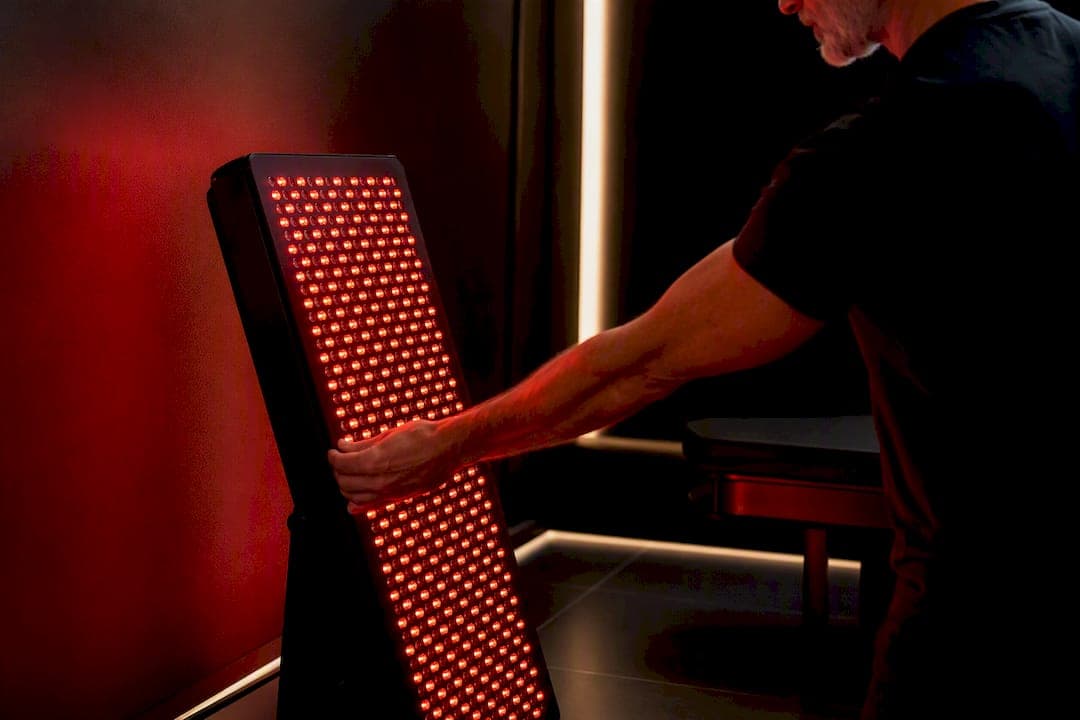
If you're chasing skin and surface repair, use 660nm. If you're after deep tissue, joints, or muscle recovery, you want 850nm. If your goals are mixed, and for most men over 30 they are, a dual-wavelength device that runs both is the smart default. That's the verdict. Everything below explains why.
The reasoning comes down to depth. Red light at 660nm gets absorbed fast by the outer layers of skin, which makes it excellent for collagen and surface healing but limits how far it travels. Near-infrared light at 850nm sits in a range that photobiomodulation research shows penetrates further, reaching muscle, joints, and connective tissue that 660nm can't touch effectively.
Here's the practical breakdown before you buy or build a routine:
- Skin, wrinkles, wound healing, hair follicles → 660nm
- Joints, deep muscle, tendons, nerve-related discomfort → 850nm
- Both goals, or you're not sure yet → a dual-wavelength device like RedRockit
Check the spec sheet before anything else. Not every red light panel actually delivers both wavelengths, and not every device delivering them does it at a strength that matters.
Key Takeaways
Choosing between 660nm and 850nm comes down to tissue depth: red light for skin and surface repair, near-infrared for muscle, joints, and deeper recovery, with dual-wavelength devices covering both when goals overlap.
| Point | Details |
|---|---|
| Match wavelength to depth | Use 660nm for skin and surface goals, 850nm for joints, muscle, and deep tissue. |
| Check the spec sheet | Confirm explicit wavelength numbers, irradiance at stated distance, and spectral test reports. |
| Consistency beats intensity | Repeated short sessions over weeks outperform occasional long ones, per clinical guidance. |
| Protect your eyes | Use goggles for close-face sessions and never stare directly into either wavelength. |
| Consider a dual-wavelength device | RedRockit combines 660nm and 850nm with app-guided protocols for mixed skin and recovery goals. |
This article is general information, not a substitute for advice from a qualified doctor. Consult a qualified healthcare professional about your own circumstances before acting on anything here.
Table of Contents
- 660nm vs 850nm Comparison: What the Numbers Actually Mean
- What 660nm (Red Light) Does Best
- What 850nm (Near-Infrared) Does Best
- Red vs Near Infrared: How Skin Tone, Fat, and Power Change the Real Answer
- When Should You Use 660nm, 850nm, or Both?
- How Do You Set Session Length and Dosage?
- Is Red Light Therapy Safe for Your Eyes and Skin?
- What Specs and Red Flags Should You Check Before Buying?
- Expert Notes From Nurse Rachel: What Practitioners Actually Watch For
- Integrating Wavelength Choice Into Your Restoration Routine
- Why RedRockit Covers Both Sides of This Comparison
- Sources
660nm vs 850nm Comparison: What the Numbers Actually Mean
A nanometer (nm) measures light wavelength, and this single number determines almost everything about how that light behaves once it hits your body. Visible red light sits around 620 to 700nm. Near-infrared light, invisible to your eye, starts around 700nm and extends past 1000nm. Both 660nm and 850nm fall inside what researchers call the "optical window," the wavelength band where light penetrates tissue efficiently instead of scattering or reflecting off the surface.
Inside your cells, this light interacts with mitochondria, the structures that produce cellular energy. The Cleveland Clinic describes this process, called photobiomodulation, as a mechanism that stimulates mitochondria and increases ATP production, the energy currency your cells run on. More available ATP means cells have more fuel to repair themselves, produce collagen, or reduce inflammation, depending on which cells are getting the light.
Here's the part most articles skip: the mechanism doesn't change between wavelengths. What changes is delivery.
- 660nm gets absorbed quickly by hemoglobin and melanin near the skin's surface, concentrating its effect in the dermis and epidermis.
- 850nm scatters less and travels further before it's absorbed, letting it reach muscle, joints, and deeper connective tissue.
- Both trigger the same cellular response once they arrive. The wavelength decides which tissue gets the dose, not what happens once it's absorbed.
That distinction matters for anyone trying to figure out which panel to buy. You're not choosing between two different technologies. You're choosing where you want the energy to land.
What 660nm (Red Light) Does Best
Red light at 660nm is the workhorse for anything happening at or near the skin's surface. If your goal involves how your skin looks, heals, or ages, this is your wavelength.
Where 660nm earns its reputation:
- Collagen stimulation, which shows up as improved skin tone and reduced fine lines over consistent use
- Wound healing support, backed by clinical interest in accelerated tissue repair
- Hair follicle stimulation, a common application for early-stage thinning
- Reduction in visible redness and inflammation at the skin surface
Statistic Callout: A 2021 study published in Lasers in Surgery and Medicine found that 660nm produced a more durable increase in cellular ATP in some cell types compared with other wavelengths tested, suggesting the response isn't just faster, it holds longer. That's a meaningful detail if you're trying to justify a daily routine over occasional sessions.
Penetration for 660nm typically tops out in the low millimeter range, enough to influence the dermis where collagen-producing fibroblasts live, but not much beyond that. This is why 660nm devices are marketed heavily for facial skin, not knees or shoulders. The physics simply don't support deep tissue claims at this wavelength, no matter what the packaging says.
On timelines: don't expect overnight results. Skin remodeling is a slow biological process. Many people using consistent 660nm sessions report noticing changes in tone and texture after a few months of regular use, which aligns with the time collagen synthesis typically takes to become visible. Anyone promising a visible difference in a week is selling you a mismatch between biology and marketing.
The evidence here is genuinely solid for cosmetic and surface applications, but it's supportive evidence, not miracle-cure evidence. Harvard Health's overview on LED light therapy makes a point worth repeating: these devices help, but they work alongside your existing habits, not instead of them. Sleep, hydration, and stress management still do heavy lifting your light panel can't replace.
What 850nm (Near-Infrared) Does Best
850nm is where things get interesting for men dealing with joint stiffness, muscle recovery, or the kind of deep, dull ache that shows up after 35 and doesn't seem to leave.
Near-infrared light at this wavelength penetrates far enough to interact with muscle tissue, tendons, and joint capsules, places 660nm simply can't reach in meaningful concentration. That depth advantage is the entire reason 850nm shows up in recovery-focused protocols for athletes and active men managing wear and tear.
Where 850nm is doing real work:
- Muscle recovery after training, supporting reduced soreness and faster return to activity
- Joint support for knees, shoulders, and hips, where inflammation sits below the skin's reach
- Tendon and connective tissue applications, relevant for chronic overuse issues
- Peripheral nerve applications, an area of growing clinical interest for neuropathy-related discomfort
- Early-stage transcranial applications, an emerging area UCLA Health notes among the newer directions in red light research, including cognitive and brain-related exploration
Statistic Callout: Clinical and institutional comparisons of red versus near-infrared light consistently place 850nm's effective range deeper than red light, capable of reaching tissue several centimeters below skin, depending on the anatomy and the device's output strength. That's the difference between treating a sunburn and treating a sore knee.
Map that to real body parts and it clarifies fast. A knee joint sits under skin, fat, and connective tissue, well past where 660nm's dose would arrive at meaningful strength. A shoulder, especially on a leaner frame, is more accessible but still benefits from the deeper reach. Thigh muscle, particularly on men carrying more mass there, needs the extra push 850nm provides to matter at all.
Set realistic expectations here too. Deep tissue work tends to produce functional gains, less stiffness, better range of motion, reduced recovery time, rather than anything visible. You won't see 850nm working. You'll feel it in how your body moves after a few weeks of consistent sessions.
Red vs Near Infrared: How Skin Tone, Fat, and Power Change the Real Answer
The textbook penetration numbers for 660nm and 850nm assume ideal conditions. Real bodies aren't ideal conditions, and three variables shift how deep either wavelength actually gets.
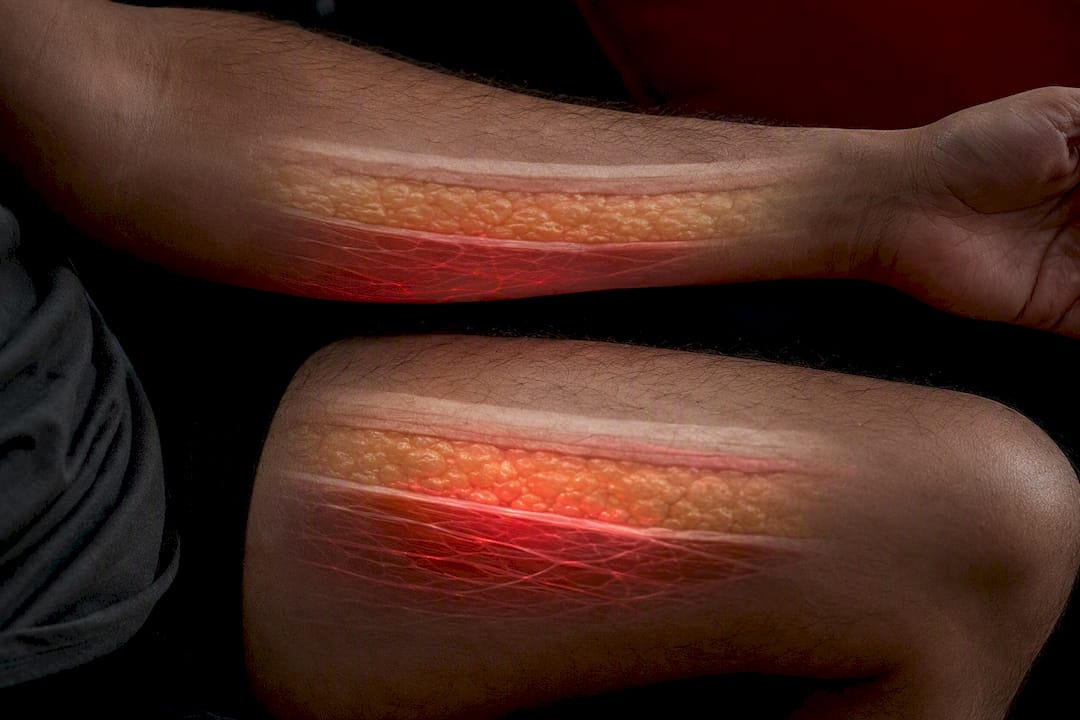
Melanin absorbs light before it reaches deeper tissue. Darker skin tones absorb more light at the surface, which means the effective dose reaching deeper layers is lower for the same device output. This isn't a reason to avoid red light therapy, but it's a reason to expect slightly different results across skin tones at identical settings.
Subcutaneous fat is the biggest deep-tissue variable nobody talks about. A thicker fat layer between skin and muscle absorbs and scatters more 850nm light before it reaches the joint or muscle underneath. If you're targeting a knee or shoulder with more tissue coverage, you may need closer positioning or a stronger device to get a meaningful dose to the target.
Device power output determines whether "invisible" means "ineffective" or just "working quietly." This is the misconception that trips up the most buyers: 850nm is nearly invisible to the human eye, so it's easy to assume a panel isn't doing anything. Experienced practitioners will tell you the opposite. Judging effectiveness by glow is backwards. A dim panel with strong measured irradiance will outperform a blinding panel with weak specs every time.
Pro Tip: Ignore how bright a panel looks. Ask for the irradiance number in mW/cm² at a stated distance, and ask if there's an independent spectral test report. That number tells you what's actually reaching your skin, not what your eyes perceive.
Quick checklist for matching wavelength to target:
- Surface skin concern → prioritize 660nm, shorter distance is fine
- Joint or muscle depth → prioritize 850nm, closer positioning helps offset fat and tissue depth
- Darker skin tone → slightly longer sessions or closer distance may help reach equivalent dose
- Uncertain or mixed goals → dual-wavelength device, alternate or run both depending on the day's focus
When Should You Use 660nm, 850nm, or Both?
Most men don't have one clean goal. You want your skin to hold up, and you want your knees to stop complaining on leg day. Here's how to decide without overthinking it.
- Skin-only goals (tone, fine lines, healing a specific area): stick with 660nm. There's no benefit to adding 850nm if your concern never leaves the surface.
- Deep-tissue-only goals (joint stiffness, muscle recovery, tendon issues): prioritize 850nm. Red light won't hurt, but it won't do much either at that depth.
- Mixed or uncertain goals, which describes most men over 30 managing both energy and physical wear: a dual-wavelength setup is the practical default. Multiple consumer and clinical wavelength guides point to this as the most common recommendation for exactly this reason, most people aren't dealing with one isolated issue.
A few real scenarios make this concrete. Facial rejuvenation calls for 660nm alone, run close to the face for shorter sessions. Knee arthritis or chronic joint stiffness calls for 850nm, positioned directly over the joint for a longer session. A recovery-plus-skin routine, the kind most men over 30 actually want, calls for both wavelengths run in sequence or simultaneously if the device supports it.
If you're stuck with a single-wavelength device already, prioritize based on what's actually bothering you daily. Chronic joint ache wins over cosmetic concerns nine times out of ten, simply because function matters more than appearance when you're the one living in that body.
How Do You Set Session Length and Dosage?
Two numbers control everything about your session: irradiance, measured in milliwatts per square centimeter (mW/cm²), and dose, measured in joules per square centimeter (J/cm²). Irradiance is how strong the light is at a given distance. Dose is how much total energy your skin absorbs over the session, and it's simply irradiance multiplied by time.
This matters because a weak panel held close for a long time can deliver the same dose as a strong panel held further away for a short time. Practical PBM guidance confirms that knowing both numbers, not just one, is what determines an effective session.
Sample consumer-friendly starting points:
- Skin-focused 660nm sessions: shorter duration, closer distance, typically in the range most home devices are designed around at their stated distance
- Deep-tissue 850nm sessions: slightly longer duration or closer positioning to offset tissue depth and fat coverage
- Either wavelength: consistency across days matters more than pushing one marathon session
Statistic Callout: The Cleveland Clinic is direct about this: benefits depend on consistent, long-term application, not single sessions. One 40-minute session won't outperform ten consistent 10-minute sessions.
When you're reading a device's spec sheet, look for irradiance stated at a specific distance (not just a peak number with no context), an independent spectral test report showing actual wavelength output, and clear toggles if it's a dual-wavelength unit. If none of that is listed, that's information the manufacturer chose not to give you.
Is Red Light Therapy Safe for Your Eyes and Skin?
Both wavelengths are non-ionizing, meaning they don't carry the cancer risk associated with UV or X-ray exposure. The real risk with either wavelength is thermal, overexposure or too-close positioning can cause skin warmth or irritation, not the wavelength itself being dangerous.
Safety essentials to keep in mind:
- Wear proper eye protection for close-face sessions, especially with 660nm, since visible red light can strain the eyes with prolonged direct exposure
- 850nm is invisible, which makes it easy to underestimate, don't stare directly at panels even when you can't see the light clearly
- If you take photosensitizing medications or have a diagnosed skin or eye condition, check with your doctor before starting a routine
- Stop and seek medical advice if you notice unusual burning, prolonged redness, or any reaction that doesn't resolve shortly after a session
Full details on contraindications and edge cases are worth reading before you start, not after something feels off. Primal Red Co has a deeper breakdown of side effects worth bookmarking.
What Specs and Red Flags Should You Check Before Buying?
A trustworthy device tells you exactly what it does. A vague one hopes you won't ask.
Non-negotiable specs to look for:
- Explicit wavelengths listed as numbers, 660nm and 850nm, not vague terms like "red and infrared spectrum"
- Irradiance values stated at a specific distance, not just a peak number with no context
- An independent spectral test report confirming actual output matches advertised wavelengths
- Named LED chip brands, when available, since this is where quality control differences show up
Red flags that should make you walk away: vague spec sheets, zero spectral data, claims that sound more like miracle cures than supportive tools, and no eye-safety guidance included anywhere in the product materials.
Pro Tip: A clinic-level breakdown of how LED light therapy works on skin is a useful gut check against marketing copy, if a product's claims don't line up with what independent clinical sources describe, that's your answer.
For a deeper dive into device selection, Primal Red Co's guide on choosing red light devices for men over 30 covers this in more detail.
Expert Notes From Nurse Rachel: What Practitioners Actually Watch For
Consistency beats intensity every time. I tell men to track three things: the distance they're sitting from the panel, how many sessions per week they're actually completing (not planning), and whether they're seeing functional change, not just checking a box. Surface skin changes take roughly two to three months. Deep tissue relief often shows up faster, sometimes within a few weeks, if the routine stays steady.
Integrating Wavelength Choice Into Your Restoration Routine
The wavelength you pick matters less than whether you actually show up for it. Pair your sessions with training days and decent sleep, not as a replacement for either. Consistency over months beats one intense week every time. And if something feels bigger than a light panel can handle, joint pain that won't quit, energy that's cratered, talk to a doctor. That's not weakness. That's strategy.
Why RedRockit Covers Both Sides of This Comparison
You don't have to choose between a 660nm panel and an 850nm panel, or own two devices to cover skin and deep tissue separately. RedRockit runs both wavelengths in one unit, built specifically for men who need surface repair and deep recovery without managing multiple gadgets.

The Rockit IQ companion app takes the guesswork out of session length and frequency, guiding you through protocols instead of leaving you to calculate irradiance and dose on your own. That structure is what turns a device into an actual routine, and routine is what produces results, not the occasional session when you remember. Primal Red Co built RedRockit for men over 30 who want to stay ahead of the shift instead of reacting to it after the fact. If you're ready to see how this fits into your own restoration routine, explore what RedRockit supports for vitality after 40 and see where you'd start.
Sources
- Red light therapy — Cleveland Clinic
- Photobiomodulation review (PMC)
- Photobiomodulation response from 660 nm is different and more durable than that from 980 nm - Wiley (2021)
- UCLA Health: 5 health benefits of red light therapy