
Most red light therapy dosage falls in a therapeutic window per treatment area, with multiple sessions per week for most goals. Your next move isn't guessing at minutes. It's finding your device's irradiance in mW/cm² and running one simple calculation. Skip that step and you're either wasting time under-dosing or, less obviously, overdosing past the point where more light stops helping and starts working against you.
TL;DR:
- Red light therapy doses should be based on measured irradiance at a specific distance, using the formula: time (seconds) = dose (J/cm²) × 1000 ÷ irradiance (mW/cm²).
- Effective doses typically range from 10 to 30 J/cm² for skin and face, 20 to 30 J/cm² for scalp, and up to 60 J/cm² for deep tissue, with wound healing requiring only 4 to 10 J/cm² daily.
- Exceeding roughly 60 J/cm² can inhibit cellular activity due to a biphasic dose response, mainly caused by excessive reactive oxygen species production.
- Longer sessions at a fixed irradiance can push doses into inhibitory territory; shorter, more frequent sessions often yield better results.
- Consistent measurement, calculation, tracking, and adherence to dose ranges optimize benefits and avoid diminishing returns or adverse effects.
Table of Contents
- What Is the Right Red Light Therapy Dosage for Your Goals?
- How Do You Calculate the Dosage Formula for Red Light Therapy?
- What Is the Therapeutic Window and Why Can More Light Hurt?
- How Do You Calculate Session Time From Your Device's Output?
- What Are the Best Dosing Protocols for Skin, Hair, Muscle, and Joints?
- How Often Should You Do Red Light Therapy and Track Results?
- How Do You Measure and Position Your Device for Accurate Dosing?
- What Side Effects Should You Watch For and When Should You See a Doctor?
- Who Is Behind This Guide and What Expertise Backs It?
- The Editorial Take
- A Practical Next Step for Guided, Trackable Dosing
- Where This Dosing Guidance Comes From
- Sources
What Is the Right Red Light Therapy Dosage for Your Goals?
Your body doesn't care how long you stood in front of a panel. It cares how much energy actually landed on your skin, measured in joules per square centimeter (J/cm²). That's the real currency of red light therapy dosage, and it's the number every serious protocol is built around.
Here's the quick-reference version, pulled from published PBM dosing tables and clinical guides that treat dose the way a strength coach treats load: precise, not vibes-based.
- Skin and complexion: 10 to 30 J/cm² per session, 3 to 5 times a week
- Hair and scalp: roughly 20 to 30 J/cm² per session, 3 to 4 times a week
- Muscle recovery: 20 to 60 J/cm² per muscle group, timed around training
- Joint pain and stiffness: condition-specific, often multiple lower doses spread across points around the joint
- Wound healing: 4 to 10 J/cm² per point, frequently daily during the acute phase
Frequency typically involves starting conservatively with more frequent sessions initially, then moving to consistent dosing a few times per week, and eventually maintaining with fewer sessions weekly as results stabilize.
The table provides examples of how a target dose might translate into minutes based on device irradiance. This is the exact relationship LightTherapyIQ's dosing guide walks through, and it's the single most useful number you'll pull from this article.
| Device Irradiance | Approximate Time for 10 J/cm² | Approximate Time for 20 J/cm² | Approximate Time for 30 J/cm² |
|---|---|---|---|
| 30 mW/cm² | about 5 and a half minutes | about 8 minutes | about 13 minutes |
| 75 mW/cm² | roughly 3 and a third minutes | roughly 6 and a half minutes | about 10 minutes |
| 100 mW/cm² | around 1 minute 40 seconds | around 3 minutes 20 seconds | 5 minutes |
Notice the pattern: double the irradiance, cut the time in half. That's not a coincidence. That's the entire formula, which we'll break down next.
How Do You Calculate the Dosage Formula for Red Light Therapy?
The formula is short enough to memorize in one read:
Dose (J/cm²) = Irradiance (mW/cm²) × Time (seconds) ÷ 1000
That's it. No calculus, no lab coat required. Rearrange it and you get the version you'll actually use at home: Time (seconds) = Dose (J/cm²) × 1000 ÷ Irradiance (mW/cm²).
Here's where most men get tripped up, and it has nothing to do with the math itself:
- Confusing milliwatts with watts. A device rated at "100 watts" of panel power is not delivering 100,000 mW/cm² to your skin. That's total electrical draw, not irradiance at your body. Irradiance is what a sensor reads at a specific distance from the panel, and it's almost always a small fraction of the panel's rated wattage.
- Mixing seconds and minutes mid-calculation. The formula runs on seconds. If you plug in "10 minutes" instead of "600 seconds," your dose estimate will be off by a factor of 60, which is the difference between an effective session and a wasted one.
- Ignoring distance. Irradiance drops fast as you move away from the light source, following an inverse-square pattern. A panel that reads 100 mW/cm² at 6 inches might read closer to 40 mW/cm² at 12 inches. If your irradiance number wasn't measured at the distance you're actually treating from, your dose calculation is fiction.
Beam geometry matters too. A tightly focused LED array delivers different irradiance than a diffuse panel of the same wattage, even at identical distances. This is why manufacturer wattage isn't a reliable stand in for measured irradiance at your skin.
Pro Tip: Keep a small note on your phone with your device's measured irradiance at your usual treatment distance. Every future session becomes a 10-second math problem instead of a guessing game.
What Is the Therapeutic Window and Why Can More Light Hurt?
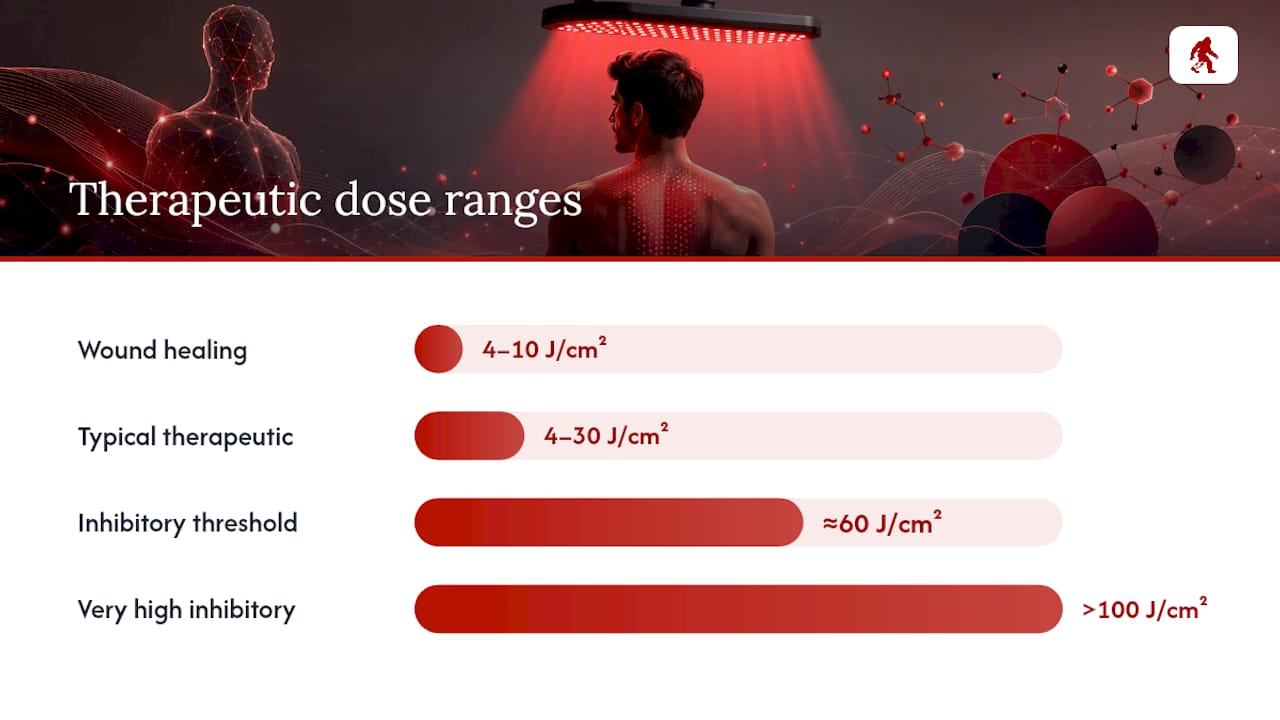
The evidence-backed range for red light therapy dosage sits between roughly 4 and 30 J/cm² for most conditions, according to the PBM dose canonical table, which compiles effective doses across 27 different clinical applications. Wound healing sits at the low end (4 to 10 J/cm²). Deep tissue and joint work sit at the higher end, sometimes pushing toward 60 J/cm² because light attenuates as it passes through skin, fat, and muscle before it reaches the target.
Here's the part conventional wellness marketing conveniently skips: more is not better. Photobiomodulation follows a biphasic dose response, sometimes called the Arndt-Schulz relationship. Low to moderate doses stimulate cellular activity. Push past a threshold, and the same light source starts inhibiting the exact processes you're trying to support.
- Doses in the 4 to 30 J/cm² range consistently show stimulatory effects across the majority of published protocols
- Doses climbing above roughly 60 J/cm² are linked to reduced or reversed benefit in multiple studies
- Very high surface fluences, sometimes exceeding 100 J/cm², show inhibitory effects on cell proliferation in lab settings and some human protocols, per analysis of the biphasic dose response
A dose above roughly 60 J/cm² is where the biological curve tends to bend backward on many outcomes, turning a helpful signal into one your cells actively resist.
Why does this happen? The leading explanation involves reactive oxygen species (ROS), small molecules your mitochondria produce in response to light exposure. A little ROS acts as a signal that triggers repair and energy production. Too much starts to look like oxidative stress instead of a helpful nudge, and your cells respond by dialing back rather than ramping up.
This is the practical trap hiding in a lot of "more is better" thinking about at-home devices. If your panel irradiance and session duration combine to a high total dose, you might exceed the upper end of effective therapeutic windows. One analysis of common consumer routines found that typical "15 to 20 minute" facial sessions at consumer irradiance levels often land users well into inhibitory territory without them realizing it. The fix isn't complicated. It's shorter sessions at the same irradiance, not longer ones.
Individual response still varies. One Stanford Medicine overview of photobiomodulation evidence notes that while specific niches like wound healing and hair loss protocols have solid backing, broader wellness claims remain under active study. Treat the published windows as a starting guardrail, then track your own response and adjust from there rather than assuming one universal number works for everybody.
How Do You Calculate Session Time From Your Device's Output?
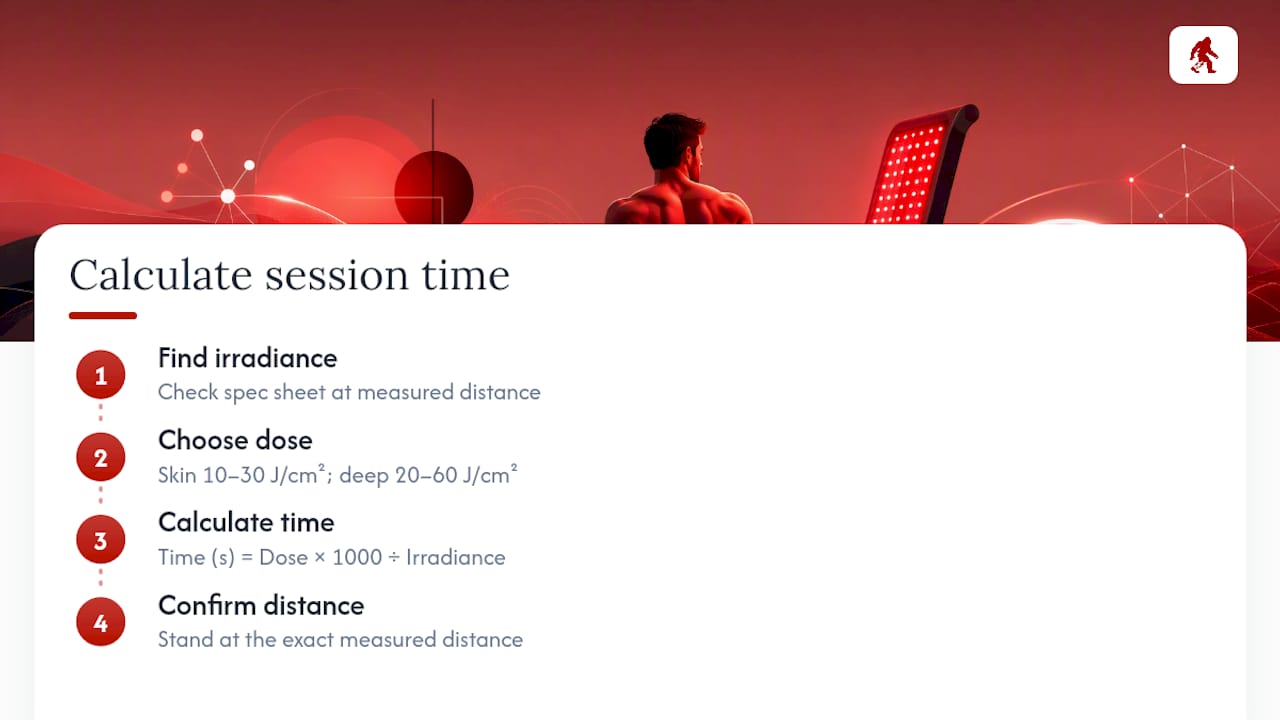
Once you have your device's measured irradiance, calculating session time takes four steps.
Step 1: Find your irradiance. Check the manufacturer's spec sheet for a number listed at a specific distance, ideally backed by third-party testing rather than marketing copy alone.
Step 2: Choose your target dose. Pull a number from the ranges above based on your goal, skin at 10 to 30 J/cm², and deep tissue at 20 to 60 J/cm².
Step 3: Calculate time. Time (seconds) = Dose × 1000 ÷ Irradiance.
Step 4: Confirm your distance. Position yourself at the exact distance the irradiance was measured, or your calculation is meaningless.
Here's how that plays out across common consumer device outputs:
Say your panel reads 75 mW/cm² at 6 inches and your goal is muscle recovery at 30 J/cm². Run the formula: 30 × 1000 ÷ 75 = 400 seconds, or 6 minutes and 40 seconds. That's your session, full stop, assuming you're standing at 6 inches and not 12.
If all you have is panel wattage with no measured irradiance figure, don't estimate blindly. Reach out to the manufacturer for third-party test data, or use a handheld light meter if you have access to one. Irradiance figures based on panel wattage alone are notoriously unreliable, and treating a guess as a fact is how men accidentally drift into the overdose range described above.
Pro Tip: Round down, not up, when your irradiance number falls between two rows on a chart like this. A slightly shorter session that undershoots your target by a minute costs you almost nothing. A session that overshoots into inhibitory territory costs you the whole point of showing up.
What Are the Best Dosing Protocols for Skin, Hair, Muscle, and Joints?
Generic advice treats every part of the body the same. That's a mistake, because light attenuates differently depending on how much tissue it has to pass through, and different conditions respond to different exposure windows.
Skin and complexion
Facial skin is thin and close to the surface, which means it needs less energy than deep tissue to get a response. Most protocols land between 10 and 30 J/cm² per session, run 3 to 5 times a week. Start at the lower end, especially on facial skin, and increase only if you're not seeing irritation or dryness after two to three weeks. A man treating his face at 10 J/cm² for 20 minutes because "more must be better" is very likely pushing well past what his skin needs and into the range where the response starts working against him.
Hair and scalp
Hair follicle stimulation protocols typically run higher than facial skin work, often in the 20 to 30 J/cm² range per session, 3 to 4 times weekly, sustained over several months. Scalp coverage matters more here than in almost any other application, since a follicle that never gets exposed doesn't respond no matter how strong the device is. If you're using a cap or helmet-style device, check that the coverage pattern actually reaches your problem areas, not just the crown. Pairing a light-based scalp routine with a topical support product like Splendora's hair loss prevention serum is a common stacking approach, since the two work through different mechanisms rather than competing for the same biological pathway.
Muscle recovery
Muscle sits deeper than skin, so it needs more light energy to reach the target, generally 20 to 60 J/cm² per muscle group or cluster. Timing matters almost as much as dose here. Treating within a few hours after training, when the tissue is already in an active repair state, tends to align better with how photobiomodulation is thought to support recovery than treating on a rest day disconnected from any training stimulus.
Joint pain and stiffness
Joints are trickier because a single point of light rarely covers the whole structure. The Hale PBM canonical table and similar WALT-aligned compendia recommend treating multiple points around a joint rather than one frontal application, since surrounding tissue and the joint capsule itself both benefit from coverage. Deeper joints, like the knee or hip, tend to need higher per-point doses than something closer to the surface, like a knuckle or wrist.
Wound healing
This is the application with the strongest research backing, and it runs on the lowest doses in this entire guide: 4 to 10 J/cm² per point, often applied daily during the acute healing phase. A peer-reviewed review of photobiomodulation trials supports this lower-dose, higher-frequency pattern specifically for wound outcomes, which is a useful reminder that "more sessions at a lower dose" beats "fewer sessions at a high dose" for tissue that's actively trying to close and repair.
How Often Should You Do Red Light Therapy and Track Results?
Structure beats improvisation here. Three phases cover nearly every use case:
- Acute phase (weeks 1 to 2): Start at the lower end of your target dose range, 4 to 6 sessions a week and pay close attention to how your skin or the treated area responds.
- Active phase (weeks 3 to 8, depending on the goal): Settle into your full target dose, 3 to 5 sessions weekly, and hold steady rather than increasing dose just because you're not seeing instant results.
- Maintenance phase (ongoing): Drop to 2 to 3 sessions weekly once you've hit your target outcome, using dose to sustain rather than push further gains.
Clinician guidance from Dr. Michael Ruscio frames this the same way you'd think about exercise: consistent moderate sessions beat occasional marathon ones, and most conditions show meaningful change over weeks to months, not days. Skin changes often show up in 4 to 8 weeks. Hair and joint protocols tend to run longer, sometimes 3 to 6 months before you can honestly judge whether it's working.
Tracking doesn't need to be complicated. A simple log covering five fields does the job:
- Date and dose (J/cm²) delivered
- Area treated
- Session frequency that week
- Subjective outcome (energy, skin texture, pain level, whatever you're tracking)
- Any side effects noticed (redness, dryness, fatigue)
Four weeks of that log tells you more about your personal response than any generic protocol ever could, because it's your data, not a study average.
How Do You Measure and Position Your Device for Accurate Dosing?
Every dose calculation is only as good as the irradiance number feeding it. Three sources exist, and they're not equally trustworthy:
- Manufacturer specs: Useful as a starting point, but treat marketing-sheet numbers with some skepticism unless they're backed by independent testing.
- Third-party lab tests: The most reliable option when available, since these are typically measured at a fixed distance under controlled conditions.
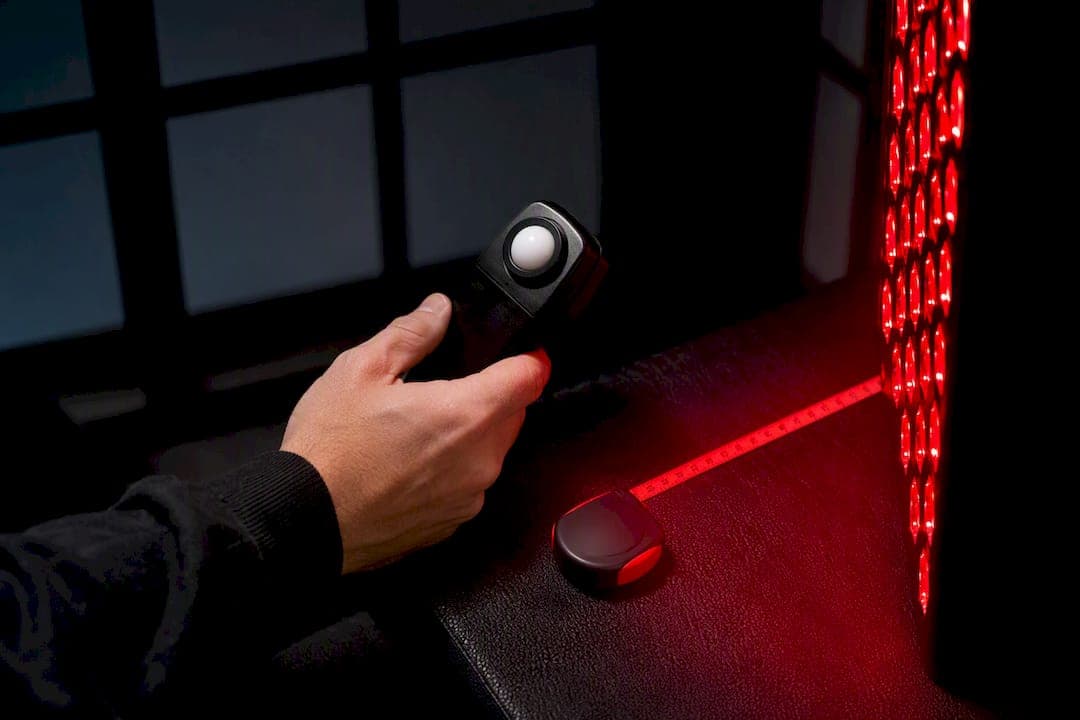
- Handheld light meters: The gold standard for verifying irradiance yourself, though not every household has one on hand.
Distance is where good calculations quietly fall apart. Irradiance drops sharply as you move away from the source, so treating at 12 inches when your number was measured at 6 inches will under-dose you significantly, even though you followed the "right" time on the clock.
- For panels: mark your treatment distance with tape on the floor so you're consistent session to session
- For masks and wraps: these are typically designed for a fixed distance against skin, which removes most of the guesswork
- For caps: check that coverage reaches your actual target areas, not just the dome of the scalp
- If you genuinely cannot get a measured irradiance number, treat conservatively and shorter rather than guessing long
Pro Tip: A cheap luxmeter isn't the same as a proper irradiance meter, but if a manufacturer or third-party source provides a measured mW/cm² figure at a stated distance, that single number is worth more than any amount of visual brightness comparison you could do yourself. For more on setup specifics by device type, Primal Red Co's home red light therapy guide breaks down how device specs translate into real-world dosing.
What Side Effects Should You Watch For and When Should You See a Doctor?
Red light therapy carries a favorable safety profile at appropriate doses, but "safe" doesn't mean "no rules." A few matters more than the rest.
- Wear proper eye protection during panel sessions, especially with higher-irradiance devices; read Primal Red Co's eye safety guidance before your first session with a new device
- Mild redness or warmth right after a session is normal and usually resolves within an hour
- Persistent irritation, unusual fatigue, or skin changes that don't settle within a day suggest you're overdosing, not undertreating; cut your dose and add rest days before doing anything else
- Photosensitizing medications (certain antibiotics, acne treatments, some antidepressants) can change how your skin responds to light exposure, so check with a pharmacist or doctor before starting
- Active skin infections or open wounds beyond minor abrasions warrant a conversation with a clinician first, not a default treatment schedule
- Pregnancy isn't a documented contraindication for most photobiomodulation use, but a quick check with your doctor is a reasonable precaution given limited research in that population
If you're already managing a diagnosed condition, especially something involving photosensitivity or an active skin disorder, loop in your doctor before adding red light therapy to your routine. For a deeper breakdown of what irritation looks like and how to dial dose back, Primal Red Co's side effects guide covers the specifics.
Who Is Behind This Guide and What Expertise Backs It?
This dosing framework was built because too many men buy a red light panel, stand in front of it for whatever amount of time feels right, and never get an answer to the one question that actually matters: is this dose doing anything? The approach is shaped around teaching men to understand their own biology instead of outsourcing every decision to a clinic.
That philosophy shows up directly in a companion app, which maps dose targets like the ranges covered above into guided presets instead of leaving men to run the math themselves every session. It's worth being direct about the gap here too: published author credentials and independent case studies would strengthen the confidence behind these protocols further, and that's an area worth continued transparency as the brand grows.
The Editorial Take
Most red light therapy advice fails men in one specific way: it treats dose as an afterthought behind marketing claims about wavelength or panel size. The math matters more than either. A weak device run at the correct dose beats a powerful one run blind, every time.
Where conventional advice really falls short is the assumption that longer sessions signal more commitment, more seriousness, more results. The biphasic response says otherwise. Men chasing results by adding minutes are frequently working against their own biology, not toward it.
Prioritize this in order: measure your irradiance first, calculate your time second, track your outcome third. Skip step one and everything downstream is a guess dressed up as a protocol. That's not a small distinction. It's the entire difference between a routine that works and one that just feels like it should.
— Nurse Rachel
A Practical Next Step for Guided, Trackable Dosing
Running the dose formula by hand every session works, but it's one more thing competing for your attention on a day that's already full. RedRockit's Activation Method handles the calculation for you, with guided presets built around the same J/cm² ranges covered throughout this guide, from lighter facial settings to deeper recovery-focused sessions.

The presets don't replace the math, they encode it, so a face setting lands closer to that 10 to 30 J/cm² window while a recovery setting pushes toward the higher end appropriate for muscle and joint work. The companion app logs your sessions automatically, which solves the tracking problem covered earlier without a separate notebook or spreadsheet. If you're the kind of man who wants a straightforward, measurable routine rather than a recalculated guess every time you step in front of a panel, check out the RedRockit Activation Method and see which preset matches where you're starting from.
Where This Dosing Guidance Comes From
This guide draws on the Hale PBM canonical dose table covering effective ranges across 27 clinical applications, LightTherapyIQ's dosing and calculation guide for the irradiance-to-time formula, SeekRedLight's condition-by-condition timing guide for frequency norms, and a peer-reviewed photobiomodulation review supporting wound healing and pain outcomes. Each source backs a specific claim made above, from the therapeutic window to the biphasic risk of overdosing.
This article is general information, not a substitute for advice from a qualified doctor. Consult a qualified healthcare professional about your own circumstances before acting on anything here.
Sources
- Red Light Therapy Dosing Guide: How to Calculate J/cm² | LightTherapyIQ
- Representative photobiomodulation review (PMC3926176)