
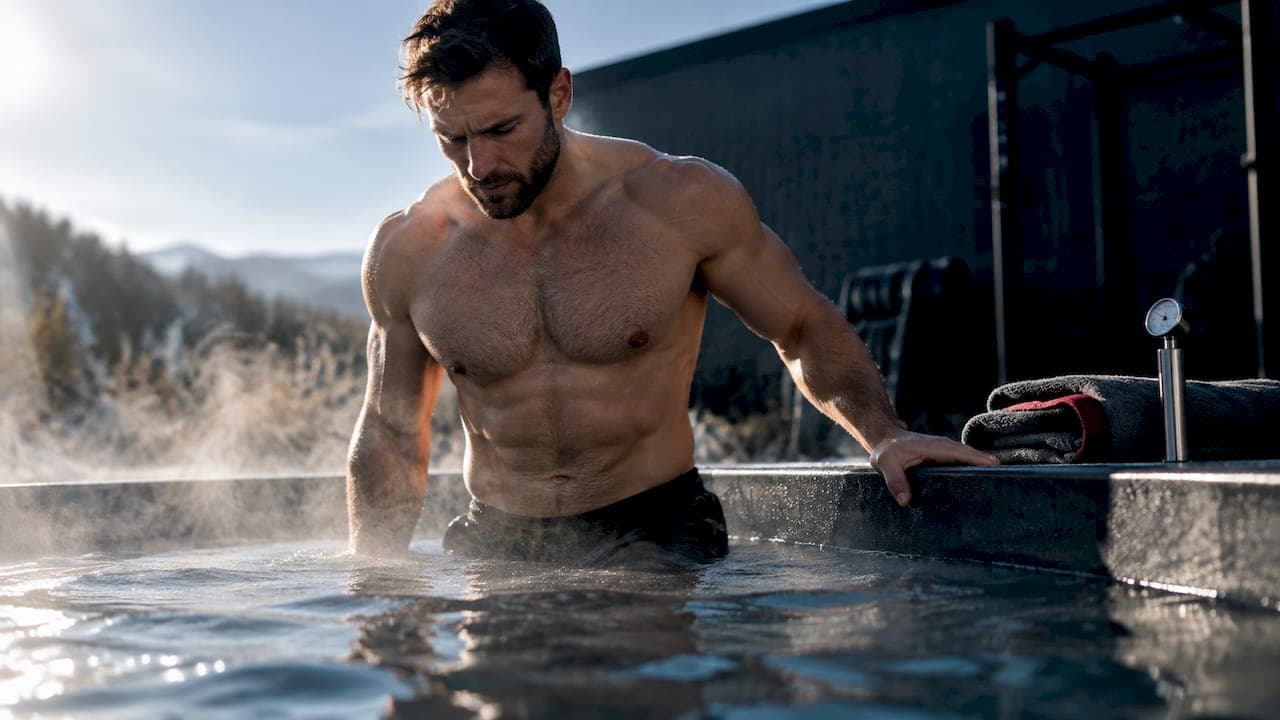
Short answer: cold exposure alone does not reliably raise testosterone. A handful of specific cold-plus-exercise protocols show delayed, modest increases days later, but plain cold showers or ice baths by themselves mostly show no change or a temporary dip. If you're chasing a hormonal edge, treat cold exposure as a small experiment, not a strategy. Check baseline labs first and put your real energy into sleep, training, and weight management.
TL;DR:
- Cold exposure alone, especially short cold showers, generally does not cause significant or lasting increases in testosterone levels.
- Delayed testosterone boosts, around 56%, have only been observed in small studies after repeated cold plus exercise protocols, measured a week later.
- Cold immediately after resistance training can blunt the usual hormonal boost, highlighting that timing and context are crucial.
- Small sample sizes, varying measurement methods, and inconsistent protocols explain why research results are scattered and inconclusive.
- For hormonal benefits, focus on sleep, resistance training, and weight management, while treating cold exposure as a minor supplementary tool.
Table of Contents
- What the Human Evidence on Cold Exposure and Testosterone Says
- Why Would Cold Exposure Affect Testosterone at All?
- The Studies Behind the Headlines
- How to Experiment With Cold Exposure Without Wasting Your Time
- Who Should Be Careful With Cold Exposure
- A Nurse's Take on Cold Exposure for Men Over 30
- Editorial Perspective: What Men Actually Need to Hear About Cold Exposure
- Where RedRockit Fits Into a Cold Exposure Routine
- Sources
- FAQ
What the Human Evidence on Cold Exposure and Testosterone Says
The research on ice baths, testosterone, and cold showers splits into three rough camps, and none of them hands you a clean "yes, this works" answer.
Camp one: short cold showers, mostly nothing. In an 11-man athlete study using four days of 10-minute cold showers at 17°C, salivary testosterone bounced around at the individual level but showed no statistically significant change across the group. Some men's numbers went up. Some went down. The average landed close to flat.
Camp two: repeated cold plus exercise, delayed gains. A 5-day outdoor exercise protocol conducted in 2°C to 3°C air found no immediate hormone shift right after the sessions. A week later, total plasma testosterone was up 56%, alongside a 54% jump in cortisol, in a small cohort of healthy male athletes.
Camp three: cold immediately after lifting, blunted response. When cold water immersion follows resistance training, it blunts and delays the testosterone and cytokine bump that normally follows a hard lifting session, compared with passive recovery. Timing changes the outcome entirely.
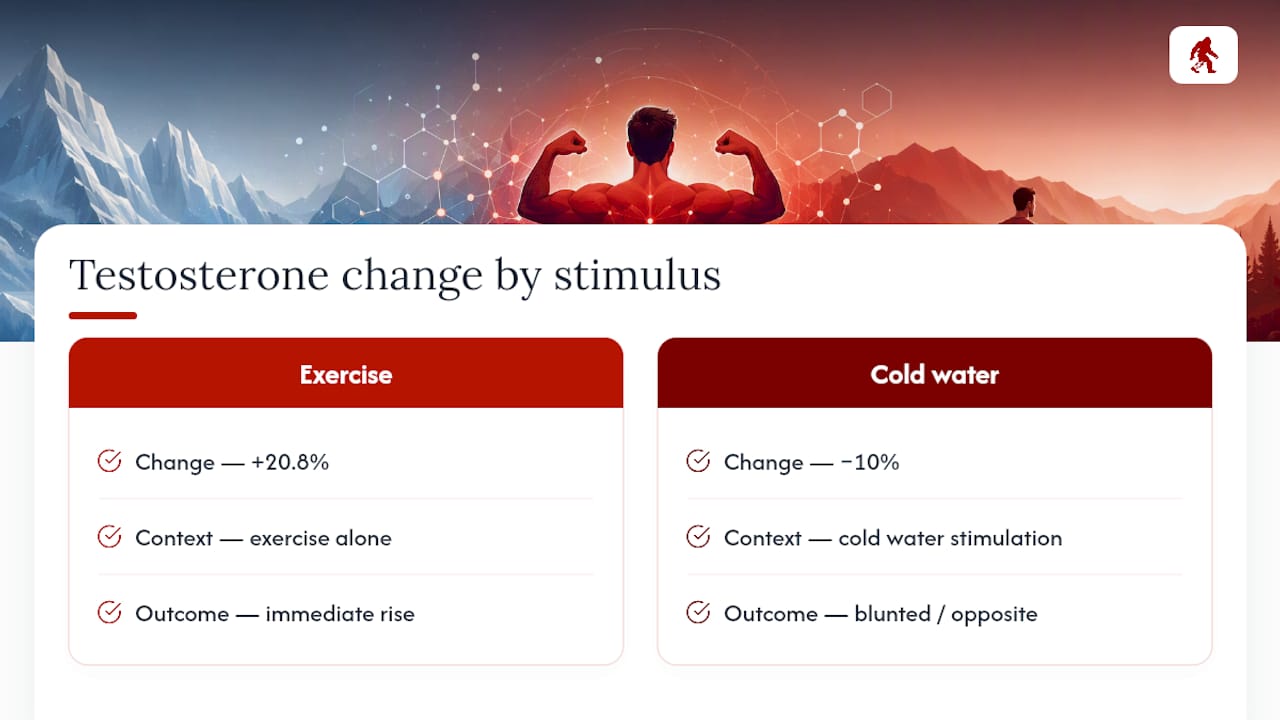
That third pattern gets confirmed in older literature too. One controlled trial found that exercise alone raised serum testosterone by about 20.8%, while cold water stimulation in the same protocol dropped testosterone by roughly 10%. Same men, same lab, opposite direction, depending on what stimulus hit their system.
Why these studies disagree so much
A few structural issues explain the scattered findings:
- Sample sizes are small. Most of these trials run 11 to 20 men. That's enough to spot a pattern worth studying further, not enough to declare a universal rule.
- Measurement methods differ. Salivary testosterone and plasma testosterone don't always move together, and timing relative to exercise, plus circadian swings, adds noise that a single blood draw can't sort out.
- Cold dose varies wildly. A 60-second cold shower at 17°C is a different stimulus than a 15-minute plunge at 10°C, yet both get lumped under "cold exposure" in casual conversation.
- Timing relative to training matters. Cold applied right after resistance work behaves differently than cold applied on its own, or cold paired with exercise over multiple days.
- Recovery windows differ. Some studies measure minutes after exposure. Others wait a full week. The 56% jump mentioned above only shows up seven days out, not immediately.
Here's the number that should anchor your expectations: across the trials reviewed here, the acute (same-day) testosterone response to cold exposure alone hovers between no change and a modest decrease, while the delayed response after repeated cold-plus-exercise protocols showed a 56% increase measured a full week later in one small study. Those are two different biological events wearing the same name.
Heterogeneity is the honest word for what's going on here. Different protocols, different populations (mostly young male athletes, not the broader population of men over 30), and different measurement windows make it nearly impossible to draw one tidy conclusion. Any article that tells you "cold showers boost testosterone by X" full stop is skipping past all of this. The real picture is more interesting and more useful: cold exposure interacts with your training, your recovery timing, and your individual stress response in ways that vary from man to man.
Why Would Cold Exposure Affect Testosterone at All?
The plausible mechanisms fall into four buckets, and understanding them explains why the studies above pull in different directions.
Testicular temperature regulation. Your testes hang outside the body cavity for a reason: Leydig cells, which produce testosterone, and the spermatogenic tissue around them function best a few degrees cooler than core body temperature. That's basic reproductive physiology, not a cold exposure trend. Brief cold exposure to the skin doesn't meaningfully change testicular temperature the way, say, tight underwear or a hot tub session might raise it. This mechanism matters more for sperm quality than for a testosterone number on a lab report.
Sympathetic activation and norepinephrine. Cold hits your skin and your sympathetic nervous system fires immediately, dumping norepinephrine into your bloodstream. That's the "gasp and clench" feeling you get stepping into a cold shower. This acute stress response is short-lived, but it runs alongside a cortisol bump, and cortisol and testosterone often move in opposite directions when the body is under any kind of physical stress.
The HPG axis and LH timing. Testosterone production depends on a signal chain: your hypothalamus sends a message, your pituitary releases luteinizing hormone (LH), and LH tells your testes to produce testosterone. That older 1970s-era study measuring cold stimulation found LH and noradrenaline shifted differently depending on whether men were exposed to exercise versus cold water, suggesting the timing of that signal chain gets disrupted by cold in a way that's distinct from exercise-driven signaling.
Exercise changes everything. This is the piece most men miss. Cold exposure on its own is one stimulus. Cold layered onto exercise is a completely different physiological event, and the order matters. Cold immediately after lifting appears to blunt the natural post-workout testosterone rise, likely because the vasoconstriction and stress response interfere with the anabolic signaling that normally follows resistance training. Cold applied across several days alongside exercise, separated from the training session itself, showed the opposite: a delayed increase measured a week later. Same tool, opposite effect, depending on sequencing.
The Studies Behind the Headlines
Here's what the actual research looked like, stripped down to what matters: who was tested, what they did, what got measured, and where the study falls short.
- The 5-day cold-plus-exercise protocol. Healthy male athletes trained outdoors in 2°C to 3°C for five days. Plasma testosterone showed no immediate change but rose 56%, alongside a 54% cortisol increase, when measured seven days later. Limitation: small athletic cohort, and the paired cortisol spike means this isn't a clean "testosterone went up" story. It's a stress-adaptation story that happens to include a testosterone increase.
- The 4-day cold shower trial. Eleven male athletes took 10-minute showers at 17°C for four days. Salivary testosterone was measured within 24 hours of the final session. Result: individual variability, no significant group-level change. Limitation: tiny sample, short duration, and salivary measurement can diverge from plasma readings.
- Cold water immersion after resistance exercise. Resistance-trained men underwent 15 minutes of cold water immersion at 15°C immediately following a lifting session. The testosterone and cytokine response that normally follows resistance training was blunted and delayed compared to passive recovery. Limitation: this only tells you about immediate post-exercise timing, not cold exposure used independently of training.
- The older cold-stimulation trial. Young men (around 19 years old) underwent bicycle ergometer exercise and separate cold water stimulation, with serum hormones measured around each. Exercise raised testosterone about 20.8%; cold stimulation dropped it about 10% in that same protocol. Limitation: an older study, narrow age range, and serum measurement windows that modern trials would likely design differently.
Line these four up and a pattern emerges: acute, isolated cold exposure tends toward null or slightly negative effects. Repeated cold exposure combined with exercise, given time to resolve, tends toward a delayed positive shift, at least in small athletic samples. Nobody has run a large trial in ordinary men over 30 who aren't competitive athletes, and that gap matters if you're the guy reading this on your phone after a long week.
How to Experiment With Cold Exposure Without Wasting Your Time
Set your expectations before you set the shower temperature. Based on what the trials above show, direct testosterone gains from cold exposure alone are likely to be small, inconsistent, or nonexistent. What tends to be more reliable: better mood, sharper focus, and improved perceived recovery. Those benefits are worth having on their own, even without a hormonal bump attached.
If you want to try it anyway, here's a sane way to structure it:
- Start with 30 to 60 seconds of cold water at the end of your normal shower. Don't jump straight to an ice bath.
- Progress slowly to 2 to 5 minutes over several weeks if you tolerate it well and want to keep going.
- Avoid cold immersion immediately after heavy resistance training if muscle growth is your main goal. The research above suggests it can blunt the anabolic response you're training for. Save the cold plunge for a rest day or a separate part of your day.
- Get medical clearance before any ice bath protocol, especially if you're over 40 or have any cardiovascular history.
- Track a baseline with a morning blood draw for total and free testosterone, then repeat the test under the same conditions (same time of day, same fasting state) 2 to 4 weeks later. One test is a snapshot. Two tests, done the same way, start to show you a trend. Our guide on normal testosterone levels walks through what those numbers actually mean.
Pro Tip: Don't chase a single lab result. Testosterone naturally fluctuates day to day based on sleep, stress, and even the time your blood was drawn. If your number looks low, retest under identical conditions before you draw any conclusions.
Cold exposure works best as a minor add-on to a program built around the drivers that actually move the needle: consistent sleep, resistance training two to four times a week, a manageable body weight, and stress that isn't constant. If you're serious about the full picture, our breakdown on what to try after 40 covers the higher-leverage moves before cold exposure even enters the conversation. Heat-based recovery tools carry their own tradeoffs too. Our sauna and testosterone piece covers the other side of the temperature spectrum if you're curious how heat compares.
Who Should Be Careful With Cold Exposure
Cold water triggers a fast, forceful physiological response: your blood vessels constrict, your heart rate and blood pressure spike, and your breathing gets involuntarily sharp. For most healthy men, that's a manageable jolt. For some men, it's genuinely risky.
Talk to a doctor before trying ice baths or extended cold exposure if you have:
- Coronary artery disease or any history of heart attack
- Uncontrolled high blood pressure
- A history of arrhythmias or irregular heartbeat
- Raynaud's phenomenon with severe ischemia
- A history of fainting or syncope
Practical rules that apply to every man, regardless of health history: start mild, never submerge alone, and stop immediately if you feel chest pain, dizziness, or numbness. And keep the bigger picture in mind. The acute cortisol and norepinephrine spike that comes with cold exposure is normal and temporary. But frequent, extreme cold exposure that keeps cortisol chronically elevated could work against the hormonal goals you're actually after. Moderation isn't a cop-out here. It's the difference between a useful tool and a self-inflicted setback.
A Nurse's Take on Cold Exposure for Men Over 30
Here's the practical read: men come to me wanting a hack, and cold exposure gets sold as one. It isn't. The data above shows real, measurable effects, but they're small, inconsistent, and highly dependent on timing. Before you touch an ice bath, get your sleep and your training dialed in. Those levers move testosterone more reliably than any plunge ever will.
A realistic daily routine looks like this: seven to eight hours of sleep, resistance training three to four days a week, a 60-second cold shower finish if you enjoy it, and a short red light session in the evening to support recovery without adding more stress to a body that's already working hard.
This is education, not diagnosis. If something feels off in your body, a lab test and a conversation with your doctor beats guessing every time.
Editorial Perspective: What Men Actually Need to Hear About Cold Exposure
The evidence supports a boring but honest conclusion: cold exposure is a minor variable, not a lever. The conventional advice men see online treats a 56% testosterone increase like a magic number, without mentioning it showed up a week later, in a tiny sample of athletes, alongside a cortisol spike that complicates the story. That's not deception exactly. It's oversimplification, and oversimplification is what sells cold plunges to men who'd be better served fixing their sleep first.
Where I'd push back hardest: the framing that cold exposure is either "proven" nor "useless." Neither is true. It's a tool with a narrow, conditional benefit that depends entirely on how, when, and how often you use it. Men over 30 don't need another gimmick promising a shortcut. You need a baseline lab test, a training program you'll actually stick with, and the patience to let the slower levers, sleep, resistance work, weight management, do the heavy lifting. Cold exposure can ride along in the passenger seat. It should never be driving.
— Nurse Rachel
Where RedRockit Fits Into a Cold Exposure Routine
This private-use red light wellness device is built for the part of your routine that cold exposure can't touch: consistent, low-stress restoration you can actually stick with on the days your training and sleep need backup.

Think of it this way: cold exposure gives you an unpredictable, occasional jolt. RedRockit gives you a repeatable session, guided through the Rockit IQ app, that supports the kind of steady recovery routine your body needs whether or not the cold plunge worked that week. We're not claiming it moves testosterone directly. We're saying it supports the sleep quality, recovery consistency, and daily restoration habits that actually back your hormonal health over months, not one dramatic week. If you're building a program instead of chasing a single data point, start with the RedRockit activation method and see how it fits into what you're already doing.
This article is general information, not a substitute for advice from a qualified doctor. Consult a qualified healthcare professional about your own circumstances before acting on anything here.
Sources
- Increase in testosterone and cortisol one week after repeated exercise in a cold environment
- A Four‐Day Cold Shower Protocol Does Not Increase Salivary Testosterone in a Small Cohort of Male Athletes: A Research Communication
- Cold-water immersion blunts and delays increases in circulating testosterone and cytokines post-resistance exercise
- Effects of physical exercise and cold stimulation on serum testosterone level in men
FAQ
Does not ejaculating for 7 days increase testosterone?
No consistent evidence supports a meaningful testosterone increase from short-term abstinence. Testosterone naturally fluctuates day to day regardless of ejaculation frequency, and no trial in this article's research supports a 7-day rule.
Why does Gen Z have lower testosterone on average?
Researchers point to a mix of factors, including rising obesity rates, less physical activity, more chronic stress, and changes in sleep patterns across younger generations, rather than any single cause.
Can you smell testosterone on a man?
Not directly. Testosterone itself has no detectable scent, though it can influence body odor indirectly through its effects on sweat composition and skin oil production.
Does testosterone make you feel cold or affect cold tolerance?
Low testosterone is sometimes linked to poor circulation and reduced cold tolerance, but the studies in this article don't show cold exposure itself reliably changing testosterone levels in the short term.
Do ice baths increase testosterone more than cold showers?
Not necessarily. Ice baths use lower temperatures and longer durations than typical cold showers, but neither modality has shown a reliable, immediate testosterone increase in the trials reviewed here. Timing and repetition seem to matter more than temperature alone.