
Sauna does not reliably raise your baseline testosterone. That is the short answer, and it is backed by controlled human trials. What sauna does do is reduce cortisol, support recovery, and create a hormonal environment where your body can do its job better over time. That is not nothing. For men trying to protect their drive and energy after 30, that indirect pathway matters more than most people realize.
A few things to hold onto before you read further:
- Acute sauna sessions do not produce a reliable testosterone spike
- Cortisol tends to drop with repeated use, which indirectly supports hormonal health
- Scrotal heat can temporarily reduce sperm quality; effects are generally reversible
- Regular sessions (roughly 3–4 per week) carry real cardiovascular and recovery benefits
Key Takeaways
Sauna does not directly raise testosterone, but consistent use reduces cortisol and supports the hormonal environment men need to maintain their drive, recovery, and energy over time.
| Point | Details |
|---|---|
| No reliable testosterone spike | Controlled trials show no significant acute testosterone increase from sauna; cortisol drops are the consistent finding. |
| Cortisol reduction is the key mechanism | Serum cortisol fell from 13.61 to 9.67 µg/ml in one controlled trial, supporting a healthier hormonal environment over time. |
| Fertility effects are reversible | Temporary sperm quality changes from heat exposure generally recover within weeks after reducing or stopping sessions. |
| Consistency drives the benefit | Three to four sessions per week delivers the cardiovascular and cortisol-reduction benefits most relevant to hormonal health. |
| Primal Red Co as a next step | The RedRockit device pairs with sauna routines as a non-TRT adjunct for men focused on recovery and restoration before clinical intervention. |
Table of Contents
- What does the sauna testosterone research actually show?
- How heat exposure affects your hormonal system
- What sauna does to sperm and male fertility
- Session variables that actually matter for your routine
- How personal variables change what sauna does for you
- Who should avoid sauna or modify their approach
- A practical sauna routine for men protecting hormonal health
- The verdict: what sauna realistically does for your testosterone
- What I actually think about sauna and men's hormonal health
- RedRockit pairs naturally with your sauna routine
- Key studies and resources used in this article
- Sources
What does the sauna testosterone research actually show?
The honest summary: the evidence is consistent but not dramatic. Sauna shifts your hormonal environment in useful ways. It does not flip a testosterone switch.
The most cited controlled trial on this question followed 30 young men through four 12-minute sauna sessions at roughly 90–91°C, each separated by cold water immersion. Serum cortisol dropped significantly, from 13.61 to 9.67 µg/ml, but testosterone moved from 4.04 to 4.24 ng/ml, a change that did not reach statistical significance. DHEA-S and prolactin were similarly unchanged. That is a well-designed protocol, and the result is representative of what the broader literature finds.
| Study / Source | Participants | Protocol | Testosterone Outcome | Cortisol Outcome |
|---|---|---|---|---|
| Podstawski et al. (2021) | 30 men | 4 × 12 min at ~90–91°C + cold immersion | No significant change | Significant decrease |
| PMC heat therapy review (2018) | Multiple trials pooled | Various passive heat protocols | Inconsistent; generally non-robust | Variable |
| Systematic review (PMC, 2024) | Population-level review | Repeated sauna bathing | No reliable acute increase | Normalizes by next day |
Comprehensive reviews confirm that sauna-induced endocrine changes, including cortisol and growth hormone fluctuations, mostly normalize within 24 hours. The fertility-related effects on sperm are reversible after exposure stops.
Study limitations are worth naming. Most trials use small samples of young, healthy men. Blood draws happen at different time points across studies, which makes direct comparison messy. Habituation also changes the response: men who sauna regularly show a blunted stress reaction compared to first-timers, which is actually a good sign for long-term hormonal health.
How heat exposure affects your hormonal system
The body reads heat as a stressor. Your core temperature rises, your sympathetic nervous system activates, and your hypothalamic-pituitary-adrenal axis responds. That is why cortisol goes up acutely in a first session. With repeated exposure, the stress response habituates and cortisol trends downward, which is the mechanism most relevant to testosterone.
Here is why that matters. Cortisol and testosterone are functionally antagonistic. Chronically elevated cortisol suppresses the hypothalamic-pituitary-gonadal axis, reducing the signal that tells your Leydig cells to produce testosterone. Lower cortisol means less interference with that signal.
Passive heat therapy produces large, acute growth hormone spikes in several trials, while testosterone responses remain inconsistent and generally non-robust. GH and testosterone are not the same lever. Do not conflate them.
There is also a direct scrotal heat effect. Leydig cells and spermatogenic tissue are temperature-sensitive by design. Scrotal temperature rising even a few degrees above baseline can temporarily suppress testosterone synthesis and sperm production. Controlled studies report temporary testosterone dips after high-heat exposure in some men, particularly when sessions are long or frequent. These are short-term effects, not permanent damage, but they are real.
One more layer: research suggests that men with higher baseline cortisol show larger cortisol reductions after sauna sessions, with a correlation of roughly r = −0.673 in one study. If you are chronically stressed, you may actually get more hormonal benefit from consistent sauna use than someone who is already calm.
- Acute heat raises cortisol initially; repeated exposure brings it down
- Growth hormone spikes are real and acute; testosterone changes are not
- Scrotal temperature sensitivity can cause temporary testosterone dips during or right after a session
- Habituation shifts the response from stress-like to restorative over weeks
Pro Tip: If you are monitoring testosterone with bloodwork, schedule your draw at least 24 hours after your last sauna session. Acute hormonal fluctuations from heat can skew a single reading and give you a misleading baseline.
What sauna does to sperm and male fertility
If you are actively trying to conceive, this section is the one that actually changes your behavior.
Scrotal hyperthermia, meaning elevated testicular temperature from sauna, hot tubs, or prolonged sitting, can temporarily reduce sperm motility and count. The systematic review evidence is clear that these effects are reversible after exposure stops, typically within several weeks. This is not a permanent fertility sentence. It is a timing issue.
What the research suggests about recovery:
- Sperm production cycles run roughly 74 days (spermatogenesis) plus transit time
- Most men see meaningful recovery in sperm parameters within 3–6 months after stopping frequent heat exposure
- Occasional sauna use (once a week or less) carries far lower risk than daily sessions
Practical guidance if conception is the goal:
- Reduce sauna frequency to once weekly or pause entirely during active conception attempts
- Avoid sessions longer than 15 minutes if you are not pausing entirely
- Give yourself a 3-month washout window before fertility testing if you have been using sauna heavily
The misconception worth correcting: temporary sperm changes are not the same as infertility. Men who stop frequent sauna use generally recover normal parameters. The concern is timing, not permanence.
The bottom line for fertility: sauna is not a contraceptive, but it is a variable worth managing if conception is on your timeline.
Session variables that actually matter for your routine
The studies that produced the clearest hormonal and cardiovascular results used specific protocols. You do not need to guess.
Temperature and duration used in human trials typically fall in the 80–91°C range, with individual bouts of 12–20 minutes. The Podstawski trial used four 12-minute rounds with cold immersion breaks. Epidemiological data from large Finnish cohort studies links 3–4 sessions per week to lower cardiovascular event risk, and clinician-facing guidance aligns with that frequency for recovery and cardiovascular benefits.
For hormonal support specifically, the indirect pathway runs through cortisol reduction and improved sleep quality. Both require consistency, not intensity.
Timing with exercise: post-strength training sauna may amplify some recovery adaptations. Exercise drives the acute testosterone response; sauna does not add to it acutely. What sauna can do is extend the parasympathetic rebound after training, supporting recovery and reducing the cortisol spike that follows hard sessions. Morning sessions tend to produce slightly different hormonal profiles than afternoon sessions, though the practical difference for most men is small.
- Avoid alcohol before or during sauna; it impairs thermoregulation and increases cardiovascular risk
- Drink 16–20 oz of water before a session and replace fluids afterward
- Infrared sauna operates at lower temperatures (typically 45–60°C) and may be better tolerated by beginners, though the hormonal research base is thinner than for traditional Finnish sauna
Pro Tip: Pairing sauna with cold immersion (contrast therapy) may help manage scrotal temperature rebound. A brief cold shower or plunge after your session supports testicular cooling and is the protocol used in several of the controlled trials cited here. If you are stacking red-light therapy into your routine, consider doing that before your sauna session when your tissue is cool.
How personal variables change what sauna does for you
Sauna does not operate in a vacuum. Your age, training status, sleep, medications, and whether you are on TRT all shape what you get out of it.
Exercise interaction: exercise is the primary driver of acute testosterone changes, not sauna. When you see a study reporting a testosterone increase after a combined exercise-plus-sauna protocol, the exercise is doing most of that work. Sauna's contribution is in the recovery window, not the acute hormonal spike.
Sleep: sauna can improve sleep onset and quality by lowering core body temperature in the hours after a session. Better sleep is one of the strongest natural supports for testosterone production. This is an indirect but meaningful pathway.
Age: men over 40 tend to have higher baseline cortisol and lower testosterone than younger men. The cortisol-reduction benefit of regular sauna may be proportionally more useful for this group, though the direct testosterone evidence does not change by age group in the available literature. If you are noticing low testosterone symptoms alongside fatigue and poor recovery, sauna is a reasonable lifestyle addition but not a replacement for a hormone panel.
Medications and conditions to flag:
- Beta-blockers blunt the cardiovascular response to heat and may reduce heat tolerance
- Some antihypertensives increase dehydration risk in a hot environment
- Psychiatric medications (particularly those with anticholinergic effects) can impair sweating and raise core temperature risk
- Uncontrolled hypertension warrants medical clearance before starting sauna
Men on TRT: sauna will not meaningfully raise exogenous testosterone levels or change how your body processes injected or topical testosterone. What it can do is support cardiovascular health, reduce cortisol, and improve recovery, all of which matter for overall wellbeing on TRT. Check with your prescribing clinician before adding frequent sauna if you are managing blood pressure or hematocrit.
Who should avoid sauna or modify their approach
Most healthy men can use sauna safely. The risks are real but manageable with basic precautions.
Standard safety rules:
- Start with 5–10 minute sessions if you are new; clinical guidance recommends gradual progression for novices
- Never use sauna while intoxicated; alcohol and heat is a dangerous combination
- Stay hydrated before, during (if session is long), and after
- Limit single sessions to 20 minutes maximum until you know your tolerance
Who needs medical clearance first:
- Men with uncontrolled hypertension or recent cardiac events
- Anyone with a history of heat stroke or heat intolerance
- Men with active infections or fever
- Those on medications that impair sweating or thermoregulation
Exit immediately if you experience:
- Dizziness or lightheadedness
- Chest pain or pressure
- Nausea or sudden weakness
- Heart palpitations
These are not "push through it" signals. Get out, cool down, and seek medical attention if symptoms persist.
Pro Tip: Sit on the lower bench during your first few sessions. Temperature stratifies in a sauna, with the highest heat near the ceiling. Lower bench = lower temperature = safer acclimation for beginners.
A practical sauna routine for men protecting hormonal health
This is the routine that translates the evidence into something you can actually do. It is built around the protocols used in human studies and the frequency guidance that shows real cardiovascular and recovery benefits.
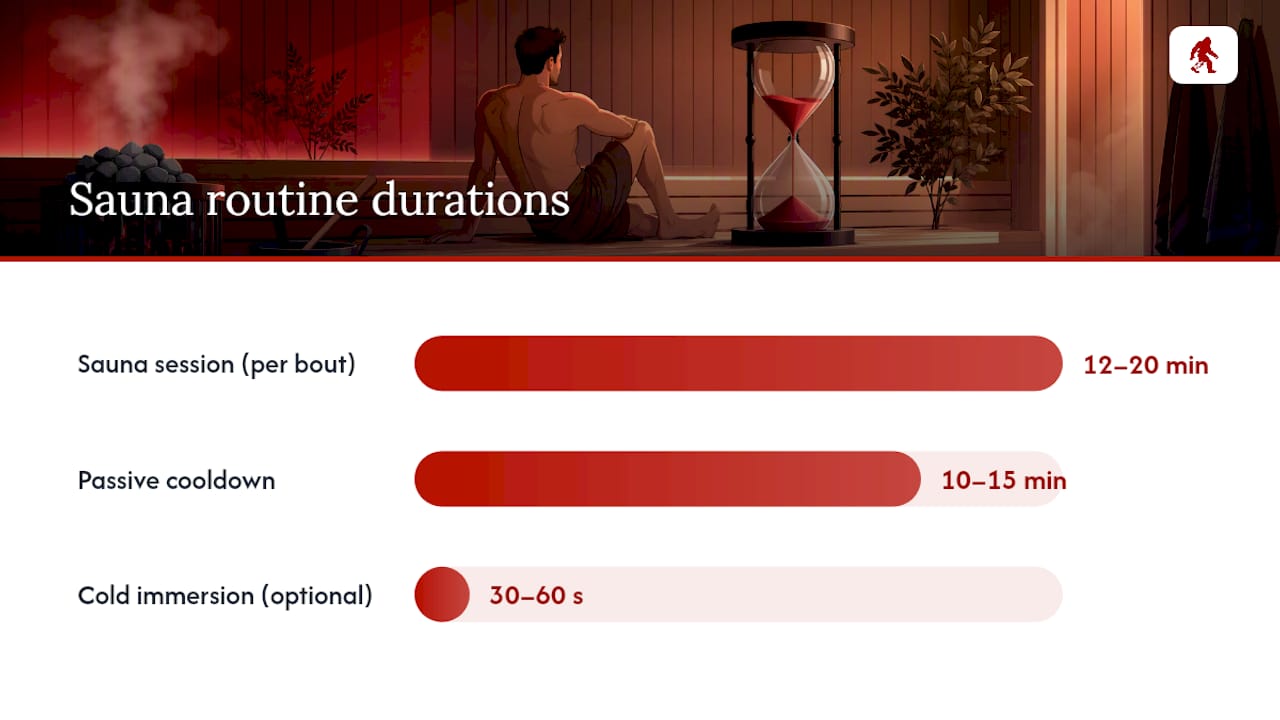
- Session length: 12–20 minutes per bout at 80–91°C (traditional sauna) or 45–60°C (infrared). Start at 12 minutes if you are new.
- Frequency: 3–4 sessions per week for cardiovascular and cortisol-reduction benefits. Two sessions per week still delivers meaningful recovery support.
- Hydration: drink 16–20 oz of water 30 minutes before each session. Weigh yourself before and after your first few sessions to calibrate fluid loss.
- Cooldown: allow 10–15 minutes of passive cooling after each session before returning to activity. Cold immersion (30–60 seconds) is optional but supported by the trial protocols.
- Timing with workouts: post-strength training sauna works well for recovery. Avoid sauna within 2 hours of bedtime if it disrupts your sleep onset.
- Fertility window: if you are actively trying to conceive, reduce to once weekly or pause entirely. Resume normal frequency after the conception attempt window.
- Bloodwork timing: if you are tracking testosterone, schedule labs at least 24 hours after your last session to avoid acute hormonal fluctuation skewing your results.
Tailor by age and goal: men over 40 focused on recovery and cortisol management can prioritize consistency at 3–4 sessions per week. Men with active fertility goals should reduce frequency during conception windows. Men with cardiovascular risk factors should get medical clearance before starting.
Pro Tip: If you are using a red-light therapy protocol alongside sauna, sequence red light first (cool tissue) and sauna second. This preserves the targeted cellular signal from red light before heat exposure raises tissue temperature.
This routine was developed by Nurse Rachel, drawing on the controlled trial protocols and clinical safety guidance reviewed throughout this article.
The verdict: what sauna realistically does for your testosterone
Sauna does not directly raise baseline testosterone. That is the honest answer, and the research is consistent on it. What it does is reduce cortisol, support recovery, improve sleep quality, and protect cardiovascular health. Those are the levers that create a hormonal environment where your body can maintain its own testosterone production more effectively over time.
Who benefits most from regular sauna use:
- Men focused on recovery and stress reduction
- Men with chronically elevated cortisol who want a non-pharmaceutical intervention
- Men prioritizing cardiovascular health as a long-term hormonal support strategy
- Men who want to protect their energy and drive without jumping straight to clinical intervention
Who should be cautious:
- Men actively trying to conceive (manage frequency and timing)
- Men with uncontrolled cardiovascular conditions (get clearance first)
- Men on medications that impair thermoregulation
Your immediate next step: commit to 2–4 weeks of consistent sessions at 3–4 per week. Then retest your baseline labs after a 24-hour washout. If you have not had a hormone panel recently, that is the first move. Knowing your actual numbers is the only way to know whether what you are doing is working.
If you are already noticing signs of low testosterone, sauna is a reasonable addition to your routine. It is not a replacement for clinical evaluation.
What I actually think about sauna and men's hormonal health
Here is the part most articles skip. Sauna is not a testosterone hack. Men who approach it that way will be disappointed and probably quit after a month. But men who use it as a recovery and stress-management tool, consistently, over months, tend to feel better. Their sleep improves. Their cortisol comes down. Their body has less interference in the system that produces testosterone naturally.
That is not a small thing. Chronic stress is one of the most underestimated suppressors of male hormonal health. It is quiet, it is cumulative, and most men do not connect the dots between a relentless work schedule, poor sleep, elevated cortisol, and a testosterone level that keeps drifting down. Sauna is one of the few evidence-backed tools that directly addresses the cortisol side of that equation without requiring a prescription.
The fertility piece is where I see the most confusion. Men hear "sauna lowers sperm count" and either panic or dismiss it entirely. The nuance is timing. If you are not trying to conceive, the temporary sperm effects are largely irrelevant. If you are, a simple protocol adjustment handles the risk. Neither extreme, panic nor dismissal, serves you.
My honest take on the bigger picture: sauna fits best as one piece of a restoration routine, not the whole answer. Pair it with strength training, quality sleep, and honest bloodwork. If your testosterone is genuinely low, get a panel and talk to a clinician. Sauna can support the environment. It cannot replace the signal.
RedRockit pairs naturally with your sauna routine
You are already doing the work. Consistent sauna sessions, managing cortisol, protecting recovery. That is the right instinct. RedRockit, Primal Red Co's private-use red-light wellness device, fits directly into that routine as a non-TRT adjunct for men who want to support their cellular recovery signal alongside heat therapy.

Red-light therapy targets mitochondrial function at the cellular level, which complements the parasympathetic recovery that sauna initiates. It is not a clinical intervention. It is not a replacement for a hormone panel or a conversation with your doctor. It is a tool for men who want to do more than wait and see. The RedRockit Activation Method includes guided session protocols through the Rockit IQ app, so you are not guessing at timing or duration. If you want to understand male vitality after 40 and what a real restoration routine looks like, that is the place to start.
Key studies and resources used in this article
- Podstawski et al. (2021) — Endocrine Effects of Repeated Hot Thermal Stress and Cold Water Immersion in Young Adult Men: the primary controlled trial showing significant cortisol reduction without significant testosterone change in 30 young men using a 4 × 12-minute Finnish sauna protocol.
- PMC Heat Therapy and Endocrine Responses (2018): documents large acute growth hormone spikes and inconsistent testosterone responses across passive heat therapy trials.
- Mayo Clinic Proceedings — Finnish Sauna Bathing and Cardiovascular Outcomes: large Finnish cohort data linking 3–7 sauna sessions per week to lower cardiovascular event risk.
- WebMD — Saunas and Your Health: clinician-sourced guidance on frequency, safety, and recovery benefits.
- SAGE Journals — Endocrine Effects of Repeated Sauna Bathing: documents the correlation between baseline cortisol levels and the magnitude of post-sauna cortisol reduction.
- PMC — Clinical Safety Guidance on Sauna Use: clinical recommendations for novice users and special populations, including gradual progression and contraindications.
This article is general information, not a substitute for advice from a qualified doctor. Consult a qualified healthcare professional about your own circumstances before acting on anything here.
Sources
- Endocrine Effects of Repeated Hot Thermal Stress and Cold Water Immersion in Young Adult Men
- Saunas and Your Health: Benefits, Risks, and Safety — WebMD
- Heat therapy and endocrine responses (PMC article)
- Sauna Benefits for Men - Complete Research Guide | UseSauna
- Sauna benefits for men: what the evidence actually shows — HeatLore