
Creatine does not meaningfully raise total or free testosterone in healthy men, whether you're loading it, cycling it, or taking it every day for years. The strongest evidence, including a recent 12-week randomized controlled trial, found no clinically significant change in androgen hormones. One small, older study hinted at a short-term DHT bump, but nothing since has replicated it. If you want the dosing specifics and safety notes, keep reading.
TL;DR:
- Creatine does not cause significant changes in testosterone or DHT levels in healthy men, even with long-term or high-dose use.
- Most studies show no hormonal effect from creatine, and the 2009 outlier about DHT increases has not been replicated or confirmed.
- Creatine’s primary role is enhancing muscle energy, not hormone modulation, and it operates independently of the hormonal regulation system.
- For hormone health, focus on body composition, sleep, and resistance training rather than relying on creatine as a testosterone booster.
- If hormone issues are suspected, testing is more effective than supplementing with creatine, which does not address underlying medical conditions.
Table of Contents
- Does Creatine Affect Testosterone Levels? What the Evidence Shows
- How Creatine Works in the Body (and Why It Doesn't Touch Your Hormones)
- What the Key Creatine and Hormone Trials Actually Found
- Creatine Dosing, Loading Protocols, and Safety Notes
- Primal Red Co's View: Creatine Is a Tool, Not a Hormone Fix
- Our Take: Stop Waiting for a Supplement to Do a Doctor's Job
- Another Option Worth Knowing About: RedRockit for Daily Restoration
- Sources
Does Creatine Affect Testosterone Levels? What the Evidence Shows
Men ask this question for a reason. Creatine is the most studied supplement in sports nutrition, and somewhere along the way, a rumor took hold that it spikes DHT and testosterone right alongside your lifts. It doesn't hold up.
The systematic review evidence on creatine and hormonal outcomes is about as consistent as clinical research gets: most controlled trials show no significant change in total or free testosterone, regardless of dose or duration. A separate meta-analysis reaches the same conclusion. Across dozens of trials, creatine just doesn't move the hormone needle the way marketing copy implies.
So where did the myth come from? Back in 2009, a small study on rugby players reported a transient rise in DHT during a creatine loading phase. It's the single data point behind almost every "creatine causes hair loss" headline you'll find online. But that original 2009 trial used a tiny sample, a short window, and has never been reliably reproduced in a larger or longer study.
More recent research settles the question with better design. A 12-week randomized controlled trial tracking men on 5 g/day of creatine against placebo found no significant difference in DHT levels, no shift in the DHT-to-testosterone ratio, and no measurable change in hair growth parameters.
Here's the pattern across the literature:
- Short-term loading protocols: no meaningful hormone shift beyond the one outlier study from 2009
- Maintenance dosing over weeks to months: flat testosterone and DHT readings
- Long-term supplementation in trained men: no cumulative endocrine effect
Statistical noise isn't a real effect. A study might report a hormone reading that moved a few percentage points in one direction. That's not the same as a clinically meaningful change your body would notice, or one a doctor would treat differently on a lab report.
How Creatine Works in the Body (and Why It Doesn't Touch Your Hormones)
Creatine's job has nothing to do with hormone signaling. It works in the phosphocreatine energy system, helping muscle cells resynthesize ATP faster during short, intense bursts of effort, according to Harvard Health. Think of it as topping off a fuel reserve for your muscles, not sending a message to your brain's hormone command center.

Testosterone production runs on a completely different system: the hypothalamic-pituitary-gonadal axis. Your hypothalamus signals your pituitary gland, which signals your testes, which produce testosterone. Creatine never enters that loop.
That said, creatine can influence hormones indirectly, just not through any mechanism that raises testosterone on its own:
- Better training capacity can support more effective resistance workouts over time
- Changes in body composition (more lean mass, less fat) are loosely linked to healthier hormone profiles
- Neither pathway produces a direct or reliable testosterone increase from creatine itself
Pro Tip: If your real goal is optimizing hormone health, the lever that matters most is body composition and training consistency, not which supplement bottle sits on your shelf.
What the Key Creatine and Hormone Trials Actually Found
Trial-level detail matters here, because vague summaries are how myths survive. Look at the actual designs and outcomes.
Early loading-protocol studies used doses in the 20 to 25 g/day range for about a week, followed by a maintenance dose. A double-blind crossover study testing this exact pattern found no significant change in testosterone response to heavy resistance training. Men lifted just as hard, recovered just as well, and their hormone panels didn't move in any meaningful way tied to the creatine itself.
Longer-duration research tells the same story with more statistical weight. Meta-analytic reviews pooling multiple trials report no clinically meaningful testosterone rise associated with creatine use, whether the participants trained for four weeks or several months.
The clearest recent data point is the 12-week randomized trial built specifically to test the DHT and hair-loss concern head-on. Researchers measured DHT, the DHT-to-testosterone ratio, and hair growth metrics in men taking 5 g/day of creatine versus placebo. The result: no significant difference on any measure.
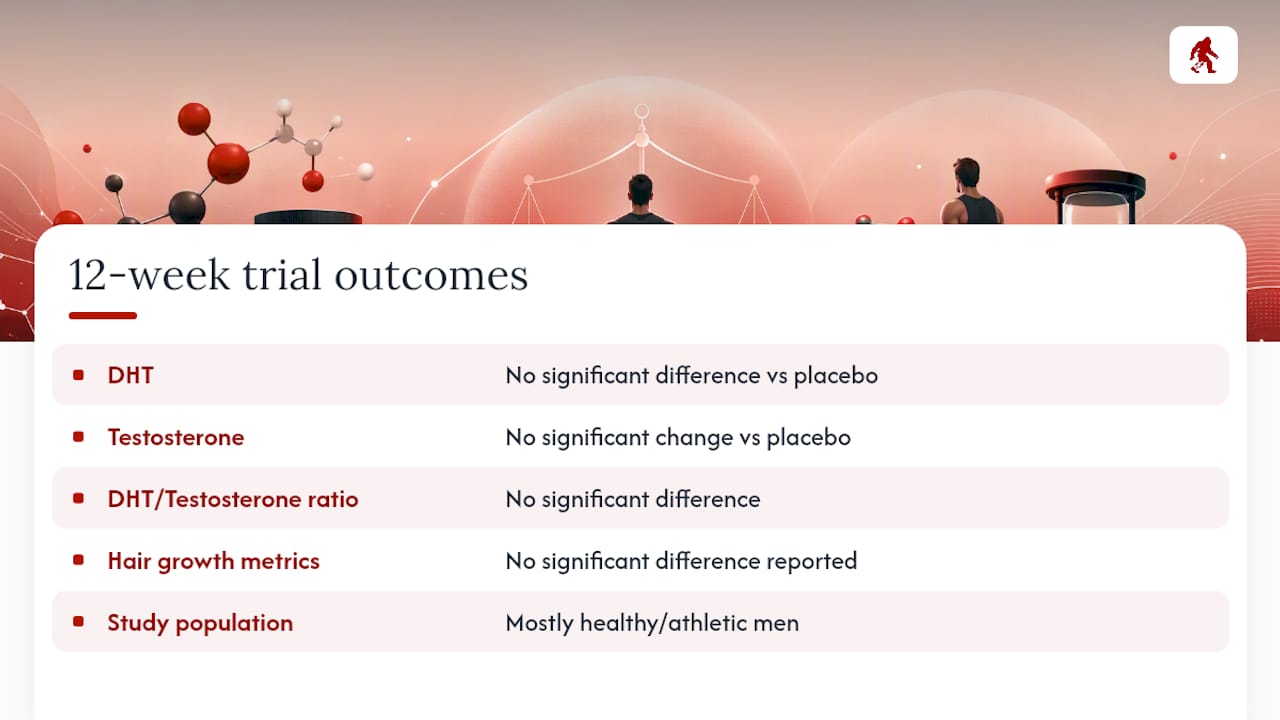
One limitation deserves a direct call-out. Nearly every trial in this body of research enrolled healthy, young, or athletic men. That's a meaningfully different population from men with diagnosed hypogonadism or men already dealing with a confirmed hormonal deficiency. If your testosterone is already low for a medical reason, these findings tell you creatine won't fix it, not that creatine is irrelevant to your situation.
Creatine Dosing, Loading Protocols, and Safety Notes
Skip the dramatic loading phase. The evidence-backed standard is 3 to 5 g/day, taken consistently, according to Harvard Health's guidance. Loading with 20+ grams for a week does saturate your muscle stores faster, but it offers no advantage for hormone health and isn't necessary if you're patient.
- Take 3 to 5 grams of creatine monohydrate daily, any time of day, with consistency mattering more than timing.
- If you have kidney disease or take medications that stress the kidneys, talk to a clinician and consider baseline labs first, since kidney safety questions come up often with long-term creatine use in that population.
- Choose a third-party-tested product. The FDA doesn't pre-approve supplements for label accuracy, so a brand with independent verification, as Baylor College of Medicine notes, is worth the extra look.
- Drink enough water and pair creatine with a real resistance training program. It amplifies effort you're already putting in; it doesn't replace it.
Pro Tip: If you notice bloating in the first week, that's water shifting into muscle cells, not a red flag. It usually settles once your body adjusts to the new baseline.
Primal Red Co's View: Creatine Is a Tool, Not a Hormone Fix
Creatine belongs in a serious training routine. It supports strength, recovery, and lean mass, especially past 30 when muscle starts slipping quietly if you don't fight for it. But treating it as a testosterone treatment sets you up to misread your own body.
If you genuinely suspect low testosterone, symptoms like flat energy, low drive, or slower recovery deserve real answers, not supplement guesswork. Start with:
- A morning total testosterone draw, since levels shift throughout the day
- Free testosterone and SHBG to see what's actually available to your tissues
- LH and FSH if your doctor needs to figure out whether the issue starts in your testes or higher up in the signal chain
- An honest look at sleep, body weight, and resistance training, the three levers that move hormone health more reliably than any pill
Nurse Rachel and the Primal Red Co education team built this content specifically for men who want facts before decisions, not another bottle promising a hormone shortcut.
Our Take: Stop Waiting for a Supplement to Do a Doctor's Job
The research is clear enough that the conventional wisdom needed correcting, not repeating. Creatine doesn't raise testosterone, and treating it as a hormone hack sends men chasing the wrong fix while the real issue, whatever it is, sits untouched.
Where most advice falls short is the jump from "safe and effective for strength" to "must be doing something hormonal too." Those are separate questions with separate answers. Creatine earns its place in a training routine on its own merits. It doesn't need a hormone story attached to justify the price tag.
If you're genuinely worried about your testosterone, prioritize testing before supplementation. A lab panel tells you something real. A tub of powder, no matter how well marketed, tells you nothing about your actual hormone status. Get the data first, then decide what belongs in your routine.
— Nurse Rachel
Another Option Worth Knowing About: RedRockit for Daily Restoration
Creatine handles the muscle side of the equation. It won't touch your hormone signaling, your recovery quality, or the low-grade fatigue that creeps in after 30, and that's exactly the gap Primal Red Co built RedRockit to address.

RedRockit is a private-use red light wellness device designed for a simple daily routine, paired with the Rockit IQ app for guided sessions. It's not a testosterone therapy, and Primal Red Co won't pretend otherwise. Think of it as a complement to your training and your lab work, not a replacement for either. If creatine covers your strength stack and a proper lab panel covers your diagnostics, RedRockit covers the daily restoration habit in between, the piece most men skip until something forces the issue.
If you're already asking questions about energy, drive, and where your testosterone actually stands, that's the right instinct. See how a restoration routine fits into the picture on the testosterone restoration guide, and decide for yourself whether it belongs in your routine.
This article is general information, not a substitute for advice from a qualified doctor. Consult a qualified healthcare professional about your own circumstances before acting on anything here.
Sources
- Does creatine cause hair loss? A 12-week randomized controlled trial
- What is creatine? Potential benefits and risks of this popular supplement - Harvard Health
- Effect of short-term creatine supplementation on hormonal responses to heavy resistance training