
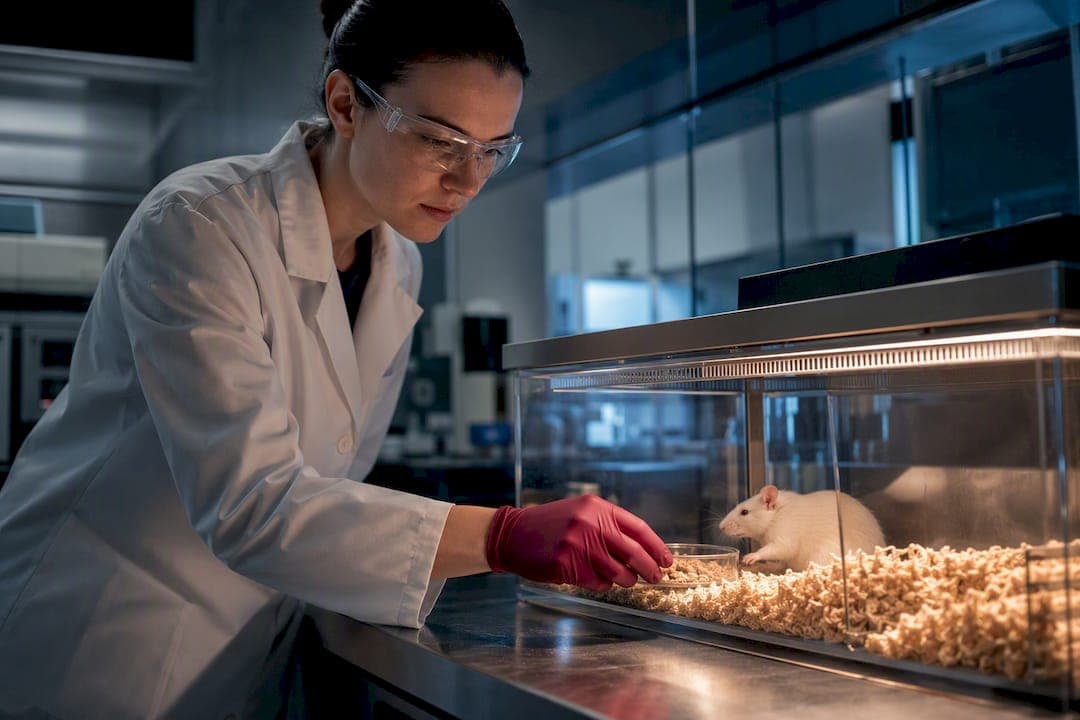
Vitamin K2 does not raise human testosterone by any confirmed mechanism, but it is not nothing either. A 2011 rat study using the MK-4 form of K2 found testicular testosterone jumped nearly 90 percent after five weeks. That number is real. What is missing is the human trial that would tell you if your body responds the same way. Treat K2 as a supporting player in your restoration routine, not a substitute for the basics, and talk to your doctor before high doses if you're on blood thinners.
TL;DR:
- The rat study showing nearly 90% increase in testicular testosterone with MK-4 used doses far beyond typical human supplement levels, so results may not translate directly to men.
- K2 influences testosterone-related pathways, such as activating PKA and upregulating CYP11A, but these mechanisms remain unconfirmed in human clinical trials.
- Human evidence linking K2 to testosterone improvement is limited to observational data and animal studies, emphasizing the need for properly designed human trials.
- K2's primary benefits relate to vascular health and calcium regulation, supporting hormone delivery and erectile function rather than directly boosting testosterone.
- Supplementation should be paired with foundational health habits like sleep, training, and diet, with K2 serving as a low-risk support option while awaiting more human-specific research.
Table of Contents
- How Vitamin K2 Could Influence Testosterone Production
- What the MK-4 Rat Study Actually Found
- Why Human Evidence Still Falls Short
- MK-4 vs. MK-7: Which Form Actually Matters Here
- Interactions and Safety: What You Need to Watch For
- Building a Realistic Routine for Men Over 30
- Testosterone Metabolism: Where K2 Might Actually Fit In
- Could K2 Matter for Low Testosterone or Andropause?
- How K2 Stacks Up Against Other Natural Modulators
- Dosage, Timing, and Absorption: What Still Isn't Settled
- A Measured Take on Where This Research Stands
- Where RedRockit Fits Into Your Restoration Routine
- Sources
- FAQ
How Vitamin K2 Could Influence Testosterone Production
Your body doesn't make testosterone in a vacuum. It's a chain reaction, and researchers think vitamin K2 might be tugging on a few links in that chain, not the whole system at once.
The clearest signal comes from a pathway involving an enzyme called Protein Kinase A, or PKA. In lab studies using testis cells, MK-4 activated PKA, which then triggered a molecule called CREB. That activation cascade led to more production of CYP11A, an enzyme that sits at the very first step of steroid hormone synthesis, the step that converts cholesterol into pregnenolone before it ever becomes testosterone. More CYP11A activity in a cell generally means more raw material moving down the line toward testosterone production. This is the mechanism researchers point to when they say dietary vitamin K alleviates the reduction in testosterone seen in deficiency states.
There's a second pathway worth knowing about, and it starts in a place you wouldn't expect: your bones. Vitamin K2's best documented job is activating proteins through a process called gamma carboxylation. Two of those proteins matter here. Osteocalcin, a bone protein, gets carboxylated by K2 and has been studied for links to metabolic and androgen markers in animal models. Matrix Gla Protein, or MGP, is the other one, and its job is keeping calcium out of your arteries and soft tissue, where it doesn't belong.
Why does arterial calcium matter for testosterone? Blood flow. Testosterone doesn't help you much if the vascular delivery system carrying it, and everything else your body needs for erectile function and drive, is stiffening up with calcium deposits. K2's role activating osteocalcin and MGP is a vascular and skeletal story first, but a healthy vascular system is the delivery infrastructure hormones need to actually do their job downstream.
Here's what the mechanism research suggests, condensed:
- PKA activation: MK-4 triggers PKA, which phosphorylates CREB and boosts steroidogenic gene expression in testis cells.
- CYP11A upregulation: More of this enzyme means more of the first conversion step in the testosterone synthesis chain.
- Osteocalcin signaling: Bone-derived osteocalcin, activated by K2, has hypothesized crosstalk with androgen production, though this is far better established in mice than in men.
- MGP and vascular calcium: K2 keeps calcium out of arteries, supporting the blood flow that hormone delivery and erectile function depend on.
- MK-4 vs. MK-7 tissue distribution: MK-4 concentrates more directly in reproductive tissue in animal models, while MK-7's longer half-life spreads exposure more evenly across the body over time.
None of this adds up to "K2 makes testosterone" in a clean, one-line equation. It adds up to a set of biologically plausible on ramps, several of which converge on the same enzyme system. That's worth paying attention to. It's not the same as proof.
What the MK-4 Rat Study Actually Found
This is the study almost every article about K2 and testosterone is quietly built around, so it's worth walking through exactly what it did and didn't show.
Researchers fed male Wistar rats a diet containing MK-4 at a high dose for five weeks. At the end of that period, plasma testosterone and testicular testosterone both showed substantial increases. Notably, luteinizing hormone, the pituitary signal that normally tells the testes to ramp up testosterone production, did not change. That detail matters: it suggests MK-4 was acting somewhere downstream, inside the testicular tissue itself, rather than by cranking up the brain's hormonal command signal. That's the Ito et al. 2011 study published in Lipids in Health and Disease, and it remains the single most cited piece of primary evidence in this entire conversation.
The same research team ran a parallel experiment using I-10 cells, a line derived from testicular tumor tissue. When exposed to MK-4, these cells showed increased phosphorylation of CREB, upregulated CYP11A protein, and higher testosterone output. When researchers introduced a PKA inhibitor, the effect was blunted, which is exactly why PKA became the leading suspect in the mechanism story rather than just a passing observation.
A few things to weigh honestly before you get too excited about these numbers:
- The dose was massive by human standards. Seventy-five milligrams per kilogram of rat diet translates, once you account for body size and metabolic rate differences, to something far beyond what any reasonable human supplement label recommends.
- Rats and men do not metabolize vitamin K identically. Rodent studies are a strong starting point for mechanism research, not a stand-in for human physiology.
- The cell experiments used concentrated MK-4 exposure, higher than what circulates in human blood after a typical dietary or supplemental intake.
- LH staying flat is interesting, but it's one data point. A single study, however well designed, is a hypothesis generator, not a verdict.
Solid science. Real numbers. Just not yet a green light to assume the same thing happens at scale in a 35 year old man taking a capsule with breakfast.
Why Human Evidence Still Falls Short
Here's the honest gap: nobody has run the trial that would settle this. What exists in humans right now is a scattering of indirect and observational signals, not a randomized controlled trial that put men on measured K2 doses and tracked their testosterone over months.
Some observational research has poked at connections between osteocalcin levels and androgen markers, since K2 activates osteocalcin and osteocalcin has its own hypothesized links to metabolic health. But correlation in an observational dataset tells you two things move together, not that one causes the other. Men with higher osteocalcin might simply be healthier overall, exercising more, eating better, sleeping longer, any of which independently supports testosterone.
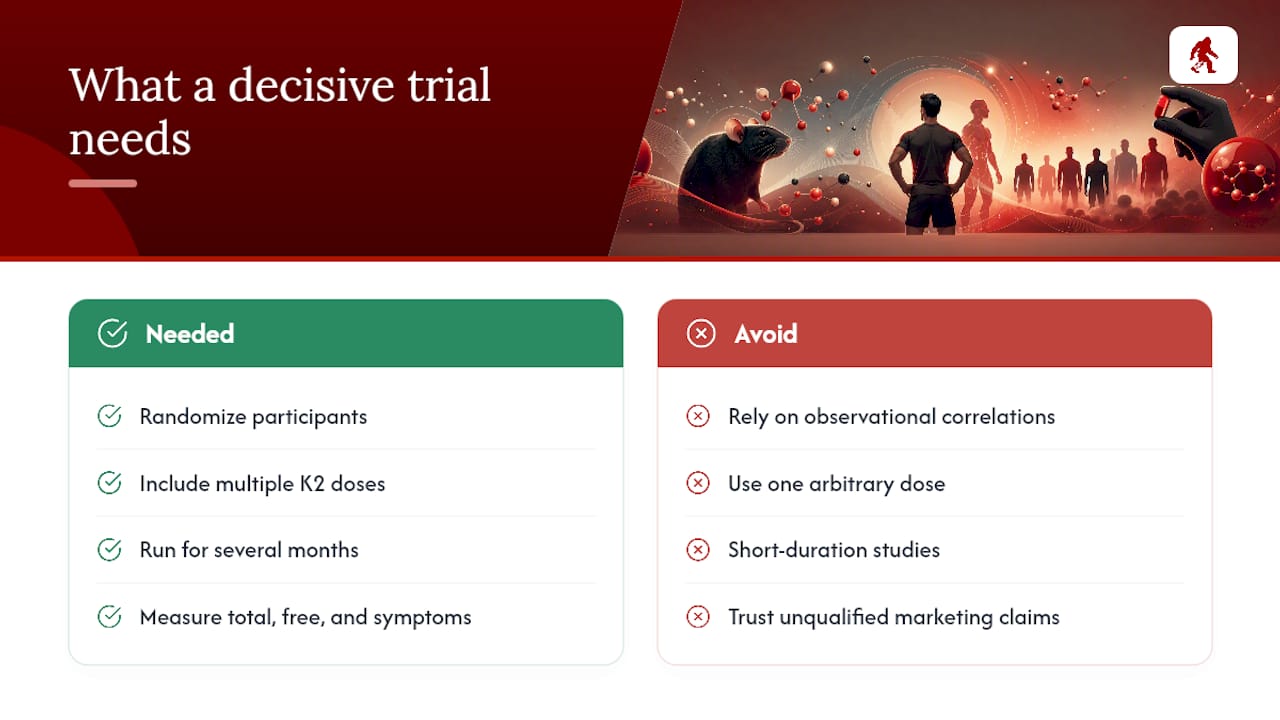
A trial that would actually answer this question needs several things the current literature doesn't have. It would need to be randomized, so K2 isn't just correlated with healthier men who happen to supplement more. It would need a dose ranging design, testing multiple K2 amounts rather than one arbitrary number, since the animal data used a dose far outside typical human supplementation. It would need to run long enough, probably several months, since hormone axis changes take time to register reliably in blood work. And it would need the right endpoints: total testosterone, free testosterone, and ideally symptom scores covering energy, libido, and mood, not just a lab value in isolation.
Until a trial like that exists, the responsible read of the testosterone and K2 relationship is this: promising mechanism, promising animal data, unconfirmed in men.
That doesn't mean every supplement claim you see online deserves the benefit of the doubt. If a product page tells you K2 will "boost your T levels" without a single caveat, that's marketing outrunning the evidence. The honest version sounds more like what you're reading now: a plausible biological story with a research gap in the middle, and a reasonable case for including K2 in a broader routine while you wait for better human data. If you're evaluating any supplement claim about testosterone, ask a simple question: is this backed by a human trial, or is it one animal study wearing a human sized headline? Most of the internet's K2 testosterone content skips that question entirely.
MK-4 vs. MK-7: Which Form Actually Matters Here
Not all vitamin K2 behaves the same way once it's in your body, and this distinction gets glossed over constantly in supplement marketing.
MK-4, or menaquinone-4, is the form used in the rat study, and it has a short half-life, meaning your body clears it relatively fast. It's also the form that shows up concentrated in animal reproductive tissue, which is part of why researchers picked it for the testosterone mechanism work in the first place. Dietary sources include animal fats and organ meats, though not in the concentrations used experimentally.
MK-7, or menaquinone-7, is the form that dominates most consumer K2 supplements today. It has a longer half-life, staying active in your bloodstream for a longer stretch, which makes it better suited for steady, day-to-day systemic support rather than a short intense spike. Natto, a fermented soybean dish common in Japanese cuisine, is by far the richest natural source, and it's also present in smaller amounts in certain aged cheeses like Gouda and Brie.
Here's the practical rundown:
- MK-4: short half-life, concentrates in reproductive and other soft tissue, harder to get meaningful amounts from diet alone.
- MK-7: long half-life, sourced mainly from natto and some fermented dairy, the more common supplemental choice for sustained blood levels.
- Grass-fed animal products: contribute modest amounts of K2, generally less concentrated than fermented sources.
- Absorption: K2 is fat-soluble, so taking it with a meal containing some dietary fat improves uptake compared to taking it on an empty stomach.
Vitamin K2 supplementation effects in everyday practice typically run in the range of 100 to 200 micrograms per day for general health support, a fraction of the milligram-scale doses used in the rat study or in specific high-dose clinical bone protocols, where doses up to 45 milligrams per day have been used under medical monitoring. Notice the units: micrograms for typical supplementation, milligrams for supervised clinical contexts. Confusing the two is an easy and potentially serious mistake.
Pro Tip: If you're adding K2 to your routine, take it alongside a meal that has some fat in it, eggs, avocado, olive oil, whatever's on your plate. Skipping the fat means you're likely absorbing less of what you paid for.
Don't chase the rat study's dose on your own. Mega-dosing K2 without clinical supervision isn't how you translate animal research into a smart human routine.
Interactions and Safety: What You Need to Watch For
The single most important safety note in this entire conversation has nothing to do with testosterone. It's about blood thinners.
Vitamin K2, like all forms of vitamin K, plays a direct role in blood clotting. If you're on warfarin or another vitamin K antagonist, introducing or changing your K2 intake can throw off your anticoagulant dosing and your clotting time. This isn't a minor footnote. Coordinate any K2 supplementation with the clinician managing your anticoagulant therapy before you start, not after.
Outside of that specific interaction, the broader safety literature on vitamin K2 is reassuring. It's generally well tolerated, and clinical contexts treating bone density issues have used doses far higher than typical supplement amounts under medical monitoring without major red flags. That said, "well tolerated in a monitored clinical setting" and "safe to self-dose aggressively at home" are two different statements.
A short list of what to actually watch for:
- Anticoagulant medications: the primary serious interaction, requiring clinician coordination, full stop.
- Rare digestive discomfort: some people report mild stomach upset at higher doses, though this isn't common at standard amounts.
- Other supplement stacking: taking K2 alongside high-dose vitamin D3 is common practice, since D3 and K2 are often paired to help direct calcium into bone rather than soft tissue, but stacking multiple fat-soluble vitamins deserves a conversation with your doctor if you're taking several at once.
- Underlying liver or kidney conditions: anyone managing chronic organ conditions should loop in their physician before adding any new supplement, K2 included.
If you're starting K2 for the first time, ease in rather than jumping to a high dose. Get baseline labs if you're already tracking your hormone panel, note any medications you're on, and if you notice anything unusual, unexplained bruising, digestive issues, or bleeding gums, stop and check in with your doctor rather than pushing through it.
Building a Realistic Routine for Men Over 30
Vitamin K2 is a supporting character in this story, not the lead. If your sleep, training, and diet are a mess, no supplement is rescuing your hormone profile on its own.
Here's a sequence that actually holds up:
- Nail the fundamentals first. Seven to eight hours of sleep, resistance training two to four times a week, and a reasonable body composition do more for your baseline testosterone than any single nutrient ever will.
- Fix your diet's basics before adding supplements. Adequate protein, healthy fats, and testosterone-supportive foods give your body raw material it can't manufacture from a pill.
- Add K2 through food where you can, natto if you can stomach it, some aged cheese, then consider a moderate supplement in the 100 to 200 microgram range if diet alone isn't cutting it.
- Pair it with vitamin D3 and dietary fat at the same meal for better absorption, since both are fat-soluble and often used together in calcium management protocols.
- Recheck labs at a reasonable interval, typically three to six months, not two weeks. Hormone shifts from lifestyle and nutrient changes take time to show up reliably.
- Know your red flags for escalation. Persistent low energy, low libido, or lab-confirmed low testosterone despite fixing sleep, training, and diet is the point to bring in an endocrinologist and discuss whether TRT pathways deserve a conversation, not something to self-manage indefinitely with supplements.
This isn't a routine that promises a dramatic testosterone jump from K2 alone. It's a sequence that puts K2 where it actually belongs: alongside the levers that move the needle the most, with your clinician in the loop the moment anything gets complicated.
Testosterone Metabolism: Where K2 Might Actually Fit In
Testosterone production isn't a single step. It starts with a signal from your brain's hypothalamus and pituitary, cascades down to the testes through LH, and then runs through a chain of enzymatic conversions, starting with that same CYP11A step mentioned earlier, that eventually yields testosterone from cholesterol.
What's notable about the MK-4 rat data is where in that chain the effect showed up. LH stayed flat while testicular testosterone rose sharply, pointing to a local, testicular-level effect rather than a change in the brain's signaling. If that pattern held in humans, it would mean K2 isn't telling your brain to shout louder at your testes. It's potentially helping the testes respond more efficiently to the signal they're already getting.
That's a meaningfully different mechanism than most testosterone-related interventions you've probably heard about. Exogenous testosterone therapy replaces the hormone directly and often suppresses your body's own LH signal in the process. Something like K2, if the animal mechanism translates, would theoretically work by supporting the existing production chain rather than overriding it. That distinction is exactly why K2 belongs in the conversation about protecting what you still have, rather than the conversation about replacing what's gone.
Could K2 Matter for Low Testosterone or Andropause?
Hypogonadism, clinically low testosterone, and the gradual decline some call andropause are both conditions where the body's own production chain is underperforming. That's precisely where a testicular-level support mechanism, if it holds up in human research, would theoretically matter most.
Right now, there's no clinical trial testing K2 specifically in men diagnosed with hypogonadism. That gap needs to be stated plainly rather than glossed over. Any suggestion that K2 could meaningfully move the needle for a man with clinically diagnosed low testosterone is extrapolating from rat data, not citing a human clinical outcome.
Where K2 has a more defensible role is at the margins, in men who are otherwise healthy but experiencing the slow drift downward that comes with age, sometimes called andropause, alongside the basics of sleep, training, and diet. It's a reasonable addition to a broader restoration approach, not a replacement for a proper hypogonadism workup if your labs come back clinically low. If you're in that territory, a testosterone panel and a conversation with your doctor about what your levels actually mean comes before any supplement decision, K2 included.
How K2 Stacks Up Against Other Natural Modulators
Vitamin K2 isn't the only nutrient with a testosterone-related research story, and it's worth seeing where it sits next to the others men usually ask about.
Zinc has a more established human evidence base, particularly in men with a documented zinc deficiency, where supplementation has shown a clearer connection to restoring testosterone toward normal levels. Magnesium has supporting research, especially tied to sleep quality and muscle recovery, both of which indirectly support hormone production. Vitamin D3 has one of the more consistent bodies of observational and interventional research linking deficiency correction to testosterone improvements, and it's frequently discussed alongside K2 for that reason.
K2's evidence base is different in kind, not just in size. It's mechanistically compelling and backed by a striking animal study, but it lacks the human trial data that zinc and vitamin D3 have already accumulated. That doesn't make it less worth including. It makes it a nutrient you add for a plausible upside, not one you lean on as your primary lever the way you might with a confirmed deficiency in zinc or vitamin D.
Dosage, Timing, and Absorption: What Still Isn't Settled
Even if you accept the mechanism story at face value, several practical questions remain genuinely unresolved, and it's worth being upfront about that instead of pretending there's a settled protocol.
Nobody has established an optimal human dose for testosterone support specifically, because no human trial has tested one. The 100 to 200 microgram range common in general supplementation is based on bone and cardiovascular research, not testosterone outcomes. Timing is another open question: whether K2 works better taken in the morning, at night, or split across meals for testosterone purposes specifically has never been studied, so the "take it with a fat-containing meal" advice is about absorption in general, not about hitting some hormonal window.
Bioavailability differences between MK-4 and MK-7 add another layer of uncertainty. Since the animal study used MK-4 and most consumer supplements use MK-7, it's not automatic that a bottle of MK-7 delivers the same tissue-level exposure the rat study achieved with MK-4. That's a translational gap most product marketing quietly skips over. Until dose-ranging human trials exist, treat any specific dosing or timing claim tied to testosterone as a reasonable guess dressed up as a protocol.
A Measured Take on Where This Research Stands
I find the MK-4 rat data genuinely exciting, and I also think it gets oversold constantly. A nearly 90 percent jump in testicular testosterone is not a small effect, and the PKA mechanism gives it real biological weight. But I've watched enough promising animal studies fail to translate cleanly to humans to know the gap between "this happened in a rat" and "this will happen in you" is wide. My honest recommendation: fix your sleep, your training, and your diet first, add K2 as a sensible low-risk supporting piece, get your labs checked, and have an actual conversation with your doctor before assuming any single nutrient is your answer.
— Nurse Rachel
Where RedRockit Fits Into Your Restoration Routine
K2 is one piece of a bigger picture, and so is every other nutrient in this article. None of it replaces a consistent daily routine that actually targets the cellular signal your body has quietly started ignoring as you've aged. That's where RedRockit comes in.

RedRockit is a private-use red light wellness device designed to support a restoration routine for men facing changes in energy, drive, and recovery. It's not a pharmaceutical, not a supplement, and not a prescription. It's a daily restoration habit with a companion app guiding your session protocols, with no subscriptions, ongoing medical appointments, or dependence. You use it as part of a routine to support your body's own signals.
If you're already thinking about how testosterone declines after 40 and want a tool that fits into the same conservative, evidence-first approach as pairing K2 with vitamin D and fixing your sleep, start by checking out the RedRockit Primal Restoration device and its activation method to see how the daily protocol actually works.
Sources
- Menaquinone-4 enhances testosterone production in rats and testis-derived tumor cells | Lipids in Health and Disease
- Dietary vitamin K alleviates the reduction in testosterone (PubMed)
- Testosterone — what it does and doesn't do | Harvard Health
FAQ
Is K2 good for erectile dysfunction?
K2 hasn't been directly studied for erectile dysfunction in human trials. Its role activating Matrix Gla Protein to reduce arterial calcification is relevant to vascular health, and healthy blood flow matters for erectile function, but that's an indirect mechanism, not a proven treatment.
Which vitamins boost testosterone?
Vitamin D3 has the strongest human evidence, particularly in men correcting a deficiency, and zinc shows a similar pattern in men who are actually deficient. Vitamin K2, specifically the MK-4 form, shows a strong effect in animal studies but still lacks confirmed human trial data for testosterone specifically.
What is the downside of taking K2?
The main risk is for anyone on warfarin or another vitamin K antagonist, where K2 can interfere with anticoagulant dosing and requires clinician coordination. Outside that interaction, K2 is generally well tolerated, though mega-dosing without medical supervision isn't advisable.
Does vitamin K2 decrease estrogen?
There's no established human evidence that K2 lowers estrogen. The animal research on K2 centers on testosterone production through the PKA and CYP11A pathway, not on estrogen metabolism, so any estrogen-related claim goes beyond what the current data actually shows.
Does vitamin K2 actually increase testosterone in men?
The strongest evidence, an MK-4 study in male rats, showed a substantial testosterone increase, but no equivalent human trial has confirmed the same effect in men. Consider K2 a reasonable, low-risk addition to a broader routine rather than a proven testosterone booster on its own.