
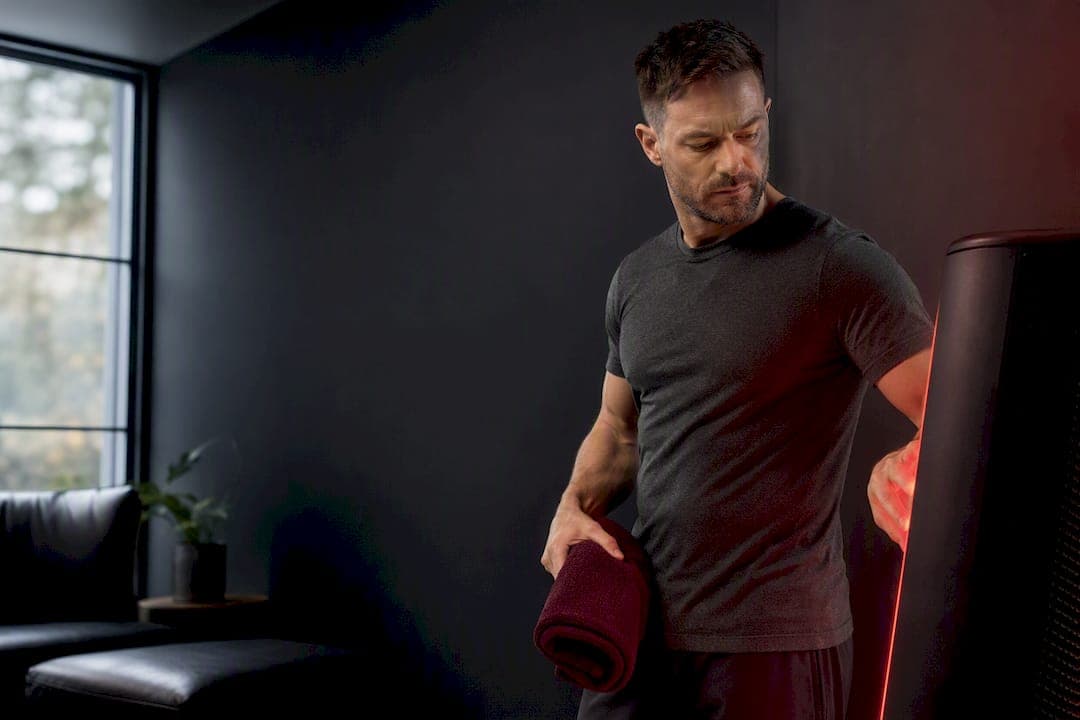
Short verdict: red light photobiomodulation is biologically plausible but unproven in humans for raising testosterone. Treat it as an experimental, supportive at‑home recovery routine, not a fertility treatment. Skip the scrotal heat, don't skip the checkup, and don't expect a lab report to change overnight.
TL;DR:
- Human evidence for red light therapy increasing testosterone remains limited and inconsistent, with no validated dosing standards or proven fertility benefits.
- Animal studies show increased Leydig cell counts and testosterone after direct testicular red light exposure, mainly in controlled conditions and not in humans.
- The safest and most effective protocol involves using red light in the 630 to 670 nanometer range, for 5 to 10 minutes every other day, over a 6 to 8 week period.
- Dosing is crucial, as higher exposure does not necessarily lead to better results due to the biphasic dose response, and heat regulation is essential to avoid tissue damage.
- Red light therapy is best viewed as a supportive recovery routine rather than a verified method for improving testosterone or fertility.
Table of Contents
- What The Research On Red Light Therapy Fertility Actually Shows
- Is This Routine Right For You?
- How Do You Build A Safe At-Home Red Light Routine?
- What Are The Real Risks And Warning Signs?
- How Do You Know If It's Working?
- Does Red Light Therapy Affect Female Fertility Too?
- How Does Red Light Compare To Other Fertility Support Options?
- Are Red Light Devices Regulated For Fertility Claims?
- Have Any Human Studies Actually Tested This?
- A Practitioner's Honest Take On Where This Fits
- A Guided Option For Building This Routine Correctly
- Sources
What The Research On Red Light Therapy Fertility Actually Shows
The animal data is real, and it's the reason this conversation exists at all. Multiple preclinical studies have found that photobiomodulation, delivered directly to testicular tissue in mice and rats, increases Leydig cell counts and raises serum testosterone. Leydig cells are the ones that actually manufacture testosterone, so a treatment that boosts their numbers has a plausible route to higher hormone output. That's not hype. That's mitochondria doing what mitochondria do when you hit them with the right wavelength.
One 2024 study pushed the concept further. Researchers induced scrotal hyperthermia in mice, essentially simulating the kind of heat damage that tanks sperm production, then applied photobiomodulation at 890 nanometers afterward. The treated mice showed better testicular structure, improved sperm parameters, and higher testosterone than the hyperthermia group left untreated. That's a repair story, not just a boost story.
Here's where it gets complicated. The mechanism behind all of this runs through cytochrome c oxidase, an enzyme inside mitochondria that responds to red and near-infrared light by cranking up ATP production. This activates a chain reaction involving reactive oxygen species regulation and cell-repair signaling. It's a legitimate biological pathway. But mechanism in a petri dish or a rodent testis doesn't automatically mean results in a grown man standing in front of a red light panel in his garage.
The honest gap: human trials just aren't there yet. A recent scoping review of alternative men's health therapies found the human evidence heterogeneous at best, with light therapy studies often showing no significant hormone change, though some men reported better subjective sexual satisfaction. That distinction between "felt different" and "tested different" matters here.
What the evidence supports strongly:
- Exercise recovery and muscle performance benefits from red light exposure
- Mechanistic plausibility for testicular tissue repair in animal models
- A clear biphasic dose response, where more light isn't automatically more benefit
What it doesn't support yet:
- Reliable testosterone increases in human men
- Any claim that red light therapy improves fertility outcomes
- Dosing standards validated in human testicular tissue
The strongest consumer-level evidence for red light devices sits in recovery and performance use, not hormone therapy. That gap between rodent data and human proof is exactly why this belongs in your "worth trying carefully" bucket, not your "solved problem" bucket.
Is This Routine Right For You?
You're a good candidate if you're a man over 30 who wants to support energy, recovery, and general vitality, and you understand this is a supportive routine, not a clinical fertility intervention. You're not chasing a diagnosis. You're maintaining ground before you need a bigger conversation.
Realistic expectations matter more than optimism here. Some men report feeling sharper, recovering faster from workouts, or noticing better morning energy. Testosterone increases specifically remain unproven and inconsistent across the limited human data available. Don't measure success by a number you haven't tested yet.
Hold off, or talk to a clinician first, if any of this applies to you:
- You have a known testicular condition, injury, or diagnosed varicocele
- You or your partner are actively pursuing fertility treatment
- You've already been diagnosed with hypogonadism or another hormonal condition
- You're on medication that affects heat sensitivity or skin photosensitivity
This isn't about fear. It's about not layering an experimental routine on top of an unresolved medical issue.
How Do You Build A Safe At-Home Red Light Routine?
The protocol that makes sense for most men is boring on purpose. Boring means safe. Here's the setup:
Wavelength. Stick with red light in the 630 to 670 nanometer range for testicular application. Near-infrared above 800 nanometers penetrates deeper and generates more heat at depth, which is exactly the risk you're trying to avoid in this region of the body.
Distance and duration. Position the device 30 to 50 centimeters from the treatment area. Keep sessions to 5 to 10 minutes. This isn't the area of your body where you go longer for better results.
Frequency and trial length. Every other day works well as a starting cadence. Give it 6 to 8 weeks before drawing any conclusions about whether it's doing anything for you.
Follow this sequence each session:
- Set up your device at the correct distance and confirm the timer before you start.
- Position yourself so the light hits the target area directly, without leaning in closer than planned.
- Check skin temperature by touch halfway through the session.
- Stop immediately and increase distance if the area feels warm rather than just lit.
- Log how you feel afterward: energy, mood, sleep quality, anything worth tracking.
Device selection matters as much as the protocol. Favor panels with lower irradiance output or active cooling features over high-powered units marketed for faster results. Avoid direct skin contact, and steer clear of high-power laser devices entirely for this application. The companion protocols in Primal Red Co's photobiomodulation guide walk through session structuring in more depth if you want a second reference point.
Pro Tip: Set a phone timer for your session length before you start. It's easy to lose track of time under warm light, and "just a few more minutes" is exactly how thermal exposure creeps up on you.
Before you start any of this, establish a baseline. Note your current energy levels, libido, morning erection frequency, and workout recovery time. Some men choose to get a morning total testosterone test done before starting, purely so they have a real number to compare against later if they want one.
What Are The Real Risks And Warning Signs?
Heat is the enemy here, not the light itself. Scrotal tissue is temperature-sensitive by design. Warming it, even a little more than intended, can interfere with sperm production and works directly against whatever benefit the light is trying to deliver. This is the single most important rule in this entire routine.
Dosing isn't linear either. Photobiomodulation follows a biphasic dose response, meaning benefits climb with dose up to a point, then flatten or reverse if you overdo it. More sessions or longer exposure is not automatically better, and pushing past the conservative parameters outlined above can undo progress instead of accelerating it.
Basic precautions worth locking in:
- Never look directly into the light source; protect your eyes.
- Keep skin free of lesions, open cuts, or active irritation before starting a session.
- Use timer-based sessions rather than eyeballing duration.
- Choose devices with clear specifications rather than vague "clinical-grade" marketing language.
Stop and see a clinician if you notice persistent warmth after sessions, any pain, new skin lesions, or a sudden drop in sexual function. None of those are things to wait out.
How Do You Know If It's Working?
Track two things: how you feel, and eventually, what a lab test says. Subjective logs covering energy, libido, and workout recovery give you the fastest signal. If you want objective data, a morning total testosterone test before you start and another after 6 to 8 weeks gives you something concrete to compare.
Don't judge results early. Hormone levels fluctuate day to day, and placebo effect is real when you're actively looking for improvement. Give the full window before deciding anything.
Talk to a clinician when:
- Lab results confirm low testosterone rather than just a feeling of low energy
- You or your partner have active fertility concerns
- You notice any adverse effects during the routine
A simple log beats guessing every time.
Does Red Light Therapy Affect Female Fertility Too?
This question comes up often enough to address directly, even though it sits outside what this routine is built for. Some research interest exists around red and near-infrared light's effects on ovarian tissue and endometrial receptivity, the lining environment that determines whether implantation can succeed. The proposed mechanism mirrors what happens in male tissue: mitochondrial stimulation via cytochrome c oxidase, potentially supporting cellular energy production in ovarian follicles or improving blood flow to the uterine lining.
That mechanistic overlap is where the similarity ends. This is a completely different physiological system, involving hormonal cycles, follicular development, and implantation biology that don't map onto testicular function in any direct way. The reproductive endocrinology field is still working through what, if anything, red light exposure reliably changes in these tissues, and any claims in this space belong to fertility specialists and reproductive medicine, not a home wellness routine.
If a partner is exploring options related to ovarian function or fertility support, that conversation belongs with a reproductive endocrinologist, not a red light panel purchased online. The mechanism might rhyme with what's happening in male tissue. The clinical application does not.
How Does Red Light Compare To Other Fertility Support Options?
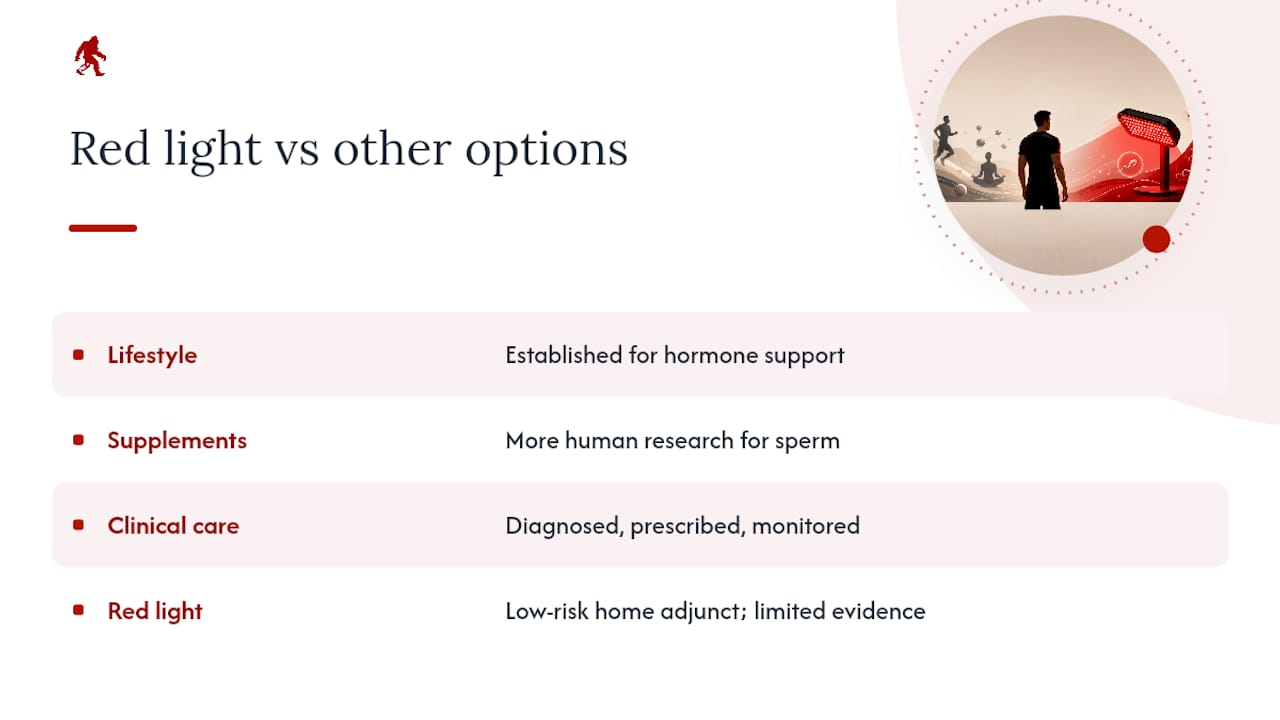
Men and couples looking at reproductive health support have more than one lever to pull, and it helps to know where red light therapy actually sits in that lineup. Lifestyle interventions, weight management, reduced alcohol intake, and improved sleep, carry a longer track record for supporting hormone balance and reproductive function than any light-based device does right now.
Nutritional and antioxidant approaches, including certain supplements marketed for male fertility, have more human research behind them for supporting sperm parameters than photobiomodulation currently does. That doesn't make them a guaranteed fix either, but the evidence base is broader.
Clinical interventions, hormone therapy, medications like clomiphene for men with confirmed low testosterone, and structured fertility treatment protocols, operate in an entirely different category. Those are diagnosed, monitored, and prescribed. Red light therapy is none of those things. It's a low-risk, low-heat, home-based routine that might support general recovery and energy while you figure out whether you need something more clinical. If you're already exploring the medical route, understanding what clomiphene actually does for confirmed low testosterone gives useful context for how that conversation differs from a wellness routine.
Red light therapy works best as one piece of a broader approach, not a replacement for any of the above.
Are Red Light Devices Regulated For Fertility Claims?
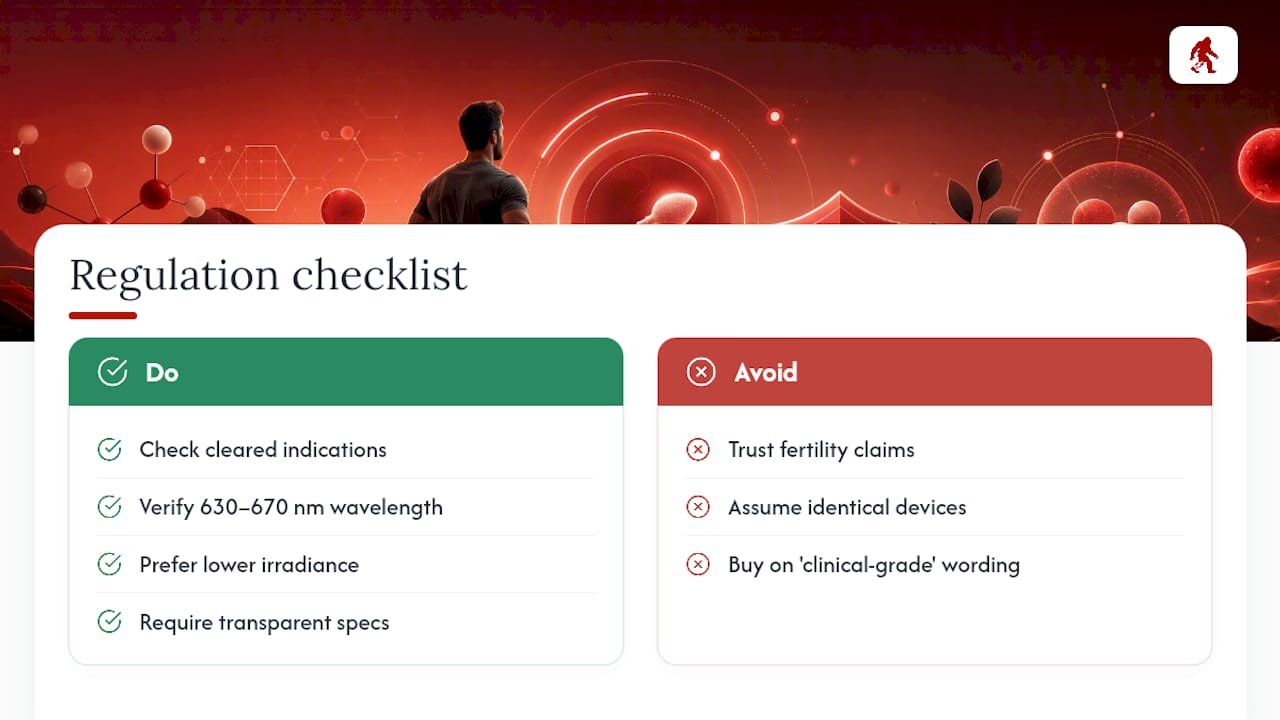
No red light device carries FDA clearance for improving testosterone or fertility outcomes, and that's worth sitting with for a second. Most consumer devices on the market are cleared under a 510(k) pathway for indications like scalp hair growth or minor pain relief, not for hormone-related claims. Device clearance is not the same as medical approval for the specific use you're considering here.
That distinction protects you as a buyer. A device cleared for pain relief can legally exist on the market without a single study behind its testosterone marketing claims. If a product page promises fertility improvements or testosterone spikes as a guaranteed outcome, that's marketing language outrunning the regulatory reality. Look instead for devices that are transparent about their actual wavelength output, irradiance specifications, and cleared indications, rather than ones that lean on vague "clinical-grade" language without backing it up. The FDA's actual position on red light therapy for men is worth understanding before you buy anything, and it applies whether you're 32 or 62.
Quality control also varies wildly between manufacturers. Irradiance output, wavelength accuracy, and build consistency differ enough between devices that two products marketed identically can perform very differently in practice. Matching your device specs to a conservative protocol, red light in the 630 to 670 nanometer range, lower irradiance, is a safer bet than chasing whichever panel promises the highest output number on the box.
Have Any Human Studies Actually Tested This?
Direct human clinical trials testing testicular photobiomodulation for testosterone or fertility outcomes are effectively absent right now. That's not a soft way of saying "limited." It means the specific study you'd want, healthy men, testicular red light exposure, measured hormone and fertility outcomes, hasn't been run at meaningful scale yet.
What exists instead is a patchwork: strong animal models showing testosterone and Leydig cell increases, mechanistic research explaining plausible pathways, and scoping reviews of adjacent men's health therapies showing mixed, often non-significant results when hormone outcomes specifically get measured in humans. Some men in those broader studies reported improved subjective sexual satisfaction even without measurable hormone shifts, which suggests something is happening, just not necessarily the something the marketing implies.
This gap is exactly why credible reviews of the space frame red light therapy's strongest human evidence around recovery and performance applications rather than hormone claims. The animal data earns cautious optimism. The human data earns patience. Anyone selling you certainty in either direction, glowing promises or dismissive skepticism, isn't reading the research the way it actually reads.
A Practitioner's Honest Take On Where This Fits
The biggest mistake I see men make with this topic is treating "biologically plausible" as the same thing as "proven." It isn't, and pretending otherwise sets you up to either overtrust a home device or dismiss a legitimate recovery tool because it didn't cure something it was never built to cure. Red light exposure has a real mechanism, real animal data, and a real place in a maintenance routine. It does not have a human trial confirming testosterone gains, and anyone telling you otherwise is skipping past the actual research.
What I'd tell any man asking about this: use it as one supportive habit among several, respect the heat rule without exception, and get labs done if something feels genuinely off rather than guessing. Support what you have. Don't wait until the only option left is a bigger, harder conversation with a specialist.
— Nurse Rachel
A Guided Option For Building This Routine Correctly
Getting the wavelength, distance, and timing right on your own takes some trial and error, and most men skip the tracking step entirely because it's tedious without a system. A red light device paired with a companion app can walk you through session length, distance guidance, and cooling cues so you're not eyeballing a timer and guessing at skin temperature.

This isn't a clinical fertility treatment, and Primal Red Co doesn't position it as one. It's a structured wellness routine for men who want consistency without having to reverse-engineer a protocol from scattered research every time they sit down for a session. The app tracks your sessions over time, which solves the biggest weakness in any self-directed routine: nobody actually remembers if week four looked different from week one without something logging it for them.
If you're ready to build this habit properly instead of piecing one together from memory, take a look at RedRockit's page for men over 30 and see how the guided session structure compares to what you're currently doing. Support what you've got before you need a bigger fix.
Sources
The peer-reviewed sources cited throughout this piece cover the Leydig cell and testosterone research, the scrotal hyperthermia recovery study, and biphasic dosing mechanics. For protocol depth, see Primal Red Co's guides on testicular red light evidence, home safety rules, and side effects to watch for.
This article is general information, not a substitute for advice from a qualified doctor. Consult a qualified healthcare professional about your own circumstances before acting on anything here.
- Photobiomodulation effects on Leydig cell activity and testosterone levels — PubMed entry (2024)
- Effects of photobiomodulation on testicular tissue after scrotal hyperthermia — PMC (2024)
- Biphasic dose response in photobiomodulation research — PubMed (2020 review)
- Red light therapy panel: evidence review — Superpower guide (2025)