
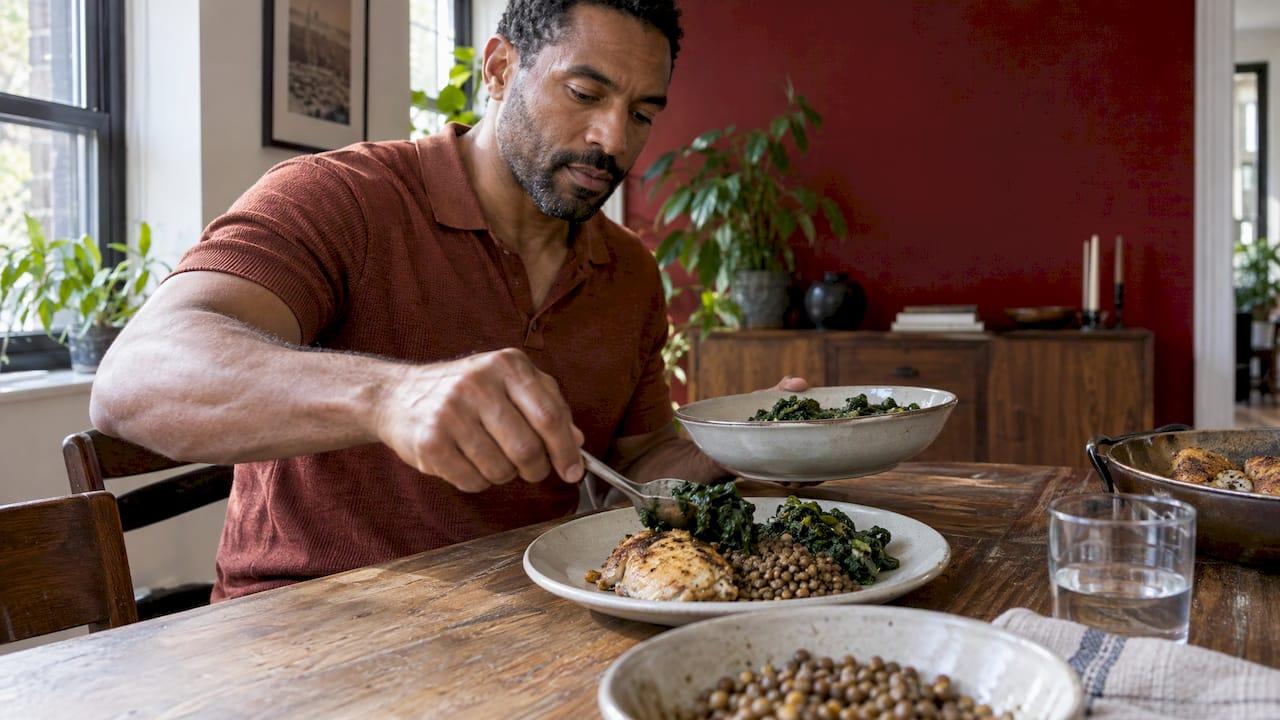
For most men, protein does not wreck testosterone. Normal and even high intakes show no consistent drop. Only extreme intakes, above roughly 3.4 grams per kilogram of body weight per day, have been tied to a measurable dip, and so has eating too little for too long. The sweet spot is boring and doable: enough protein, enough total food, and a plate that is not built on one macro.
You have probably seen both stories. One says protein is the building block of every strong man. The other says shakes and steak are quietly draining your T. Neither holds up as a blanket rule. Here is what the studies show, where the confusion comes from, and what to do with it.
TL;DR
- Moderate and high protein intakes (about 1.25 to 3.4 g/kg/day) have not shown a consistent drop in testosterone. Only very high intakes above 3.4 g/kg/day have.
- Eating too little protein, or too little food overall, can lower testosterone. That effect is generally reversible when intake is restored.
- Animal vs. plant protein shows small differences in observational data. Small, and not proof of cause.
- Whey and soy are not testosterone villains in the studies we reviewed.
- Protein is one lever. Sleep, strength training, body composition, and total calories matter just as much.
Table of Contents
- What the research says about high-protein diets
- What happens when you eat too little protein
- How much protein should a man eat?
- Animal protein vs. plant protein
- Whey and soy: what the studies actually found
- The part everyone skips: what protein replaces
- A plate that supports testosterone
- Our perspective
- Build the routine, not just the plate
- FAQ
- Sources
What the research says about high-protein diets
The most useful single source here is a 2022 commentary by registered dietitian Joseph Whittaker. It sorted diets into bands: very high protein (above 3.4 g/kg/day), high (1.9 to 3.4), moderate (1.25 to 1.9) and low (below 1.25). His conclusion: only very high-protein diets show a consistent decrease in total testosterone, while high and moderate ones do not.

Put that in real numbers. A 180-pound man weighs about 82 kg. The very high band starts near 278 grams of protein a day. Most men eat nowhere close. The same commentary notes that the general population averages around 1.3 g/kg/day and conventional high-protein diets rarely pass 3 g/kg/day.
Where the scary headline comes from
A 2022 meta-analysis by Whittaker and Harris found that low-carbohydrate, high-protein diets decreased men's resting total testosterone by about 5.23 nmol/L. Look at the fine print:
- It pooled three studies with only 26 men in total.
- The diets lasted just 3 to 10 days.
- The effect showed up with very high protein and low carbohydrate together, not with protein alone.
Older work points the same way. A 1987 study found testosterone was higher after 10 days on a high-carbohydrate diet than on a high-protein one (468 vs. 371 ng/dL). Another small study of 11 healthy men found that drinking a protein solution lowered mean serum testosterone from 415 to 340 ng/dL, with suppression lasting about 320 minutes.
These are short-term, small, tightly controlled experiments. They show the body reacts to what you eat. They do not show that a normal protein-rich week turns you into a different man.
Why the body might do this
Whittaker suggests the dip on very high protein may be part of a protective response, a hormonal adjustment that helps the body handle the extra nitrogen load (he links it to the urea cycle and ammonia). If that is right, it is the body managing a load, not a sign of damage.
Protein and weight loss together
Context matters. In a 2016 trial of 118 overweight or obese men on a 52-week calorie-restricted diet, one group ate higher protein (35% of energy) and the other higher carbohydrate (17% protein). Both groups saw significant increases in total testosterone, with no meaningful difference between them. In that study, losing excess body weight did more for T than the protein ratio did.
If you carry extra fat around your middle, that is worth sitting with. Fat tissue and insulin problems pull on your hormones. We cover that loop in our piece on insulin resistance and testosterone.
What happens when you eat too little protein
Here is the part nobody posts about. Under-eating is a bigger and more consistent threat to T than a chicken breast ever was.
- A 1975 study of 28 men with severe protein-calorie malnutrition found low total and unbound testosterone that rose to normal during two to five months of refeeding. The problem traced mainly to reduced Leydig cell function, the cells in the testes that make testosterone.
- In a 1999 study of hospital patients with protein-energy malnutrition, total testosterone was subnormal in 31.4% of the men, more often in those with low BMI.
- In an 8-day field exercise with severe energy deficit, total testosterone fell 49% and free testosterone 60%. Protein intakes of 0.5 and 0.9 g/kg only minimally softened the drop.
Those are extreme cases, but the lesson scales down. A review of energy deficit concluded that it can lower testosterone through the hypothalamic-pituitary-testicular axis, and that this is generally reversible by restoring energy balance.
That matters for the guy who crash-diets, skips meals, trains hard, and wonders why he feels flat. If that sounds like you, read our take on overtraining and low testosterone and what fasting does to your T.
How much protein should a man eat?
The official floor is modest. The recommended dietary allowance for adults is 0.8 g/kg/day, which is a minimum to avoid deficiency, not a target for a man who trains.
A few practical anchors:
| Intake band | Grams per kg per day | About, for a 180 lb (82 kg) man | What research suggests for T |
|---|---|---|---|
| Low | Below 1.25 | Under 102 g | Fine if calories are adequate; very low intake plus under-eating can lower T |
| Moderate | 1.25 to 1.9 | 102 to 156 g | No consistent drop |
| High | 1.9 to 3.4 | 156 to 279 g | No consistent drop |
| Very high | Above 3.4 | Above 279 g | Consistent short-term decrease in total T |
Bands come from Whittaker's definitions. The gram figures are our arithmetic.
More is not automatically better, either. In the OPTIMen trial, 78 men aged 65 and older ate either 1.3 or 0.8 g/kg/day for six months, and the higher protein group did not gain lean mass or muscle performance. That is an older group, so do not stretch it to every man, but it shows protein is not a magic dial.
UCLA Health notes that most healthy people can safely eat up to 2 grams per kilogram, about 135 grams a day for a 150-pound person. For a man who lifts, landing in the moderate to high band, spread across meals, covers most goals without brushing the very high zone.
Animal protein vs. plant protein
This is where the newest headlines live. A 2026 cross-sectional study of 2,546 Finnish men aged 42 to 60 found that men in the highest animal-protein quartile had total testosterone 1.2 nmol/L lower than the lowest quartile, while the highest plant-protein quartile had levels 1.1 nmol/L higher. SHBG, the protein that binds testosterone in the blood, followed the same pattern.
Before you toss the steak, read what the researchers said. The University of Eastern Finland's Miika Wynne-Ellis noted the differences, though statistically significant, were relatively small, and the design cannot show that animal protein lowers T or that a plant-based switch raises it. The same coverage reported dairy protein linked with lower testosterone and SHBG, meat protein with lower SHBG but not testosterone, and non-cereal plant protein with higher testosterone.
Our read: it is a pattern worth knowing, not a verdict. Men who eat more plants also tend to eat more fiber and less processed food, and they tend to differ in other ways. If your plate is all meat and no vegetables, add plants. You do not need to give up meat.
SHBG changes how your lab results read. If your numbers confuse you, see why men should order total T and SHBG together, before 10 AM.

Whey and soy: what the studies actually found
Whey. In a 2018 trial, 47 college-aged men resistance-trained for 12 weeks. Whey protein concentrate raised fasting total testosterone more than soy concentrate or placebo, and estradiol did not change in any group. That does not make whey a testosterone booster. It does mean the claim that whey lowers T has little support here.
Soy. A 2021 meta-analysis of 41 studies found no significant effect of soy or isoflavone intake on male testosterone, regardless of dose or duration. One small 2013 study of 10 trained men found that 14 days of soy isolate partially blunted the testosterone response to a heavy lifting session, so the picture is not perfectly tidy. We break it down in soy and testosterone: what men need to know.
Takeaway: choose the protein you will actually eat, tolerate well, and can afford. Rotate sources. Do not build your whole identity around one powder.
The part everyone skips: what protein replaces
Cleveland Clinic lists the usual signs of overdoing protein: constipation when protein replaces fiber, dehydration, bad breath on very low-carb plans, and weight gain when extra protein pushes calories too high. UCLA Health adds that too much protein is a concern when it crowds out carbohydrates or healthy fats.
One diet pattern also shows up in the data. In NHANES data on 3,128 men, mean testosterone was lower in men on a low-fat diet (410.8 ng/dL) than in men on a nonrestrictive diet (443.5 ng/dL). The lesson is that extreme restriction of any macro, fat included, tends to cost you.
Safe-use notes, where they matter:
- If you have kidney disease, talk with your doctor or a registered dietitian before raising protein. Northwell Health reports that excess protein can increase kidney workload, especially with existing kidney disease.
- If you raise protein, raise water. Fatigue, headaches, or dark urine can signal dehydration, per the same source.
- If your protein comes mainly from red or processed meat, saturated fat climbs with it. Mix in fish, eggs, beans, and dairy.
- Heavy protein intake can also affect calcium handling. If that concerns you, read about protein and bone density.
A plate that supports testosterone
Protein is a piece of the puzzle. Here is a simple build for the man over 30 who wants steady energy, not a lab experiment:
- Anchor each meal with protein. Aim for the moderate to high band, roughly 1.25 to 2 g/kg/day if you train.
- Keep carbs and fats in the picture. Do not run very high protein with very low carbs for weeks on end.
- Eat enough. Under-fueling is the easiest way to push T down. Cut calories gently if you are losing weight.
- Fill the rest of the plate with real food: vegetables, fruit, nuts, seeds, olive oil, fish, eggs.
- Lift. Resistance training does more for how you feel and perform than any macro tweak. See why strength training beats chasing testosterone spikes.
- Check the basics. Our guides on foods that support testosterone and zinc and testosterone go deeper on specific nutrients.
If you want a plant-forward angle on hormone support, one resource covers hormonal balance ingredients and rituals from a vegan nutrition view.
Our perspective
Men write to us worn out and sure that something they ate broke them. Usually it is not the chicken or the shake. It is the whole picture: poor sleep, skipped meals, too much stress, too little lifting, and a body that has quietly stopped getting the signal it used to get automatically.
We built Primal Red Co. for the man who feels the shift coming and wants to act before bigger decisions land on the table. We are not a clinic. We are not TRT. We do not diagnose, and we will never tell you that you are broken.
Here is what we do believe. Food matters. Protein matters. But no macro fixes a tank that never fills. That is why we pair smart eating with a daily restoration routine. RedRockit is our private-use red light wellness device, designed to support energy, drive, and recovery, with a companion app, Rockit IQ, for guided sessions. No subscriptions. No appointments. No ongoing dependence.
YOU HAVEN'T LOST IT. Eat enough, lift something heavy, sleep, and give your body a reason to answer. And if your symptoms are heavy or persistent, get your labs checked and talk to your doctor. That is smart, not weak.
Nurse Rachel
Build the routine, not just the plate
Diet is the foundation. If you are done with feeling flat and want a daily practice to sit on top of it, RedRockit is designed to be that tool: a private, at-home red light wellness device that supports a simple restoration routine for men over 30. It is not a supplement, not a prescription, and not a clinic visit.
See how it works on the RedRockit page, or read our honest look at alternatives to TRT and what to try before TRT. Partner reading the labels for him? Start with the page for her.
Not sure whether your numbers are low to begin with? Our guide to normal testosterone levels in men explains the ranges.
FAQ
Does a high-protein diet lower testosterone?
Usually not. Moderate and high intakes, up to about 3.4 g/kg/day, have not shown a consistent drop in total testosterone. The decrease appears at very high intakes, in short, small studies, often combined with low carbohydrate intake.
Can too little protein lower testosterone?
Yes, especially when it comes with too few calories overall. Studies of malnutrition and severe energy deficit found lower testosterone that generally recovered when intake was restored. If you are cutting weight or training hard, eat enough.
Is whey or soy protein bad for testosterone?
The research does not support that fear. One 12-week trial in trained men found whey raised fasting total testosterone more than soy or placebo, and a meta-analysis of 41 studies found no significant effect of soy on male testosterone. Pick what suits your digestion and goals.
Is plant protein better than animal protein for testosterone?
Not proven. A Finnish observational study linked higher plant protein to slightly higher testosterone and higher animal protein to slightly lower, but the researchers said the differences were small and cannot show cause. A mix with plenty of vegetables is a sound approach.
What are signs I am eating too much protein?
Common signs include constipation, dehydration, bad breath on very low-carb plans, bloating, and weight gain from extra calories. If you have kidney disease, check with your doctor before raising protein.
Sources
- High-protein diets and testosterone (PMC, 2022)
- Low-carbohydrate diets and men's cortisol and testosterone (2022)
- Diet-hormone interactions: protein/carbohydrate ratio (1987)
- Oral ingestion of macronutrients and testosterone (2022)
- Long-term effects of a randomised controlled trial in obese men (PLOS One, 2016)
- The pituitary-gonadal axis in men with protein-calorie malnutrition (1975)
- Protein-energy malnutrition and testosterone in men and women (1999)
- Effects of dietary protein content on IGF-I and testosterone (Journal of Applied Physiology)
- Dysregulation of the hypothalamic-pituitary-testicular axis due to energy deficit
- Eating more protein may not benefit older men (ScienceDaily, 2018)
- How much protein do you really need? (UCLA Health, 2025)
- Associations of dietary proteins with serum testosterone (Finnish men)
- More greens, higher testosterone? What a Finnish study found (Euronews)
- Soy protein supplementation is not androgenic or estrogenic (2018)
- Effects of soy and whey protein supplementation (2013)
- Neither soy nor isoflavone intake affects male reproductive hormones (2021)
- The association between popular diets and serum testosterone
- Can you eat too much protein? (Cleveland Clinic)
- How much protein is too much? (Northwell Health)