

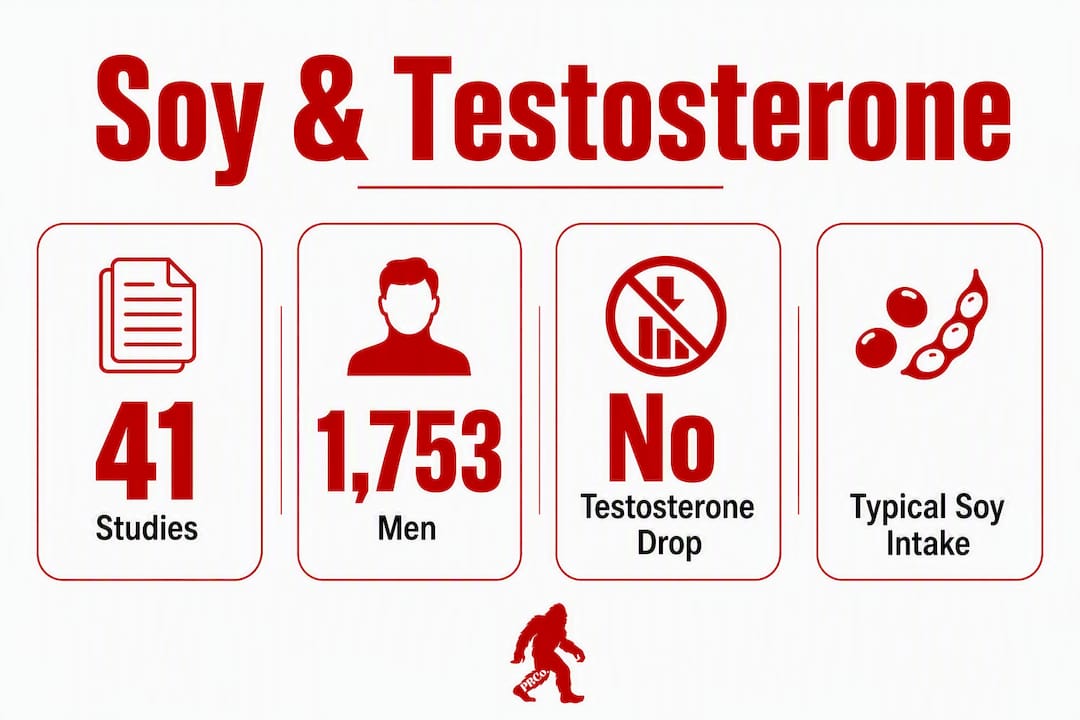
The bottom line on soy testosterone concerns is this: clinical meta-analyses consistently find that typical soy food intake does not meaningfully lower testosterone in healthy men. A 2021 expanded meta-analysis covering 41 studies and approximately 1,753 men found no significant effect on total testosterone, free testosterone, estradiol, estrone, or SHBG, regardless of dose or duration. That is not a small dataset. That is the most comprehensive human evidence available on this question, and it points in one direction.
So if you have been cutting tofu out of your diet because you heard it kills your testosterone, you can stop. The fear is louder than the evidence.
- The soy-lowers-testosterone claim is largely driven by animal studies and isolated case reports, not aggregate human clinical data.
- Typical whole-food soy servings contain isoflavone levels well below doses associated with any hormonal signal in trials.
- If you are experiencing low libido, fatigue, or erectile dysfunction, the culprit is far more likely to be sleep, body composition, alcohol, or stress than soy.
Pro Tip: Before you eliminate any food group, get your labs done. Total testosterone, free testosterone, LH, and SHBG tell you far more than any dietary experiment.
Table of Contents
- What the clinical research actually shows about soy and testosterone
- Why people worry: how isoflavones actually interact with your hormones
- Whole-food soy vs. supplements: does the form actually matter?
- What the outliers and case reports actually tell you
- What about estrogen, sperm quality, and fertility?
- What to actually do if you're worried about your testosterone
- A clinician's perspective on soy, testosterone, and what men actually need
- Key Takeaways
- The signal worth paying attention to
- What to try before the bigger decisions arrive
- Useful sources and further reading
What the clinical research actually shows about soy and testosterone
The evidence here is unusually consistent for a nutrition topic. When you pool the data across decades of randomized trials and observational studies, the signal is clear.
The 2021 Reed et al. meta-analysis is the anchor. Forty-one studies. Roughly 1,753 men with measured total testosterone. No significant effect. Sub-analyses by dose and duration did not change the conclusion. Whether men consumed soy for a few weeks or longer than 12 weeks, whether they ate whole foods or protein isolates, the aggregate result held.
Statistic to know: Meta-analyses covering many studies and men found no statistically significant change in total or free testosterone due to soy protein or isoflavone intake.
A 2025 dose-response systematic review added another layer of confidence. Researchers looked specifically for a linear or nonlinear dose-response relationship in healthy men. They found none. More soy did not mean lower testosterone in any consistent pattern.
There are outliers. A 2007 trial of 12 men consuming 56 grams of isolated soy protein daily for four weeks reported a mean testosterone decrease of around 19%. That result gets cited a lot. What gets cited less: twelve men, four weeks, isolated protein at a dose most men never approach. Small trials produce noisy results. Meta-analyses exist precisely to correct for that noise.
- Most trials run 4–12 weeks; longer trials show the same null result.
- Dose sub-analyses in the 2021 meta-analysis found no threshold effect.
- The 2007 outlier trial used 56 g isolated soy protein daily, far above typical dietary exposure.
- Heterogeneity in some analyses traces back to a small number of influential studies, not a consistent pattern.
The science is not ambiguous here. The popular narrative is just running about 20 years behind it.

Why people worry: how isoflavones actually interact with your hormones
Soy contains isoflavones, specifically genistein and daidzein. These are phytoestrogens, plant compounds with a chemical structure loosely similar to human estradiol. That structural resemblance is where the fear starts. It is also where the science gets more nuanced than most headlines allow.
Phytoestrogens are not estrogen. They bind to estrogen receptors, but they behave as partial agonists or antagonists depending on the tissue and the receptor subtype. Their binding affinity for estrogen receptors is orders of magnitude weaker than endogenous estradiol. Confusing structural similarity with physiological estrogenicity is one of the most common errors in popular coverage of this topic.
The rodent studies that launched much of the public concern are a good example of why translation matters. Rodents metabolize isoflavones differently from humans. They produce equol, a downstream isoflavone metabolite, at much higher rates than most humans do. They also receive doses in studies that are many times higher than anything a man eating a normal diet would encounter. Applying those results directly to men eating tofu twice a week is a category error.
Pro Tip: When you see a headline about soy "feminizing" men, check whether the study used rats or humans, and what the dose was. Those two details change everything.
- Isoflavones act as partial estrogen receptor agonists/antagonists, not as human estrogen equivalents.
- Rodent equol production is significantly higher than in most humans, making animal-to-human translation unreliable.
- Only about 30–50% of people are "equol producers," meaning individual metabolic variation affects how isoflavones are processed.
- Tissue-level effects, such as any influence on DHT conversion, remain less studied and represent a genuine knowledge gap.
The mechanism for harm exists on paper. In practice, at the doses men actually eat, it does not appear to translate into measurable hormonal disruption.
Whole-food soy vs. supplements: does the form actually matter?
Yes, and this is where the nuance lives. Not all soy is the same, and the dose gap between a serving of edamame and a concentrated isoflavone supplement is significant.
| Soy Food | Typical Serving | Estimated Isoflavones |
|---|---|---|
| Edamame | 1 cup | typical isoflavone level |
| Tofu, firm | 3 oz | ~20 mg |
| Soy milk | 1 cup | ~6–7 mg |
| Tempeh | 3 oz | typical isoflavone level |
| Textured soy protein | ¼ cup dry | typical isoflavone level |
| Isolated isoflavone supplement | 1 capsule | typical isoflavone range |
Typical Japanese dietary intake, often cited as a high-soy reference point, runs roughly 25–50 mg of isoflavones per day. Case reports describing hormonal disruption have involved intakes up to ~360 mg per day, many times that level. That context matters enormously when you are deciding whether your morning soy latte is a problem.
The 2021 meta-analysis found no effect across the dose ranges used in clinical studies, which generally reflect realistic dietary exposure. The 2025 dose-response review confirmed no linear association even when dose was the primary variable.
- Whole-food soy at normal serving sizes: no meaningful hormonal concern based on current evidence.
- Isolated soy protein at very high doses (e.g., 56 g/day): limited evidence of a transient effect in small trials.
- Concentrated isoflavone supplements (100 mg+ daily): the highest-plausibility category for hormonal effects; discuss with a clinician if you are using these regularly.
- Soy protein in standard protein powders: typically within ranges covered by the null-effect meta-analyses.
If you eat soy a few times a week as part of a normal diet, the evidence does not support concern. If you are stacking high-dose isoflavone supplements on top of that, that is a different conversation.
What the outliers and case reports actually tell you
Case reports are not nothing. They are signals worth understanding. They are just not the same as evidence of a population-level effect.
The most-cited cases involve men who developed gynecomastia or signs of hypogonadism after consuming soy at doses far exceeding typical diets, sometimes upward of 360 mg of isoflavones daily. When intake was reduced, symptoms often resolved. These cases are real. They are also extreme outliers in terms of dose.
Individual metabolic variation plays a role here. Equol producers, the roughly 30–50% of people whose gut bacteria convert daidzein into the more potent equol, may be more sensitive to high isoflavone loads. Baseline hormonal status matters too. A man with already-suppressed testosterone may respond differently than a healthy man with normal levels.
Study limitations also explain some of the noise in the literature:
- Many trials are short (under 8 weeks), which limits detection of slower hormonal shifts.
- Sample sizes in individual trials are often small, making outlier results more likely.
- Populations vary: some studies include men with prostate cancer or other conditions that affect hormone metabolism.
- Self-reported dietary intake in observational studies introduces measurement error.
The 2025 dose-response meta-analysis specifically addressed whether a threshold dose might exist below which soy is safe and above which it is not. No clear threshold emerged. That does not mean one cannot exist at extreme intakes, but it does mean the evidence does not support drawing a line at any realistic dietary level.
What about estrogen, sperm quality, and fertility?
Testosterone is not the only thing men ask about. Fair. Here is what the evidence says on the other endpoints.
Estradiol and SHBG: The 2021 meta-analysis found no significant effect on estradiol, estrone, or SHBG overall. Some sensitivity analyses in the 2025 review identified small signals for estradiol or SHBG, but these disappeared when influential single studies were removed. The overall evidence on estrogen endpoints is inconsistent and not robust enough to support a clinical concern at typical intakes.
Sperm quality and fertility: The picture here is less settled. Some observational studies have found associations between higher soy intake and lower sperm concentration, but the quality of evidence is limited by confounding factors, self-reported diet data, and small samples. Randomized trial data on sperm outcomes is sparse. If you are actively trying to conceive and have concerns, that is worth discussing with a reproductive specialist, not something to resolve by reading meta-analyses alone.
- Estradiol: no consistent effect at typical dietary intakes; sensitivity analyses show some signal but it is not stable.
- SHBG: similar pattern, inconsistent across analyses.
- Sperm concentration: some observational associations, but causality is not established.
- Fertility outcomes: insufficient high-quality trial data to draw firm conclusions.
If fertility is your primary concern, understanding your options before TRT is worth your time, because testosterone therapy itself carries well-documented fertility risks that dwarf anything in the soy literature.
What to actually do if you're worried about your testosterone
Stop Googling foods to eliminate. Start with data.
- Get a morning blood test. Testosterone peaks in the early morning. Test total testosterone, free testosterone, LH, and SHBG. A single low reading is not a diagnosis. Retest on a separate morning before drawing conclusions.
- Audit your sleep first. Poor sleep is one of the most reliable suppressors of testosterone. Even one week of restricted sleep can measurably reduce morning testosterone levels. Fix this before you change your diet.
- Check your body composition. Excess body fat, particularly visceral fat, drives aromatase activity, which converts testosterone to estrogen. Weight management has stronger evidence for improving testosterone than almost any dietary intervention.
- Moderate alcohol. Heavy alcohol use suppresses the hypothalamic-pituitary-gonadal axis. This is not a gray area in the research.
- Add resistance training. Compound movements, done consistently, support testosterone and growth hormone signaling. This is one of the highest-return lifestyle investments available to men.
- Treat metabolic issues. Insulin resistance, type 2 diabetes, and thyroid dysfunction all affect testosterone. Address the root cause, not the symptom.
- On soy specifically: moderate whole-food soy is safe for most men based on current evidence. If you are taking high-dose isoflavone supplements, discuss that with a clinician. Do not eliminate nutritious whole foods based on fear.
Clinician commentary consistently points to sleep, metabolic health, and body composition as the highest-leverage targets when addressing low testosterone symptoms. Soy is not on that list.
Pro Tip: Track your symptoms and labs together over 8–12 weeks. A symptom journal alongside repeat bloodwork tells you far more than removing one food and waiting to feel different.
You can also test testosterone at home with modern kits that make it easier to establish a baseline before your next clinical appointment.
A clinician's perspective on soy, testosterone, and what men actually need
The conversation about foods that lower testosterone often misses the bigger picture. Men come in worried about tofu when they are sleeping five hours a night and carrying 40 extra pounds. That is where the clinical attention belongs.
Practical routine guidance for men who want to be proactive:
- Monitor symptoms (energy, libido, mood, recovery) alongside lab values, not instead of them.
- If you make a dietary change, give it at least 8–12 weeks and retest labs before attributing any change to that adjustment.
- If testosterone comes back consistently low with symptoms, escalate to a urologist or endocrinologist. Low testosterone is a medical condition, not a lifestyle problem to solve with supplements.
- High-dose isoflavone supplements are worth flagging with your clinician, especially if you are on medications that affect hormone metabolism.
- High estrogen in men has real causes worth investigating. Soy at normal dietary levels is not typically one of them.
Key Takeaways
Clinical meta-analyses covering 41 studies and approximately 1,753 men consistently find that typical soy food intake does not significantly affect testosterone or other reproductive hormones in healthy men.
| Point | Details |
|---|---|
| Soy does not lower testosterone at typical intakes | Meta-analyses of ~1,753 men found no significant effect on total or free testosterone. |
| Dose and form matter | Concentrated isoflavone supplements warrant more caution than whole-food soy at normal serving sizes. |
| Lifestyle factors outrank diet | Sleep, body composition, alcohol, and metabolic health have stronger evidence for affecting testosterone than any single food. |
| Test before you change anything | Morning bloodwork (total T, free T, LH, SHBG) gives you real data; dietary experiments without labs are guesswork. |
| Primal Red Co supports the routine | RedRockit is a daily restoration device for men who want to support energy and drive before bigger clinical decisions are on the table. |
The signal worth paying attention to
Here is what Primal Red Co believes: the soy panic is a distraction. Not because food does not matter, but because the men who are quietly losing their drive, their energy, and their edge are not losing it to tofu. They are losing it to years of poor sleep, chronic stress, a body that stopped getting the signals it needs, and a culture that told them to push through until they crash.
The evidence on soy and testosterone is actually reassuring. It means you do not have to fear your food. What it does not mean is that everything is fine if you feel like the tank is running low. That feeling is real. It deserves a real response.
RedRockit is not a diagnosis. It is not TRT. It is a daily restoration routine for men who are paying attention before the bigger decisions arrive. That is the whole point.
What to try before the bigger decisions arrive
If your labs are borderline, your energy is not what it was, and you are not ready to walk into a TRT conversation, there is a middle path.
The RedRockit Activation Method is a private-use red light wellness device built for men over 30 who want a daily restoration routine they can actually stick with. It is not a replacement for clinical care. If you have symptoms of low testosterone, get tested and talk to a clinician. But if you want to support your energy, recovery, and drive as part of a daily routine while you figure out your next step, this is what Primal Red Co built it for.
Men who are experiencing low libido after 40 often find that the first step is simply understanding what is happening in their body. RedRockit, paired with the Rockit IQ app, gives you a structured daily protocol to work with, not a quick fix, but a consistent signal your body can respond to over time.
This content is for general informational purposes only and is not a substitute for professional medical advice, diagnosis, or treatment. Consult a qualified healthcare provider for any symptoms or concerns related to testosterone or hormonal health.
Useful sources and further reading
The research on soy and male hormones is more settled than popular media suggests. When evaluating any claim about foods that affect testosterone, prioritize meta-analyses and randomized controlled trials over case reports or animal studies.
| Source | What it shows |
|---|---|
| Reed et al. 2021 meta-analysis | 41 studies, ~1,753 men; no significant effect of soy or isoflavones on total T, free T, estradiol, estrone, or SHBG. |
| 2025 dose-response meta-analysis | No linear or nonlinear dose-response association between soy intake and testosterone in healthy men. |
| 2007 AACR small trial | n=12; reported transient testosterone decrease with 56 g isolated soy protein daily; limited by small sample and short duration. |
| ScienceDirect case report context | Extreme case reports involved intakes up to ~360 mg/day isoflavones, far above typical dietary exposure. |
- Prioritize meta-analyses. A single trial with 12 participants cannot override pooled data from 41 studies. That is not how evidence works.
- Check the dose. Most alarming claims about soy involve doses that bear no resemblance to normal eating patterns.
- Animal studies are not human studies. Rodent isoflavone metabolism differs substantially from human metabolism, making direct translation unreliable.
- Case reports identify hypotheses, not conclusions. They are worth knowing about; they are not a reason to panic about your diet.