
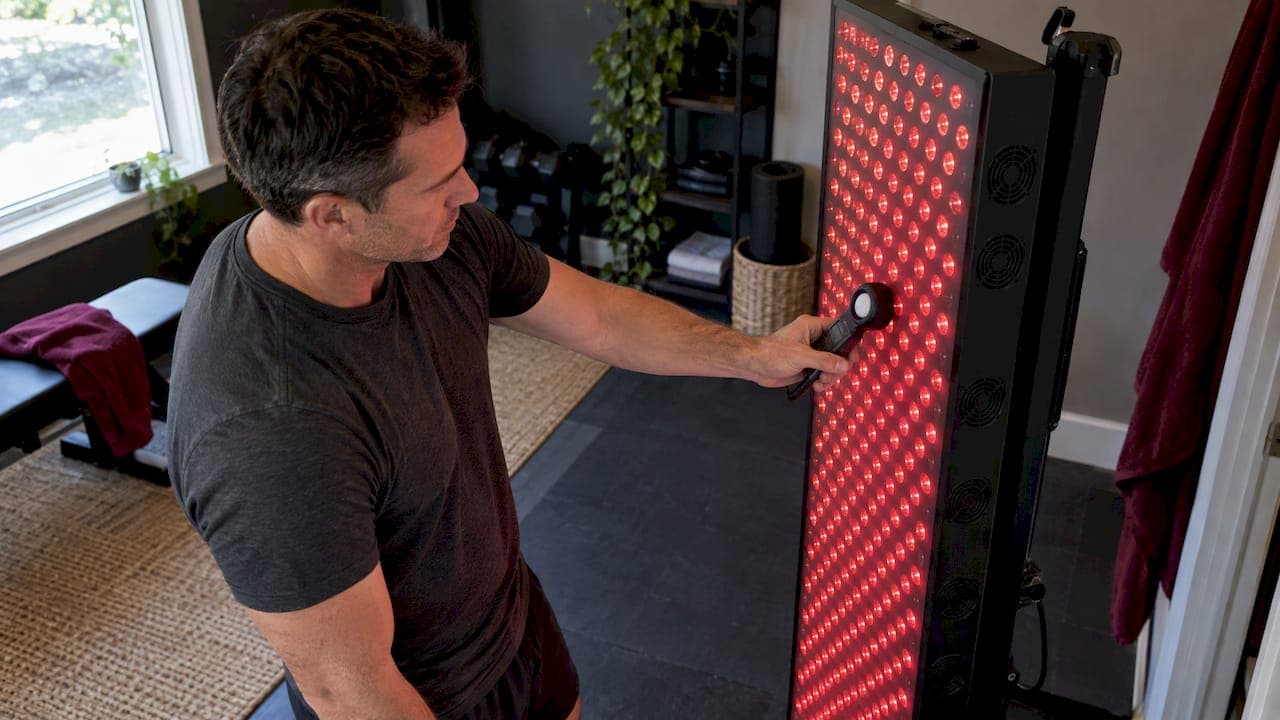
Irradiance is the amount of light energy hitting a surface per square centimeter, measured in milliwatts per square centimeter (mW/cm²). Once you know a device's irradiance at your treatment distance, you can calculate how long to sit in front of it to hit your target dose, instead of guessing. Nurse Rachel and the team behind this guidance built it for men who want real numbers, not marketing fog.
TL;DR:
- The device's irradiance should be verified at the treatment distance using a handheld radiometer to ensure accurate fluence calculations.
- Achieving effective results requires exposing skin to a dose between 10 and 30 J/cm², which may take from 3 to 17 minutes depending on the device's irradiance.
- Moving farther from the panel or increasing the beam angle reduces irradiance, necessitating longer sessions for the same therapeutic dose.
- Peak irradiance numbers are less meaningful without considering measurement methods, distance, and uniformity across the panel surface.
- Overexposure risks are minimal within standard protocols but can cause skin discomfort or burns if skin temperature is not monitored during treatment.
Table of Contents
- What Irradiance Measures: Units, Wavelength, and Spec Fallacies
- Irradiance vs. Dose: Turning Power Into an Actual Treatment Plan
- How Distance and Beam Angle Change What You're Actually Getting
- How to Measure Irradiance Without Getting Fooled by Marketing
- Practical Irradiance Ranges and Where Safety Limits Actually Sit
- Turning Irradiance Numbers Into a Device Checklist You Can Use
- Clinician Notes From Nurse Rachel: Safe Starting Parameters
- Why Irradiance Literacy Actually Protects You
- RedRockit: Built Around the Numbers in This Guide
- FAQ
- Sources
What Irradiance Measures: Units, Wavelength, and Spec Fallacies
Irradiance tells you how much power is landing on your skin right now, at this moment, at this distance. It's measured in milliwatts per square centimeter (mW/cm²) or watts per square centimeter (W/cm²), and it is a snapshot, not a total. Think of it like water pressure from a hose: irradiance is how hard the water is hitting you, not how much water has soaked your shirt by the time you walk away.
Wavelength matters just as much as power. Red light in the 600 to 700 nanometer range tends to work on surface tissue, skin, collagen, fine lines, while near-infrared light stretches deeper into muscle and joint tissue. The difference between red and infrared changes what the light can actually reach, so two devices with identical irradiance numbers can produce very different results if their wavelengths differ.
Here's where a lot of men get misled by spec sheets:
- Peak versus average irradiance: a manufacturer might advertise the highest reading from the brightest single diode, not what you actually receive across the panel.
- Measurement distance: an irradiance number means nothing without a stated distance. The same panel can read 100 mW/cm² at 6 inches and a third of that at 12 inches.
- Warm-up lag: some diodes need a few minutes to reach full output, so a cold start reading understates real performance.
- Spectral mismatch: a sensor calibrated for one wavelength range can over or underreport light outside that band.
None of this is about catching anyone in a lie. It's about reading a spec sheet the way you'd read a nutrition label: know what you're looking at before you trust it.
Irradiance vs. Dose: Turning Power Into an Actual Treatment Plan
Irradiance is power. Dose, also called fluence, is power multiplied by time, and it's the number that actually predicts results. The formula is simple:
- Fluence (J/cm²) = Irradiance (W/cm²) × Time (seconds)
- Convert your device's mW/cm² to W/cm² by dividing by 1,000.
- Solve for time: Time = Target Fluence ÷ Irradiance.
Say your panel delivers 50 mW/cm² (0.05 W/cm²) at your treatment distance, and your target is a common protocol dose of 10 to 30 J/cm². These correspond to 200 to 600 seconds, or roughly 3 to 10 minutes.
More light is not automatically better. The Arndt-Schulz principle, long observed in photobiomodulation research, describes a biphasic response: doses that are too low do little, doses in the right window help, and doses pushed too high can blunt or even reverse the benefit. This is why chasing the highest-irradiance panel on the market isn't a shortcut. It's a good way to overshoot the window that actually works.
The takeaway: a device's irradiance number only becomes useful once you turn it into a time, and that time has a ceiling, not just a floor.
How Distance and Beam Angle Change What You're Actually Getting
Move six inches back from a light panel and you don't lose a little intensity. You can lose a lot of it. Small, point-like light sources follow the inverse-square law, where irradiance drops with the square of the distance. Broad LED panels fall off more gently because they're not a single point, but the principle holds: closer is stronger, and the relationship isn't a straight line.
Beam angle changes the picture too. A narrow beam concentrates power into a smaller area, creating a bright hotspot with sharp dropoff at the edges. A wide beam spreads the same total output over more surface area, which lowers peak irradiance but treats a larger patch of skin evenly. Neither is wrong. They're just different tools.
A few practical adjustments follow from this:
- If you move farther from your panel for comfort or coverage, expect to extend your session time to hit the same fluence.
- Check whether a device's advertised irradiance is measured at the center of the beam or averaged across the panel face, since center readings overstate what your shoulders or forehead actually receive.
- For larger areas like your back or torso, prioritize even coverage over a high peak number, since uneven exposure means uneven dosing.
Pro Tip: If you're treating a wide area like your chest or back, step back slightly and accept a lower peak irradiance in exchange for more even coverage across the whole target zone.
This is also why "peak irradiance" printed in bold on a product page tells you less than it seems to. A single hotspot reading doesn't describe what the rest of your skin is getting, and a device with a lower peak but better uniformity can outperform one with a flashier number.
How to Measure Irradiance Without Getting Fooled by Marketing
If you want to verify a device's specs yourself, or simply understand what a manufacturer's claim actually represents, a few tools and habits make the difference between a real measurement and a guess.
- Handheld radiometers are the most practical option for home use. They give a direct mW/cm² reading at a specific point and distance.
- Integrating spheres capture total optical output from every angle and are typically used in lab settings rather than at home, since they require the device to be fully enclosed.
- Thermopile power meters measure total radiant power rather than a single-point reading, which is useful for calculating output across an entire panel.
Whichever tool you use, the reading is only as good as the method behind it. Hold the sensor at the exact distance you plan to treat from, not pressed against the panel. Keep the sensor perpendicular to the light source, since even a slight angle skews the reading low. Let the device warm up for the manufacturer's stated time before measuring. Take several readings across the panel's surface and average them rather than trusting a single point. And check that your meter's spectral sensitivity actually covers the wavelength you're measuring, since a sensor built for a different light type will misreport the number entirely.
When a manufacturer's claimed irradiance seems inflated compared to what you measure, ask what distance and method they used. A legitimate company will tell you exactly how they got their number.
Practical Irradiance Ranges and Where Safety Limits Actually Sit
Most red light protocols aim for a fluence of 10 to 30 J/cm² per session, and the irradiance of your device determines how long that takes.
- At 20 to 30 mW/cm² (a lower-output panel), reaching 20 J/cm² takes roughly 11 to 17 minutes.
- At 50 to 60 mW/cm² (a mid-range panel), the same dose takes about 6 to 7 minutes.
- At 100 mW/cm² (a higher-output panel at close range), you'd hit 20 J/cm² in roughly 3 minutes.
The real ceiling isn't the irradiance number. It's the fluence, and the evidence on that ceiling is more specific than most marketing suggests. Dose-escalation randomized controlled trials found LED red light was generally safe up to 320 J/cm² for skin of color and 480 J/cm² for non-Hispanic Caucasian participants, with dose-limiting side effects like blistering and prolonged redness showing up above those thresholds. That's far beyond a typical 10 to 30 J/cm² home session, which is exactly the point: standard protocols sit well inside a wide safety margin.
Heat, not light dose, is usually what causes problems first. A panel can be within safe optical limits and still warm the skin enough to cause discomfort or a surface burn if you sit too close for too long. Watch your skin temperature during a session the same way you'd watch a stovetop, and back off if it feels hot rather than warm.
Skin tone affects photosensitivity, and the trial data above reflects that directly: the safe dose ceiling for skin of color was lower than for lighter skin in that research. If you have darker skin, start conservatively and escalate slowly rather than assuming one protocol fits everyone. For a deeper look at where overexposure risk actually starts, our breakdown of red light overexposure thresholds covers it in more detail. Red light has also shown promise for joint and bone health applications at doses within these same general ranges.

Turning Irradiance Numbers Into a Device Checklist You Can Use
Once you understand irradiance, buying or using a device stops being a guessing game. Here's what to check before you commit to a routine:
- Ask for measured irradiance at a stated distance, not just a peak number pulled from a single diode.
- Confirm the wavelength range matches what you're trying to treat: surface skin benefits from red light, deeper tissue needs near-infrared.
- Find out whether the spec is peak or average output, since that single distinction can double or triple your real session time.
- Ask how the company measured the number, radiometer, integrating sphere, or something else, and at what distance.
For a face routine, a lower irradiance panel held at a comfortable distance for 8 to 10 minutes often lands in the right fluence window. A scalp or torso routine, covering more surface area, usually calls for stepping back slightly and extending time rather than crowding the panel for a shorter session.
Pro Tip: Write down your device's measured irradiance and your target fluence once, then calculate your session time ahead of time instead of eyeballing it every day.
This device's documented specs are built around these same principles, measured output at a stated distance, a wavelength range matched to common restoration routines, so the math in this guide applies directly to how it is suggested for use.
Clinician Notes From Nurse Rachel: Safe Starting Parameters
When men ask me where to start, I tell them the same thing every time: start low, track how you feel, and let the data guide the next step rather than your impatience.
- Begin at the lower end of common protocols, around 10 J/cm² per session, before working toward 20 to 30 J/cm² as your skin adjusts.
- Watch for redness that lingers past an hour, unusual warmth, or any tightness in the skin, and stop the session if you notice any of it.
- If a reaction doesn't resolve within a day, or you notice blistering, that's your signal to pause and talk to a clinician rather than push through.
- Three to five sessions a week tend to fit well into a normal week without crowding your recovery time.
- Pair sessions with sleep and recovery windows rather than right before intense training, since your body is already managing enough demand on a hard training day.
Men over 30 are usually not dealing with a single problem. You're dealing with a system that's asking for more attention than it used to need, and light therapy is one input among several, not a replacement for sleep, training, or nutrition.
Why Irradiance Literacy Actually Protects You
Here's my honest take after years of watching men get talked into things they don't understand: the supplement aisle and the TRT conversation both move faster than most men's ability to evaluate them. Irradiance is different. It's a number you can check yourself, with a formula anyone can run. That's rare in wellness, and it's worth taking seriously.
I'd rather see every manufacturer publish measured irradiance at a stated distance than hide behind a glossy peak number. Until that's standard, the responsibility falls on you: start conservative, verify what you can, and build the habit before you chase the intensity.
— Nurse Rachel
RedRockit: Built Around the Numbers in This Guide
We built RedRockit around the exact math in this article: a documented wavelength range, measured output, and session guidance that maps to real fluence targets instead of a flashy peak number buried in fine print. You don't need a radiometer or a spreadsheet to use it. The Activation Method walks you through guided sessions built on these same irradiance principles, so the calculation is already done for you.

- No clinic visits, no prescriptions, no ongoing subscription needed to maintain a routine.
- The device comes with a craftsmanship guarantee.
- Sessions are designed to fit into a normal week without being burdensome.
If you're ready to stop guessing and start a routine built on real numbers, visit the RedRockit product page and see where it fits into your week.
This article is general information, not a substitute for advice from a qualified doctor. Consult a qualified healthcare professional about your own circumstances before acting on anything here.
FAQ
What is a good irradiance level for red light therapy?
Most home protocols work well with irradiance in the 20 to 100 mW/cm² range at the treatment distance, adjusted so your session time lands you in a 10 to 30 J/cm² fluence target. The right number for you depends on your device's output, your distance from it, and how your skin responses over time.
Can you overdo red light therapy?
Yes. Research on LED red light found dose-limiting side effects like blistering and prolonged redness appearing at fluences above 320 to 480 J/cm², well beyond typical home sessions, but heat buildup from sitting too close for too long can cause problems before you ever reach that ceiling. Starting conservative and tracking your skin's response matters more than chasing a higher dose.
Can red light therapy cure basal cell carcinoma?
No. Red light therapy is not a treatment or cure for basal cell carcinoma or any skin cancer, and any skin lesion or suspicious growth needs evaluation by a qualified clinician rather than a light device. Photobiomodulation research covers other applications like pain and skin appearance, not cancer treatment.
Can red light therapy tighten saggy skin?
A systematic review of photobiomodulation outcomes found moderate-certainty evidence for some skin-related benefits, though results vary by study and many proposed uses are still considered emerging. Consistent sessions at an appropriate fluence are more likely to support gradual changes in skin appearance than dramatic or fast tightening.
Sources
- Systematic review on photobiomodulation outcomes (2025)
- Safety of light emitting diode‐red light on human skin: Two randomized controlled trials