
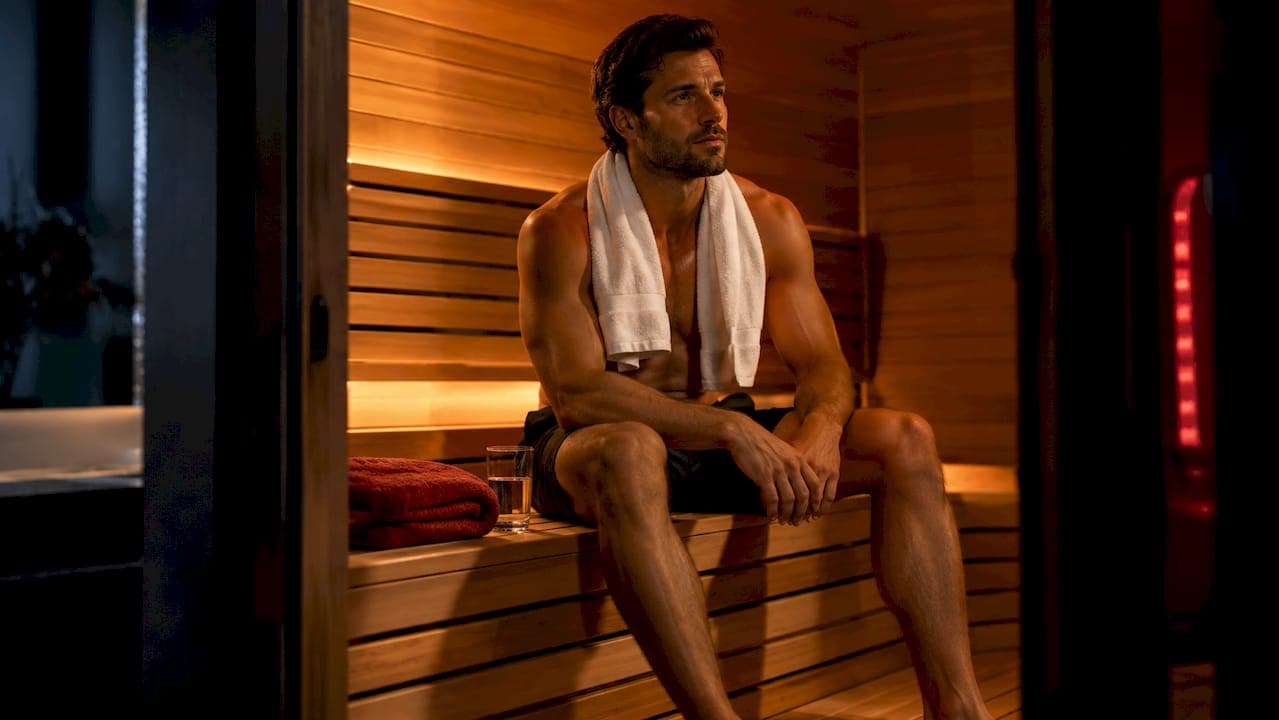
Use a sauna for whole-body heat stress that trains your heart and helps you unwind. Use red light for targeted skin, muscle, and recovery work you can do in ten minutes flat. Cohort data on frequent sauna users and clinical reviews on photobiomodulation point in different directions for different jobs, and Primal Red Co built its entire approach around that split. Most men over 30 end up using both, red light first, then heat.
TL;DR:
- Frequent sauna use (four to seven sessions weekly) is associated with a 27% to 50% reduction in cardiovascular mortality, based on long-term cohort data.
- Red light therapy primarily benefits localized tissue recovery, skin quality, and inflammation, with strongest evidence from clinical trials rather than population studies.
- Sauna sessions typically last 20 to 30 minutes and induce systemic cardiovascular stress, while red light sessions are shorter, targeting specific areas without raising core temperature.
- Safety considerations include dehydration and blood pressure drops for sauna users with cardiovascular conditions, whereas red light carries minimal risks if devices have documented wavelengths and proper irradiance levels.
- The best approach involves sequencing red light before sauna for targeted recovery and systemic training, with optimal results achieved through routine use rather than one-off sessions.
Table of Contents
- Red Light Vs Sauna: The Quick Comparison
- How Saunas Work: Heat, Sweat, and Cardiovascular Stress
- How Red Light Therapy Works: Wavelength, Dose, and Distance
- What the Research Actually Shows
- Building a Routine That Actually Uses Both
- Safety, Downsides, and How to Spot a Weak Device
- The Marketing Gap Nobody Talks About
- Sources
- FAQ
Red Light Vs Sauna: The Quick Comparison
The core difference is mechanism. A sauna works through thermal stress, heating your whole body and forcing your heart, lungs, and sweat glands to respond. Red light works through photobiomodulation, a targeted light signal that talks directly to your cells without raising your core temperature at all.
That distinction drives everything else:
- Mechanism: Sauna triggers systemic heat adaptation; red light triggers localized cellular response through cytochrome c oxidase activation.
- Session time: Sauna sessions typically run 20 to 30 minutes; red light sessions run 10 to 20 minutes and can target one body part at a time.
- Experience: Sauna means sweat, elevated heart rate, and a slow exit; red light means sitting or standing close to a panel with no sweat involved.
- Evidence type: Sauna's strongest signal comes from large observational cohorts on cardiovascular outcomes; red light's strongest signal comes from randomized trials on localized tissue and skin.
- Cost and space: A quality sauna requires real square footage and often professional installation. A red light device fits on a shelf.
Frequent sauna use, four to seven sessions a week, was tied to a 27% to 50% reduction in cardiovascular mortality in Finnish cohort data. That is a systemic, whole-body number. Red light doesn't have an equivalent longevity statistic because it isn't trying to solve that problem. It's solving a different one, closer to the skin and the muscle.
How Saunas Work: Heat, Sweat, and Cardiovascular Stress
A traditional sauna heats the air around you through convection, running 150 to 195°F. A far-infrared sauna skips the hot air and radiates heat directly into your skin and tissue, usually operating cooler, around 120 to 150°F, but reaching deeper before you feel it.
Either way, your body responds the same way it would to a hard cardio session:
- Core temperature climbs, and your heart rate can rise to 100 to 150 beats per minute.
- Blood vessels near the skin dilate to dump heat, which is the same vascular flexibility training that cardio produces.
- Sweat glands activate to cool you down, flushing fluid and electrolytes.
- Cells produce heat shock proteins, which help repair damaged proteins and may play a role in the cardiovascular benefits researchers keep finding.
That cascade is why the Laukkanen cohort found such a strong association between frequent sauna use and lower cardiovascular mortality. You're stressing the same systems that cardiovascular training stresses, just while sitting still.
How Red Light Therapy Works: Wavelength, Dose, and Distance
Red light therapy delivers specific wavelengths of visible red and near-infrared light, generally around 660 nanometers and 810 to 850 nanometers, into your skin and the tissue beneath it. Those wavelengths get absorbed by cytochrome c oxidase, an enzyme inside your mitochondria, and that absorption appears to shift how efficiently your cells produce ATP and modulate nitric oxide signaling.
The catch is dose. Clinical studies backing photobiomodulation typically use 1 to 10 joules per square centimeter, delivered at irradiance levels around 10 to 100 milliwatts per square centimeter. Hit that window and you get a real biological signal. Miss it, and you're sitting under a warm light with no measurable effect.
- Confirm your device lists actual wavelengths (not just "red light") and an irradiance figure at a stated distance.
- Sit as close as the manufacturer recommends. Light intensity drops with the square of the distance, so a few extra feet can gut your dose.
- Match session length to the panel's power output rather than guessing.
Pro Tip: If a product page won't tell you the wavelength or the irradiance at distance, that's not a marketing oversight. It usually means the number wouldn't help their case.
What the Research Actually Shows
Sauna's best evidence is long-range and population-level. The Laukkanen cohort tracked Finnish men for years and found that frequent users, four to seven sessions weekly, showed dramatically lower rates of fatal cardiovascular events than infrequent users. That's an observational association, not a randomized proof of causation, but the size and consistency of the effect is hard to dismiss.
Red light's best evidence sits at the tissue level. The Hamblin review and the trials it summarizes show consistent benefit for wound healing, reduced localized inflammation, and skin quality markers like collagen density. Separate work on inflammatory markers such as TNF-alpha and IL-6 shows measurable reductions in some studies, reinforcing the localized anti-inflammatory story.
Here's where you need to stay honest with yourself:
- Sauna evidence is strongest for cardiovascular and longevity outcomes, weaker for anything specific like joint pain or skin.
- Red light evidence is strongest for localized recovery, skin, and soreness, weaker for systemic claims like hormone shifts or organ-level change.
- Neither modality has strong support for dramatic testosterone spikes or deep-organ repair, no matter what a product page implies. If a brand promises that, read the fine print.
Building a Routine That Actually Uses Both
If soreness, sleep, and skin are all on your list, sequencing matters more than most people assume.
- Start with red light if soreness or skin is the target. Ten to 20 minutes, positioned close to the panel per manufacturer specs, works best before your body temperature climbs and your skin gets flushed from heat.
- Move to sauna for systemic recovery and sleep. Twenty to 30 minutes is the common range, though beginners often start around ten and build up.
- Track one variable at a time. Note soreness, sleep quality, or skin texture for two weeks using just one tool before adding the other, so you know what's actually working.
- Adjust for constraints. If you only have time for one, red light fits into a lunch break; sauna needs a real block of time and, often, real plumbing.
Budget shapes this too. A red light panel is a one-time purchase you can use daily in a bathroom or bedroom. A sauna is a bigger investment in money and square footage, which is part of why so many men start with red light and add heat later.
Safety, Downsides, and How to Spot a Weak Device
Sauna carries real physiological load, which means real cautions. Dehydration is common if you skip water. Blood pressure can drop suddenly on standing, and anyone on blood pressure medication or with an arrhythmia should get medical clearance first. Pregnant women and anyone with serious cardiovascular disease should skip sauna sessions entirely without a doctor's sign off.
Red light carries a much smaller risk profile, but it isn't zero. Direct eye exposure to high-intensity panels isn't a good idea, and certain medications cause photosensitivity that heat lamps and red light panels can both aggravate. You can read more about the full red light safety profile here.
The bigger real-world risk with red light is buying a device that doesn't do anything:
- Check for documented wavelengths, not vague "red light" marketing language.
- Confirm irradiance is measured at a real distance, ideally close to skin contact.
- Be skeptical of red LEDs bolted onto sauna walls across the room. Distance kills dose fast, and a glowing red light across a six-foot sauna is often decorative, not therapeutic.
Pro Tip: A sauna with a red bulb in the corner is not red light therapy. It's a sauna with a red bulb.
The Marketing Gap Nobody Talks About
Here's what gets lost in most comparisons: the evidence for sauna and red light is genuinely strong, but only when you use the right tool for the right job and stop expecting either one to fix something it was never built to fix.
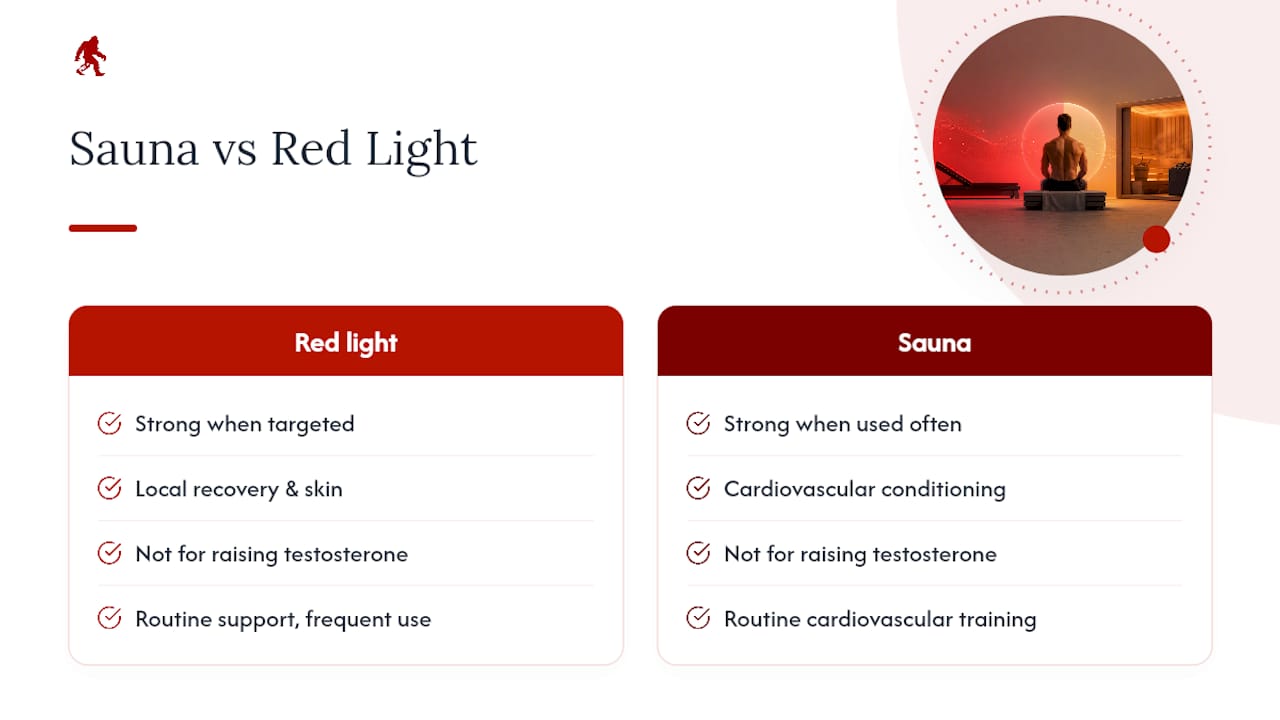
Men come to us asking whether red light will "boost testosterone" the way TRT does. It won't, and we're not going to pretend otherwise. What red light does well, backed by real trials, is support the kind of localized recovery, skin quality, and consistency that keeps you functioning instead of grinding down. Sauna does something different: it trains your cardiovascular system the way frequent Finnish sauna users have shown for decades. Neither one is a shortcut. Both work better as part of a routine you actually stick with, not a one-time miracle session.
If you're weighing your options before you consider something more clinical, start with the tools that ask less of your body and your wallet. Explore restoration routines built for men over 40 before you look at anything more invasive, and if a testosterone conversation is already on your radar, understand what to know before choosing a testosterone path first.
— Nurse Rachel
This article is general information, not a substitute for advice from a qualified doctor. Consult a qualified healthcare professional about your own circumstances before acting on anything here.
Sources
- Sauna use linked to longer life, fewer fatal heart problems | Harvard Health
- Photobiomodulation review (Hamblin et al.) DOI 2022
- Does red light therapy in a sauna actually work? | SaunaCloud
- Infrared sauna FAQ | Mayo Clinic
FAQ
What's the Downside of Red Light Therapy?
The main practical downside is device quality: many panels sit too far from the skin or use undocumented wavelengths, delivering little to no therapeutic dose. Real risks are minor but include eye strain from direct exposure and interactions with photosensitizing medications.
Should You Do Red Light or Sauna First?
Most routines work best with red light first, since ten to 20 minutes close to the panel gets a clean dose before heat and sweat change your skin's condition. Sauna afterward gives you the systemic, cardiovascular side without interfering with the light session.
What Are the Downsides of Using an Infrared Sauna?
Infrared saunas can cause dehydration, sudden blood pressure drops, and complications for people on certain medications or with cardiovascular conditions. Mayo Clinic recommends medical clearance for anyone with heart disease, pregnancy, or blood pressure concerns before starting.
What Is the 200 Rule for Sauna Use?
There's no single clinically established rule tied to the research behind sauna cardiovascular outcomes. Some sauna communities use informal heuristics like this, but the actual evidence base centers on session frequency and duration, not a fixed combined number.
Is Red Light Therapy Better Than a Sauna?
Neither is universally "better." Red light wins for localized skin and muscle recovery, while sauna wins for whole-body cardiovascular training and relaxation, and the strongest routines often use both for their separate strengths.