
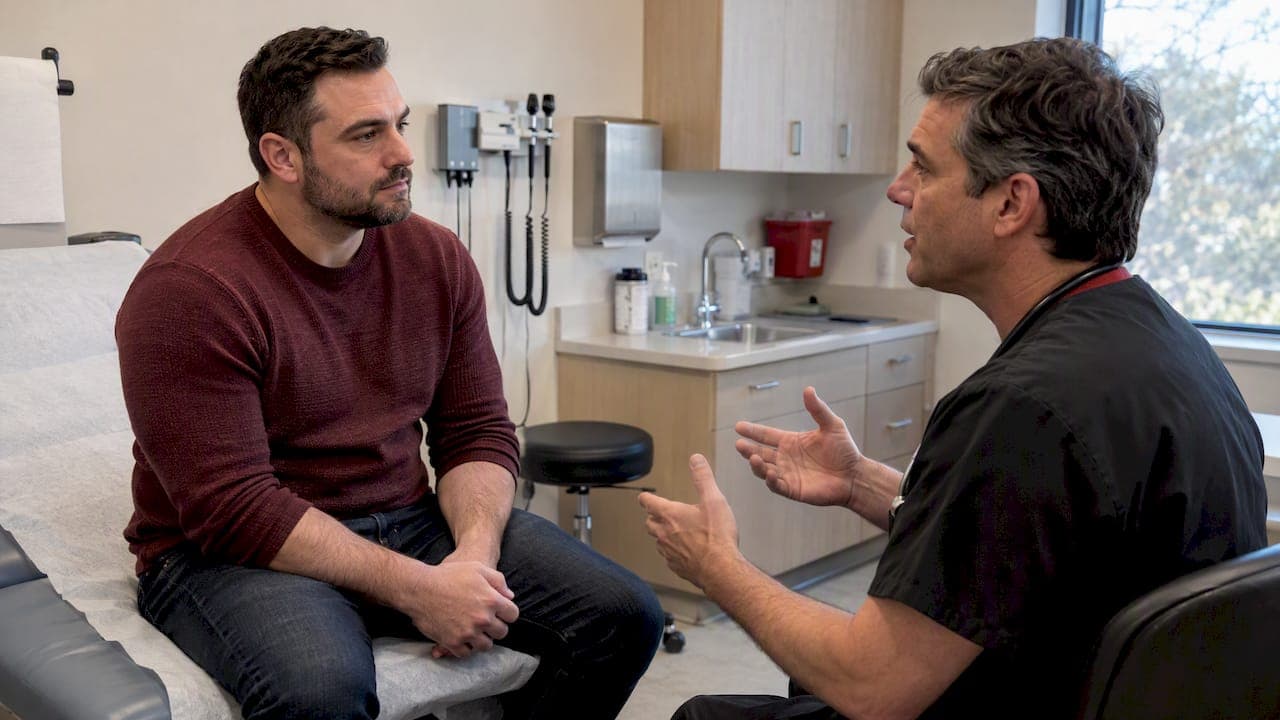
Short answer: vasectomy does not lower your testosterone, and it does not reliably reduce your sex drive. Major urology guidance and systematic reviews back this conclusion. You might deal with short-term soreness or swelling after the procedure, but your long-term hormone production stays exactly where it was before you walked into the clinic.
TL;DR:
- Soreness, swelling, or bruising commonly lasts through the first one to two weeks; resume sex only after discomfort resolves and your clinician advises it.
- If you take or are considering testosterone therapy, discuss sperm freezing and fertility plans with a reproductive specialist before making a permanent contraception decision.
- For fatigue or libido changes that persist months later, ask about a morning testosterone test before 10 AM; clinicians repeat low results before diagnosing deficiency.
- Hematoma or infection occurs in roughly 1% to 2% of cases, while chronic scrotal pain affects about 1%; discuss these surgical risks during consultation.
Table of Contents
- What studies measured: testosterone and other hormones after vasectomy
- Sex drive, erections, and satisfaction after vasectomy
- Prostate cancer, autoimmune theories, and why study quality matters
- How experts interpret the evidence on vasectomy and hormones
- Testosterone therapy and vasectomy: what to plan ahead of time
- Aftercare timeline: contraception, semen analysis, and hormone testing
- Balancing contraception choices with long-term vitality goals
- A non-prescription option for men focused on energy and drive
- FAQ
- Sources
What studies measured: testosterone and other hormones after vasectomy
Here's the thing men rarely hear from a doctor rushing to the next appointment: researchers have actually checked this. Multiple times, over multiple decades. The question was never whether vasectomy changes your plumbing. It's whether cutting the vas deferens sends a signal upstream to the testicles that says "stop producing." It doesn't.
Short-term studies, the kind that draw blood at baseline and then again at three, six, and twelve months after the procedure, found no consistent change in serum testosterone, LH, or FSH. Your pituitary keeps sending the same signals. Your testicles keep responding the same way. The feedback loop that governs hormone production, the hypothalamic-pituitary-gonadal axis, never touches the vas deferens at all.
Longer-term observational cohorts tell a slightly messier story, and we won't pretend otherwise. Some peer-reviewed analyses published in the Journal of Urology66696-5) found small, time-dependent increases in testosterone or DHT decades after vasectomy in certain groups. Interesting? Sure. Proof of a causal hormonal shift? Not even close. These older cohort studies carry real limitations: small sample sizes, inconsistent follow-up windows, and confounding factors like age, weight changes, and lifestyle shifts that happened over those same decades. A man's testosterone naturally fluctuates with sleep, stress, body composition, and age regardless of what happened in a surgical suite twenty years earlier.
The physiology explains why. Testosterone is made in the Leydig cells of the testicles and secreted directly into your bloodstream. It never travels through the vas deferens. A vasectomy blocks the tube that carries sperm out through semen. It does nothing to the blood supply, the nerve signals, or the hormone-producing tissue itself. Think of it like closing a side road while leaving the highway completely untouched: traffic to the rest of the system flows exactly the same way it always did.

Some researchers have looked at seminal-plasma steroids rather than blood hormones. One multi-timepoint analysis found shifts in seminal DHT and androstenedione up to twelve months after vasectomy. That sounds alarming until you understand what it actually measures: local changes in the fluid that no longer carries sperm, not a systemic drop in the testosterone circulating through your body. Seminal fluid composition and blood hormone levels are two different conversations entirely.
Here's what the evidence adds up to:
- Short-term studies (up to 12 months) show no consistent change in serum testosterone, LH, or FSH.
- Long-term cohorts occasionally report small increases in testosterone or DHT, but confounding limits what we can conclude.
- Seminal-plasma steroid changes do not indicate systemic testosterone deficiency.
- The physiologic pathway for testosterone production has no connection to the vas deferens.
Most men never need a testosterone test after a vasectomy. If you're feeling symptoms like persistent fatigue, low mood, or a flagging sex drive months later, that's worth a conversation with your clinician, who can order a morning total testosterone draw. But the vasectomy itself is not the reason to suspect a hormone problem.
Sex drive, erections, and satisfaction after vasectomy
A systematic review evaluating sexual function and satisfaction after vasectomy pooled data across multiple studies using the IIEF, the standard clinical tool for measuring erectile and sexual function. Average scores held steady: 65.8 before the procedure versus 67.08 after. Most domains, including erectile function, desire, and overall satisfaction, showed no change or a slight improvement.
Read that again. Improvement, not decline. How does cutting a tube make sex better for some men? The physiologic explanation is almost nonexistent. The psychological one is obvious once you say it out loud: a lot of anxiety during sex comes from the fear of an unplanned pregnancy. Remove that fear, and some couples report more relaxed, more satisfying intimacy. That's not a hormone shift. That's your nervous system finally getting out of its own way.
Short-term recovery is a different story, and it deserves its own honest mention. The first one to two weeks after a vasectomy often come with soreness, swelling, or bruising around the surgical site. Sex during that window can be uncomfortable, and most clinicians recommend waiting until the discomfort resolves before resuming normal activity. That temporary dip is about healing tissue, not about your libido or your hormones packing up and leaving.
Pro Tip: Give yourself the full healing window your clinician recommends before judging how sex "feels different." Early discomfort fades, and most men report their sexual function is unchanged or improved once recovery is complete.
A few things worth distinguishing clearly:
- Short-term discomfort during recovery is a surgical-site issue, not a hormonal or psychological one.
- Long-term IIEF data shows stable or slightly improved sexual function across pooled studies.
- Reduced pregnancy-related anxiety may explain reported improvements in satisfaction.
- Persistent sexual changes that last well beyond the recovery window deserve a conversation with a urologist, not silent worry.
If you're sitting across from a provider and want a short mental checklist before the appointment: ask whether your symptoms started before or after the procedure, whether they've changed over time, and whether a hormone panel makes sense given your overall picture. That's the kind of direct conversation that gets you real answers instead of guesswork.
Prostate cancer, autoimmune theories, and why study quality matters
For a while, vasectomy carried a shadow it probably didn't deserve. Earlier studies raised concern about a link to prostate cancer, and that concern spread fast, the way scary headlines always do. Men whispered about it in waiting rooms for years.
More recent, better-designed research tells a different story. A meta-analysis adjusting for screening differences and study quality found that the prostate-cancer association weakens or disappears once you account for confounding factors. Men who get vasectomies tend to interact with the healthcare system more often. More interaction means more PSA testing. More PSA testing means more diagnoses get caught, not necessarily more cancer gets created. That's detection bias, not causation, and it's a distinction that matters enormously when you're the one trying to decide whether to worry.
Autoimmune theories followed a similar arc. The hypothesis went something like this: a vasectomy exposes the body to sperm antigens it wouldn't normally encounter in the bloodstream, and that exposure could theoretically trigger an autoimmune response. It's a reasonable question to ask. It has not produced robust causal evidence linking vasectomy to autoimmune disease in the decades since the theory first circulated.
A few points worth holding onto:
- Earlier prostate-cancer associations were likely driven by screening and healthcare-utilization differences, not a biological mechanism.
- Adjusted meta-analyses reduce or eliminate the signal once confounders are accounted for.
- Autoimmune hypotheses remain theoretical, without strong causal data behind them.
- Current consensus does not support a causal link between vasectomy and either condition, though researchers acknowledge some datasets still carry uncertainty.
The honest takeaway: no study is perfect, and medicine rarely hands you a clean, permanent answer. But the weight of adjusted, higher-quality evidence leans firmly toward reassurance, not alarm.
How experts interpret the evidence on vasectomy and hormones
When you line up the research side by side, urology guidelines, government health agencies, and major academic hospitals all land in the same place. That kind of agreement across independent sources is worth paying attention to.
The systematic review on sexual function and satisfaction concludes that sexual and endocrine problems after vasectomy are rare. StatPearls, the clinical reference used widely in medical training, states plainly that testosterone and libido following vasectomy have been studied and shown to be unaffected. It also notes the real, if uncommon, surgical risks worth knowing about: hematoma and infection occur in roughly 1 to 2% of cases, and chronic scrotal pain in about 1%. Those are the honest numbers, and they're small.
Mayo Clinic's patient guidance states that vasectomy does not affect testosterone, erections, or orgasmic function for most men. University of Utah Health's patient-facing explainer walks through the same physiologic reasoning we covered earlier: testosterone enters the bloodstream directly, never riding through the vas deferens, so there's no mechanical pathway for a vasectomy to interrupt it.
Vasectomy is a mechanical procedure. It closes a tube. It does not touch the hormone factory.
- Systematic reviews report sexual and endocrine problems are uncommon after vasectomy.
- AUA, CDC, and major hospital systems counsel patients that testosterone production is unaffected.
- Nurse Rachel's read: order a testosterone test only when symptoms persist well beyond the recovery window, not as a reflexive post-surgical check.
- Future research could still clarify long-term cohort anomalies and refine autoimmune hypotheses with larger, controlled studies.
What should you actually test for if something feels off weeks or months later? A morning total testosterone draw, ideally before 10 AM when levels run highest, repeated before anyone labels you with low testosterone based on a single number. That's standard clinical practice, not a vasectomy-specific precaution.
Testosterone therapy and vasectomy: what to plan ahead of time
If you're on testosterone therapy, or thinking about starting it, and a vasectomy is somewhere on your radar, the order of operations matters. Testosterone therapy suppresses spermatogenesis. Your body reads exogenous testosterone as a signal to dial back its own production, and that same feedback loop throttles sperm production along with it. UrologyHealth's patient guide is direct about this: testosterone therapy is intended for clinically diagnosed hypogonadism, and men who want children down the road should not start it without a real conversation about fertility first.
Here's what that conversation should cover:
- If you're already on testosterone therapy and considering a vasectomy, ask your clinician whether sperm cryopreservation makes sense before you move forward with anything permanent.
- Discuss whether a temporary pause in therapy, under specialist supervision, fits your situation and your fertility timeline.
- Get a referral to a reproductive urologist if fertility preservation is even a possibility you want to keep open.
- Set a monitoring schedule: total testosterone and standard safety labs every 6 to 12 months while on therapy, so changes get caught early rather than guessed at later.
- Flag red flags with your provider ahead of time: unexplained fatigue, mood changes, or shifts in libido that don't track with your usual baseline.
If you're weighing testosterone therapy against its fertility tradeoffs, that's a conversation worth having before any permanent procedure, not after.
Pro Tip: Bring a written list of questions to your pre-vasectomy consult if you're on TT, including fertility-preservation options and your current monitoring schedule. A rushed five-minute visit is the wrong place to make a permanent decision.
Men exploring options before committing to lifelong therapy sometimes find value in reviewing steps clinicians recommend trying before testosterone therapy, especially if low energy or libido is what's driving the conversation in the first place.
Aftercare timeline: contraception, semen analysis, and hormone testing
Getting the permanent-contraception part right matters just as much as understanding the hormone question. The CDC's guidance on permanent contraception is specific: use alternative contraception for 8 to 16 weeks after your vasectomy, and complete a post-vasectomy semen analysis to confirm azoospermia before relying on the procedure alone.
By 12 weeks, about 80% of men achieve azoospermia, meaning no sperm detected in semen. That leaves roughly one in five men who need more time or a repeat test before the all-clear.
Here's the practical sequence:
- Use condoms or another reliable method for 8 to 16 weeks after the procedure, no exceptions.
- Schedule your semen analysis per your surgeon's instructions, typically starting around the 12-week mark.
- Confirm azoospermia before dropping backup contraception entirely.
- If you're dealing with symptoms unrelated to fertility, like persistent low energy or libido months out, ask your primary care provider about a morning testosterone test rather than assuming it's connected to the vasectomy itself.
- Follow up with urology for anything surgical (pain, swelling, lump), and with primary care for anything hormonal or systemic.
Balancing contraception choices with long-term vitality goals
Here's what twenty years in and around men's health has taught me: vasectomy is mechanical. It's a closed door in one specific hallway of your body. It has nothing to do with the room where your hormones get made.
I've sat across from plenty of men who felt a strange guilt or worry after the procedure, like they'd traded something essential for convenience. You haven't. The research is consistent, and the physiology backs it up completely.
What I do recommend: have the honest conversation with your provider before the procedure, especially if you're on testosterone therapy or thinking about kids down the road. And after? Pay attention to your energy, your drive, your overall sense of being dialed in, the same way you should at any point past 30, vasectomy or not. If something feels off, don't assume it's the procedure talking. Get it checked. And if you're looking for ways to support your energy and recovery day to day, lifestyle and restoration routines are worth having in your back pocket, separate from any clinical question your doctor is answering.
— Nurse Rachel
A non-prescription option for men focused on energy and drive
Vasectomy doesn't touch your hormones, but plenty of other things chip away at your energy, drive, and recovery as you get older: poor sleep, stress, a body that doesn't bounce back the way it used to. That's where we come in.

RedRockit is an at-home red light wellness device designed to support a simple daily routine aimed at energy, drive, and recovery without a prescription, a clinic visit, or a subscription hanging over your head. This device is not a clinic service, and is not related to TRT. It is intended for men who feel changes in their energy or vitality and want a straightforward tool to try before bigger decisions come into play.
If your bloodwork comes back normal and your provider rules out anything clinical, but you still feel like your edge has dulled a little, that's exactly the gap a daily restoration routine is built to fill. Pair it with the guided protocols in our companion app, and you've got a five-minute habit instead of a guessing game. Check out RedRockit™ Primal Restoration and see whether it fits where you're at.
This article is general information, not a substitute for advice from a qualified doctor. Consult a qualified healthcare professional about your own circumstances before acting on anything here.
FAQ
Can you tell if a man has had a vasectomy?
A vasectomy typically leaves no visible external signs beyond a small scar near the scrotum that fades over time. The only reliable way to confirm one has been performed is through a semen analysis showing azoospermia or a review of medical records.
What is the relationship between vasectomy and autoimmune disease?
Researchers have theorized that vasectomy could expose the body to sperm antigens and trigger an autoimmune response, but this hypothesis lacks robust causal evidence. Current data does not support a confirmed link between vasectomy and autoimmune disease.
Are there any health benefits to a vasectomy?
Beyond highly effective, permanent contraception, some studies note modest improvements in sexual satisfaction, likely tied to reduced pregnancy-related anxiety rather than a physiologic change. A systematic review found stable or slightly improved IIEF scores after the procedure across pooled studies.
What is a vasectomy?
A vasectomy is a permanent contraception procedure that cuts or blocks the vas deferens, the tube that carries sperm from the testicles into semen. It does not affect testosterone production, since hormones are secreted directly into the bloodstream through a completely separate pathway, as outlined in Mayo Clinic's patient guidance.
Does testosterone therapy affect vasectomy planning?
Yes. Testosterone therapy suppresses sperm production, so men on or considering TT should discuss fertility preservation options like sperm cryopreservation with a specialist before a vasectomy.
Sources
- A systematic review evaluating the effects of vasectomy on sexual function and satisfaction
- CDC: Permanent contraception (vasectomy) guidance
- StatPearls — Vasectomy
- UrologyHealth — Testosterone Therapy patient guide