
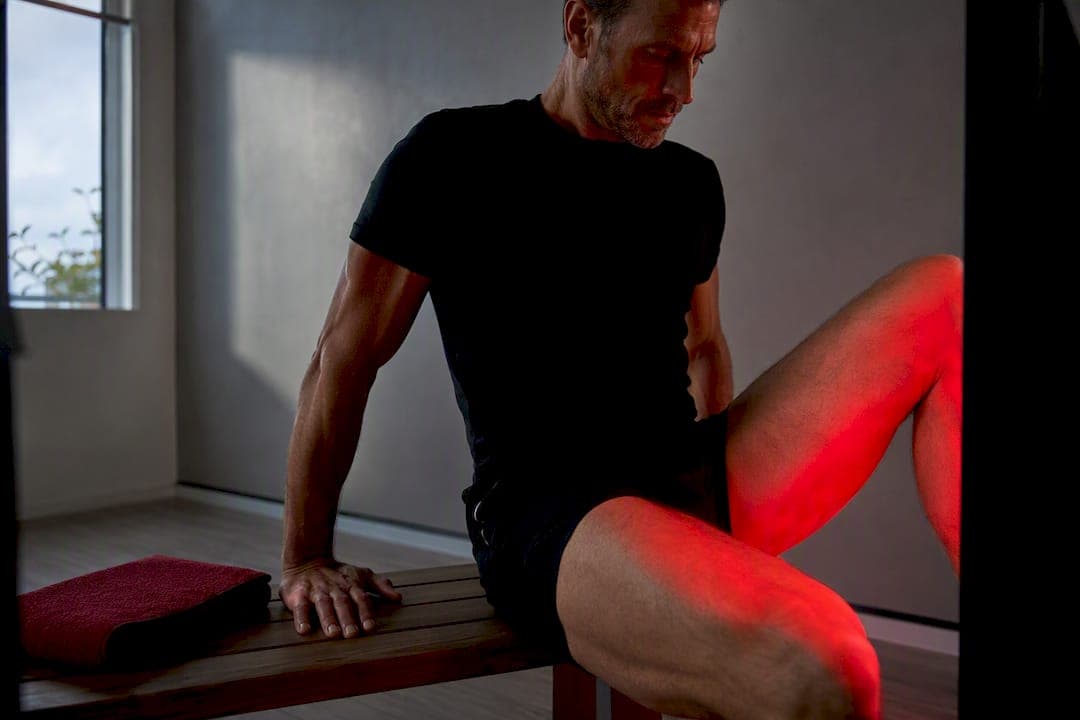
Red light therapy can modestly reduce muscle soreness after training and support some endurance and fatigue markers, but the evidence for strength gains stays inconsistent. Safety at consumer doses is generally good, though dosing standards don't exist yet. Treat it as a backup system for sleep, nutrition, and progressive training, not a replacement for any of them.
TL;DR:
- Red light therapy shows consistent benefits for reducing muscle soreness and improving endurance markers, especially when applied immediately after exercise.
- The effects on increasing maximal strength are unreliable, with mixed results across studies due to device variability, dosing differences, and small sample sizes.
- Optimal dosing is non-linear, requiring careful adjustment because overexposure can negate benefits, making consistent logging and gradual changes essential.
- Safety concerns are minimal but include the importance of eye protection and caution with photosensitizing medications or skin conditions; long-term safety data remain limited.
- Most users see the clearest gains if they train regularly, and it is best layered into a routine that prioritizes sleep and nutrition, not as a replacement.
Table of Contents
- How Red Light Therapy Recovery Actually Works in Your Muscles
- What Does the Research Say About Muscle Recovery?
- When Should You Use Red Light for Recovery?
- Is Red Light Therapy Safe? What to Watch For
- Who Actually Benefits Most From This?
- A Recovery Routine You Can Actually Test
- Where Red Light Therapy Fits in a Man's Recovery Toolkit
- Does Red Light Therapy Interact With Medications or Conditions?
- What Happens With Long-Term or Chronic Use?
- Where This Actually Belongs in Your Recovery Plan
- RedRockit: A Practical At-Home Option Built for This Routine
- Sources
- FAQ
How Red Light Therapy Recovery Actually Works in Your Muscles
Your muscles don't heal because a light feels warm on your skin. They heal because red and near-infrared wavelengths get absorbed by an enzyme inside your mitochondria called cytochrome c oxidase, and that absorption appears to boost ATP production, the energy currency your cells burn to repair tissue. That's the leading mechanism behind photobiomodulation, and Stanford Medicine's overview of the research backs it as the primary pathway worth taking seriously.
Two mechanisms run alongside that mitochondrial boost:
- Local vasodilation. Increased blood flow to the treated area may help ferry nutrients in and metabolic waste out faster.
- Reduced inflammatory signaling. Some research points to lower inflammatory markers post-exercise, which could explain reports of less next-day stiffness.
Wavelength matters here. Red light (roughly 620 to 700 nanometers) tends to stay closer to the surface, useful for skin and shallow tissue. Near-infrared light (roughly 700 to 1,100 nanometers) pushes deeper, which is why most recovery-focused protocols lean on NIR or a red/NIR combination for muscle work rather than red alone.
Here's the part most guides skip: dosing isn't linear. Photobiomodulation follows a biphasic dose response, meaning a little light helps, more light helps more, and then past a certain point, the benefit flattens or reverses. Underdose it and you're wasting your time. Overdose it and you might actually blunt the effect you're chasing. That single fact explains why so many red light studies produce wildly different results using what looks, on paper, like a similar setup.
What Does the Research Say About Muscle Recovery?
The honest answer: real signal, uneven strength. Systematic reviews and randomized, placebo-controlled trials report reduced delayed-onset muscle soreness and lower creatine kinase in a meaningful share of protocols. Creatine kinase is a blood marker of muscle fiber damage. When it drops after a PBM protocol compared to a placebo group, that's a real physiological signal, not just people reporting they feel better.
The pattern that shows up most consistently: benefits look stronger for fatigue and endurance measures (things like time-to-exhaustion or repeated sprint performance) than for maximal strength output. If your goal is squeezing out one more heavy single on deadlift day, don't count on red light to get you there. If your goal is showing up to Thursday's session without your legs feeling like sandbags, the data gives you more to work with.
Why the mixed results across studies? A few reasons keep surfacing:
- Devices vary enormously in wavelength mix, power output, and total energy delivered.
- Distance from skin changes effective dose dramatically, even at identical device settings.
- Timing differs, some trials dose before exercise, others immediately after, others hours later.
- Sample sizes in many trials are small, which limits how confidently you can generalize findings.
Cleveland Clinic frames it plainly: promising signals exist, but researchers still need more robust human trials before anyone should call this settled science. Read that as your permission to try it and your warning not to expect a miracle.
When Should You Use Red Light for Recovery?
Two timing strategies dominate the practical literature, and they serve different jobs.
- Pre-conditioning. Applying light 40 to 60 minutes before an intense session aims to prime muscle tissue before you load it, with some trials linking this to better performance output rather than faster repair.
- Post-exercise application. Using it right after training targets the repair window directly, aiming to reduce soreness and speed the return to baseline.
Physio-Pedia's breakdown of muscle recovery protocols treats these as genuinely separate goals: one is about performance, the other about repair. Pick based on what you're solving for.
There's no industry-standard dose yet. The FITT framework (frequency, intensity, time, type) gives you a way to structure your approach even without a fixed number to chase. ACE Fitness's research summary on red light and recovery notes most consumer protocols involve several minutes per muscle group, repeated multiple times per week, adjusted based on whether you're chasing pain relief or endurance support.
Pro Tip: Don't chase a bigger dose just because a little helped. The biphasic response means more light past your sweet spot can cancel out the benefit. Log how you feel for two weeks at one setting before you touch the dial.
Is Red Light Therapy Safe? What to Watch For
Most men tolerate red light therapy well. Expect temporary warmth or mild redness at the treated area, nothing more, in the large majority of cases. Rare concerns exist, and they're worth knowing before you start.
- Eye protection matters. Direct retinal exposure to high-intensity red or near-infrared light is a real risk. Use the goggles that came with your device, every session, no exceptions.
- Photosensitizing medications change the math. Certain antibiotics, acne medications, and some blood pressure drugs increase skin sensitivity to light. Stanford Medicine's clinical overview recommends checking with a clinician before starting if you're on any of these.
- FDA clearance isn't the same as proof of effectiveness. Clearance generally confirms a device met safety requirements for its category. It does not mean regulators validated the recovery claims on the box.
- Unusual or severe pain isn't a "push through it" situation. See a clinician if soreness looks or feels different from normal training fatigue.
Our detailed breakdown of red light therapy side effects covers the full precaution list if you want to go deeper before your first session.
Who Actually Benefits Most From This?
Athletes and people training regularly tend to see the clearest results, mostly around reduced soreness and faster readiness for the next session. If you're training four or five times a week, that repeat-session readiness matters more than any single data point.
Recreational exercisers can still get something out of it, just calibrate your expectations lower. A twice-a-week gym routine won't generate the same accumulated fatigue that makes recovery tools shine.
- Regular trainees: clearest signal, most consistent reported benefit.
- Occasional exercisers: some relief possible, results tend to be modest.
- Anyone expecting it to replace actual training adaptation: wrong tool, wrong job.
Individual response varies a fair amount too. Some men notice a difference within two weeks. Others need a full month of consistent use before they can tell if anything changed at all.
A Recovery Routine You Can Actually Test
Run this for at least a few weeks before you decide if it's working for you.
- Post-workout protocol: several minutes per major muscle group, multiple times weekly, positioned at the distance your device manufacturer specifies for irradiance.
- Optional pre-conditioning add-on: applied well before your hardest sessions of the week, same distance guidance.
- Tracking: Log a 1 to 10 soreness score, note perceived recovery the next morning, and track any performance changes in your key lifts or conditioning work.
Distance isn't a suggestion, it's the dose. Move too far from a consumer panel and you may be well below an effective threshold, no matter how long you sit there. Harvard Health's coverage of red light devices notes that clinic-grade equipment generally runs more powerful than home units, so don't expect identical results from a handheld device and a treatment table at a recovery clinic.
Pro Tip: Adjust one variable at a time, either session length or frequency, never both together. Otherwise you won't know what actually moved the needle. Our guide to red light recovery routines for men walks through a few variations if the base protocol needs tweaking for your schedule.
Where Red Light Therapy Fits in a Man's Recovery Toolkit
Overuse is the mistake I see most: men treating this like more is automatically better, then wondering why nothing changed. Skipping eye protection because "it's just a quick session" is the other one. Neither habit serves you.
Layer this into your existing routine, don't let it replace the routine. Sleep and nutrition still do the heavy lifting. Red light is the supporting habit that helps you show up ready for tomorrow's session.
A quick session with proper eye protection, logged consistently for a few weeks, tells you more about whether this works for your body than any single study ever will. Consistency beats intensity here, every time.
Does Red Light Therapy Interact With Medications or Conditions?
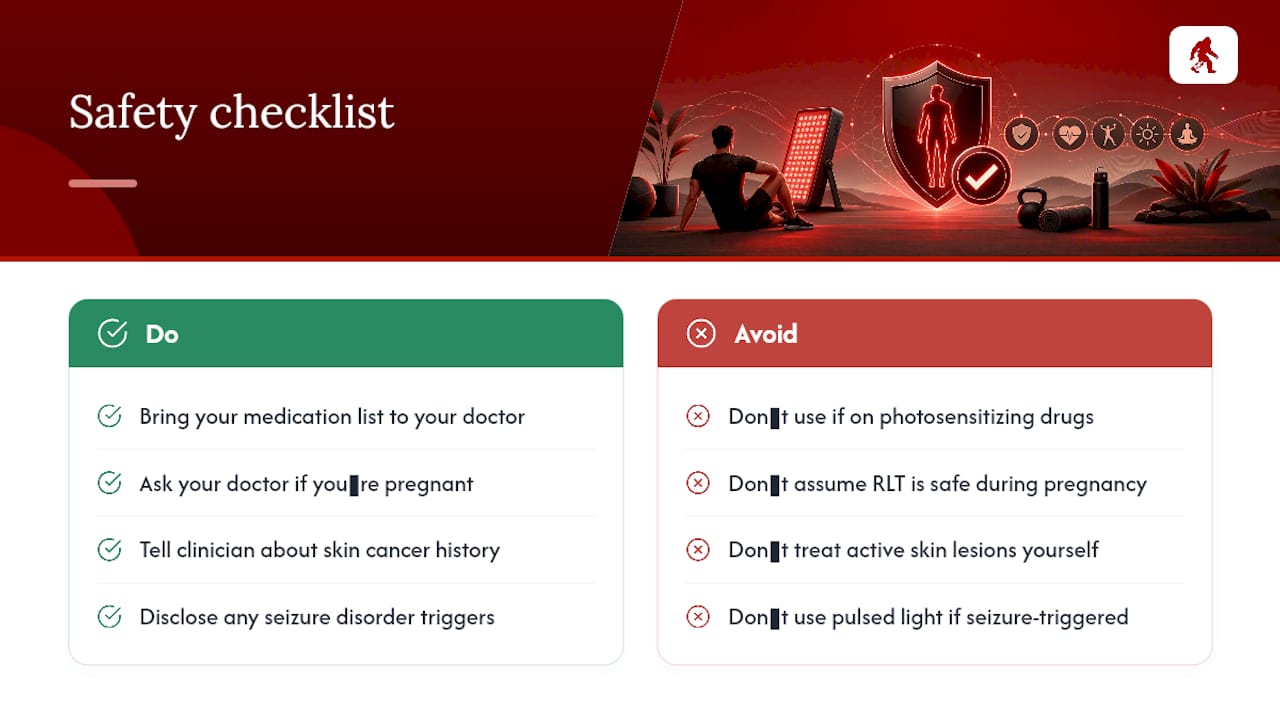
Certain medications and health conditions change the risk profile enough that they deserve a direct look before you start. Photosensitizing drugs sit at the top of that list, including some antibiotics like tetracyclines, certain acne treatments (isotretinoin among them), and a handful of diuretics and blood pressure medications. These drugs increase how reactive your skin becomes to light exposure, which raises the chance of irritation or burns even at doses that would be harmless otherwise.
Pregnancy is another situation where the safe answer is: ask your doctor first. There isn't enough dedicated research on photobiomodulation during pregnancy to give a confident blanket clearance, so caution beats assumption.
If you have a history of skin cancer, active lesions, or any condition affecting how your skin responds to light (certain autoimmune conditions included), talk to a clinician before starting a routine. The same goes for anyone with a diagnosed seizure disorder that's triggered by flashing or pulsing light, since some device settings use pulsed output rather than continuous.
None of this means red light therapy is off the table for most men. It means the "just try it" approach works fine for a healthy adult with no complicating medications, and it means a five-minute conversation with your doctor is worth having if any of the above applies to you. Bring your current medication list. That's the fastest way to get a clear answer instead of guessing.
What Happens With Long-Term or Chronic Use?
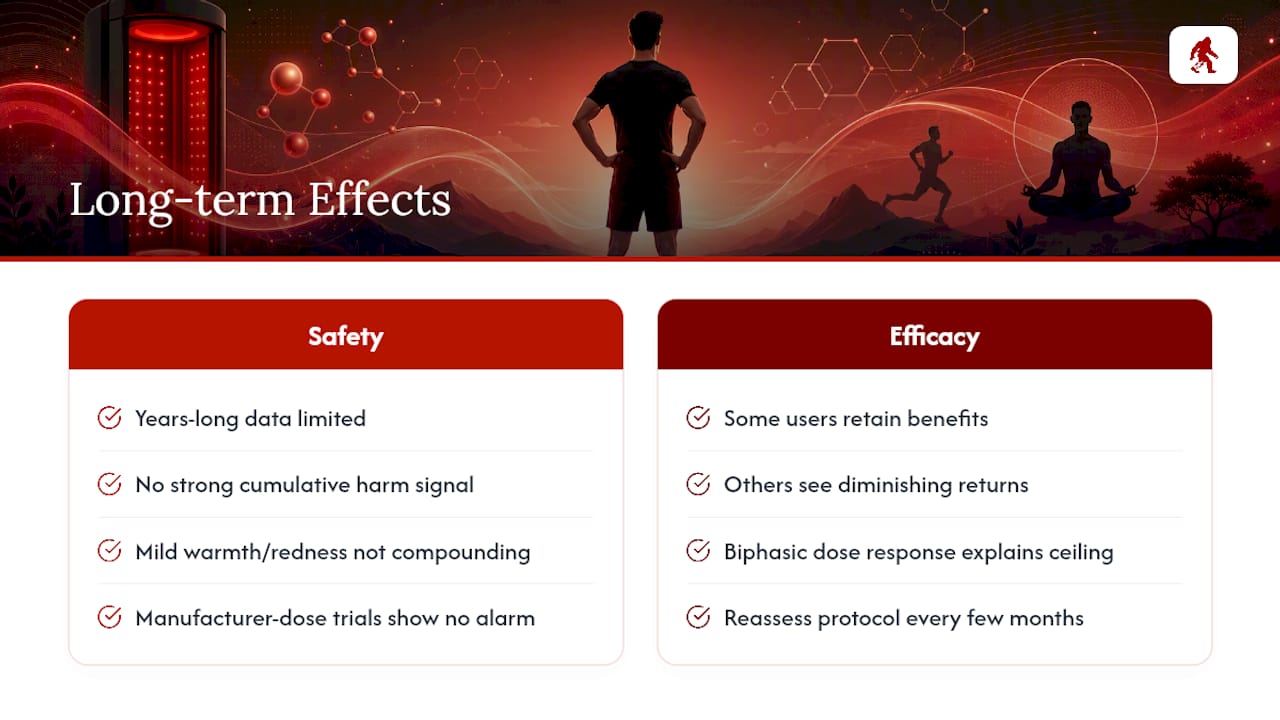
The research on years-long, consistent red light use is thinner than the research on short-term protocols, and that's worth saying plainly instead of glossing over. Most trials run a handful of weeks, not a handful of years, so nobody has airtight long-term safety data at consumer doses.
What we do have: no strong signal of cumulative harm from mild, well-protected sessions used the way manufacturers intend. The mild warmth and occasional redness that shows up short-term doesn't appear to compound into something worse with repeated use, based on the trial data available so far.
The more practical long-term question isn't safety, it's whether continued use keeps producing a benefit or whether your body adapts and the effect plateaus. Some men who stick with a consistent routine for months report the recovery benefit holding steady. Others notice diminishing returns after the first few weeks, which lines up with how the biphasic dose response works, your system may simply reach its ceiling for what a given dose can accomplish.
The sensible approach: reassess every few months. If soreness scores and recovery feel stayed improved, keep the routine. If you've plateaued and adding more time or frequency doesn't move anything, you've likely found your body's ceiling for that protocol, and that's useful information, not a failure.
Where This Actually Belongs in Your Recovery Plan
Red light therapy is a low-risk, additive habit, not a foundation. Fix your sleep and training load first. Then test this consistently for a few weeks and track the numbers instead of trusting how you feel on any single day.
— Nurse Rachel
RedRockit: A Practical At-Home Option Built for This Routine
If everything above sounds worth testing but you don't want to guess at distance, timing, or session length every time, that's exactly the gap RedRockit was built to close. It's a private-use red light wellness device made for men who want a repeatable restoration routine, not a device you have to research settings for every single week.

Red light devices often include companion apps that guide users through session protocols, helping manage distance and timing consistently. These can support routines like post-workout sessions and optional pre-conditioning windows, encouraging a consistent pattern to determine effectiveness over several weeks. Such devices can be used independently without recurring clinic visits or subscriptions.
Primal Red Co built RedRockit around the idea that restoration should be something you do consistently, not something you chase during a crisis. If you want to see how it fits into your own recovery routine, check out RedRockit™ Primal Restoration and get the specifics on the device itself.
Sources
For deeper reading: the systematic review on photobiomodulation and muscle recovery, ACE Fitness's dosing breakdown, and Cleveland Clinic's clinical overview each cover a different angle worth your time. For dosing specifics, this bone health guide on red light therapy dosage breaks down the FITT approach clearly.
This article is general information, not a substitute for advice from a qualified doctor. Consult a qualified healthcare professional about your own circumstances before acting on anything here.
- Photobiomodulation and muscle performance/recovery (systematic review)
- ACE Fitness: red-light therapy and post-exercise recovery
- Red light therapy: What the science says (Stanford Medicine)
- Red light therapy (Cleveland Clinic)
FAQ
What Should You Not Do After Red Light Therapy?
Don't skip eye protection even for a "quick" session, and don't immediately increase your dose because one session felt good. Give your body a few sessions before adjusting anything.
Why Don't Doctors Recommend Red Light Therapy More Often?
Most clinicians want larger, more standardized human trials before treating it as a proven recovery tool. Cleveland Clinic's overview calls it a promising but still-emerging therapy rather than a settled treatment, which is a fair, honest read of where the evidence stands.
Is Three Times a Week Enough for Red Light Therapy?
For most consumer post-workout protocols, three sessions weekly for four to six weeks is a reasonable starting frequency to test whether it's helping. Track your soreness and recovery feel over that window before deciding to increase or decrease frequency.
What's the Downside of Red Light Therapy?
The biggest downsides are dosing uncertainty (there's no universal standard yet), inconsistent effects on strength specifically, and the risk of eye exposure if you skip protective goggles. Cost is a factor too, since clinic-grade sessions run more powerful than most at-home devices like RedRockit, which trades some intensity for convenience and repeatable use.
How Much Does RedRockit Cost?
Current pricing is available on the RedRockit product page rather than listed here, since it's worth checking directly for the most accurate figure.