
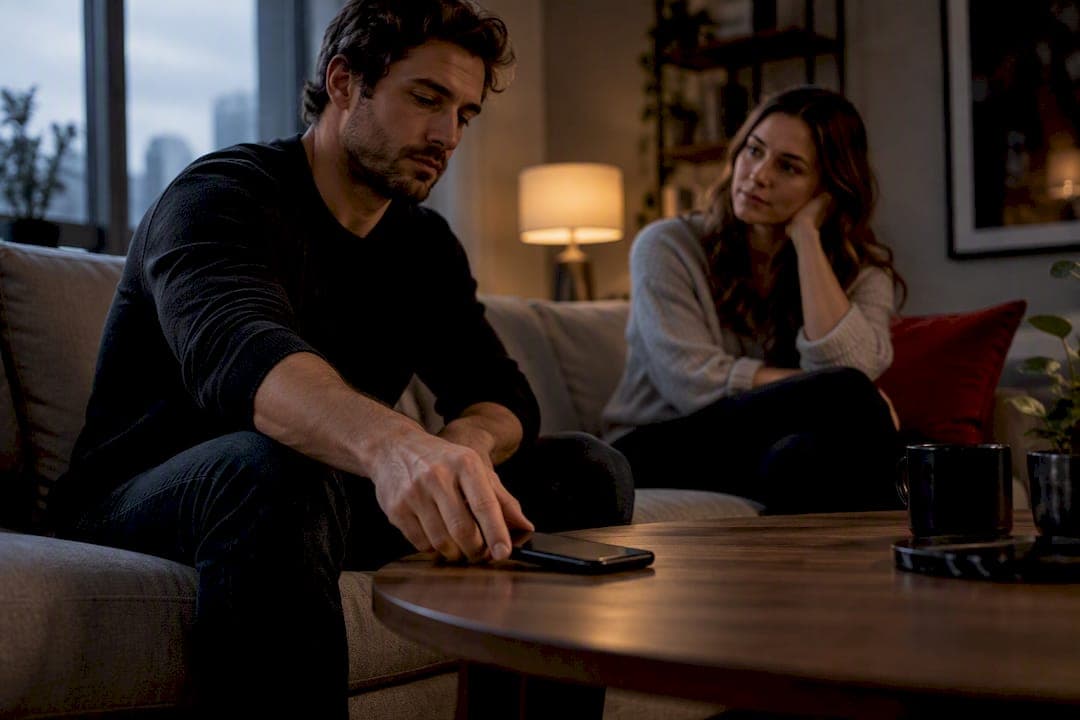
Porn-induced ED isn't a diagnosis you'll find in any medical manual, but it's a real pattern clinicians see: a man gets hard easily to porn but struggles with a partner. If that's you, your first move isn't panic. It's a structured porn break with simple tracking, or a doctor's visit if red flags show up. The AUA-guideline) wants ED to be checked medically first, and the research on porn's role is genuinely mixed.
TL;DR:
- The research indicates that heavier, compulsive pornography use may be associated with situational erectile difficulties, but it does not cause long-term erectile dysfunction in most men.
- Tracking sexual responses over two to six weeks can help distinguish between conditioning issues and underlying medical problems, with normal morning erections suggesting good blood flow.
- A four-week porn abstinence and gradual lifestyle changes, such as improving sleep and reducing stress, are recommended first steps before considering medical or psychological interventions.
- Serious symptoms like sudden ED, pain, or complete loss of erections, especially with additional health issues, require prompt medical evaluation rather than self-diagnosis.
- Supplements or devices like RedRockit support overall energy and recovery but do not replace medical care for persistent erectile or sexual dysfunction.
Table of Contents
- What Porn-Induced ED Actually Means
- What the Research Actually Shows
- Track Your Own Pattern Before You Diagnose Yourself
- Recovery Strategies Worth Trying First
- When It's Time to See a Clinician
- Daily Habits That Rebuild Real Response
- A Nurse's Honest Take on Recovery Expectations
- An Adjunctive Routine Worth Considering
- Sources
- FAQ
What Porn-Induced ED Actually Means
Nobody's putting "PIED" on a chart at your doctor's office. It's not in the DSM, and it's not an official urological diagnosis. What it describes is something more specific: a man who can get and keep an erection during solo masturbation with porn, but loses that response with a partner. That's situational, and it's different from erectile dysfunction that shows up everywhere, every time.
Clinicians care less about how often you watch porn and more about two things: whether you feel out of control around it, and whether it's causing you real distress. A guy who watches porn twice a week with zero anxiety about it isn't the same as a guy escalating to more extreme content, feeling shame afterward, and noticing his body isn't responding the way it used to. That second pattern is what researchers call problematic pornography use, or PPU, and it's the version that actually correlates with sexual difficulty.
Most sexual health providers use a biopsychosocial model to sort this out. That means three lanes get checked, not one:
- Medical factors — blood flow, hormones, cardiovascular health, medication side effects
- Psychological factors — anxiety, depression, performance pressure, conditioned arousal patterns
- Relationship factors — communication, attraction, unresolved tension with a partner
Porn use lives in the psychological lane. It's rarely the whole story.
What the Research Actually Shows
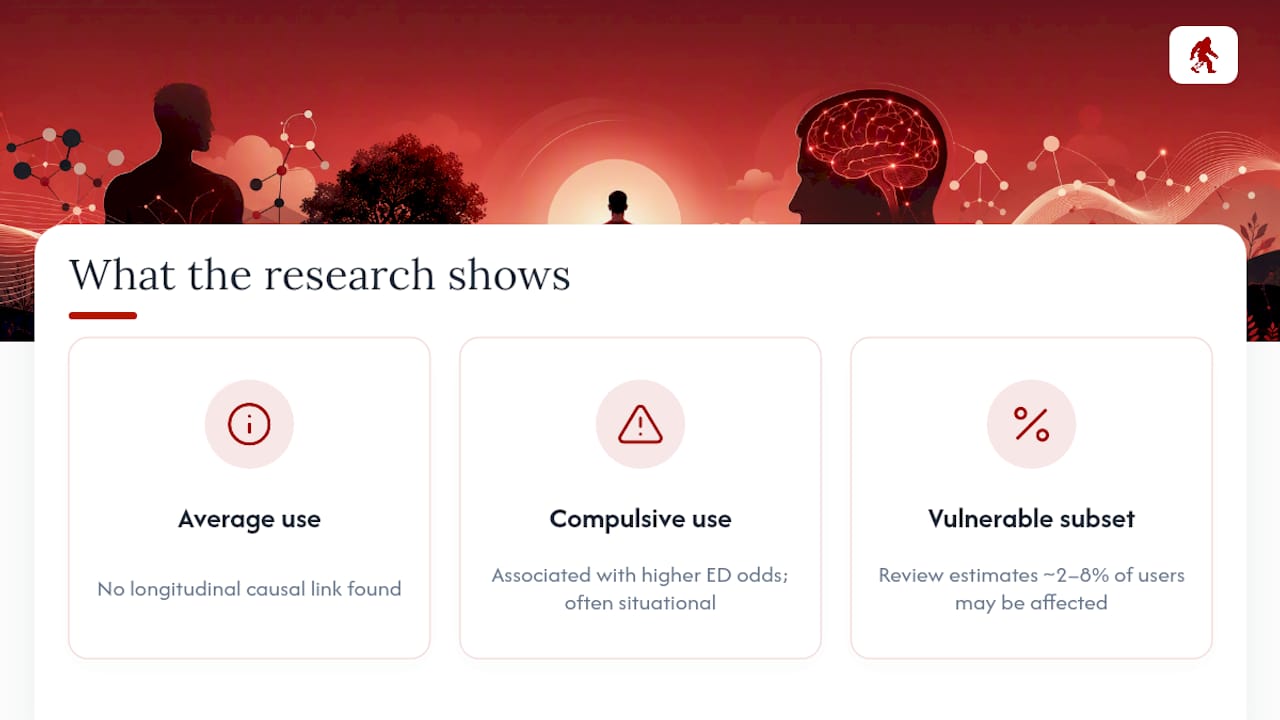
Here's the uncomfortable truth: the science does not back a clean cause-and-effect line from porn to ED for the average guy. A cross-sectional and longitudinal study tracking men over time found that while problematic pornography use correlated with ED symptoms at a single point in time, the longitudinal data showed no significant causal relationship between porn variables and how ED developed over time. Use alone didn't predict future dysfunction.
Where the picture gets murkier is with heavier, compulsive patterns. A 2021 international web survey of young men found that higher problematic-consumption scores tracked with higher odds of ED, and a lot of those cases were situational. Guys could perform with porn but struggled with a partner. A 2023 clinical study on men already diagnosed with psychogenic ED found a strong inverse relationship between porn-use frequency and erectile-function scores, but relationship adjustment mediated that link. In plain terms: how good the relationship was mattered as much as the porn habit itself.
The research gap that matters most: a 2023 review concluded that strong claims of a direct pornography-to-dysfunction relationship are largely unsupported. Problematic or compulsive use predicted poorer sexual function more consistently, and the review estimated only a small subset of users, perhaps 2 to 8 percent, may actually be vulnerable to this effect.
Every one of these studies leans on self-report, which brings bias. Men in clinical samples already suspect porn is the problem, which skews what they report. Masturbation conditioning (speed, pressure, grip, how fast you're used to finishing) rarely gets isolated from porn exposure itself, and relationship quality and health conditions like diabetes or high blood pressure almost never get fully ruled out. The honest takeaway: ordinary porn use probably isn't the enemy. Compulsive, escalating use paired with distress is worth taking seriously.
Track Your Own Pattern Before You Diagnose Yourself
You don't need a lab to start figuring out what's going on. You need two to six weeks of honest tracking. Here's what to log every day, even when the answer is "nothing happened":
- Morning and nighttime erections — Do you wake up with one? This is one of the clearest signs blood flow and nerve function are working.
- Masturbation without porn — Can you get and maintain an erection using touch and fantasy alone, no screen?
- Masturbation with porn — Note how it compares in speed, firmness, and intensity of stimulation needed.
- Partnered attempts — What happens when a real person is involved? Full erection, partial, none at all?
- Mood and stress that day — Anxiety, depression, and work stress all move the needle on arousal.
- Alcohol, drugs, and medications — Antidepressants and blood pressure meds are common, underrated culprits.
- Overall sexual desire — Are you still interested in sex, or has desire itself dropped off?
If you're getting firm morning erections and can perform solo without porn, but struggle only with a partner, that points toward a situational or conditioning issue tied to anxiety or arousal patterns. If erections are weak or absent in every context, including sleep, that's a signal worth bringing to a doctor sooner rather than later. When you do see a clinician, bring the log. Dates, patterns, specific examples. A doctor working from two weeks of real data can help you faster than one working from "I think it's the porn."
Recovery Strategies Worth Trying First
Before you chase anything complicated, run a simple experiment. Set a defined stretch, four weeks is a reasonable starting point, where you cut porn out completely. Don't use the break to constantly test whether you're "fixed" by trying to get erections on demand. That turns recovery into another performance metric, and performance pressure is often part of the problem in the first place. Judge progress by softer signals instead: relaxed desire, spontaneous erections you didn't force, and whether sex with a partner feels less like an exam.
While you're at it, look at how you masturbate outside of porn too. Fast, high-pressure, high-novelty stimulation trains your body to expect a very specific kind of intensity that a partner can't replicate. Slowing down, easing off constant edging, and reducing the need for novelty retrains that response over time.
- Set a fixed porn-break window, not an open-ended one
- Skip the urge to "test" yourself daily
- Slow masturbation pace and cut edging
- Loop your partner into the process instead of hiding it
- Consider cognitive behavioral therapy or sex therapy if anxiety is driving the pattern
Therapy earns its place here, particularly CBT-based approaches and sex therapy, when anxiety, shame, or conditioned arousal patterns are running the show. A therapist trained in sexual health can help unwind the specific loop you're stuck in, which a generic "just quit porn" plan can't do. If a partner is involved, bring them in early. Reducing performance pressure as a couple, and taking the goal off "getting hard" and onto "staying connected," tends to work better than solo willpower.
Pro Tip: Skip anything promising a fixed "reboot" timeline. Recovery windows anecdotally reported in online communities vary wildly and aren't backed by controlled data, so treating a stranger's 90-day story as your own medical timeline will only set you up for disappointment. Don't self-prescribe testosterone or unregulated supplements either. That decision belongs with a doctor who's actually run your labs.
When It's Time to See a Clinician
Some symptoms don't belong in a self-experiment. They belong in a doctor's office, this week.
- Sudden-onset ED that appeared overnight, not gradually
- Painful erections or pain during sex
- No erections in any context, including sleep and solo masturbation
- Chest pain, shortness of breath, or other signs pointing toward cardiovascular disease
The AUA's evaluation approach starts with a full medical, sexual, and psychosocial history, a physical exam, and selective lab work, testosterone included, when your history suggests a hormonal issue. Cardiovascular risk gets checked too, since ED can be an early warning sign for heart disease before other symptoms show up. From there, a clinician might recommend PDE5 inhibitors for a fast physical fix, a vacuum erection device for mechanical support, or a referral to a mental health or sex therapy professional when anxiety or compulsive behavior is clearly part of the picture. None of these paths require you to have already figured out whether porn is "the cause." That's the clinician's job to help sort out, not yours to diagnose solo.
Daily Habits That Rebuild Real Response
Recovery isn't just about what you stop doing. It's about what you build underneath it. Sleep is the most underrated lever here. Poor sleep tanks testosterone and blunts arousal in ways most men never connect back to the bedroom. Alcohol in excess does the same thing, and regular aerobic and resistance training improves blood flow, which is the actual mechanical foundation erections depend on.
On the sexual-practice side, scheduled intimacy that takes performance off the table (touch and connection first, intercourse optional) helps rebuild a response that isn't chained to anxiety. Paced masturbation without high-novelty stimulation, and gradual, low-pressure exposure to partnered scenarios rather than jumping straight back into full expectations, both give your nervous system room to recalibrate.
- Prioritize consistent sleep, seven to nine hours
- Moderate alcohol, especially before intimacy
- Train aerobically and with resistance three to four times a week
- Build in stress management, even ten minutes of daily decompression helps
- Try scheduled, pressure-free intimacy sessions with a partner
Energy and vitality feed sexual function directly. A man running on four hours of sleep and constant stress isn't going to perform well regardless of his porn habits, and some men explore photobiomodulation routines as one piece of a broader energy-focused restoration plan.
A Nurse's Honest Take on Recovery Expectations
Every man who comes to me convinced porn broke him wants a fast answer. I never give one. The real work starts with an honest assessment, not shame, and not a 30-day miracle promise from a forum post. Run the experiment. Track it. Talk to your partner without turning it into a blame session, and talk to a doctor without treating the conversation like a confession.
Recovery is stepwise. It's measurable. And it rarely looks like the dramatic before-and-after story you read online.
— Nurse Rachel
An Adjunctive Routine Worth Considering
None of this replaces medical care, and RedRockit isn't a treatment for ED. It's not a drug, it's not a prescription, and it doesn't diagnose anything. What it is: a private-use red light restoration device built for men who want a consistent daily routine that supports energy, drive, and recovery, the foundation that everything else in this article depends on.

Think of it as one piece of the same rebuild you just read about. Better sleep, consistent training, reduced stress, and a few minutes with RedRockit as part of your morning or evening routine, not a substitute for therapy, tracking, or a doctor's visit if red flags are on your list. If persistent or organic symptoms are in play, see a clinician first. If you're a man focused on maintaining energy and drive as you age, certain wellness routines may offer supportive options without involving prescriptions. Check the RedRockit product page to see how the routine works and whether it fits into what you're already rebuilding.
Sources
- Is pornography use related to erectile functioning? Results from cross-sectional and latent growth curve analyses
- Pornography and sexual dysfunction: is there any relationship? (2023 review)
- Associations between online pornography consumption and sexual dysfunction in young men: multivariate analysis based on an international web-based survey
- Effect of internet pornography use frequency on psychogenic erectile dysfunction severity in young men (2023)
FAQ
Can too much masturbation cause ED?
Frequency alone isn't the main driver, what matters more is the style of stimulation and whether it's paired with distress or loss of control. High-pressure, high-novelty masturbation habits can condition your body to expect a specific intensity that partnered sex doesn't replicate, which shows up as situational difficulty rather than a physical problem.
Can ED be reversed naturally?
Many cases tied to lifestyle, anxiety, or conditioning improve with structured changes: better sleep, exercise, reduced alcohol, a porn break, and therapy when anxiety is driving the pattern. ED linked to underlying medical conditions needs a clinician's evaluation, since treatment options vary depending on the actual cause.
How long does it take to recover from PIED?
There's no scientifically established universal timeline, and community "reboot" stories reporting quick fixes in 30 or 90 days aren't backed by controlled research. Progress is better measured by relaxed desire and spontaneous erections over several weeks than by a fixed calendar date.
Is porn-induced ED linked to mental health?
Yes, anxiety, shame, and performance pressure frequently drive the pattern more than porn exposure itself, and the AUA guideline specifically recommends referral to mental health professionals when anxiety or compulsive behaviors are present. Addressing the psychological piece often matters as much as changing porn habits.
Does Primal Red Co treat erectile dysfunction?
No, RedRockit is a private-use red light restoration device meant to support energy, drive, and daily recovery routines, not a medical treatment for ED. Men with persistent or severe symptoms should see a clinician for a proper evaluation before relying on any adjunctive tool.