
You tighten the muscles you'd use to stop passing gas. Hold for a few seconds. Relax for the same count. Repeat 10 to 15 times, at least three times a day. That's the core of pelvic floor training for men, and Mayo Clinic's guidance lays it out in exactly that shape.
Simple. But most men get it wrong in the first week. They squeeze their abs, clench their glutes, hold their breath, or push so hard they tire the muscle out. This guide shows you how to find the right muscles, build a routine you can stick with, and spot the signs that you need a professional instead of another set of squeezes.
TL;DR
- Find the muscles first: the ones you'd use to stop passing gas. Belly, thighs and buttocks stay quiet.
- A common starting routine: squeeze 3 to 5 seconds, relax the same, 10 reps, three sessions a day. Build toward 10-second holds.
- Expect weeks, not days. Many sources point to 6 to 12 weeks of steady practice for the first changes.
- More is not better. Past about 100 a day you can tire the muscle. Pain means stop and get checked.
- Kegels train a muscle. They are not a hormone treatment, so low testosterone is a separate question for a blood test and a clinician.
Table of Contents
- What the pelvic floor does in a man
- Do you need pelvic floor exercises?
- How to find the right muscles
- The routine: how to do them
- When will you see results?
- Mistakes that stall your progress
- The Kegel and testosterone question
- Build it into a routine you keep
- Ready to build a restoration routine?
- FAQ
- Sources
What the pelvic floor does in a man
Your pelvic floor is a sling of muscle at the base of your pelvis. It supports the bladder and bowel, and you use it to control when you pee and poop. Cleveland Clinic describes Kegels as the way to strengthen those muscles.
Why it matters after 30? Because this is a muscle group most men never think about until something changes. A little dribble after you zip up. A leak when you cough. A sense that things down there don't respond like they used to. Like any muscle, it responds to training.
Do you need pelvic floor exercises?
Mayo Clinic says men may benefit if they dribble after urinating, leak urine, leak after a sudden strong urge, or leak stool. It adds that Kegels may also improve sexual function.
A review in the Journal of Urology by Siegel lists conditions where pelvic floor muscle training may help: stress incontinence after prostate surgery, overactive bladder, postvoid dribbling, erectile dysfunction, ejaculation issues including premature ejaculation, and pelvic pain from levator muscle spasm.
Signs your pelvic floor may need attention:
- Dribbling after you finish urinating
- Small leaks when you cough, sneeze, lift or laugh
- Urgency that shows up with little warning
- Erections that feel softer or less reliable than before
- You're about to have prostate surgery
Notice the catch. Several of those can have more than one cause. A weak floor is one. An overly tight floor is another, and the two need opposite approaches. More on that below.
How to find the right muscles
This is the step that trips most men up. NIDDK says many people have trouble finding the right muscles, and that squeezing the wrong ones (stomach, thighs) can put more pressure on the bladder and make leaking easier.
Try one of these:
- The gas test. Tighten the muscles you'd use to keep from passing gas. Both Mayo Clinic and NIDDK use this cue.
- The mirror check. Standing in front of a mirror, squeeze. Advanced Urology says the penis should draw in and the scrotum should lift. UNC's urology guide agrees that the penis should move slightly when you squeeze correctly.
- The finger check. Mayo Clinic describes placing a finger in the anus and squeezing as if holding in urine. A feeling of tightness on the finger confirms you've got the right muscles.
The stop-the-stream trick: once, not as a workout
Stopping your urine midstream is a common way to locate the muscle. Use it a time or two to learn the feeling, then stop. University of Michigan Health says repeating it as an exercise can be harmful, because holding urine can contribute to bladder infection and damage normal urinary reflexes.
When you can't find them
No shame in that. A doctor, nurse or pelvic floor therapist can watch you do the exercise and confirm your technique. NIDDK notes they can also recommend aids such as biofeedback, electrical stimulation or special weights.
The routine: how to do them
The sources differ a little on counts. That's fine. They agree on the pattern: squeeze, hold, fully relax, repeat, several times a day.
| Source | Hold / rest | Reps | Sessions per day |
|---|---|---|---|
| Mayo Clinic | 3 sec / 3 sec | 10 to 15 | At least 3 |
| Cleveland Clinic | 5 sec / 5 sec, work up to 10 / 10 | 10 | 3 |
| Memorial Sloan Kettering | 5 sec / 5 sec, build to 10 / 10 | 10 | At least 3 |
| UCLA Health | 5 sec | 10 to 20 | 3 to 4 |
| UNC Urology | 5 count / 5 count | 10 | Work up to 5 (50 total) |
A simple way to start
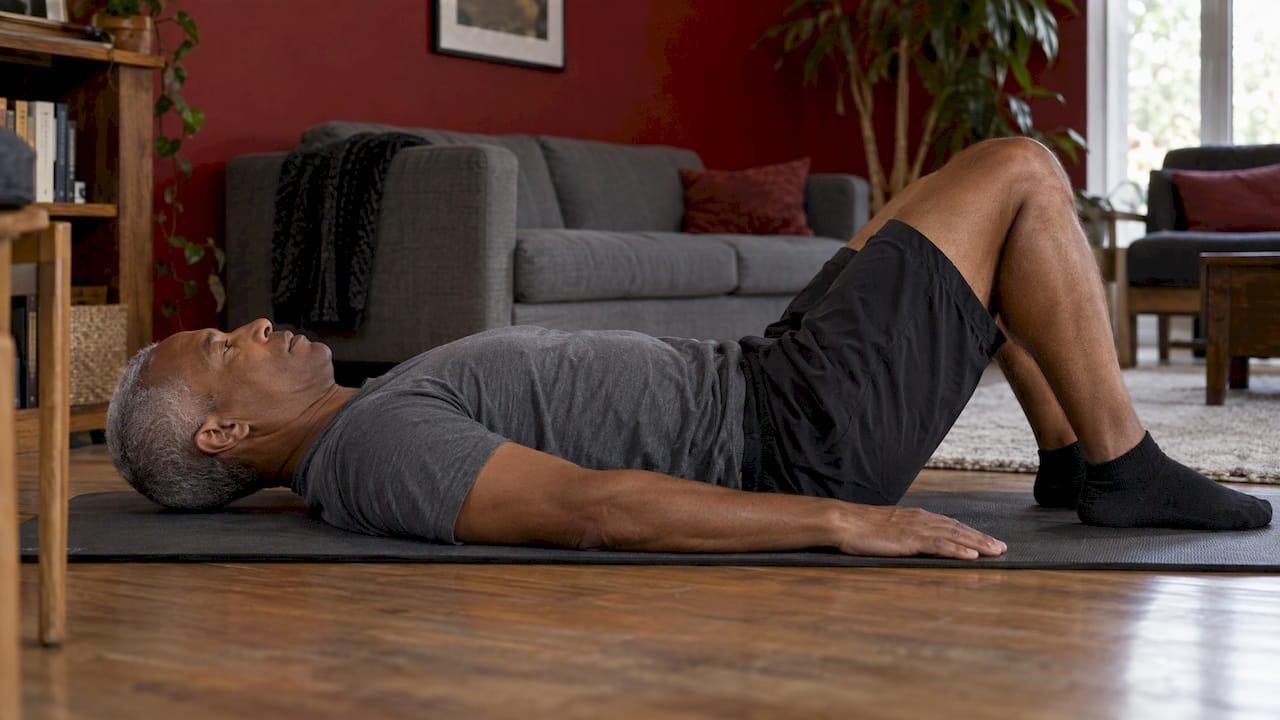
- Lie on your back with knees bent. Lying down takes gravity out of it.
- Squeeze the muscles you found. Hold for 3 seconds.
- Relax completely for 3 seconds. The rest is half the exercise.
- Breathe normally the whole time. UNC warns that holding your breath can put extra pressure on the pelvic muscles.
- Do 10 reps. That's one set.
- Repeat three times through the day: morning, afternoon, evening.
- Each week or two, lengthen the hold toward 5 seconds, then toward 10.
Once the movement feels easy, move to sitting, then standing. Tie it to something you already do: coffee brewing, a red light at a stoplight, the first minute of your commute. Habit beats willpower.
After you pee
Men with dribble have a specific tool. In a randomized trial by Dorey and colleagues, pelvic floor training that included a post-void "squeeze out" contraction left 27 of 55 men (75%) free of post-micturition dribble after three months of exercises plus three months of home practice. Those men also had erectile dysfunction. Ask a urologist or pelvic floor therapist to show you the squeeze-out.
When will you see results?
Give it time. Mayo Clinic says that with regular practice, results can come within a few weeks to a few months, such as leaking less often, and that the exercises should become a lasting part of your daily routine. UNC says it often takes 6 to 12 weeks when done regularly.
The first wins tend to be small. Less dribble. Fewer surprise leaks. Don't wait for a dramatic moment. Track the little things.
Before prostate surgery
If prostate treatment is on your calendar, start now. UCLA Health says it can take six weeks or longer to strengthen the pelvic floor, and that most men regain control of leakage within nine to 12 months after surgery. The AUA/SUFU guideline says patients may be offered pelvic floor muscle exercises before radical prostatectomy and that clinicians should offer them in the immediate post-operative period. Your surgical team sets the plan, so follow theirs.
Mistakes that stall your progress
- Squeezing the wrong muscles. Belly, thighs and glutes should stay relaxed.
- Holding your breath. Breathe freely.
- Overdoing it. UNC warns that more than 100 Kegels in a day can tire the muscles and make you leak more. Muscles grow on training plus rest.
- Practicing with a catheter in. Cleveland Clinic says never do Kegels with a Foley catheter, because it may cause bleeding or bladder muscle spasms. UCLA and MSK give the same warning.
- Pushing through pain. Cleveland Clinic says you shouldn't feel pain. If you do, you may be doing it wrong or Kegels may not suit you. Talk to a healthcare provider, who may suggest physical therapy with relaxation strategies, biofeedback or manual therapy.
Weak floor or tight floor?
Here's the part most articles skip. Not every pelvic floor problem is weakness. Advanced Urology explains that a tight, overactive floor can be made worse by strengthening moves, and that a urologist should determine whether the floor is underactive or overactive before exercises are prescribed.
See a urologist or pelvic floor physical therapist first if you have pelvic, perineal or testicular pain, pain with ejaculation, a weak or interrupted stream, or trouble starting to pee. Don't guess.
The Kegel and testosterone question
Men who search this topic are often really asking: is this about my drive? Fair question.
Kegels train a muscle that controls bladder, bowel and sexual function. The medical guidance above describes them as helping leaks and possibly sexual function. None of it presents them as raising testosterone, so don't treat them as a low-T fix. If your energy, drive or mood has slipped, that's a conversation about sleep, stress, body composition, medications and, if warranted, a morning blood test with your clinician.

On the erection side, the evidence is more specific. Siegel reports that in a study by Dorey and colleagues, pelvic floor training for ED led to normalization in 22 of 55 men (40%), improvement in 19 (35%), and no benefit in 14 (25%). Real numbers. Not a guarantee.
For the bigger picture, our 12-week plan to improve erectile function naturally puts pelvic floor work alongside the other daily levers.
What we think
Here's what we see every day. A man hits his 30s or 40s and something shifts. He doesn't feel broken. He feels off. The energy that used to come automatically takes effort. Recovery drags. Drive goes quiet. And the first answer he hears is "get the shot."
We believe you deserve more options than that. Pelvic floor work is a perfect example: no prescription, no clinic visit, a few minutes a day, and it teaches you to listen to a part of your body most men ignore. That's the mindset we build everything around. YOU HAVEN'T LOST IT. The signal just needs support.
That's why we pair daily habits like Kegels, strength training, sleep and sunlight with a restoration routine you can actually keep. RedRockit is our private-use red light wellness device, designed to support that routine at home, with a companion app that guides your sessions. It's not a clinic and it's not TRT. It's a tool for men who want to protect what they have and stay in the game for their family, their work and themselves.
Start with the basics. Build the habit. Stack the routine.
Nurse Rachel
Build it into a routine you keep
The men who see results aren't the ones who do 200 reps for three days. They're the ones who do a modest set most days for months. Mayo Clinic says to keep Kegels as a lasting part of your daily routine to keep the benefits.
A realistic weekly frame:
- Daily: three short Kegel sets, breathing normally.
- Three days a week: squats, glute bridges and bird dogs. They train the muscles around the pelvis.
- Every day: a few minutes of deliberate relaxation. Let the floor fully let go.
- Weekly: note one thing, such as dribble, leaks or erection quality. Progress hides in details.
Want the full picture beyond the floor? See our male vitality routine for men over 30 and our guide to photobiomodulation for men.
Ready to build a restoration routine?
Kegels cover one piece. If you want a simple daily system for energy, drive, recovery and vitality, we built RedRockit Primal Restoration for exactly that: a private-use red light wellness device with the Rockit IQ app for guided session protocols. No subscriptions, no appointments, and a lifetime craftsmanship guarantee.

It's designed to support your routine, not replace medical care. If you have symptoms like leaking, pain or erection problems, get them checked and use RedRockit alongside that guidance.
FAQ
How does a man do pelvic floor exercises?
Find the muscles you'd use to stop passing gas. Squeeze and hold for 3 to 5 seconds, relax for the same count, and repeat 10 to 15 times. Aim for at least three sets a day, and breathe freely throughout.
How do I know if my pelvic floor is weak?
Common signs are dribbling after you pee, leaking when you cough or lift, and sudden urgency. Because a tight floor can cause similar symptoms, a urologist or pelvic floor therapist can tell which you have before you start a program.
How can men strengthen their pelvic floor fast?
There's no shortcut. Muscles adapt gradually, and sources point to 6 to 12 weeks of regular practice for first changes. Doing more than about 100 a day can tire the muscles and backfire, so consistency wins.
Do Kegels raise testosterone?
No source we found presents Kegels as a testosterone treatment. They train the muscles that support bladder, bowel and sexual function. For concerns about drive or energy, ask a clinician about testing.
Sources
- Kegel exercises for men: Understand the benefits, Mayo Clinic
- Kegel Exercises, NIDDK
- Pelvic Floor Muscle Exercises for Men, UNC Urology
- Kegel exercises for men, UCLA Health
- Kegel Exercises for Men, Cleveland Clinic
- Pelvic Floor Muscle (Kegel) Exercises for Males, Memorial Sloan Kettering
- Kegels: Male Pelvic Floor Exercises, University of Michigan Health
- How to Do Kegel Exercises for Men, Advanced Urology
- Pelvic Floor Dysfunction in Men, Advanced Urology
- Pelvic Floor Muscle Training in Males, Siegel, Urology
- Pelvic floor exercises for treating post-micturition dribble, Europe PMC
- Incontinence After Prostate Treatment: AUA/SUFU Guideline