
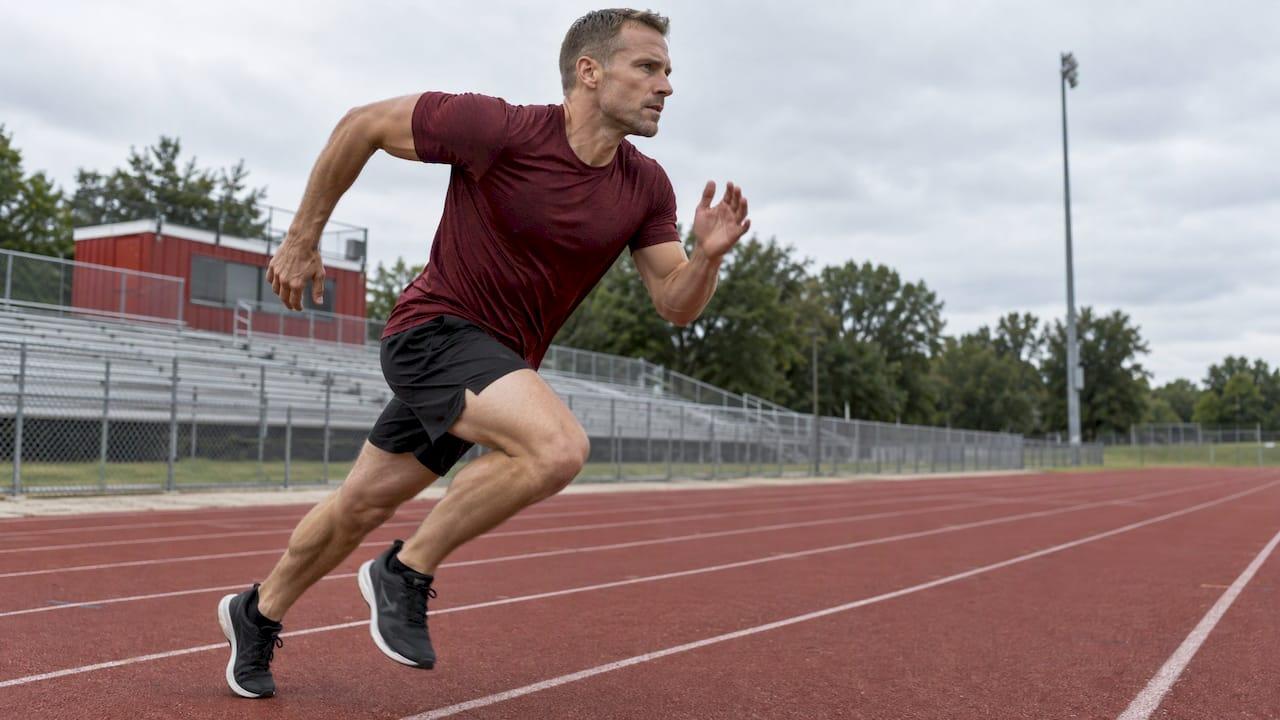
HIIT raises testosterone, but only for a short window. A hard session lifts it for roughly half an hour, and it is back to baseline within an hour. That bump is real. It is not a lasting fix. What moves the needle over months is the whole picture: how hard you train, how well you recover, and whether your body is getting the signal to keep going. That last piece is what we built RedRockit around, a private-use red light wellness device for a daily restoration routine.
If you are a man over 30 who feels the shift coming, or a wife trying to understand why your husband is flat, this is the straight version.
TL;DR
- A single HIIT session raises testosterone right after exercise. A 2021 meta-analysis found the rise gone by 30 minutes and baseline by 60.
- Testosterone and cortisol were both back to baseline after 24 hours, so one workout does not change your baseline.
- Overdoing high intensity can backfire: extended hard exercise can suppress testosterone during recovery for up to 72 hours.
- Short sprint sessions, spaced with real recovery, are the smart way to use HIIT after 30.
- Recovery is half the equation. That is where a consistent restoration routine earns its place.
Table of Contents
- What HIIT actually does to testosterone
- Does HIIT raise testosterone long term?
- Sprinting and testosterone
- What the studied workouts look like
- Why more is not better: cortisol and recovery
- A smart HIIT week for men over 30
- For her: what to look for
- Where a restoration routine fits
- Perspective
- FAQ
- Sources
What HIIT actually does to testosterone
HIIT means high-intensity interval training: short, hard efforts with recovery between them. Sprints are the purest form.
Here is what the best evidence says.
- Right after the session, testosterone goes up. A 2021 meta-analysis pooled 10 controlled studies (213 people) and 50 pre-post groups (677 people). Testosterone rose significantly immediately after one HIIT session.
- The rise is brief. In that same analysis it disappeared by 30 minutes and returned to baseline by 60. After 24 hours, testosterone and cortisol were both back at baseline.
- Intensity matters. A 2020 meta-analysis of 48 studies found acute increases after moderate and high-intensity exercise but not mild activity, and only within 30 minutes afterward.
So is a post-workout spike worth chasing? Not by itself. Your body is not building a new testosterone baseline in 30 minutes. Think of it as the body answering a stress, then settling down.
Does HIIT raise testosterone long term?
This is where the claims online get ahead of the science.
A 2016 review found the mid- and long-term effects of exercise on testosterone are less clear. Some studies show increases after five weeks of endurance training. Others found no difference, or lower levels, in highly trained endurance athletes compared with controls.
The studies that do show gains tend to be specific. In a 2017 study of 17 male masters athletes with an average age of 60, six weeks of low-volume HIIT raised peak power output from 799 to 865 W. Free testosterone rose slightly, from 7.0 to 7.5 ng/dL. Total testosterone rose from 15.2 to 16.4 nmol/L, which did not reach statistical significance.

A 2018 study of 40 moderately trained men combined sprint and resistance training. Resting total testosterone increased significantly in the middle-aged trained men (average age 41). That closed the age gap with the younger trained group.
Take the honest message from this: training helps, and smart training helps your body work with the hormones it has. But a few sprints a week is a tool, not a switch.
Sprinting and testosterone
Sprinting is the hardest version of interval work, and it gets its own attention for good reason.
In one study of adolescent boys, six months of sprint training raised total testosterone at the end of a 6-second sprint and during recovery. That tells us sprinting is a strong acute signal.
But sprinters are not walking testosterone factories. A study of 16 high-level sprinters and 15 untrained men found no significant difference in baseline testosterone between the groups. Within eight sprinters, baseline testosterone was lower during heavy sprint-specific training (20.99 nmol/L) than during a low-intensity period (23.37 nmol/L).
The lesson: sprinting is a sharp tool. More is not better.
What the studied workouts look like
Researchers define the terms like this. According to a 2022 review, high-intensity interval exercise is performed at 85 to 100% of VO2max (your body's maximum oxygen use), in bouts of 12 seconds to 4 minutes. Sprint interval exercise is all-out effort in bouts of 5 to 30 seconds.
Two protocols show what that looks like in practice:
| Study | Protocol | What happened |
|---|---|---|
| Herbert et al., 2017 | Six weeks, nine sessions, 6 x 30-second sprints at 40% peak power, 3 minutes active recovery, one session every 5 days | Small rise in free testosterone in men averaging 60 |
| Cofré-Bolados et al., 2019 | 20 minutes of 15-second intervals at 110% VO2max with 15 seconds of active rest, versus 20 minutes steady aerobic work | Both raised free testosterone right after; no difference at 12 hours |
Notice the spacing in the first one. One session every five days. That was not an accident. The authors noted five days were needed for peak power to recover in older males.
Why more is not better: cortisol and recovery
Cortisol is your stress hormone, and it pushes against testosterone. A January 2026 systematic review reported that moderate-to-high-intensity exercise causes a temporary testosterone rise, while extended high-intensity exercise suppresses testosterone during recovery for up to 72 hours because of cortisol.
The same review found the exercise-related testosterone response is stronger in younger males than in older adults.
That is the trap for men over 30. You feel flat, so you train harder. You sleep worse, recover slower, and feel flatter. The tank never fills. We wrote more on this in our piece on overtraining and low testosterone.
The good news from the same research: regular interval training lowers resting cortisol and blunts the stress response compared with a single bout, per the 2022 review. Your body adapts when you give it room.

A smart HIIT week for men over 30
This is a practical frame built from the studied protocols, not a prescription. If you have heart disease, high blood pressure, joint problems, or haven't exercised in a while, see your doctor before starting all-out intervals.
- Pick one or two interval days, not five. The masters protocol spaced sessions five days apart.
- Keep sprints short. Efforts of 5 to 30 seconds fit the sprint interval definition.
- Recover fully between efforts. Quality beats volume.
- Add strength work. Sprint plus resistance training was the combination that raised resting testosterone in the 41-year-old group. Our guide to strength training and testosterone explains why lifting beats chasing spikes.
- Protect sleep and recovery. This is where most men lose the gains.
Movement also matters beyond intervals. A 2020 analysis of 7,372 US men found that obese men exceeding guideline activity levels were less likely to have low testosterone (below 300 ng/dL), with an odds ratio of 0.523. Staying active is one of the strongest moves you have. How exercise intensity shapes these responses also connects to testosterone and bone density in men, since your skeleton responds to load too.
For her: what to look for
If you are a wife or partner reading this, you probably noticed it before he did. Less drive. Short fuse. Tired by 3 p.m. Pulling away.
HIIT is not the answer to all of that, and a hard workout will not fix a low-energy husband overnight. What helps is a steady routine he can actually keep: sleep, strength work, smart movement, and daily recovery. If symptoms are persistent, a doctor can check his levels. Our guide to free vs total testosterone testing shows what to ask for.
Where a restoration routine fits
Intervals are a stress you apply. Restoration is what lets you answer that stress. Most men get the first part right and skip the second.
RedRockit is a private-use red light wellness device designed to support a simple daily restoration routine for energy, drive, recovery, and vitality. The Rockit IQ companion app guides your session protocols. It is not a clinic, not TRT, and not a prescription. There are no subscriptions and no medical appointments, and it comes with a lifetime craftsmanship guarantee.
Pair it with two smart interval days and a lifting plan, and you have a routine you can sustain.
See RedRockit Primal Restoration

Still weighing your options? Start with what to try before TRT.
Perspective
Men come to us doing everything "right." They grind through hard workouts, skip rest, and wonder why the tank never fills.
Here is what we believe. YOU HAVEN'T LOST IT. Your body is still listening for the signal. Training sends a stress. Restoration tells the body it is safe to rebuild. Skip the second half and you are just spending.
We built RedRockit for the second half. A daily routine, done at home, with no subscriptions and no appointments, that supports the energy, drive, and recovery you want to keep. Men deserve more than "just get the shot" as the first answer. Start with the routine.
Nurse Rachel
FAQ
Does HIIT increase testosterone permanently?
No. A 2021 meta-analysis showed the rise after one session was gone within an hour, with baseline back at 24 hours. Long-term effects depend on training habits, recovery, and age.
Is sprinting better than steady cardio for testosterone?
Both raised free testosterone right after exercise in a 2019 study, with no difference at 12 hours. Sprinting is shorter and efficient, but it also demands more recovery.
How often should I do HIIT after 30?
The studied masters protocol used one session every five days. Start with one or two sessions a week and let recovery, sleep, and energy tell you whether to add more.
Can too much HIIT lower testosterone?
Yes. A 2026 review reported that extended high-intensity exercise can suppress testosterone for up to 72 hours of recovery. Spacing sessions and sleeping well protect you from this.
Sources
- Acute effect of HIIT on testosterone and cortisol levels (Scand J Med Sci Sports, 2021)
- Endogenous transient doping: physical exercise acutely increases testosterone (2020)
- Exercise, Training, and the Hypothalamic-Pituitary-Gonadal Axis in Men and Women (2016)
- HIIT produces increases in muscle power and free testosterone in masters athletes (2017)
- Sellami et al., effect of acute and chronic exercise on steroid hormones (2018)
- Androgen responses to sprint exercise in young men (2010)
- Gonadal hormone status in highly trained sprinters and untrained men (2010)
- Endocrine responses of the stress system to different types of exercise (2022)
- Testosterone and cortisol responses to HIIT and continuous exercise (2019)
- Effect of acute exercise on the dynamics of testosterone (2026)
- Exercise thresholds and low testosterone in US men, NHANES (2020)