

Total testosterone measures every molecule of the hormone in your blood, bound or not. Free testosterone measures only the unbound fraction, the part your tissues can actually grab and use. Start with total T. If your total comes back normal but your body is still sending distress signals, that is when free T earns its place on the order sheet.
TL;DR:
- Men with the same total testosterone level can have different free testosterone levels due to variations in SHBG, affecting symptoms and hormone availability.
- Testing free testosterone is most valuable when symptoms persist despite normal total testosterone, especially in cases involving obesity, age, or thyroid issues.
- Equilibrium dialysis provides the most accurate free T measurement, but most clinics rely on calculated free testosterone using total T, SHBG, and albumin values.
- Blood should be drawn before 10:00 AM to accurately reflect baseline testosterone levels, and results should be confirmed with repeat tests if borderline or abnormal.
- Interpreting testosterone results requires symptoms and context, as a single number rarely indicates deficiency without additional clinical information.
Table of Contents
- Free vs Total Testosterone: The Physiology Behind the Numbers
- When Doctors Order Total vs Free Testosterone
- How Labs Actually Measure Free Testosterone
- What Your Results Actually Mean
- Getting Ready for a Testosterone Test the Right Way
- What Happens After You Get Your Results
- Nurse Rachel's Appointment Checklist for Testosterone Testing
- Why Most Men Get This Backward
- A Practical Next Step Before You Consider TRT
- Sources
Free vs Total Testosterone: The Physiology Behind the Numbers
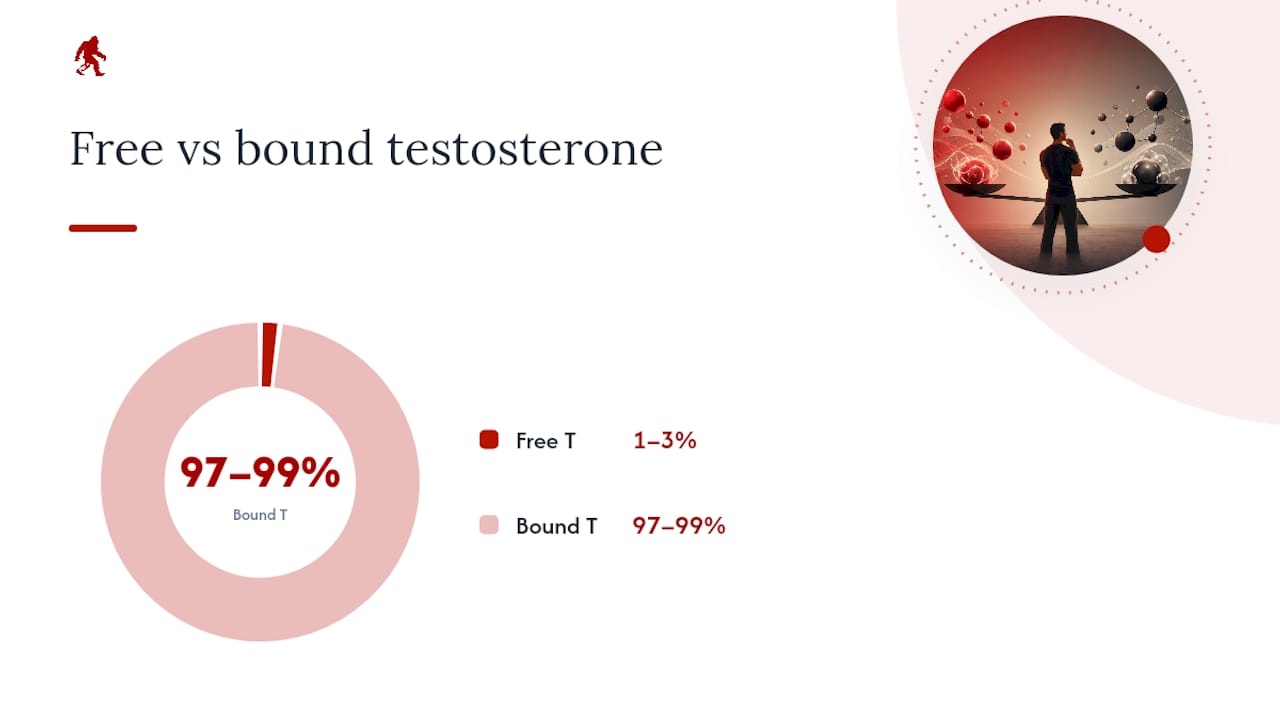
Your bloodstream doesn't carry testosterone loose and unattended. Most of it rides shotgun, bound to proteins that keep it locked up and unavailable. Total testosterone is the sum of everything: bound and unbound. Free testosterone is the unbound fraction, and it typically makes up only 1 to 3 percent of the total. Bioavailable testosterone is a middle category: free testosterone plus the portion weakly attached to albumin, which lets go easily enough that tissues can still use it.
Two proteins run this show:
- Sex hormone binding globulin (SHBG) grips testosterone tightly and does not let go easily, effectively taking that portion out of circulation for active use.
- Albumin holds testosterone loosely, so that bound fraction still counts toward the bioavailable total, even though it is not technically "free."
Here is where it gets interesting for real men in real exam rooms. Two guys can post identical total testosterone numbers, say 450 ng/dL, and have completely different symptom pictures. If one has high SHBG (common with aging, thyroid issues, or liver conditions), more of his hormone is locked away. His free T is low even though his total looks fine on paper. The other guy, with normal SHBG, has plenty of usable hormone and feels like himself. Same total. Different reality. This is the encyclopedia entry on bioavailable testosterone in a nutshell: what's circulating matters less than what's actually available to do the work.
When Doctors Order Total vs Free Testosterone
Most clinicians follow a sequence, not a guess. Total testosterone is the standard first test, and for a lot of men, it settles the question outright. A total T under 300 ng/dL with clear symptoms usually confirms deficiency. A total T solidly in the normal range with no symptoms usually closes the case. The gray zone is where free T earns its keep.
Here's the practical sequence clinicians tend to follow:
- Order total testosterone first. It's cheaper, widely available, and sufficient for clearly low or clearly normal cases.
- Escalate to free or calculated free T when symptoms (low libido, fatigue, poor recovery, mood changes) persist despite a "normal" total.
- Add SHBG testing when you suspect it's skewing the picture, particularly with obesity, aging past 50, thyroid disease, or liver disease.
- Consider free T as part of an infertility workup, since sperm production depends on local testosterone availability, not just what shows up on a total panel.
- Use free T to monitor TRT response, since therapy changes both total and SHBG dynamics in ways a single total number can't capture.
A quick self-check before your next appointment: if you have unexplained fatigue, low drive, or poor recovery from training, and your last total T came back "normal," that's exactly the scenario where LabCorp's clinical guidance says free testosterone testing adds real diagnostic value. Obesity, chronic illness, and age past 50 are the three biggest reasons SHBG drifts out of its usual range, and any one of them is reason enough to ask for it by name.
How Labs Actually Measure Free Testosterone
Not all free testosterone results are built the same way, and that difference can change how you should read your own numbers.
- Total T assays are generally reliable but can vary between labs due to differences in immunoassay calibration, so a borderline result deserves a repeat test before you act on it.
- Equilibrium dialysis is the reference standard for free T. It physically separates bound and unbound hormone using a dialysis membrane. It's accurate, but slow and expensive, so it's mostly reserved for research settings and specialized reference labs.
- Direct analog assays are the cheap, fast, common method most routine labs use, and they can produce misleading numbers because they don't isolate the free fraction as cleanly as dialysis does.
- Calculated free testosterone uses your total T, SHBG, and albumin values plugged into a validated formula, most commonly the Vermeulen or Sodergard equation.
Statistic to remember: free testosterone represents roughly 1 to 3 percent of your total testosterone. That's not a rounding error, it's the entire reason two men with the same total can feel completely different.
Calculated free T has become the practical workhorse in most clinics, and for good reason: it correlates well with equilibrium dialysis when total T and SHBG are measured accurately, without the cost or turnaround time of true dialysis testing. That's a reasonable tradeoff for routine care.
Pro Tip: Ask your lab directly whether your free T result is calculated or measured by direct analog assay. If the report doesn't say, call and ask. That one phone call can be the difference between trusting your result and chasing a number that was never reliable to begin with.
What Your Results Actually Mean
Lab reports don't interpret themselves, and a single number rarely tells the whole story. Here's how to read the four patterns you're most likely to see.
- Clearly low total T with matching symptoms. Fatigue, low libido, poor recovery, and a total under roughly 300 ng/dL usually confirm deficiency without needing free T to settle it.
- Normal total, low free. This is the pattern that gets missed most often. High SHBG is masking real deficiency behind a normal-looking total. This is exactly the scenario MedPage Today's clinical breakdown flags as the case for ordering SHBG and calculated free T rather than trusting the total alone.
- Borderline total (300 to 400 ng/dL range). Don't label this deficiency off one draw. Repeat the test, ideally another early morning sample, check SHBG, and match the number against how you actually feel day to day.
- Discordant or confusing results across repeat tests. This is your cue to loop in an endocrinologist or urologist rather than keep re-ordering the same panel and hoping for clarity.
If you want a deeper breakdown of what counts as normal by age and how ranges shift over a man's life, our guide to normal testosterone levels in men walks through the ranges lab reports rarely explain well.
Pro Tip: Write down your symptoms the same day you get your blood drawn, not from memory a week later when you're staring at the results. A doctor comparing your mood, energy, and libido notes against the exact draw date catches patterns that a number alone can't show.
Getting Ready for a Testosterone Test the Right Way
Bad timing wrecks good testing. Testosterone follows a diurnal rhythm, peaking in the early morning and dropping through the day, so the Cleveland Clinic recommends drawing blood before 10:00 AM to get a number that actually reflects your baseline rather than an afternoon low.
- Schedule your draw early, before 10:00 AM whenever possible. An afternoon test on the same man can read meaningfully lower for no reason other than the clock.
- Confirm fasting rules with your specific lab. Some testosterone panels require fasting, others don't; this varies by facility, not by some universal rule.
- Repeat any abnormal or borderline result at least once before accepting it as your baseline. One odd draw doesn't make a diagnosis.
- Bring a full list of medications and supplements, including over the counter products. Things like biotin, certain steroids, and even some hair loss treatments can shift SHBG or interfere with assay accuracy.
If shift work or irregular sleep is part of your life, mention it. Testosterone's rhythm follows your circadian pattern, not the clock on the wall, and a clinician who knows your schedule can time the draw against your actual biology instead of a generic 8:00 AM slot. For men curious about testing logistics outside a clinic visit, our guide to testing testosterone at home covers what home kits can and can't tell you.
What Happens After You Get Your Results
A lab value alone doesn't diagnose anything. Real diagnosis requires biochemical evidence that lines up with symptoms you're actually experiencing, not a number floating in isolation on a printout. A borderline total T in a man with zero symptoms rarely warrants treatment. A borderline total in a man who's lost his drive, his recovery, and his patience is a different conversation entirely.
When results and symptoms don't cleanly agree, clinicians typically widen the workup:
- SHBG to check if binding protein levels are skewing the free fraction.
- LH and FSH to determine whether the issue originates in the testes or upstream in the pituitary.
- A repeat total T, always drawn in the morning, to rule out a fluke result.
- Prolactin levels or a testicular exam when the clinical picture suggests something beyond simple age-related decline.
Before treatment enters the conversation, plenty of ground exists to cover first: sleep quality, weight management, resistance training, and nutrition all move the needle on natural testosterone production and how efficiently your body uses what you've got. These aren't afterthoughts. They're the foundation most men skip on their way to asking about a prescription.
If TRT genuinely becomes the next step, that conversation needs to include fertility impact, hematocrit monitoring for erythrocytosis risk, and a real monitoring plan, not a one-time shot and a follow-up in six months. Our breakdown of hematocrit risk and nurse-led TRT monitoring covers exactly what that plan should include before anyone signs on.
Nurse Rachel's Appointment Checklist for Testosterone Testing
Walking into a lab draw unprepared is how men end up with a stack of confusing numbers and no plan. Bring three things to every testosterone appointment: a symptom timeline (when things changed, not just how you feel today), a complete medication and supplement list, and copies of any prior lab reports, ideally with the assay method noted if you can find it.
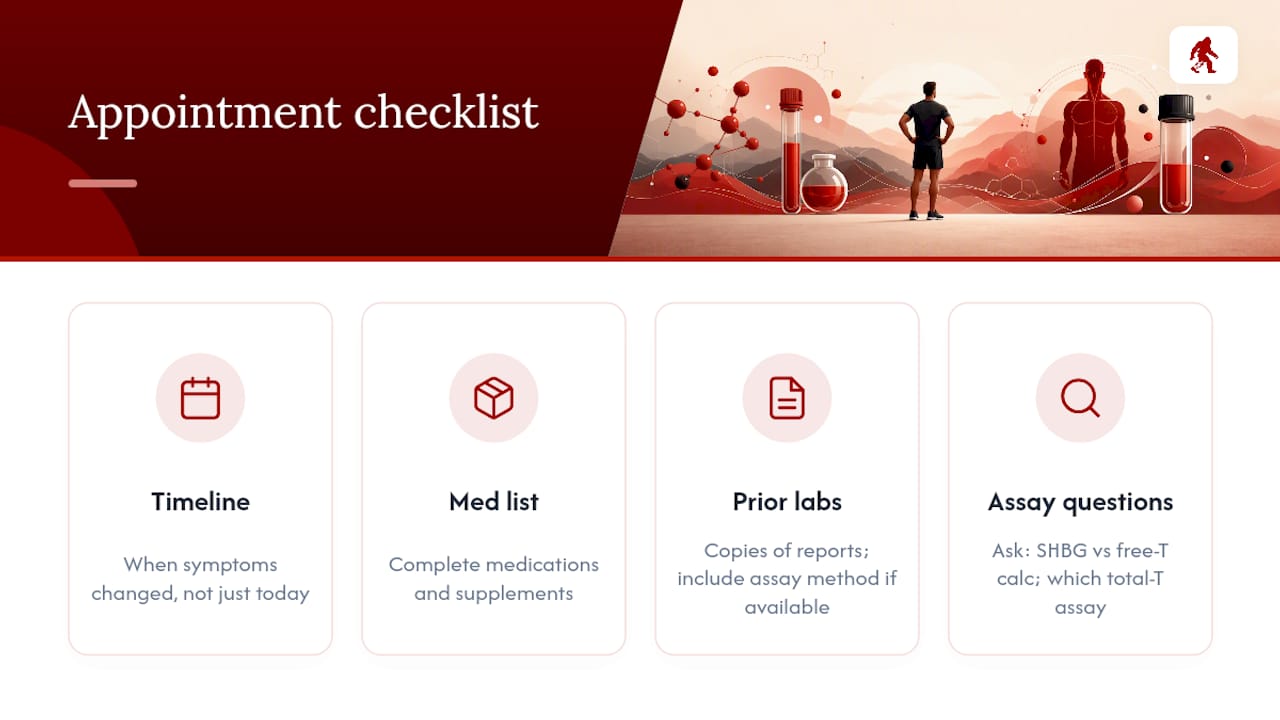
Ask your clinician two direct questions. Was SHBG measured, or was free T calculated from total T and albumin? What assay was used for your total T? Most men never ask this, and most clinicians are happy to answer once someone actually asks.
One more thing worth remembering: testosterone fluctuates day to day, sometimes more than people expect. A single low or borderline result is a data point, not a verdict. Confirm it before you build a treatment plan around it.
If therapy does start, monitoring matters as much as the prescription itself. Hematocrit, PSA, and a fertility conversation belong in that plan from day one, not added later as an afterthought once something's already gone sideways.
Why Most Men Get This Backward
The conventional advice treats a single total testosterone number like a verdict. It isn't. What the research actually supports is a process: total T first, context and symptoms always, free T and SHBG when the picture doesn't add up. Men get talked into treatment off one low-normal number, and just as often, men with real symptoms get dismissed because their total looked fine on paper while their free T was quietly in the basement.
Here's what I'd tell any man reading his own results for the first time: your total number is a starting point, not a diagnosis, and how you feel matters as much as what the lab prints. Don't let one draw, taken at the wrong time of day or read by the wrong assay, decide something this important. Ask what method your lab used. Repeat anything borderline. And if the numbers and the symptoms don't match, that mismatch is information, not confusion.
The men who navigate this well aren't the ones with the best labs. They're the ones who ask better questions before they accept an answer.
— Nurse Rachel
A Practical Next Step Before You Consider TRT
Testing clarifies what's happening in your bloodstream. It doesn't fix the daily grind of feeling flat, slow to recover, or checked out from your own drive. That gap is exactly where Primal Red Co built RedRockit, a private-use red light wellness device designed for daily restoration, not diagnosis.

To be direct: if your labs point to real deficiency, that conversation belongs with a clinician first, full stop. RedRockit isn't a replacement for medical evaluation, and we're not pretending otherwise. What it's built for is the maintenance window, the years where you're not in crisis but you can feel the shift starting, and you'd rather build a routine now than wait for a bigger decision later. It fits into a daily restoration habit alongside the sleep, training, and nutrition fundamentals covered above. If you want the fuller picture on what that maintenance routine looks like for men over 40, start with our guide to male vitality after 40 and see whether it's the missing piece in your own routine.
This article is general information, not a substitute for advice from a qualified doctor. Consult a qualified healthcare professional about your own circumstances before acting on anything here.
Sources
- Testosterone Levels Test
- Testosterone Deficiency - Establishing A Biochemical Diagnosis
- Understanding total testosterone vs. free testosterone - LabCorp
- Testosterone test — Cleveland Clinic