
Clinic sessions run $25–$200 each. A quality home device costs $100–$3,000+ depending on coverage and power. Those two numbers are the core of every red light therapy cost decision you'll make, and according to INIA, home devices typically become cost-effective for regular users within just a few months of consistent use.
The range is wide for a reason. A targeted spot treatment at a wellness studio in a mid-size city costs very differently than a full-body session at a medical spa in Manhattan. A $60 LED face mask does very different work than a $1,200 full-panel system. Understanding what moves the price is what separates a smart purchase from an expensive mistake.
Here's what you need to know upfront:
- Clinic sessions: often vary in price depending on treatment type; packages and memberships typically help reduce the per-session price
- Home devices: prices vary widely based on size, power, and coverage area
- Insurance: Most insurers classify red light therapy as cosmetic and do not cover it
- HSA/FSA: Sometimes eligible with a Letter of Medical Necessity from a qualified provider
- Breakeven: Regular home device users typically see cost benefits within a few months of consistent use
WebMD notes that sessions commonly run around $80 each, with home devices ranging from budget masks to full-body systems costing thousands. That $80 figure is a reasonable midpoint for planning, but your actual number depends heavily on where you go and what you're treating.
Key Takeaways
A home device used 3–5 times per week typically costs less than studio sessions within 2–6 months, making consistent home use the most cost-effective long-term approach for most buyers.
| Point | Details |
|---|---|
| Clinic session range | Per-session costs run $25–$200 depending on venue type, location, and session format. |
| Home device range | Devices cost $100–$11,000+; most committed buyers land in the $300–$1,500 range for solid panel coverage. |
| Breakeven timeline | Regular home users (3–5x per week) typically break even on a mid-range device within 2–6 months. |
| HSA/FSA eligibility | Reimbursement is sometimes possible with a Letter of Medical Necessity; confirm with your provider and HSA/FSA administrator before purchasing. |
| RedRockit for men 30+ | RedRockit is a private-use device with guided protocols designed for daily restoration routines, with breakeven typically within 2–4 months at 4–5 sessions per week. |
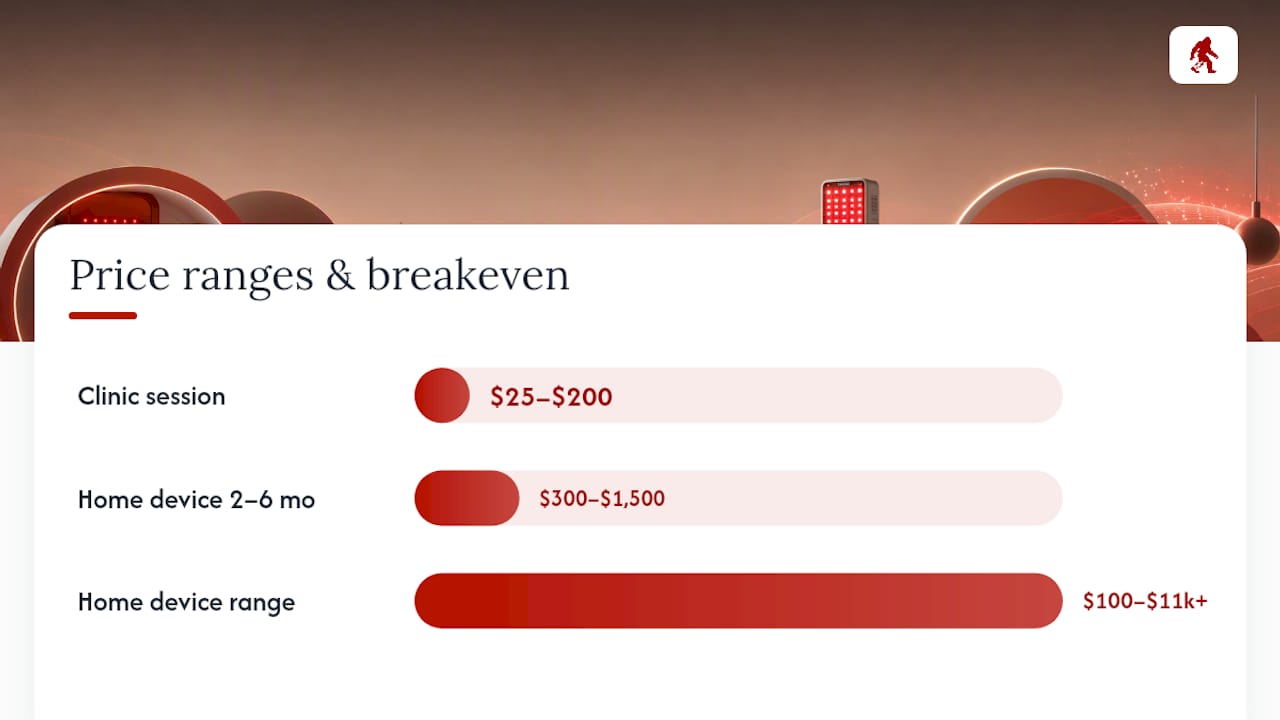
Table of Contents
- How much does red light therapy cost at a clinic?
- What do home devices cost, and what does each price tier get you?
- What actually drives the price of red light therapy?
- Pricing models, memberships, and how to pay for it
- Clinic vs. home device: the real cost math over 12 months
- Is red light therapy worth the price?
- How to choose between clinic sessions and buying a device
- What sensible budgeting actually looks like for men over 30
- RedRockit is built for exactly this kind of math
- Sources
How much does red light therapy cost at a clinic?
The venue type matters more than most people realize. A gym add-on session and a dermatologist-supervised phototherapy protocol are not the same thing, even if both involve red light.
Wellness studios and tanning-style studios are the most accessible entry point. Per-session prices are generally lower for targeted or partial-body exposure. These are often stand-up or lay-down pod setups with minimal staff involvement. The equipment varies widely in quality.
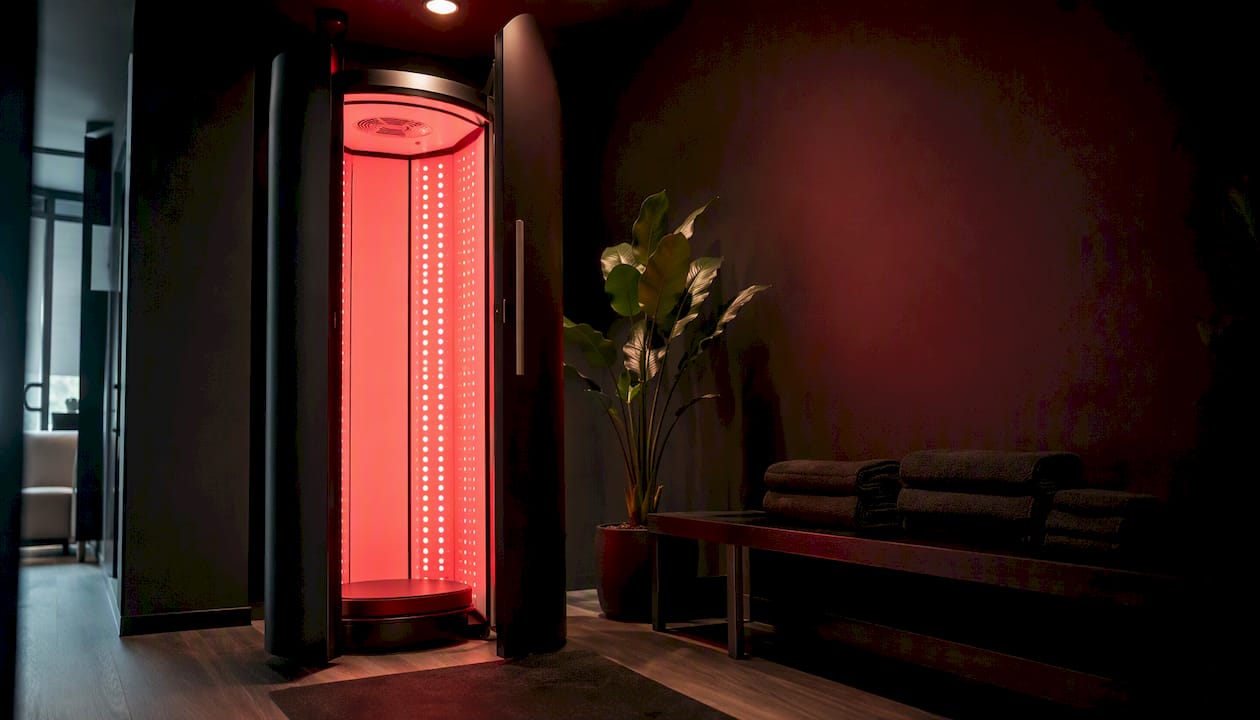
Medical spas and aesthetic clinics tend to charge higher prices due to overhead and equipment quality. Trained professionals often guide the protocols. Full-body sessions at this level generally cost more than partial treatments.
Dermatologist offices and academic medical centers sit at the top of the price range for supervised phototherapy. NYU Langone Health and UCI Health both describe clinic-based phototherapy protocols for conditions like psoriasis and vitiligo that involve multiple supervised sessions per week. At this level, you're paying for clinical oversight, diagnostic context, and medical-grade equipment, not just light exposure.
Gym memberships with red light add-ons (Planet Fitness is a well-known example) offer some of the lowest per-session costs, sometimes included in a monthly membership tier. The tradeoff is that gym-level devices are typically lower power and shorter sessions.
Red Light Finder's 2026 pricing data shows studio memberships often reduce per-session costs significantly for frequent users. That math only works if you actually go consistently.
One factor that rarely gets mentioned: some commercial beds and pods used by premium clinics require substantial equipment investment. That capital cost gets baked into session pricing, which is a big reason why a high-end studio charges $150 when a gym charges $20.
Pro Tip: Before booking, ask the clinic for their device's irradiance rating (mW/cm²) and session length. A 10-minute session at 100 mW/cm² delivers a very different dose than a 20-minute session at 30 mW/cm². Price per session means nothing without knowing what you're actually getting.
What do home devices cost, and what does each price tier get you?
The home red light therapy market has exploded, and the price spread reflects genuinely different device classes, not just marketing.
- Handheld wands and spot devices: often suitable for occasional targeted use on small areas, usually at the lower end of price ranges.
- LED face masks: designed for facial skin routines; quality and price vary widely, with some budget options lacking sufficient irradiance.
- Mini and mid-size panels: popular among buyers, covering face and upper body or targeted zones, and generally delivering effective treatment irradiance.
- Large and multi-panel systems: offer full torso or near-full-body coverage, built for serious daily users; most committed home buyers invest in mid-range panels covering face and key body areas.
- Full-body beds and pods: commercial-grade equipment intended for home use; generally a significant investment suited for daily users with extensive coverage needs.
Add-ons affect total cost more than buyers expect. A quality mounting stand or ceiling mount runs $50–$150. Replacement LED components, if needed, vary by brand. Shipping on large panels can add $50–$100. Budget for these when you're comparing device prices.
The key specs that separate price tiers are wavelength, irradiance, LED density, and coverage area. A device that hits the therapeutic wavelength range (typically 630–670 nm for red, 810–850 nm for near-infrared) at adequate irradiance is doing real work. One that doesn't is just a light.
What actually drives the price of red light therapy?
Two categories of factors move the number: technical specs and business overhead. Knowing which is which helps you evaluate whether a higher price is justified.
Technical drivers
Wavelength is the most fundamental spec. Therapeutic red light typically falls in the 630–670 nm range; near-infrared (NIR) runs 810–850 nm. Devices that hit these ranges precisely cost more to manufacture than those that approximate them.
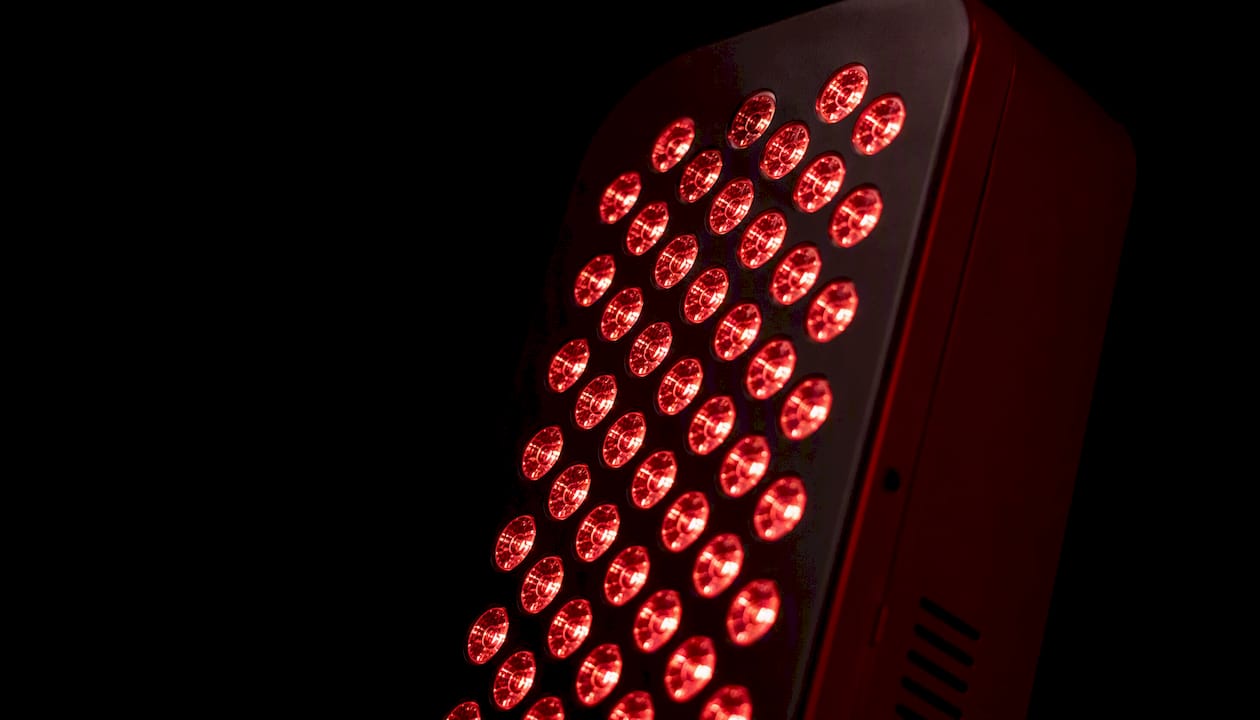
Irradiance (mW/cm²) is arguably the most important number for home buyers. Higher irradiance means shorter session times for the same therapeutic dose. Devices with strong irradiance cost more but deliver more per minute. Red Light Finder confirms that irradiance and wavelength are the key technical specs determining treatment time and effectiveness.
LED density and panel size determine coverage. More LEDs, better spacing, and larger panels cost more to build. A cheap panel with sparse LEDs creates uneven coverage and longer effective session times.
Cooling and duty cycle matter for longevity and consistent output. Devices with active cooling maintain irradiance output over time. Passive-cooled budget devices can degrade faster.
Business drivers
At clinics, you're paying for rent, staff wages, equipment amortization, liability insurance, and in some cases medical oversight. A dermatologist's office charges more than a wellness studio partly because the overhead structure is fundamentally different. Location compounds this: the same session costs more in San Francisco than in Tulsa.
Session length also affects per-session cost math. A 20-minute full-body session at a premium studio costs more to deliver than a 10-minute targeted session, even on the same equipment.
Pro Tip: When comparing home devices, ask the vendor for irradiance measured at your actual treatment distance (typically 6 inches), not at the panel surface. Surface irradiance numbers look impressive but aren't what your body receives.
Pricing models, memberships, and how to pay for it
Single sessions are the most expensive way to use a clinic long-term. Memberships go further.
Common pricing structures you'll encounter:
- Single session: typically the highest per-session cost without long-term commitment
- 5- or 10-session packages: Typically 20–30% below single-session price
- Monthly memberships: $59–$249/month depending on session frequency and provider tier; often the best per-session value for regular users
- Gym add-on tiers: Some gyms include red light access in a premium membership tier for $10–$25/month above base membership
- First-visit discounts: Common at wellness studios, often 50% off or free for the first session
HSA and FSA eligibility
This is where most people leave money on the table. AARP's coverage of red light therapy confirms that insurers generally classify red light therapy as cosmetic and do not cover it, but HSA and FSA reimbursement is sometimes possible with a Letter of Medical Necessity (LMN) from a qualified provider.
An LMN is a written statement from your doctor or nurse practitioner explaining that the treatment addresses a diagnosed medical condition. Chronic pain, wound healing, and certain skin conditions are the most common qualifying contexts. Without an LMN, most HSA/FSA administrators will reject the claim.
The practical path: talk to your provider before purchasing. Get the LMN in writing. Submit it with your receipt. Not every administrator will approve it, but many will, and it's worth the 15-minute conversation.
CareCredit and financing
CareCredit is a healthcare credit card accepted at many medical spas, dermatology offices, and wellness clinics. It offers promotional financing periods (often 6–24 months interest-free) on qualifying purchases. For a device purchase or a multi-session package over $500, this can make the upfront cost manageable. The risk is the deferred interest structure: if you don't pay the balance in full before the promotional period ends, interest accrues retroactively. Read the terms before you sign.
Clinic vs. home device: the real cost math over 12 months
Here's where the numbers get honest. The right choice depends on your frequency, your goals, and your budget. These scenarios use realistic mid-range assumptions.
Scenario C: Daily full-body user
The math consistently favors home devices for anyone using red light therapy more than twice a week. For occasional or exploratory users, studio sessions let you test the protocol before committing to hardware.
Pro Tip: Add $100–$200 to your home device budget for mounting hardware, a timer, and the first year of electricity cost. A large panel running 20 minutes daily adds roughly $3–$8 per month to your electric bill, which is negligible but worth knowing.
Is red light therapy worth the price?
The honest answer: it depends on what you're treating and how consistently you use it.
The American Society of Plastic Surgeons is clear that LED phototherapy offers noninvasive improvements for skin and certain conditions, but it is not a replacement for lasers, injectables, or invasive procedures. That framing matters for budgeting. If you're expecting red light therapy to do what a CO2 laser does, you'll be disappointed. If you're using it as a consistent, low-risk addition to a restoration routine, the evidence is more encouraging.
Here's where the evidence is strongest:
- Skin rejuvenation and collagen support: Multiple studies show modest but real improvements in skin texture, tone, and fine lines with consistent use. The AARP review notes dermatology experts emphasize that consistent use produces the ROI, not sporadic sessions.
- Pain and inflammation: Evidence for musculoskeletal pain and joint inflammation is reasonably solid, particularly for short-term relief with regular application.
- Hair loss (androgenic alopecia): Low-level laser/light therapy has FDA clearance for hair loss in both men and women. Results are modest and require ongoing use to maintain.
- Energy and recovery: This is where the science for men over 30 is particularly interesting. For a deeper look at the evidence, the science behind red light therapy for men is worth reading before you spend a dollar.
When in-office treatment is worth the premium: if you're treating a diagnosed condition like psoriasis or vitiligo, clinician-supervised phototherapy with medical-grade equipment is the right call. The AAD's guidance on wearable light and clinical phototherapy protocols both emphasize proper device specs and supervision for these conditions. A $60 home mask is not a substitute for a monitored protocol.
Safety profile is generally favorable for consumer-grade devices. The main risks are eye exposure (always use protective eyewear) and overuse on sensitive skin. For EMF considerations with powered devices, Primal Red Co's EMF safety guide covers what men need to know.
The single biggest predictor of value: frequency and consistency. A $300 panel you use five days a week will outperform a $1,500 panel you use twice a month.
How to choose between clinic sessions and buying a device
Work through this checklist before you spend anything.
Define your goal first:
- Skin rejuvenation and facial protocol? A quality face mask or small panel may be enough.
- Full-body recovery and energy restoration? You need panel coverage, not a wand.
- A diagnosed condition requiring medical oversight? Start with a clinician, not a device purchase.
Estimate your realistic frequency:
- 1x per week or less: Studio sessions or a gym membership add-on may be cheaper.
- 2–3x per week: Breakeven on a mid-range home device typically hits within 3–5 months.
- Daily use: A home device is almost certainly cheaper within 2–3 months.
Check device specs before buying:
- Wavelength: Look for 630–670 nm (red) and/or 810–850 nm (near-infrared).
- Irradiance: Ask for mW/cm² at 6 inches of treatment distance, not at the panel surface.
- Coverage: Match panel size to your treatment area, not your ambition.
Compare per-session equivalent cost:
- Divide device price by expected sessions in 12 months. A $900 panel used 3x per week = 156 sessions per year = $5.77 per session equivalent.
Questions to ask a clinic:
- What device brand and model do you use?
- What is the irradiance output and session length?
- What protocol do you recommend for my specific goal?
- Do you offer package pricing or memberships?
Questions to ask a device seller:
- What is the irradiance at 6 inches?
- What wavelengths does the device emit?
- What is the warranty period and return policy?
- Is there an app or guided protocol included?
Warranty and return policy matter more than most buyers realize. A 30-day return window and a 2-year warranty on a $600 panel is a very different risk profile than a 14-day return and a 90-day warranty. App-guided protocols, like the Rockit IQ system included with RedRockit, add real value by removing the guesswork from session timing and frequency. The role of a companion app in building a consistent protocol is worth understanding before you buy.
What sensible budgeting actually looks like for men over 30
Most of the red light therapy content out there is written for people who want to look younger or recover from a workout. That's fine. But if you're a man over 30 who's noticing the shift in energy, drive, and recovery, the budgeting calculus is a little different.
You're not looking for a one-time treatment. You're building a routine. That changes everything about how you should spend.
A $75 studio session once a month is not a restoration protocol. It's a curiosity expense. The men who actually see results from red light therapy are the ones who build it into their week, consistently, over months. That's the only way the biology works.
For most men in this category, a mid-range home panel in the $500–$1,200 range is the practical answer. It covers enough body area to matter, delivers adequate irradiance for real protocol work, and pays for itself within a few months of regular use. Going cheaper usually means compromising on irradiance or coverage. Going higher is only justified if you're treating a large body area daily and have the discipline to use it.
The facial protocol question is separate. If your primary goal is skin rejuvenation rather than systemic restoration, a quality face mask or small panel optimized for facial wavelengths may serve you better than a large body panel. These are different tools for different jobs.
One thing I'd push back on: the idea that you need a clinical setting to get results. For most men using red light therapy as part of a daily restoration routine, a well-specced home device used consistently will outperform sporadic clinic visits. The clinical setting matters when you have a diagnosed condition that requires supervision. For general restoration, consistency beats location every time.
RedRockit is built for exactly this kind of math
You've done the math. You know a home device pays for itself fast for regular users. The question is which device actually fits your life and your goals as a man over 30.

RedRockit, Primal Red Co's private-use red light wellness device, is built for men who want a daily restoration routine without a clinic schedule or a clinical price tag. It's designed for the face, neck, and key body areas that matter most for energy, drive, and recovery, paired with the Rockit IQ companion app that guides your sessions so you're not guessing at timing or protocol.
At its price point, RedRockit typically reaches breakeven against studio session costs within 2–4 months for men using it 4–5 times per week. That's before you factor in the time you're not spending driving to a studio. The device comes with a warranty and real support, not a 14-day return window and a disconnected number.
If you're a man over 30 who's ready to stop treating restoration as an afterthought, the RedRockit Activation Method is where to start. Or if you want to understand the full picture of what male vitality after 40 actually looks like, that conversation starts here.
Sources
- Does Red Light Therapy Really Work on Wrinkles? — AARP
- Red light therapy: Effectiveness, treatment, and risks — WebMD
- Red Light Therapy Cost: At-Home vs. Clinic Pricing 2026 — INIA
- Plasticsurgery