
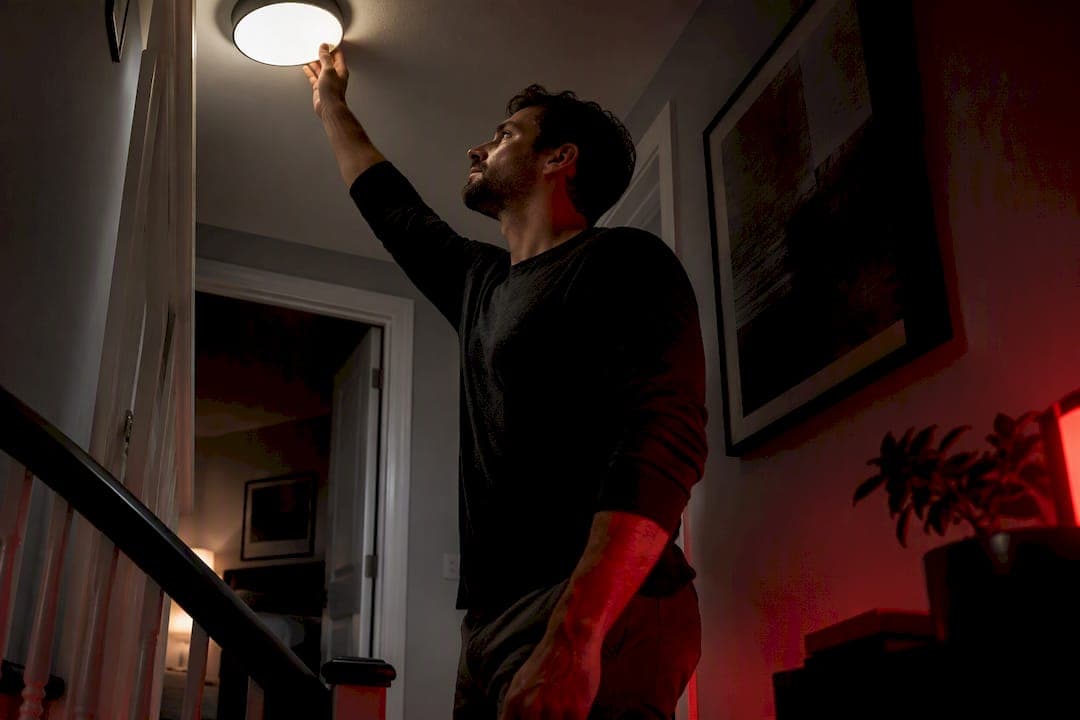
Short answer: red light is far less disruptive to your circadian clock than blue or white light. Human studies on melatonin levels during evening light exposure back this up, and when you use conservative intensity and timing, red light can support relaxation and ease sleep inertia without shutting down your body's natural signal.
TL;DR:
- Red light has a much lower impact on melatonin suppression than blue or white light because it barely activates melanopsin-containing retinal cells.
- Human studies show that red light allows melatonin levels to rebound after two hours of exposure, unlike blue light, which keeps melatonin suppressed.
- Keeping evening light exposure under 10 melanopic EDI minimizes circadian disruption, with red light usually staying within this safe threshold even at moderate brightness.
- Animal research indicates that chronic exposure to low-intensity red light during the dark phase can disrupt melatonin production and metabolic rhythms, so moderation is essential.
- The best practice involves dimming blue-white light two to three hours before bed, using red light for 10 to 30-minute sessions, and avoiding continuous all-night red lighting.
Table of Contents
- How light controls your circadian clock
- What the human and animal research actually shows
- How to build a conservative red light protocol
- Comparing red light device formats
- Safety limits and open questions in the research
- Where Primal Red Co. fits into your restoration routine
- The overrated fix and the one that actually matters
- Bring red light into a routine built to last
- Sources
- FAQ
How light controls your circadian clock
Your body runs on a signal. It's called the circadian clock, and it lives in a tiny cluster of brain cells called the suprachiasmatic nucleus, or SCN. That signal tells your body when to release melatonin, when to feel alert, and when to wind down. It doesn't run on a wall clock. It runs on light, and specifically, on a type of retinal cell most people have never heard of: intrinsically photosensitive retinal ganglion cells, or ipRGCs.
These cells contain a photopigment called melanopsin, and melanopsin has a peak sensitivity around 480 nanometers, which sits squarely in the blue part of the visible spectrum. When blue-heavy light hits your eyes at night, melanopsin fires, sends a signal straight to the SCN, and your body reads that as "still daytime." Melatonin gets suppressed. Your internal clock can shift. This is the mechanism described in public circadian biology resources like the NIGMS circadian rhythms fact sheet, which frames light as the dominant zeitgeber, the master timing cue your body listens to above almost everything else.
Red light sits at the opposite end of the visible spectrum, typically in the 630 to 660 nanometer range. Melanopsin barely responds to it. That's the whole reason red light has earned a reputation as the "safe" evening light. But safe isn't the same as inert, and intensity still matters. This is where most casual advice stops short, because it treats "red" as a magic word instead of a variable that still has a dose.
Photopic lux versus melanopic metrics. Lux measures brightness the way your eye perceives it overall. It doesn't tell you how much a light source is actually stimulating melanopsin and your circadian system. That's what melanopic equivalent daylight illuminance, or melanopic EDI, is for. Two lamps can read the same lux value on a light meter and have wildly different circadian effects depending on their spectrum. Applied lighting research summarized in melanopic metrics and circadian lighting guidance treats melanopic EDI as the number that actually correlates with ipRGC activation and melatonin suppression, not lux, and not color temperature.
A few practical distinctions worth holding onto:
- ipRGCs and melanopsin drive the circadian light response, peaking near 480 nanometers, which is why blue and cool white light have outsized effects on melatonin.
- Photopic lux measures visible brightness to your eye but does not predict circadian impact on its own.
- Melanopic EDI measures the circadian-active portion of a light source and is the more useful number for evening lighting decisions.
- Red wavelengths (630 to 660 nanometers) fall far from melanopsin's peak sensitivity, giving them low melanopic effectiveness even at moderate brightness.
A conservative target worth knowing: recent circadian lighting recommendations suggest keeping evening light exposure at or below 10 melanopic EDI to protect melatonin secretion. Red light sources tend to sit well under that threshold even at brightness levels that would push a blue-white lamp far past it. That gap is the entire reason red light gets recommended for the hours before bed, and it's also why "how bright" still matters more than people assume, even under a red bulb.
What the human and animal research actually shows
Here's where the picture gets more honest, and more useful. Red light isn't magic. It's just less circadian-disruptive than what most of us are staring at after dark, and the evidence for that claim is stronger in some places than others.
Start with the clearest human data point. A controlled study exposing healthy adults to red or blue LED light for three hours in the evening measured salivary melatonin hourly. Under blue light, melatonin stayed suppressed for the full three hours. Under red light, melatonin began rebounding by the second hour, reaching 26.0 pg/mL under red light versus 7.5 pg/mL under blue light at the two-hour mark. That's a meaningful gap, and it's one of the cleanest human demonstrations that spectrum, not just brightness, changes how your body handles nighttime light.
Next comes a different kind of evidence, further from the eye and closer to the skin. A randomized, sham-controlled trial tested a cervical red and near-infrared collar worn before bed in adults with sleep complaints. Participants reported feeling more relaxed and perceived their sleep as better, but the objective outcomes measured by actigraphy showed no clear difference between the real device and the sham. The researchers pointed to skin warming, nitric oxide pathways, and parasympathetic effects as more plausible mechanisms than any direct circadian signal, since a collar on the neck isn't reaching the retina the way a lamp or mask would. Subjective relief showed up. Objective proof of a circadian shift didn't.
A third study looks at a completely different problem: sleep inertia, that groggy fog right after waking. Delivering red light through closed eyelids during sleep, or through goggles right after waking, improved short-term performance and reduced some markers of that grogginess, and it did this without suppressing melatonin at the doses tested. That's a narrow but genuinely useful finding for anyone who struggles to feel human in the first thirty minutes after an alarm.
Then there's the finding that should keep anyone honest about dosing. Rats exposed to low-intensity red safelight throughout the entire dark phase, night after night, showed markedly suppressed nocturnal melatonin and disrupted circadian metabolic rhythms compared with dark controls. The exposure was 8.1 lux, which sounds trivially dim. It still mattered, because it was chronic and constant across the entire dark period. Animal studies don't map one-to-one onto human physiology, and rodents process light differently than we do, but this result is a real caution against assuming red light carries zero dose-response risk just because it's red.
| Study type | What it measured | Key finding |
|---|---|---|
| Human, 3-hour evening exposure | Salivary melatonin under red vs blue LED | Red allowed melatonin rebound by hour two; blue kept it suppressed |
| Human, randomized sham-controlled | Cervical red and NIR collar before bed | Subjective relaxation improved; objective sleep measures unchanged |
| Human, within-subjects crossover | Red light mask and goggles for sleep inertia | Performance improved without melatonin suppression at modest doses |
| Animal, chronic dark-phase exposure | Nocturnal melatonin in rats under red safelight | Melatonin and metabolic rhythms disrupted at low but constant intensity |
Put together, this points to moderate confidence, not certainty. Red and near-infrared light appear less disruptive to melatonin than blue or white light across every human study on the list, and there's decent support for a role in easing sleep inertia specifically. But the collar trial shows subjective and objective results don't always agree, and the rat data shows that "red" doesn't mean "no dose ceiling." Treat this as a dimmer switch, not an on-off toggle.
How to build a conservative red light protocol
If you want the practical version of everything above, here's how to translate it into something you can actually do tonight.
- Pick your wavelength range. Studies cluster around 630 to 660 nanometers for red exposure, with some near-infrared trials extending to 740, 810, and even 870 nanometers for skin-targeted devices. Eye-directed light and skin-directed light are not interchangeable: one works through the retina and your circadian pathway, the other likely works through warming and local nitric oxide effects.
- Respect intensity, not just color. Aim to stay under roughly 10 melanopic EDI for ambient evening lighting. If you don't have a meter, err dim rather than bright, since animal work has shown that red light at 20 lux or higher altered sleep architecture in mice, while 10 lux or below did not.
- Time it deliberately. Cut blue and white light exposure two to three hours before bed, and use red light in that same window instead. Targeted near-infrared sessions in trials ran 10 to 30 minutes; low-intensity ambient red light can run longer since it's doing less at any given moment.
- Match frequency to the goal. The collar trial used an alternate-night protocol over weeks, not nightly use indefinitely. Sleep inertia trials used single sessions tied to sleep or waking. There's no evidence that more exposure equals more benefit.
- Set up the room correctly. Eyes-closed delivery, like a mask, differs from eyes-open ambient red lighting. Keep the source at a comfortable distance, dim the rest of the room, and pair it with blocking blue light from screens rather than trying to out-compete it.
Sleep hygiene fundamentals still carry most of the weight here. A natural sleep improvement guide covering consistent timing, temperature, and wind-down habits pairs well with any lighting change, since light alone rarely fixes a sleep problem built from a dozen small habits.
Pro Tip: Start with one variable at a time. Change your evening light before you add a new supplement, a new gadget, or a new bedtime, so you can actually tell what worked.
If a new light routine makes your sleep worse, more fragmented, or leaves you unusually alert at night, stop and reassess rather than pushing through it. Anyone with a diagnosed sleep disorder, an eye condition, or a photosensitizing medication should talk to a clinician before adding light exposure to their routine, not after.

Comparing red light device formats
Research on red and near-infrared light for sleep hasn't used one standard tool. It's used at least four distinct formats, and they're not interchangeable.
- Eye-directed masks and goggles deliver light through closed eyelids or directly to open eyes, the format used in the sleep inertia trials, and the most direct route to any circadian pathway effect.
- Cervical collars wrap red and near-infrared light around the neck, targeting skin and local tissue rather than the retina, the approach used in the sham-controlled collar trial.
- Panels and pads cover larger skin areas at higher irradiance, common in general red light therapy use, though less represented in sleep-specific trials.
- Ambient red lamps light a room at low intensity for general evening use, the format closest to what most people picture when they hear "red light for sleep."
What actually separates a serious device from a marketing gimmick is the spec sheet, not the color. Ask for the spectral power distribution, the specific peak wavelength or wavelengths, and the irradiance in milliwatts per square centimeter. A device that can't produce these numbers is asking you to trust a color instead of a measurement.
For pre-bed relaxation, ambient lamps and eye-directed masks have the strongest direct evidence tie to melatonin behavior. For sleep inertia specifically, eye-directed light after waking has the clearest support. Collars and panels lean on skin-mediated relaxation, which shows up in how people feel more reliably than in objective sleep metrics. Distrust any marketing claim built on Kelvin temperature or vague "warm light" language. As broader research on melanopic metrics points out, color temperature doesn't predict circadian impact the way melanopic values do, and a "warm" 2700K bulb can still carry meaningful blue content.
Safety limits and open questions in the research
The rat data on chronic low-intensity red safelight is the clearest warning sign here. It showed that 8.1 lux of red light across the entire dark phase disrupted melatonin amplitude and metabolic rhythms in Sprague-Dawley rats, even though the exposure would strike most people as dim and harmless. Rodents process light differently than humans do, so this doesn't prove the same outcome in people. It does prove that "red" isn't automatically "circadian-neutral" at every dose and duration, and that assumption deserves more scrutiny than it usually gets in casual wellness advice.
Human research carries its own limits worth naming directly:
- Small sample sizes across most trials, often 12 to 30 participants, limit how confidently results generalize.
- Subjective outcomes like perceived relaxation don't always match objective measures like actigraphy or salivary melatonin.
- Device and dosing variation across studies makes it hard to say one wavelength or intensity is definitively "the" right number.
- Short trial durations mean almost nothing is known about years of nightly use versus weeks.
There's no strong evidence that conservative red light exposure causes harm in healthy adults, but a few possible responses are worth watching for: increased alertness in some individuals, mood shifts tied to any light change, photosensitivity in people on certain medications, and interactions with drugs that affect light sensitivity or sleep architecture. A single controlled study found red light allowed melatonin to reach 26.0 pg/mL by the two-hour mark in healthy adults, a result specific to that dose and population, not a universal guarantee.
The mitigations are simple. Keep intensity conservative, don't run ambient red light all night every night without a break, and stop if your sleep gets worse instead of better. Anyone with a major sleep disorder, an eye condition, or a condition affecting light sensitivity should loop in a healthcare provider before building a routine around this.
Where Primal Red Co. fits into your restoration routine
We built Primal Red Co. for men over 30 who feel the shift happening before it becomes a crisis. Not a clinic. Not a prescription pad. A tool, and a routine, for men who'd rather understand what's happening in their body than wait for a doctor to hand them a diagnosis and a shot.
Red light's role in a man's evening routine isn't about chasing a melatonin spike. It's about removing a variable, the harsh blue-white light most of us stare at until the second we close our eyes, and replacing it with something your circadian system barely notices. That's the whole logic behind conservative red light use, and it's the same logic behind RedRockit's Activation Method, which walks you through session structure instead of leaving you guessing at wavelength and timing on your own.
If you want the deeper science before the routine, our red light therapy science guide for men over 30 and our breakdown of what blue light does to sleep at night both connect directly to what's covered here. For timing specifically, our piece on the best time for red light therapy by goal is worth reading before your first session.
None of this replaces a conversation with a doctor if you're dealing with a diagnosed sleep disorder or a medication that affects light sensitivity. A general, conservative sample routine looks like this: dim the room and cut blue light two to three hours before bed, use a targeted red light session for 10 to 30 minutes, and keep the habit consistent rather than sporadic. That's a starting point, not a prescription.
The overrated fix and the one that actually matters
Red light gets sold as a sleep hack. It's really a subtraction, not an addition. The benefit isn't some special property red light has. It's the blue-white light you stop bombarding yourself with every night on your phone, your TV, your overhead LEDs.
Here's what conventional advice gets wrong: it treats color as the whole story and ignores intensity and duration. "Red light good, blue light bad" is a decent starting rule and a bad final answer. The rat data proves dose still matters even under red. Most people chasing a red bulb online never ask about melanopic EDI, irradiance, or how long they're actually exposed each night.
What should you prioritize first? Cut the blue-white light before bed. That single change carries more evidence weight than any specific red light product you could buy. Add red light as a deliberate, conservative layer on top of that habit, not as a replacement for basic sleep hygiene you're still ignoring.
— Nurse Rachel
Bring red light into a routine built to last
You don't need to guess at wavelengths, hunt for spec sheets, or piece together a protocol from six different studies every night. RedRockit is built around the same conservative principles covered here: red and near-infrared wavelengths, sessions timed to support your evening wind-down, and a companion app that walks you through the routine instead of leaving you to freelance it.

Here's what that actually looks like in practice:
- A private-use device designed for at-home sessions, not a clinic visit or a subscription service.
- Guided protocols through a companion app, so timing and duration follow the same conservative logic outlined above.
- A craftsmanship guarantee, with no ongoing dependence on appointments or prescriptions.
If low energy, drive, or recovery have been creeping up on you, our page on male vitality after 40 connects the dots between what you're feeling and what a consistent routine can support. Visit RedRockit's product page to see how the device and app work together, and decide if it fits into what you're already trying to build.
Sources
The claims in this guide draw on primary research and applied standards rather than general wellness advice.
- Comparative effects of red and blue LED light on melatonin levels during three-hour exposure in healthy adults
- A randomized, sham‑controlled trial of a novel near‑infrared phototherapy device on sleep and daytime function
- Effects of red light on sleep inertia
This article is general information, not a substitute for advice from a qualified doctor. Consult a qualified healthcare professional about your own circumstances before acting on anything here.
FAQ
Why do I feel sleepy after red light therapy?
Red light doesn't strongly stimulate the melanopsin pathway that keeps you alert under blue or white light, so your body's natural wind-down signal isn't being fought against. Some people also associate a calm, dim red setting with a relaxation cue, which can add to the effect.
Is it good for you to sleep with a red light on?
Low-intensity red light appears far less disruptive to melatonin than blue or white light in human studies, including one showing melatonin rebounding under red exposure by the two-hour mark. Chronic all-night exposure hasn't been proven safe in humans, and animal research has shown that even dim red light can disrupt circadian rhythms when left on for an entire dark phase, so conservative and intermittent use is the safer approach.
Can red light reduce cortisol?
There's no direct human trial in this body of research measuring cortisol specifically under red light exposure. What the cervical collar trial does show is improved subjective relaxation, which plausibly involves stress-related pathways, though that remains a reasonable inference rather than a proven mechanism.
Is it okay to use red light every night?
Short, targeted red light sessions appear well tolerated in the human trials reviewed here, and some protocols used alternate nights rather than nightly exposure. Given the animal findings on chronic low-intensity exposure, keeping sessions time-limited and watching how your sleep responds is the more cautious approach than leaving a red light on continuously every night.