
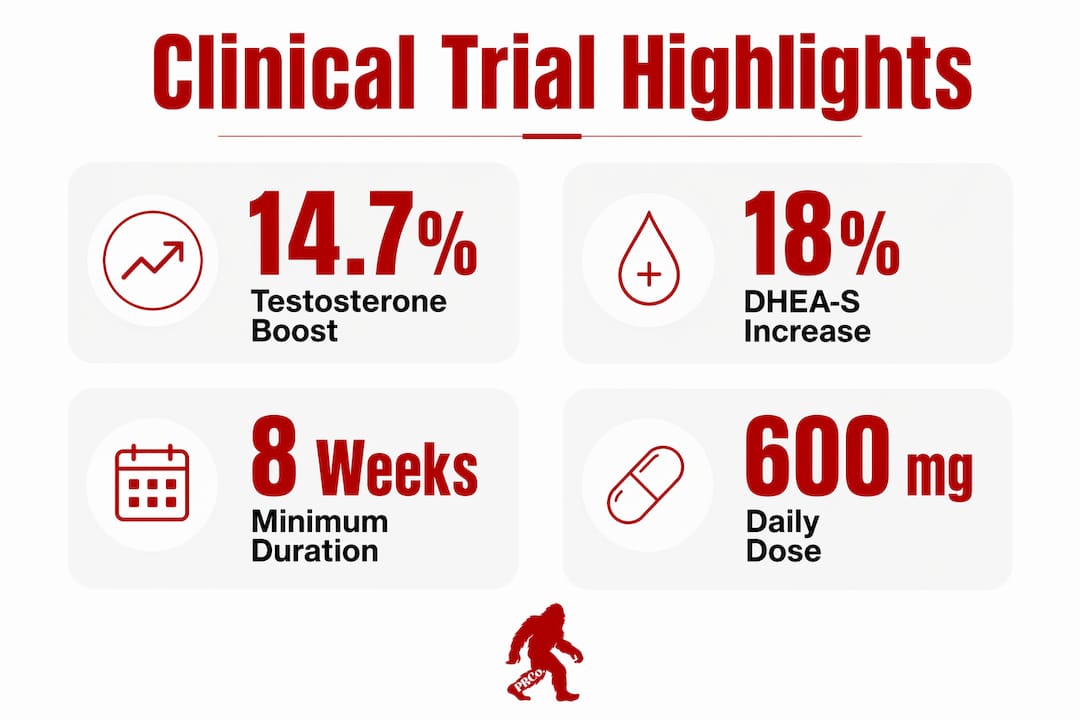
Yes, ashwagandha can modestly support testosterone in certain men. It is not a substitute for clinical testosterone replacement therapy, and it will not transform your levels overnight. But the clinical evidence is real. In a 16-week crossover RCT of overweight men aged 40–70, eight weeks of a standardized ashwagandha extract was associated with a 14.7% greater increase in salivary testosterone and an 18% greater increase in DHEA-S versus placebo. Those are meaningful numbers for a natural supplement, and they come from a well-designed trial, not a marketing sheet.
The catch? The men who benefit most are not the ones with perfect labs and low stress. The evidence consistently points to stressed men, overweight men, men with fertility challenges, and men doing resistance training as the populations most likely to see a real signal. If you are already optimized, the effect is likely smaller.
The short version:
- Standardized ashwagandha extracts (300 mg twice daily or 600 mg/day delivering ~21 mg withanolide glycosides) produced measurable testosterone increases in multiple RCTs after 8 weeks.
- Effects are modest and appear to require continued use to be sustained.
- Best candidates: stressed, overweight, infertile, or resistance-trained men.
- Not a replacement for medical evaluation or TRT when clinical hypogonadism is present.
Table of Contents
- What do clinical studies actually show about ashwagandha testosterone?
- How might ashwagandha actually influence your hormones?
- Which men are most likely to see real gains from ashwagandha?
- What dose and formulation did the studies actually use?
- What are the side effects and safety concerns you should know?
- When will you see results, and how should you track them?
- How do you choose a quality ashwagandha supplement?
- What should you actually do next if you want to try ashwagandha?
- Key Takeaways
- Ashwagandha works best when you stop treating it like a shortcut
- Your restoration routine does not have to start with a prescription
- Primary studies and references used for this guide
What do clinical studies actually show about ashwagandha testosterone?
The trial record is more consistent than most people expect from an herbal supplement. Several randomized, double-blind, placebo-controlled trials have reported statistically significant testosterone increases. Here is what the key studies found:
Key RCTs at a glance
| Study | Population | Dose | Duration | Primary testosterone result |
|---|---|---|---|---|
| Crossover RCT (PMC6438434) | Overweight men, 40–70 yrs, mild fatigue | 600 mg/day (21 mg withanolide glycosides) | 8 weeks | 14.7% greater increase vs placebo (p = .010) |
| PubMed RCT | Adult men, sexual function concerns | 300 mg twice daily | 8 weeks | Significant serum testosterone increase vs placebo |
| PubMed RCT (PMID 35873404) | Adult men, well-being and sexual performance | Standardized root extract | 8 weeks | Significant serum testosterone increase vs placebo |
| Frontiers RCT (Reproductive Health) | Healthy adult men | Standardized root extract | 8 weeks | Significant serum testosterone, semen volume, sperm count, and motility gains |
The pattern across these trials is hard to ignore: standardized extract, eight weeks, measurable hormonal and functional improvements. That said, a systematic review of herbs and testosterone puts it plainly — ashwagandha is among the herbal treatments with positive evidence, but study heterogeneity and small sample sizes limit how definitive any single conclusion can be.
What the evidence adds up to:
- Multiple independent RCTs show statistically significant testosterone increases, not just trends.
- Effect sizes are modest, not dramatic. You are not looking at TRT-level changes.
- DHEA-S increases alongside testosterone in several trials, suggesting upstream androgen support.
- Functional improvements in sexual function, libido, and semen parameters appear across trials, sometimes even when between-group hormone differences are small.
- Adverse events in RCTs were minimal. Tolerability across trials was consistently reported as good.
The honest read: ashwagandha has a real, if modest, testosterone signal in the right populations. It is not a placebo effect dressed up in statistics.
How might ashwagandha actually influence your hormones?
The mechanism is not a direct testosterone injection. Your body does not read ashwagandha as a hormone signal. The pathways are indirect, which is exactly why the effect size varies so much between men.
Cortisol as the main lever
Chronic stress keeps cortisol elevated. Elevated cortisol suppresses the hypothalamic-pituitary-gonadal axis, the signaling chain your body uses to produce testosterone. When cortisol stays high, your body treats reproduction as a low priority. Ashwagandha's withanolides appear to modulate this stress response. Lower cortisol means the endocrine environment becomes more permissive for androgen production. That is why stressed and metabolically burdened men show larger, more consistent benefits in trials.
DHEA-S and androgen balance
DHEA-S is a precursor hormone that feeds downstream androgen production. The crossover RCT showing an 18% greater DHEA-S increase alongside the testosterone rise suggests ashwagandha may support the upstream androgen pool, not just testosterone in isolation. That is a more systemic hormonal effect than most supplements produce.
Antioxidant and endocrine-modulating activity
Oxidative stress in testicular tissue can impair testosterone synthesis and sperm production. Ashwagandha's antioxidant activity may reduce this cellular noise, which helps explain the semen parameter improvements seen in trials of infertile men. The endocrine-modulating effects of withanolides are still being characterized, but the reproductive health data points to real biological activity.
Sleep and stress resilience
Poor sleep is one of the fastest ways to tank testosterone. Ashwagandha's adaptogenic properties appear to improve sleep quality and stress resilience, which creates a better hormonal environment indirectly. This is not a flashy mechanism, but it may be the most practically important one for men over 40 who are running on empty.
Pro Tip: If your stress is high and your sleep is poor, ashwagandha has more biological runway to work with. If you are already sleeping eight hours and managing stress well, the effect will likely be smaller.
Which men are most likely to see real gains from ashwagandha?
Not every man will respond the same way. The trial data makes the segmentation fairly clear.
Men with the strongest evidence behind them
- Stressed men with elevated cortisol. The cortisol-testosterone relationship is the most mechanistically supported pathway. If chronic stress is suppressing your hormonal signal, reducing that cortisol load can free up androgen production.
- Overweight or metabolically burdened men. The crossover RCT specifically enrolled overweight men aged 40–70. Metabolic dysfunction often correlates with suppressed testosterone, and ashwagandha's effects on DHEA-S and testosterone were significant in this group.
- Men with fertility concerns. Multiple trials in oligospermic and infertile men show improvements in sperm count, motility, and semen volume alongside testosterone increases. If fertility is a priority, ashwagandha is one of the better-supported natural options.
- Men doing resistance training. Earlier trials in men undergoing resistance training showed testosterone and muscle-strength gains, suggesting ashwagandha may amplify the hormonal response to exercise stress.
Men less likely to see a meaningful effect
- Healthy young men with normal baseline testosterone and no significant stress or metabolic burden.
- Men already on TRT or other exogenous testosterone protocols — the hormonal environment is already externally managed.
- Men expecting TRT-equivalent results from a supplement.
A simple decision framework
Before you spend money on a bottle, run through this:
- Do you have symptoms of low testosterone or declining vitality? (Low energy, reduced drive, poor recovery, mood changes.) Check your low testosterone symptoms against what you are actually feeling.
- Is your stress chronically elevated, your sleep poor, or your weight above where it should be?
- Have you had baseline labs drawn? Total testosterone, free testosterone, SHBG, and DHEA-S give you a real starting point.
If you answered yes to at least two of those, the evidence suggests you are a reasonable candidate for an ashwagandha trial. If all three are no, manage your expectations accordingly.
What dose and formulation did the studies actually use?
This is where most men go wrong. They buy a cheap root powder capsule, take it inconsistently, and wonder why nothing happened. The trials that produced real results used specific formulations and stuck to them.
Dosing regimens from key trials
| Regimen | Extract type | Duration | Outcome |
|---|---|---|---|
| 600 mg/day (21 mg withanolide glycosides) | Shoden standardized extract | 8 weeks | 14.7% greater increase in salivary testosterone and 18% greater increase in DHEA-S vs placebo |
| 300 mg twice daily | Standardized root extract | 8 weeks | Significant serum testosterone and sexual function improvements |
| Standardized root extract (withanolide-standardized) | Root-only standardized | 8 weeks | Testosterone, semen parameters, and sexual function gains |
The common thread: standardized extract, consistent daily dosing, eight weeks minimum.
Why standardization matters
Not all ashwagandha products contain the same active profile. Clinical trials use standardized extracts that report withanolide or withanolide glycoside content. Raw root powder without standardization rarely matches the reproducibility of what was tested in studies. When you see a label that says "ashwagandha root powder" with no withanolide percentage, you are guessing at the dose.
What to look for on the label
- Withanolide content listed as a percentage (typically 2.5–5% withanolides) or as an absolute amount (e.g., 21 mg withanolide glycosides per serving).
- Total daily dose matching trial regimens: 600 mg/day or 300 mg twice daily.
- Root-only extract, not leaf or whole-plant blends (trials used root).
Duration matters too. Most trials ran eight weeks, and the crossover data shows that hormonal gains decline after stopping. Plan for ongoing use, not a one-month experiment.
What are the side effects and safety concerns you should know?
The good news: clinical trials consistently report good tolerability. The crossover RCT noted no adverse events or participant withdrawals attributed to ashwagandha. That is a meaningful safety signal from a well-designed study.
But "well-tolerated in trials" does not mean risk-free for everyone.
Common mild side effects reported
- Gastrointestinal discomfort (nausea, loose stools) at higher doses, usually dose-dependent.
- Drowsiness, particularly when taken with other sedating agents.
- Rare reports of headache or mild dizziness.
Drug interactions to take seriously
Ashwagandha can interact with several medication classes. Talk to your clinician before starting if you take any of the following:
- Sedatives or sleep medications: Ashwagandha has mild sedative properties; combining it with benzodiazepines, sleep aids, or other CNS depressants may amplify sedation.
- Thyroid medications: Ashwagandha may increase thyroid hormone levels. Men on levothyroxine or other thyroid drugs need monitoring.
- Immunosuppressants: Ashwagandha's immune-modulating activity could theoretically counteract immunosuppressive therapy.
- Blood pressure medications: Some evidence suggests ashwagandha may lower blood pressure; combining it with antihypertensives warrants monitoring.
- Anticoagulants: Potential additive effects with blood-thinning medications have been noted in clinical guidance.
Who should avoid it
- People who are pregnant or breastfeeding.
- Men with autoimmune conditions (rheumatoid arthritis, lupus, multiple sclerosis) where immune stimulation could worsen symptoms.
- Anyone with active thyroid disorders not yet stabilized on medication.
If you think you are having a reaction
- Stop taking ashwagandha immediately.
- Document the symptom, the dose, and the timing.
- Contact your clinician or call the Poison Control Center (1-800-222-1222) if symptoms are severe.
- Do not restart without medical clearance.
The standardized root extract trials report low adverse-event rates in their populations, but those populations were screened. Your situation may differ.
When will you see results, and how should you track them?
Eight weeks. That is the window most trials used, and it is the minimum you should commit to before drawing any conclusions. Expecting a meaningful hormonal shift at week two is setting yourself up for disappointment.
A practical monitoring plan
- Before you start: Get baseline labs drawn in the morning, fasted. Total testosterone, free testosterone, SHBG, and DHEA-S. Morning is critical because testosterone peaks between 7–10 AM. Use a home testosterone test or schedule a draw with your primary care provider.
- Weeks 1–4: Track symptoms, not labs. Energy levels, sleep quality, morning drive, recovery after workouts. These often shift before labs do.
- Week 8: Retest labs under the same conditions (same time of day, fasted, same lab if possible). Compare to baseline.
- Evaluate: If labs improved and symptoms improved, continue. If labs are unchanged but symptoms improved, that is still a meaningful outcome. Functional improvements in libido and energy are what men actually care about.
- If nothing changed: Stop, reassess your stress load, sleep, and diet. Consider whether clinical evaluation is warranted.
Symptom changes can lead lab changes
Several trials reported clinically meaningful improvements in sexual function and energy even when between-group hormone differences were modest. Your body's response to better hormonal signaling often shows up in how you feel before it shows up in a number on a lab report.
Pro Tip: Track three things weekly: sleep quality (1–10), morning energy (1–10), and libido (1–10). A consistent upward trend across all three over eight weeks is a real signal, even if your lab numbers move modestly.
When to escalate to a clinician: if your baseline testosterone is clinically low (typically below 300 ng/dL), if symptoms are significantly affecting your quality of life, or if you see no improvement after a full eight-week evidence-backed trial. Those situations call for a medical conversation, not another supplement.
How do you choose a quality ashwagandha supplement?
The supplement market is full of products that would never survive a clinical trial. Here is how to filter them out.
What a quality label looks like
- Standardized extract with withanolide percentage listed. If the label says "ashwagandha root powder" with no standardization claim, move on.
- Dose per serving matches trial regimens. 300 mg per capsule (for twice-daily dosing) or 600 mg per serving, with withanolide content specified.
- Root-only extract. Trials used root, not leaf or whole-plant blends. Root-only standardized extracts are what the evidence supports.
- Third-party testing certification. Look for NSF International, USP, or Informed Sport certification on the label. These programs test for label accuracy, contaminants, heavy metals, and microbes.
- Transparent labeling. Every ingredient listed with its exact amount. No "proprietary blends" that hide individual doses.
Red flags to walk away from
- Proprietary blends that list ashwagandha as part of a complex without disclosing the mg per ingredient.
- "Herbal complex" language with no standardization data.
- No third-party testing mentioned anywhere on the label or brand website.
- Withanolide content not specified, or listed only as a percentage of a non-standardized extract.
Pro Tip: Brands that publish their Certificate of Analysis (COA) from third-party labs are showing you the actual batch data. If a brand will not share that, treat it as a red flag.
For men over 40 comparing ashwagandha to other supportive supplements, a broader look at supplements for men over 40 can help you build a regimen that makes sense for your specific situation.
What should you actually do next if you want to try ashwagandha?
Evidence is only useful if you act on it correctly. Here is the research-driven plan, condensed.
- Get baseline labs. Total testosterone, free testosterone, SHBG, DHEA-S. Morning draw, fasted. This is your before picture.
- Choose a standardized product. Withanolide-standardized root extract, 300 mg twice daily or 600 mg once daily, third-party tested. Match what the trials used.
- Lock in the lifestyle foundation first. Ashwagandha works best when it is not doing all the heavy lifting. Prioritize: 7–9 hours of sleep, progressive resistance training at least three days per week, adequate protein intake (0.7–1 g per pound of bodyweight), and active stress management. These are not optional add-ons. They are the foundation for testosterone support that ashwagandha builds on.
- Run an eight-week trial. Consistent daily dosing, same time each day (many men take it with dinner to leverage the mild sedative effect for sleep). Do not skip days and expect the same result.
- Track weekly. Sleep, energy, and libido on a simple 1–10 scale. Note any side effects.
- Retest labs at week 8. Same conditions as baseline. Compare numbers and symptoms.
- Decide. Improved on both fronts? Continue. Improved symptoms but modest labs? Your call, but functional gains are real gains. No change at all? Stop and consider a clinical conversation.
Lifestyle changes that amplify the effect
Ashwagandha's cortisol-lowering mechanism is most effective when you are also reducing the inputs that drive cortisol up. Sleep deprivation, sedentary behavior, and chronic caloric restriction all suppress testosterone independently. Pair the supplement with structured movement and a wellness routine built for men and you are giving the herb something to work with.
When to stop and escalate
If your baseline testosterone is clinically low, if symptoms are severe, or if eight weeks of consistent supplementation and lifestyle work produces no measurable change, that is a signal to talk to a clinician. Ashwagandha is a supportive tool. It is not a treatment for clinical hypogonadism. Understanding what to try before TRT can help you map out that conversation before you walk into a doctor's office.
Key Takeaways
Ashwagandha modestly supports testosterone in stressed, overweight, infertile, and resistance-trained men when taken as a standardized extract at 300–600 mg daily for at least eight weeks, with effects that require continued use to sustain.
| Point | Details |
|---|---|
| Effect size is real but modest | A crossover RCT found a 14.7% greater increase in salivary testosterone and 18% greater increase in DHEA-S versus placebo after 8 weeks. |
| Right population matters | Stressed, overweight, infertile, and resistance-trained men show the most consistent benefits across trials. |
| Standardized extract is non-negotiable | Use withanolide-standardized root extract at trial doses (300 mg twice daily or 600 mg/day); unstandardized powder does not match trial reproducibility. |
| Eight weeks is the minimum | Most RCTs ran 8 weeks; hormonal gains decline after stopping, so sustained use is needed to maintain changes. |
| Primal Red Co approach | Primal Red Co frames ashwagandha as one tool inside a broader restoration routine, paired with sleep, resistance training, and daily recovery protocols. |
Ashwagandha works best when you stop treating it like a shortcut
Here is what most articles on this topic get wrong: they present ashwagandha as a standalone fix. Take the capsule, watch your testosterone climb. That is not what the trials show, and it is not how the biology works.
The men who saw real results in these studies were not just taking a supplement. They were enrolled in structured trials with controlled conditions. Their sleep was monitored. Their stress was assessed. The supplement was standardized and dosed precisely. When you replicate those conditions in your own life, you give the herb a real chance to do something.
What I find most clinically interesting is the DHEA-S finding. An 18% greater increase in DHEA-S alongside the 14.7% greater increase in salivary testosterone suggests ashwagandha is touching the upstream androgen pool, not just nudging a single hormone. That is a more systemic effect than most people expect from an adaptogen. It also means the benefits may extend beyond testosterone alone, into energy, mood, and recovery.
The other thing worth saying plainly: if your testosterone is clinically low and your symptoms are significantly affecting your life, ashwagandha is not the answer on its own. It is a supportive tool. The men who use it best are the ones who treat it as part of a restoration routine, not a replacement for one. Get your labs. Fix your sleep. Train consistently. Then add the supplement and see what it does on top of that foundation.
Measured expectations are not pessimism. They are how you actually get results.
Your restoration routine does not have to start with a prescription
If you have read this far, you are the kind of man who wants to understand what is happening in his body before making bigger decisions. That is exactly who Primal Red Co was built for.

The RedRockit is a private-use red light wellness device designed to support a daily restoration routine for men over 30. Not a clinic. Not TRT. A consistent, at-home protocol that targets energy, recovery, and drive at the cellular level, the kind of foundation that makes everything else, including supplements like ashwagandha, work better. The companion Rockit IQ app guides your sessions so you are not guessing at protocols.
Ashwagandha can support your hormonal environment. Red light can support your cellular recovery. Sleep, training, and stress management hold it all together. That is a restoration routine, and it is what The Signal is built around.
Ready to see what a structured daily routine actually feels like? Explore the RedRockit Activation Method and build the foundation your supplements deserve.
This article is general educational information, not medical advice. Confirm current guidelines and your individual situation with a qualified healthcare provider before starting any supplement.
Primary studies and references used for this guide
| Source | Design and population | Key finding |
|---|---|---|
| Crossover RCT: Ashwagandha in Overweight Males (PMC6438434) | 16-week crossover RCT; overweight men 40–70 yrs; 600 mg/day (21 mg withanolide glycosides); 8-week treatment periods | 14.7% greater increase in salivary testosterone and 18% greater increase in DHEA-S vs placebo; hormonal gains declined after cessation |
| Ashwagandha and Sexual Function RCT (PMID 41766918) | RCT; adult men with sexual function concerns; 300 mg twice daily; 8 weeks | Significant serum testosterone increase and sexual function score improvements vs placebo |
| Standardized Root Extract RCT (PMID 35873404) | Randomized, double-blind, placebo-controlled; adult men; standardized root extract; 8 weeks | Significant testosterone and well-being improvements; good tolerability with low adverse-event rates |
| Ashwagandha and Sexual Health in Healthy Men (Frontiers) | Prospective RCT; healthy adult men; standardized root extract; 8 weeks | Significant gains in serum testosterone, semen volume, sperm count, motility, and sexual function scores |
| Systematic Review: Herbs and Testosterone (ScienceDirect) | Systematic review of herbal testosterone trials | Ashwagandha among herbs with positive evidence; heterogeneity and small samples limit definitive conclusions; stressed/metabolic men show stronger responses |
| Clinician Commentary on Herbal Approaches vs TRT (Thieme) | Expert clinical commentary | Ashwagandha effects are modest; best used as part of a multi-component restoration routine, not a TRT substitute |